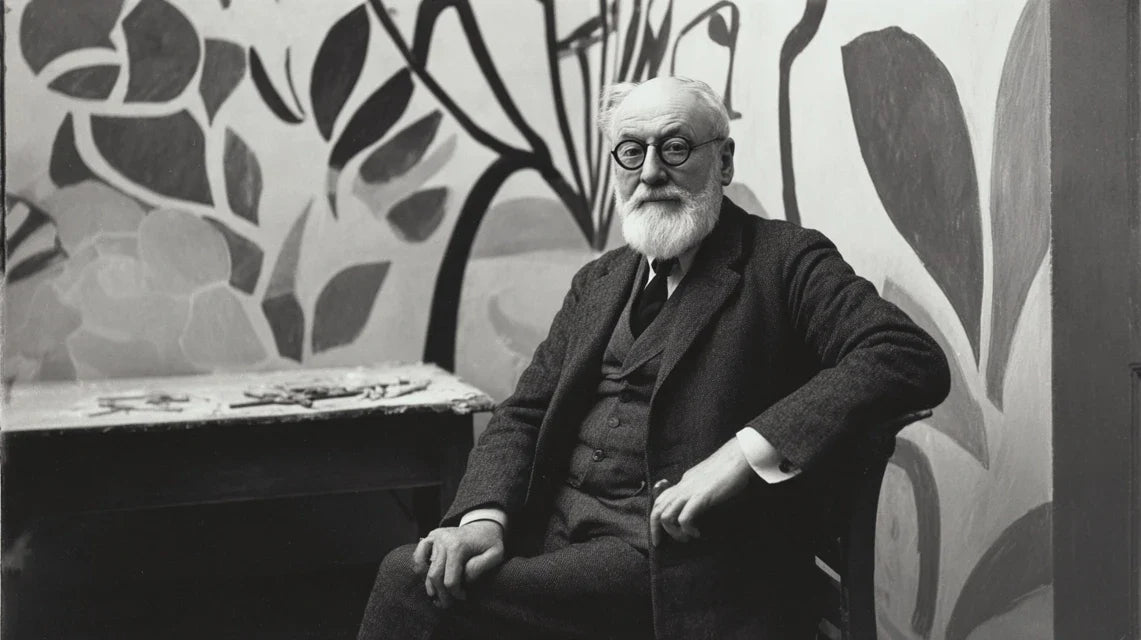
Imagine a man confined to his bed by illness, armed with nothing but a simple pair of scissors, who revolutionizes 20th-century art by cutting colored papers. This vision may seem trivial, yet it embodies the creative genius of Henri Matisse in his later years.
In the golden light of his Nice hotel Regina bedroom, the Fauvist master transforms his convalescence into an artistic laboratory. The walls are covered with vibrant shapes: blue swallows, green algae, violet snails dancing in a ballet of pure colors. 🎨 His assistants tirelessly pin and reposition these gouache papers according to the artist's instructions, who, from his bed, orchestrates this visual symphony with a simple gesture.
But this period of cut-out papers represents only the culmination of a revolutionary career spanning more than sixty years. From the scandalous explosion of Fauvism to the sensual odalisques of Nice, from portraits in impossible colors to large decorative panels, Henri Matisse has constantly pushed the boundaries of pictorial representation. How did this son of grain merchants from northern France become one of the most influential painters in art history?
This biography reveals the man behind the work, his doubts and artistic revolutions, to understand why Matisse remains today an inexhaustible source of inspiration - the undisputed king of pure color
Henri Matisse : the French revolutionary of modern color
Knowing the true story of Henri Matisse means understanding how a clerk can become the leader of an artistic revolution that forever transforms our perception of color and form. Far from golden legends, his biography reveals a determined man who conquered each innovation at the cost of hard work and constant questioning.
| Biographical highlights | Artistic legacy |
|---|---|
|
Full name : Henri Émile Benoît Matisse Birth date : December 31, 1869 in Cateau-Cambrésis Death date : November 3, 1954 in Nice Nationality : French |
Movement : Fauvism (leader) Style : Pure colors and simplified forms Key work : The Dance (1910) Innovation : Technique of cut-out papers |
📅 This exceptional trajectory spans nearly 65 years of creation, from his first attempts in 1890 to his death in 1954. Matisse crosses and influences all the major artistic movements of his time, from neo-impressionism to Fauvism, from decorative art to the avant-gardes of the 20th century.
Henri Matisse as a child : when illness reveals an artistic vocation
Henri grew up in the austere region of Northern France, in Bohain-en-Vermandois, where his parents Émile Hippolyte Matisse and Anna Héloise Gérard run a thriving seed and grain business. Nothing predisposed this eldest son of merchants to revolutionize Western art. The boy is studious but has no particular passion for drawing, attending the lycée of Saint-Quentin where he obtained his baccalaureate in 1887.
The appendicitis that changed art history: In 1890, at 21 years old, Henri suffers from severe appendicitis which immobilizes him for several months. To occupy his convalescence, his mother gives him a box of colors. "As soon as I had this brush in my hand, I felt that it was my true life. It was as if I were entering a kind of paradise," he will later confide. This revelation overturns his destiny: goodbye law, hello art!
The fundamental principle revealed from his beginnings: Moreau perceives in Matisse this unique ability to purify forms without losing their expressiveness. This intuition of the master will prove prophetic, as all of Matisse's work will tend towards this quest for maximum simplification for maximum emotional impact.
Henri Matisse and the artistic effervescence of the Belle Époque
Matisse comes to maturity as an artist in Paris during the Belle Époque, a period of intense creative ferment where Western art experiences its greatest revolutions. Impressionism triumphs in the salons, but a new generation of artists already aspires to go further in pictorial expression.
In the 1890s-1900s, the French capital attracts avant-gardes from all over the world. Cézanne develops his research on the geometrization of forms, Gauguin explores arbitrary colors in Brittany and then in Polynesia, while Van Gogh reveals the expressive power of colored paste. These post-Impressionist masters pave the way that Matisse will follow and revolutionize.
Matisse rubs shoulders in Montmartre cafes and Marais galleries with an exceptional generation: Picasso (his future rival and friend), Derain, Vlaminck, Dufy, but also visionary collectors like Gertrude and Leo Stein who organize at their salon at 27 rue de Fleurus the most stimulating encounters of the time.
The Universal Exhibitions of 1889 and 1900 reveal to Parisians African, Oceanian and Japanese art. These discoveries nourish Matisse's research who collects African masks and draws inspiration from Japanese prints to simplify his compositions. Western art finally opens up to other aesthetics, preparing the revolutions of the 20th century.
The artist of synthesis of his time: Matisse synthesizes all the research of his time - the science of color of the neo-impressionists, the expressiveness of Van Gogh, the construction of Cézanne, the exoticism of Gauguin - to create a completely new pictorial language that still influences contemporary art.
Henri Matisse and the crossing of the desert: 1892-1904
Matisse's Parisian beginnings prove to be more difficult than expected. His first paintings, influenced by Flemish masters and Impressionists, do not find their audience. His "Books and candle" (1890) and "The Dessert" (1897) reveal a certain talent but still prisoner of academic conventions. 🎨 The young painter struggles to reconcile the lessons of his masters with his nascent personal vision.
In 1898, his marriage to Amélie Parayre, a woman from Toulouse with character, brings him emotional stability and unconditional support. The couple settles in a modest apartment in the 19th arrondissement, where Henri sets up his first real studio. Amélie, understanding the importance of art for her husband, accepts a modest life and encourages his most daring research.
The birth of Jean in 1899 then Pierre in 1900 (in addition to Marguerite, daughter of Henri and his companion Caroline Joblaud) complicates the financial situation. Matisse accepts decoration work and sells a few paintings at derisory prices. Some months, the family lacks necessities, but Henri stubbornly refuses to return to the family business.
The revelation comes during a trip to Brittany in 1896-1897 then a decisive meeting with art collector John Peter Russell who introduces him to Van Gogh. This discovery shakes all his certainties: "I understood that one could paint with pure colors," he will confide. From then on, his palette brightens and his compositions gain boldness.
These years of training shape his artistic character: the habit of daily work, determination in the face of obstacles, the ability to draw creative energy from adversity. This period of hardship develops within Matisse a work ethic that will never leave him.
Henri Matisse and the Fauve scandal: when art provokes society
The Salon d'Automne of 1905 marks Matisse’s explosive entry into art history. His “Woman with a Hat,” portrait of his wife Amélie with impossible colors - green face, red hair, multicolored hat - unleashes a storm of criticism. The bourgeois public cries scandal at these "child's scribbles."
The critic Louis Vauxcelles, discovering the room where Matisse is exhibiting with Derain, Vlaminck, Marquet and Friesz, utters a phrase that goes down in history: "Donatello among the wild beasts!" referring to a classical sculpture exhibited in the same room. The term "Fauves" is born, and Matisse immediately becomes its leader.
This controversy reveals Matisse’s artistic philosophy: “I don't paint a woman, I paint a painting.” For him, color should no longer imitate reality but directly express emotion. Red, green, blue become the words of a pictorial vocabulary freed from all descriptive constraints.
The phrase that defies his time: Asked about these "impossible" colors, Matisse replies with quiet confidence: “When I put in green, it doesn't mean grass; when I put in blue, it doesn't mean the sky. Color expresses something by itself.” This revolutionary statement liberates Western painting from five centuries of mimicry.
Paradoxically, the scandal ensures Matisse’s commercial success. Leo and Gertrude Stein immediately buy “Woman with a Hat,” while Russian collector Sergei Shchukin begins to acquire his works. This early recognition allows Matisse to fully embrace his artistic audacity.
The Fauvist movement lasts only three years (1905-1908), but definitively transforms Western art. Matisse gains international renown and the financial freedom necessary for his future research. 🌟 This foundational period establishes his reputation as a color revolutionary.
Henri Matisse and the invention of a new pictorial language: 1906-1917
After the Fauvist explosion, Matisse embarks on a period of artistic maturation where he systematizes his discoveries. His masterpiece “The Joy of Living” (1905-1906) synthesizes all his research: simplification of forms, arbitrary colors, decorative composition that already foreshadows the decorative arts of the 20th century.
The order from Sergueï Chtchoukine in 1909 marks the peak of this period. The Russian collector asks Matisse for two decorative panels for his Moscow living room. Thus were born "La Danse" and "La Musique", two revolutionary works that reduce painting to its essence: a few pure colors, forms simplified to the extreme, an emotion of unparalleled power.
The Dance by Henri Matisse: the work that revolutionizes modern art
"La Danse" (1910) represents the culmination of Matisse's research: five nude bodies dance in a primitive circle on a green hill under a blue sky. Only three colors - vermilion red, emerald green, ultramarine blue - are enough to create an image of striking expressive force. This work of 260 x 391 cm transforms decorative painting into major art.
The audacity of Matisse astounds his contemporaries: no anecdotal detail, no modeling, no traditional perspective. The red bodies stand out in flat silhouettes against the two-color background. This formal radicalism expresses a primitive and universal joy de vivre that transcends the conventions of Western art.
Henri Matisse's revolutionary techniques: drawing in color
Matisse develops during this period his revolutionary technique of "drawing in color". Abandoning the traditional preparatory sketch, he directly applies color by outlining shapes with a black line. This method unifies drawing and color in a single gesture, resolving the old conflict between supporters of Poussin (drawing) and those of Rubens (color).
Henri Matisse facing Picasso and Cézanne: influences and rivalries
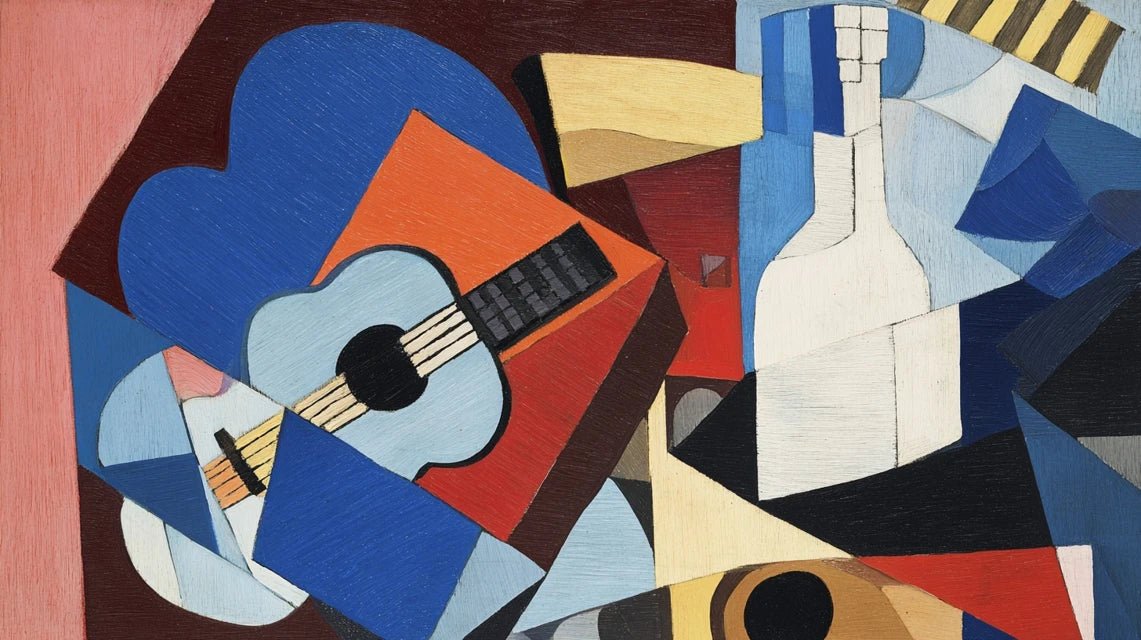
🎨 The meeting with Picasso in 1906 stimulates Matisse's research. The two men, whom Gertrude Stein calls "the North and South poles of modern art", influence each other while following opposite paths. When Picasso fragments reality with Cubism, Matisse simplifies it with Fauvism.
The influence of Cézanne remains constant: Matisse owns in his personal collection the "Three Bathers" of the Aix master which he considers his "talisman". From Cézanne, he retains the lesson of construction through color and the geometrization of volumes.
OUR RECOMMENDED PRODUCTS
This period definitively establishes Matisse as one of the masters of modern art. His technical and aesthetic innovations influence a whole generation of artists and prepare for future developments in non-figurative art.
Henri Matisse intimate: the man behind the color revolutionary
Behind the image of a revolutionary artist lies a bourgeois man with orderly habits. Matisse leads a life as regimented as sheet music: waking up at 6 am, frugal breakfast, working in his studio until 6 pm with a strictly timed lunch break. This quasi-monastic discipline fuels his exceptional creativity.
His wife Amélie plays a crucial role in his career. A woman of character and culture, she manages the practical aspects of their lives, organizes exhibitions, receives collectors, and protects her husband's working time. Their marriage, despite some crises, withstands trials and temptations of burgeoning fame.
The most dramatic episode in his private life occurs during World War II: his wife Amélie and his daughter Marguerite are arrested by the Gestapo in April 1944 for acts of resistance. Marguerite, tortured, narrowly escapes deportation. These trials deeply mark Matisse who expresses his pain in several poignant portraits of his wounded daughter.
Matisse also reveals a generous and pedagogical personality. He opens a Matisse Academy from 1908 to 1911 where he teaches free of charge his discoveries to young artists from all over the world. His patience and ability to analyze make him a remarkable teacher. 📚 This transmission of knowledge reveals his awareness of the historical dimension of his innovations.
Henri Matisse and international recognition: 1910-1954
Matisse's international recognition accelerates from 1910. His exhibitions multiply in Europe and the United States, while collectors compete for his works. Art critic Roger Fry promotes him in England, and Alfred Stieglitz organizes his first personal exhibition in New York as early as 1912.
The symbolic anecdote of his consecration occurs during the Armory Show of 1913 in New York: his "Nu bleu, souvenir de Biskra" provokes such a scandal that conservative students burn a reproduction of the work in public. Paradoxically, this controversy ensures his American notoriety and explodes the prices of his paintings.
Henri Matisse and record prices: evolution of the art market
The evolution of Matisse's prices reflects his progressive recognition and then his definitive consecration. From a few hundred francs in the 1900s, his paintings reach several thousand francs in the 1920s, then considerable sums after his death.
| Period | Average value | Record sale |
|---|---|---|
| 1900-1920 | 500 to 5,000 francs | "La Femme au chapeau": 500 francs (1905) |
| 1920-1954 | 10,000 to 100,000 francs | Decorative commissions: 200,000 francs |