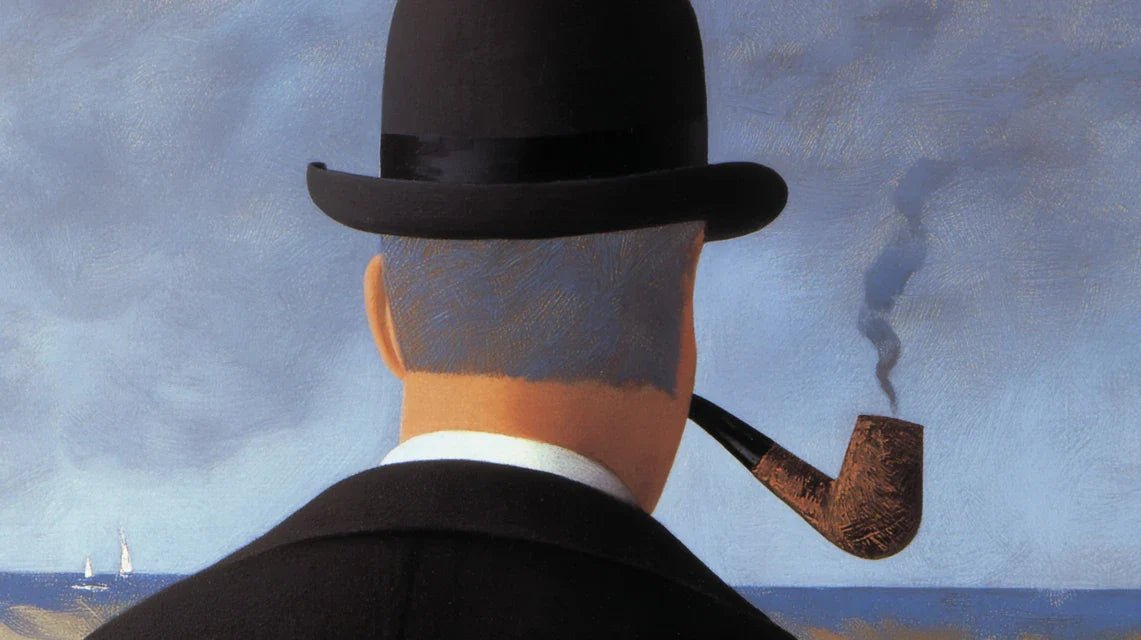
Imagine a man in a dark overcoat walking peacefully through the streets of Brussels, the bowler hat firmly on his head, a green apple floating mysteriously in front of his face.
This enigmatic image, which has become one of the most famous works of global Surrealism, is perfectly representative of René Magritte’s essence: an artist who transformed everyday life into visual poetry, unveiling the extraordinary within the ordinary.
Behind this apparent simplicity lay an artistic genius that revolutionized our perception of reality. René François Ghislain Magritte did not simply paint objects; he questioned their very essence, creating visual paradoxes that continue to fascinate the world nearly sixty years after his death.
Discover how this discreet Brussels bourgeois became the undisputed master of visual mysteries, innovating modern art with his unique philosophy of the visible and invisible - a captivating biography that reveals the man behind the bowler hats
René Magritte: The visual alchemist who transformed Belgian reality into a universal mystery
Understanding René Magritte requires abandoning our certainties about what a painter truly is. Unlike the tormented artists of his time, this meticulous man led a deliberately ordinary existence while creating some of the most extraordinary art of the 20th century.
| Biographical Highlights | Artistic Legacy |
|---|---|
|
Full name: René François Ghislain Magritte Birth date: November 21, 1898, Lessines (Belgium) Death date: August 15, 1967, Brussels Nationality: Belgian |
Movement: Belgian Surrealism Style: Mysterious realism and visual paradoxes Key work: “The Treachery of Images” (1929) Innovation: Philosophical questioning through image |
This duality between the invisible man and the revolutionary artist is key to understanding the fascinating universe of a creator who made contradiction his primary artistic tool.
The roots of René Magritte: The mysterious childhood that shaped the genius of paradox
The story of René Magritte begins in the industrial landscapes of Hainaut, where he was born on November 21, 1898 in Lessines as the eldest son of Léopold Magritte, tailor and textile merchant, and Régina Bertinchamps, dressmaker before her marriage.
The founding drama that forever marked his worldview: The March 12, 1912, when René was only thirteen years old, his mother Régina committed suicide by drowning in the Sambre River at Châtelet. Her body was found several days later, her nightgown covering her entire face. This traumatic image of a veiled face would become a recurring motif in Magritte's work, particularly visible in "The Lovers" (1928).
The aesthetic revelation that changed everything: In 1922, René Magritte discovered a reproduction of “Song of Love” by Giorgio de Chirico. This encounter with metaphysical painting revealed to him the possibility of creating pure poetry by assembling incongruous objects in unreal spaces.
René Magritte and his time: Belgian avant-garde in the turbulence of the 20th century
The artistic emergence of René Magritte is part of the cultural effervescence of Europe between the two wars, a period when traditional certainties collapse derneath the onslaught of Freudian psychoanalysis and artistic revolutions.
The Belgium of the 1920s is a fertile ground for artistic innovation. In Brussels forms an autonomous surrealist group, distinct from the Parisian movement of André Breton, with figures such as Paul Nougé, E.L.T. Mesens and Marcel Lecomte.
Unlike his contemporaries Salvador Dalí or Max Ernst, Magritte developed a meticulous and thoughtful approach to surrealism, prioritizing technical precision in service of complex philosophical ideas.
The historical upheavals of this era - World War I, the 1929 crisis, the rise of fascism - deeply influenced his worldview, leading him to question appearances and established certainties.
Belgian originality in global surrealism: Where French surrealism privileged automatic writing and the spontaneous expression of the unconscious, the Belgian group around Magritte developed a conceptual and literary approach, blending poetry and philosophy in visually rigorous creations.
René Magritte facing adversity: the years of learning and artistic research (1920-1926)
The early professional life of René Magritte perfectly illustrates the difficulties encountered by avant-garde artists in conservative Belgium in the 1920s. Forced to earn a living, he worked as a drafter in the Peters-Lacroix wallpaper factory alongside painter Victor Servranckx.
Parallel to this, René developed his talents as a advertising graphic designer, creating posters and advertisements for various Brussels companies. This experience, which he would later describe with disdain as "silly works", unexpectedly taught him the communicative power of images and the importance of visual clarity.
The decisive meeting with Georgette Berger in 1920 - whom he had known as a child at a fair in Charleroi in 1913 - brings essential emotional stability to his artistic development. Their marriage in 1922 marks the beginning of an unwavering union that will last until the painter's death.
These formative years forge in Magritte a exemplary work ethic and a methodical approach to creation, characteristics that will distinguish his work from traditional surrealist improvisation.
The decisive turning point occurs in 1926 when a contract with the Le Centaure Gallery finally allows him to devote himself entirely to painting, freeing his creative genius from commercial constraints.
René Magritte and artistic scandals: the birth of a visual revolutionary (1926-1930)
The year 1926 marks a radical turning point in René Magritte's career with the creation of "The Lost Jockey", his first authentically surrealist work which scandalizes the Brussels public.
His first solo exhibition in 1927 at the Le Centaure Gallery provokes a real outcry of criticism. Belgian newspapers welcome his sixty paintings with a concert of incomprehension and sarcasm, describing his art as "pretentious absurdities" and "hoaxes".
Deeply hurt by this resounding failure, Magritte makes the courageous decision to move to Paris in 1927, settling in the Parisian suburb of Perreux-sur-Marne to join the international surrealist movement.
The artistic philosophy that challenged the establishment: "What matters is to eliminate the difference between our feelings and our ideas about the world and mystery. We must not try to solve the mystery, but to make it consciously exist," declared Magritte, defending a vision of art as revealer of the inexplicable rather than simple aesthetic entertainment.
These successive controversies and ruptures form Magritte's independent character, leading him to develop his own artistic path, liberated from dogmas and external influences.
René Magritte revolutionizes modern art: the invention of conceptual surrealism (1929-1940)
Magritte's return to Brussels in 1930 marks the beginning of his most creative and revolutionary period. Freed from Parisian influences, he develops his unique artistic language, mixing technical precision and conceptual audacity.
It is during this prolific period that he creates his most iconic works, firmly establishing his reputation as a master of visual paradox. His canvases become veritable philosophical laboratories where the relationships between image and reality are questioned.
"The Treachery of Images" (1929): when René Magritte reveals the imposture of representation
This revolutionary work, depicting a pipe accompanied by the inscription "This is not a pipe", disrupts traditional painting codes. Magritte demonstrates with implacable logic that the image of an object is never the object itself, introducing into art a meta-conceptual dimension of striking modernity.
This reflection on the nature of representation influences conceptual art and the philosophy of the image durably, anticipating contemporary questions about the society of the spectacle and the manipulation of images.
René Magritte's technical innovations: magical realism at the service of the impossible
Unlike the automatic techniques favored by other surrealists, Magritte develops a meticulous working method based on a traditional technical mastery put at the service of revolutionary ideas.
René Magritte facing his contemporaries: Belgian originality in international art
Where Salvador Dalí cultivated eccentricity and provocation, où Joan Miró explored poetic abstraction, René Magritte deliberately chose the path of apparent simplicity and conceptual depth.
An illuminating anecdote: at a Parisian dinner, a collector asks Magritte why he doesn't paint from nature. The Belgian painter replies with mischief: "But I only paint from nature! It is the nature of my ideas that I paint."
OUR RECOMMENDED PRODUCTS
This period of intense innovation definitively establishes René Magritte as one of the most influential artists of the 20th century, a creator of a visual language whose modernity continues to fascinate.
René Magritte, the man behind the artist: The paradoxical personality of a revolutionary bourgeois
The most fascinating paradox of René Magritte lies in the striking contrast between the aesthetic revolution of his work and the deliberately ordinary life he led with his wife Georgette in their modest home in Jette, a Brussels suburb.
Unlike the bohemian artists of his time, Magritte cultivated a methodical and bourgeois existence: waking up at a fixed hour, daily walk with his dog Loulou, poker games with the neighbors, and immutable ritual at the Greenwich Café Place Eugène Flagey.
A revealing event occurs in 1938: invited to give a lecture in London, Magritte arrives dressed in his eternal dark suit and bowler hat, surprising an audience who expected to meet an eccentric. This deliberately banal appearance was actually his most subversive work of art: social invisibility as a form of conceptual art.
His fused relationship with Georgette, who posed for many canvases, reveals a man of absolute fidelity, finding in this emotional stability the necessary balance for his revolutionary creation.
This duality between apparent conformity and profound subversion iluminates all of Magritte's work: transforming the ordinary into the extraordinary through the power of art and thought alone.
René Magritte and international consecration: From incomprehension to global triumph (1940-1967)
The recognition of René Magritte follows a paradoxical path, passing from local misunderstanding in the 1920s to the status of a global artistic icon in the 1960s.
The turning point occurs in 1965 with his first major retrospective at the Museum of Modern Art in New York, which reveals to the American public the extent of his creative genius. This exhibition definitively establishes Magritte as one of the undisputed masters of modern art.
The market value of René Magritte’s works: a spectacular evolution of an artistic price tag
The evolution of Magritte's price on the international art market testifies to his growing recognition by collectors and institutions.
| Period | Average value | Sale record |
|---|---|---|
| 1920-1967 (living) | 500 to 5,000 Belgian francs | 15,000 francs ("The Lost Jockey", 1966) |
| 1970-1990 (posthumous recognition) | $50,000 to $500,000 | $1.8 million ("The Empire of Light", 1988) |
| 2000-2025 (current market) | $2 to $20 million | $79.7 million ("The Empire of Light", 2022) |
This exceptional progression reflects the growing influence of Magritte on contemporary art and global popular culture, his iconic images becoming universal references.
Today, major works by René Magritte rank among the most sought-after art investments, testifying to the permanence of his aesthetic message and his ability to question our time.
René Magritte’s death and his eternal influence: the legacy of a visionary (1967-2025)
René Magritte passed away on August 15, 1967 in Brussels, after being struck by a pancreatic cancer at the age of 68. His latest works, including "The Son of Man” (1964), disclose an artist at the peak of his creative maturity, continuing to explore the mysteries of identity and representation.
His death paradoxically coincides with the explosion of his worldwide fame. The pop art and conceptual art movements of the 1960s-70s recognize him as an essential precursor, especially his questioning of the nature of the image and the relationships between art and consumer society.
René Magritte’s influence on contemporary art: an exceptional creative posterity
The artistic legacy of René Magritte permeates all of contemporary creation. Andy Warhol acknowledges his debt to the Belgian master in his approach to reproducible images. Jasper Johns develops his reflections on symbols and their meaning. More recently, artists such as Jeff Koons or Damien Hirst are pursuing his questioning of the relationships between art and reality.
How to recognize the Magritte legacy in contemporary art: Look for works that question visual evidence, play on the paradoxes of representation, or blend familiar objects and unexpected contexts. The influence of Magritte can also be seen in contemporary advertising, graphic design and even social networks, where images are diverted and visual games proliferate.
Where to discover René Magritte today: places of memory and major collections
The Magritte Museum in Brussels, inaugurated in 2009 Place Royale, is home to the largest worldwide collection of the artist with more than 250 works. The René Magritte Museum in Jette allows you to visit his family home preserved in its original condition. Internationally, the Museum of Modern Art in New York, the Tate Modern in London and the Centre Pompidou in Paris hold major pieces from his work.
This worldwide Magritte geography is a testament to the universality of his artistic message and his unique ability to speak to all cultures and generations.
🎁 Special offer for readers
Because you took the time to inform yourself, enjoy 10% discount on your first order:
⏰ Valid 72h after reading • Applicable to all our products
Frequently asked questions about René Magritte's biography
René François Ghislain Magritte (1898-1967) was a Belgian surrealist painter who became famous for his works questioning the nature of reality and representation. Son of a tailor from Lessines, he revolutionized modern art by creating visual paradoxes such as "The Treachery of Images" with its famous pipe accompanied by the inscription "This is not a pipe". His fame rests on his unique ability to transform the ordinary into the extraordinary through the power of conceptual art.
Magritte began drawing in 1910 and joined the Royal Academy of Fine Arts in Brussels in 1916, but traditional teaching did not suit him. His real training came from discovering “Song of Love” by Giorgio de Chirico in 1922, which revealed to him the possibilities of metaphysical painting. He then developed his unique style by combining traditional realistic technique and revolutionary surrealist concepts, creating what is known as "magic realism".
Unlike Surrealists who favored automatism, Magritte developed a meticulous and thoughtful method, using a traditional realistic technique to represent impossible situations. His innovation lay in the use of photographic precision at the service of revolutionary conceptual ideas. He painted familiar objects with perfect realism but placed them in unexpected contexts, thus creating "poetic collisions" that questioned our perception of reality.
Although his early exhibitions in the 1920s were critical failures, Magritte’s recognition was built gradually. The decisive turning point was his retrospective at the Museum of Modern Art in New York in 1965, which revealed his genius to the American public. His notoriety truly exploded in the 1960s-70s with the emergence of Pop Art and Conceptual Art, movements that recognized him as an essential precursor. His death in 1967 paradoxically coincided with the beginning of his worldwide fame.
Magritte’s works are among the most sought-after on the international market. Sold for a few thousand Belgian francs during his lifetime, they now fetch record sums: "Empire of Light" sold for $79.7 million in 2022, setting a new record for the artist. Major paintings generally sell for between $2 and $20 million, while drawings and gouaches are accessible from €50,000. This exceptional progression reflects Magritte’s growing influence on contemporary art.
Magritte’s legacy permeates all of contemporary creation. He directly influenced Pop Art (Andy Warhol), Conceptual Art (Jasper Johns, John Baldessari) and continues to inspire current artists such as Jeff Koons or Damien Hirst. His questioning of the nature of image and the relationships between reality and representation anticipates contemporary issues of digital media and social networks. His artistic philosophy - revealing the extraordinary in the ordinary - remains strikingly modern in an age of omnipresent images.
René Magritte, eternal poet of visual mystery: why his art still fascinates today
More than fifty years after his disappearance, René Magritte continues to fascinate with the unsettling relevance of his artistic message. In the age of artificial intelligence and deepfakes, his questions about the truth of the image and the relationships between reality and representation resonate with a particular acuity.
His genius lies in his unique ability to have created a universal visual language that transcends eras and cultures. Whether in contemporary advertising, graphic design or digital art, the Magritte legacy permeates our daily visual life with a discretion that would have delighted this man of paradox.
Beyond the aesthetic aspect, Magritte leaves us a philosophy of wonderment : the one that consists of looking at the familiar world with the new eyes of childhood, to question the obvious and to cultivate mystery in a world that claims to explain everything.
The permanent invitation to imaginary travel: Discovering René Magritte means offering yourself a new look at everyday life and developing this valuable ability to see the extraordinary in the ordinary. His art teaches us that poetry is hidden all around us, simply waiting for us to know how to look at it.