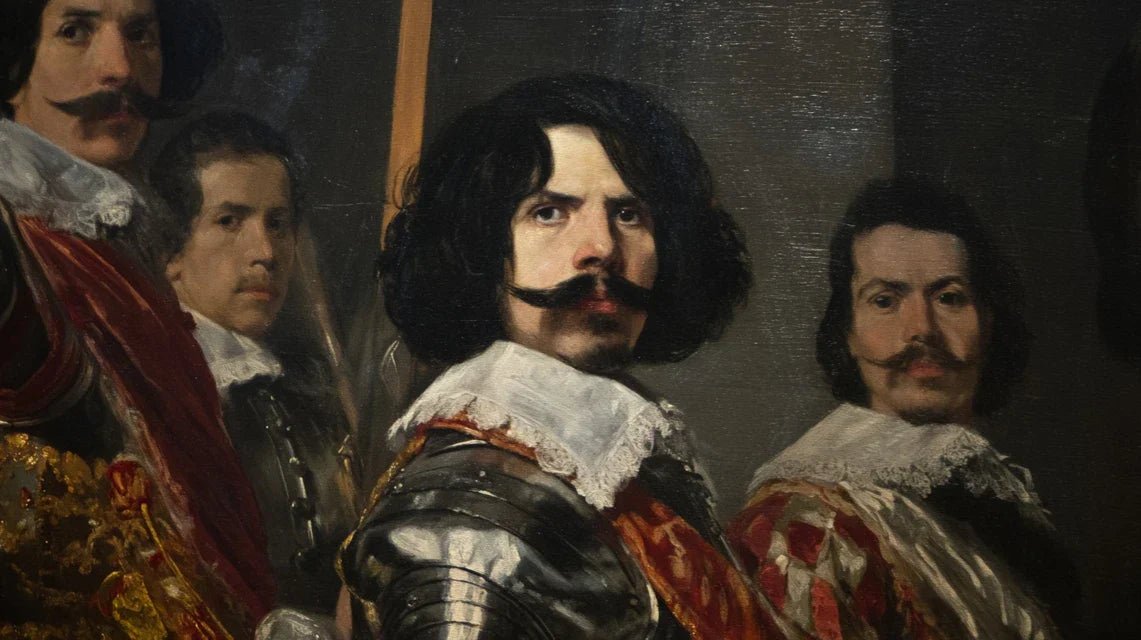
Madrid, 1656. In the luminous workshop of the royal palace, a man of 57 years raises his piercing eyes to the viewer. 🎨 Diego Velázquez holds his brush suspended, interrupting his work on a mysterious canvas whose front we will never see.
This frozen moment in Las Meninas captures the essence of a genius who revolutionized Western art. In this room of the Alcázar palace, surrounded by the infanta Margaret’s ladies-in-waiting, Velázquez offers us more than just a royal portrait: he invites us into the intimacy of his artist's gaze, one that captures the human soul with a disturbing truth.
Four centuries later, this painting continues to fascinate art historians, philosophers and art lovers around the world. But who was the man behind this masterpiece? How did this son of a Seville notary become the "painter of painters" according to Manet?
This biography reveals the fascinating story of Diego Velázquez, from his Andalusian beginnings to his artistic apotheosis - discover how an apprentice painter became equal to kings
Diego Rodríguez de Silva y Velázquez: the undisputed master of Baroque portraiture
Knowing Diego Velázquez (1599-1660) is to understand how an artist can transcend his time to become timeless. His exceptional journey illustrates social ascension through talent in Spain’s Golden Age, a period when Philip IV reigned over an empire where the sun never set.
| Biographical highlights | Artistic legacy |
|---|---|
|
Full name: Diego Rodríguez de Silva y Velázquez Birth: June 6, 1599, Seville Death: August 6, 1660, Madrid Nationality: Spanish (Portuguese origins) |
Movement: Spanish Baroque Style: Naturalistic realism and tenebrism Flagship work: Las Meninas (1656) Innovation: Revolution of perspective and gaze |
The story of Velázquez leads us from the lively streets of Seville to the gilded salons of Madrid, where he forged a unique relationship with royal power while preserving his artistic integrity.
Diego Velázquez child prodigy: the first revelations of an exceptional talent
Seville, 1599. The richest city in Spain sees the birth of its most illustrious artistic son. Juan Rodríguez de Silva, a notary of Portuguese origin, and Jerónima Velázquez, from the lower Andalusian nobility, give birth to Diego in a family context that prioritizes intellectual education.
The spark that changed everything: At just 11 years old, the young Diego shows such an extraordinary aptitude for drawing that his parents abandon their legal career plans. This courageous decision leads him to the workshop of Francisco de Herrera the Elder, a renowned but difficult painter. The experience is short-lived: the child cannot tolerate the master's authoritarianism.
The secret of his early genius: From his earliest works, Velázquez masters chiaroscuro without ever having seen the canvases of Caravaggio. His natural technique of tenebrism reveals an instinctive understanding of light as a revealer of human truth.
Velázquez and Golden Age Spain: when art reflects imperial grandeur
The time of Velázquez coincides with the artistic apogee of Habsburg Spain. Under the reign of Philip IV (1621-1665), Madrid becomes a major European artistic hub, attracting the greatest masters and collecting Italian and Flemish masterpieces.
Seville, where the artist grew up, benefits from the commercial monopoly with the Americas. This exceptional prosperity nourishes powerful ecclesiastical patronage and attracts a cosmopolitan population of Flemish and Italian merchants. Workshops multiply, creating intense artistic emulation.
His contemporaries - Zurbarán, Murillo, Ribera - excel in religious art, but Velázquez stands out for his revolutionary approach to portraiture. Where his peers glorify the divine, he reveals the profound humanity of his models, whether they are kings or servants.
The historical context shapes his vision: Spain militarily dominates Europe but experiences its first economic frailties. This tension between displayed grandeur and complex realities is reflected in Velázquez's art, which captures the melancholy behind royal splendor.
His timeless genius: Velázquez transcends his time by painting not imperial glory, but universal human essence. This approach explains why his works still speak to audiences of the 21st century.
Velázquez's early years in Madrid: conquering the capital through talent (1622-1628)
1622. Fortified by his Sevillian reputation, Velázquez attempts a first foray into Madrid with the support of his father-in-law Pacheco. Despite the quality of his works, this attempt to approach the royal court ends in failure. The Madrid networks remain closed to this unknown provincial.
Returning to Seville, far from being discouraged, the artist refines his technique and enriches his repertoire. He paints bodegones (genre scenes) with a striking realism: “The Old Woman Cooking Eggs” (1618) already reveals his mastery of texture and natural light.
The turning point comes in 1623 thanks to Gaspar de Guzmán, Count-Duke of Olivares, first minister of Philip IV and Sevillian compatriot. This decisive encounter finally opens the doors of the royal palace. Olivares, recognizing Velázquez's genius, commissions a portrait of the young king.
This period of perseverance shapes the artist’s character: he never compromised on quality, preferring to wait for deserved recognition rather than accept artistic compromises. This requirement will become his signature throughout his career.
The success of the portrait of Philip IV in 1623 marks the end of his years of uncertainty and the beginning of a dazzling rise that will lead him to the summit of European art.
Revolutionary Velázquez: when art challenges the conventions of its time
Velázquez's arrival at the royal court is not without friction. His immediate appointment as “Painter to the King” at 24 years old provokes jealousy and criticism. Established artists contest this express promotion of a “provincial” who upsets Madrid pictorial codes.
His first artistic revolution scandalizes: he represents buffoons, dwarfs and servants with the same dignity as nobles. His portraits of “El Primo” and “Sebastián de Morra” reveal the profound humanity of these court marginals, shocking a rigidly hierarchical society.
Even more subversive, Velázquez refuses the traditional idealization of royal power. His portraits of Philip IV show a human monarch, sometimes melancholic, far from the image of the sun king. This psychological truth disturbs the supporters of an art of royal propaganda.
His revolutionary artistic philosophy: “I paint what I see, not what is expected of me,” Velázquez is said to have declared. This motto summarizes his approach: art must reveal human truth, even when it disturbs social conventions.
This audacity prepares his most spectacular technical innovations which will revolutionize European art.
The revolutionary art of Velázquez: master of Baroque realism and forerunner of modernity
The meeting with Pierre Paul Rubens in 1628 marks a decisive turning point. The Flemish master, impressed by the talent of the young Spaniard, encourages him to discover Italy. This recommendation leads to Velázquez's first Italian journey (1629-1631), a true artistic revelation.
In Rome and Venice, he studies Titian, Tintoretto and Veronese. This immersion radically transforms his palette: he abandons the dark browns of tenebrism to adopt the pearly grays, the golden ochres and the subtle greens that will become his chromatic signature.
The Maids of Honour (1656): Diego Velázquez's absolute masterpiece
"Las Meninas" represents the apotheosis of his genius. In this revolutionary composition, Velázquez orchestrates a play of mirrors and perspectives of unparalleled complexity. The artist depicts himself painting, looking towards us spectators, while a mirror in the background reflects Philip IV and Queen Mariana.
This brilliant mise en abyme questions the very nature of artistic representation. Who is watching whom? What is Velázquez really painting on his mysterious canvas? This visual enigma still fascinates philosophers and art historians, from Michel Foucault to Daniel Arasse.
Velázquez's revolutionary technical innovations
His pictorial technique revolutionizes Western art. He develops a free impasto and ingenious applications that create a unique luminous vibration. His brushstrokes, visible up close, blend into distance with models of striking realism, foreshadowing the Impressionism of two centuries.
Velázquez facing his contemporaries: Rubens, Poussin and the Spanish school
Unlike Poussin who favors intellectual composition, or Rubens who exalts Baroque movement, Velázquez chooses the path of direct observation. His modernity lies in this quasi-scientific approach to light and space.
In contrast to his compatriots Zurbarán and Murillo, masters of religious art, he establishes portraiture as a major art form, proving that a simple likeness can equal the depth of the greatest historical compositions.
OUR RECOMMENDED PRODUCTS
This artistic revolution is accompanied by a social ascent that will make Velázquez much more than just a court painter.
The fascinating personality of Velázquez: the man behind the artistic genius
Behind the official artist lies a man of remarkable intelligence and encyclopedic culture. His personal library, comprising 154 volumes, reveals his passions: mathematics, geometry, anatomy, architecture, and art theory. This erudition nourishes the intellectual sophistication of his art.
His privileged relationship with Philippe IV goes beyond a simple master-servant dynamic. The king, twelve years his junior, frequents Velázquez's studio daily, discussing art and politics. Upon the painter’s death, Philippe IV will scribble in the margin of a document: "I am broken," an emotional testament to their sincere friendship.
The most revealing anecdote about his personality concerns Juan de Pareja, his Moorish slave. Velázquez secretly teaches him painting, grants him his freedom in 1650, and makes him his principal portraitist during the second Italian journey. This humanity contrasts with the prejudices of the time.
His character is revealed in his painting: reserved but not shy, observant but never indiscreet, socially ambitious but never a courtier. This integrity shines through in all his self-portraits, where a profound melancholy blends with legitimate pride.
This psychological complexity explains the disturbing depth of his portraits and prepares for his final consecration in the last years of his life.
Velázquez's recognition: from royal success to universal acclaim
Velázquez’s recognition was established gradually, culminating in his appointment in 1659 to the order of Santiago, a rare ennoblement for an artist. This distinction crowns an exceptional social ascent: from the son of a craftsman to the rank of grand marshal of the palace.
His public apotheosis occurs with the reception of the portrait of Pope Innocent X (1650) in Rome. Italian connoisseurs, heirs to Michelangelo and Raphael, unanimously praise this masterpiece. The pope himself, known for being difficult, declares this portrait too true - the highest compliment for a realist artist.
The evolution of Velázquez's value: from court success to international records
The estimation of his works reflects his growing recognition through the centuries, confirming his status as a universal master.
| Period | Average value | Sale record |
|---|---|---|
| During his lifetime (1620-1660) | 500-2000 reales per portrait | Royal commissions at 4000 reales |
| Posthumous (1661-1850) | Limited recognition outside Spain | European royal acquisitions |
| Modern era (1850-present) | 10-50 million euros (estimates) | Portrait of Juan de Pareja: $5.4 million (1970) |
This spectacular progression can be explained by the rediscovery of his genius in the 19th century, when Manet proclaimed him "painter of painters", influencing all artistic modernity.
The rarity of his works on the market - most belonging to the Prado - makes each appearance exceptional, justifying record estimates.
The Death of Velázquez (1660): End of an Artistic Reign, Birth of a Legend
August 6, 1660. Exhausted by his palace duties and weakened by the organization of the marriage of Infanta Maria Theresa with Louis XIV, Velázquez died in Madrid at the age of 61. His last works - "Las Meninas", "The Spinners" - testify to an absolute mastery, like an artistic testament.
His death marks the end of the Spanish Golden Age. No successor will equal his genius, and the Spanish school begins its decline. Symbolically, Juana Pacheco, his faithful wife, follows him in death eight days later, definitively closing an era.
Velázquez's Revolutionary Influence on Contemporary Art
His legacy permeates all artistic modernity. Manet discovered in him the father of modern art, Picasso dedicated 58 variations to the Meninas, Francis Bacon reinterprets his Portrait of Innocent X. This lineage proves the universality of his artistic message.
The Impressionists recognize in him a precursor: his technique of impasto, his landscapes of the Villa Medici anticipate their research on natural light. Monet and Renoir venerate this master who, three centuries before them, already painted "en plein air".
How to recognize his influence today: Observe contemporary fashion photography, auteur cinema, current figurative painting: all use his lessons in framing, natural light and psychological truth. His aesthetics permeate our visual era.
Where to discover Velázquez's universe: museums and essential collections
The Prado Museum in Madrid preserves the bulk of his work: 50 canvases, including "Las Meninas", visible in room XII dedicated to the master. The National Gallery in London possesses "Venus with a Mirror", the Metropolitan Museum in New York exhibits "Juan de Pareja". These artistic pilgrimages reveal the intact power of his genius.
This permanence of his influence explains why Velázquez remains, four centuries after his birth, an absolute reference for understanding art and humanity.
🎁 Special offer for readers
Because you took the time to inform yourself, enjoy 10% discount on your first order :
⏰ Valid 72h after reading • Applicable to all our products
Frequently asked questions about Diego Velázquez : everything you need to know about the Spanish master
Born in 1599 in Seville to a Portuguese notary father and an Andalusian minor nobility mother, Velázquez grew up in a cultivated environment that privileged education. This intellectual training, complemented by six years with the master Francisco Pacheco (whom he married in 1618), shapes his vision of a humanist artist. His early marriage and parenthood of two daughters anchor him in family stability, contrasting with the bohemian image of the artist. This personal solidity is reflected in the serenity of his compositions.
After a brief stint with Francisco de Herrera the Old around 1610, Velázquez entered the workshop of Francisco Pacheco at age 11. This six-year training (1611-1617) taught him perspective, proportion, anatomy and artistic theory. Even more crucial, Pacheco's school introduces him to Seville's intellectual circles and the philosophy of art. A self-taught master of chiaroscuro, he naturally develops his tenebrist technique before even knowing Caravaggio’s work.
Velázquez revolutionizes painting with his "free stroke" : learned impastos and visible brushstrokes that create a unique luminous vibration. His palette evolves from Sevillian tenebrism (browns and ochres) to pearlescent grays and subtle greens after his Italian journey. His major innovation lies in the direct observation of natural light, foreshadowing Impressionism. This technique, combined with rigorous mathematical perspective, produces a realism of disturbing psychological truth.
His recognition began in 1623 with his appointment as "painter to the king" Philip IV at only 24 years old, thanks to a royal portrait that impressed the court. His rise culminates with ennoblement in the Order of Santiago (1659) and his appointment as grand marshal of the palace. Internationally, his Roman triumph with the portrait of Innocent X (1650) confirms his European reputation. This official recognition is accompanied by a privileged relationship with Philip IV, going beyond a simple master-servant relationship.
Velázquez's works achieve exceptional valuations, justified by their rarity (most belong to the Prado) and historical influence. The "Portrait of Juan de Pareja" was sold for $5.4 million in 1970, a record at the time. Today, expert estimates value his major paintings between €10 and €50 million. This valuation reflects his rediscovery in the 19th century by Manet and his influence on artistic modernity, making each Velázquez an invaluable national treasure.
Velázquez's legacy permeates contemporary visual creation because he anticipates modern concerns: psychological truth, direct observation, questioning of representation. Manet proclaims him father of modern art, Picasso dedicates 58 variations to him, Francis Bacon reinterprets his portraits. Photographers, filmmakers and contemporary painters draw inspiration from his framing, his natural light and his ability to reveal the essence of humanity. His artistic message - painting truth rather than appearance - resonates particularly in our era of questioning about image and reality.
The eternal artistry of Velázquez: why the Spanish master still fascinates
Four centuries after his birth, Diego Velázquez remains a fascinating enigma and an inexhaustible source of inspiration. His genius lies in this unique ability to transcend his time to speak to universal humanity. Where his contemporaries painted for their time, he created for eternity.
His modernity is surprising: this 17th-century master anticipates contemporary art's questioning about representation, reality and illusion. "Las Meninas" still questions philosophers and artists today, proving that great art poses timeless questions rather than definitive answers.
His message resonates particularly in our image-saturated era: Velázquez teaches us to really look, to seek the human essence behind appearances, to question what we see. This lesson of lucidity and humanity constitutes his true legacy, beyond pictorial technique.
Velazquez inspiration for our time: Discovering Velázquez means learning to see the world with more depth, to seek truth behind social masks, to cultivate this intelligence of sight that enriches our understanding of art and life.