Balthus: The Enigmatic Painter of Suspended Time
Balthus Klossowski de Rola: The Painter of Suspended Time and Adolescent Mysteries
| Biographical Highlights | Artistic Legacy |
|---|---|
|
Full name: Balthasar Klossowski de Rola Birthdate: February 29, 1908, Paris (France) Death date: February 18, 2001, Rossinière (Switzerland) Nationality: Franco-Polish |
Movement: Modern figurative realism Style: Metaphysical and symbolic painting Key work: The Guitar Lesson (1934) Innovation: Art of suspended time and ambiguity |
The Mysterious Origins of Balthasar Klossowski: Between Parisian Exile and Aristocratic Dreams
A gilded childhood abruptly interrupted: In 1914, the declaration of war disrupted this peaceful existence. The family, of German nationality, had to flee Paris to avoid internment. This marked the beginning of a wandering that would deeply affect the young Balthasar: Switzerland, Germany, and finally settling in Geneva in 1917.
The early revelation of artistic gift: At thirteen, Balthus already signed his works "Baltusz", disclosing this obsession with mystery and identity metamorphosis that would characterize his entire career.
Balthus and his era: a figurative painter in the whirlwind of modern art
The 1920s-1930s saw the birth of the most revolutionary artistic avant-gardes: Dadaism, Surrealism, Cubism, Abstract Art. Within this context of creative effervescence, Balthus made the radical choice of figurative tradition.
This decision was not by chance but stemmed from a deep conviction. During his initiatory journey in Tuscany in 1926, inanced by the patron Jean Strohl, he tirelessly copied the frescoes of Piero della Francesca and Masaccio.
His contemporaries were Picasso, Breton, Éluard. They all came to visit his Parisian studio in 1933, but left disappointed by his "naturalistic orientation" which did not correspond to the surrealist canons of the time.
Paradoxically, this assumed marginality was his strength. When Derain gave him technical advice or when Giacometti became his faithful friend, they recognized in him an authentic painter, impermeable to trends and external influences.
Art as resistance to modernity: Balthus developed an aesthetic of "time regained", creating timeless works that seem to escape the historical convulsions of his era.
Balthus’s early Parisian years: between creative poverty and first scandals (1930-1940)
Returning to Paris in 1933, the young Balthus rented a modest studio and survived thanks to commissions for portraits of wealthy patrons. These early years were marked by material hardship as well as a fierce determination to impose his artistic vision.
The most revealing episode of his personality takes place at the Louvre: for three consecutive months, he obsessively copied "Echo and Narcissus" by Poussin, perfecting his technique to absolute mastery.
His meeting with Antoinette de Watteville in Beatenberg in 1924 - she was only twelve years old - shook up his sentimental and artistic life. This nascent passion would inspire some of his most beautiful portraits, among them "Young Girl in an Amazon Costume" (1932).
Military service in the Morocco (1930-1931) brought him a new maturity. Returning to Europe, he embarked on illustrating "Wuthering Heights" by Emily Brontë, a project that revealed his genius for dramatic staging.
These years of difficult training forged his character as an uncompromising artist, refusing any compromise with public tastes and the demands of the emerging art market.
The scandalous explosion of 1934: how Balthus revolutionized art with "The Guitar Lesson"
April 1934: the Pierre Gallery is preparing to welcome the first solo exhibition of Balthus. The artist, then aged 26 years, deliberately chose to provoke the Parisian public with works of unprecedented audacity.
"The Guitar Lesson" creates a sensation - and scandal. The painting depicts an adult woman manipulating the nude body of a very young adolescent in an explicitly erotic pose. The painting, inspired by the Pietà of Villeneuve-lès-Avignon, transforms religious iconography into a disturbing scene.
Balthus fully embraces this strategy of provocation, declaring to his relatives: "The only way to become known quickly is through scandal." He defined his painting as "ferocious, all the tragic throbbing of a drama of the flesh".
Art as an exorcism of forbidden impulses: "I see adolescents as a symbol. The adolescent embodies the future, the being before it transforms into perfect beauty." - This quote reveals the profound artistic philosophy of Balthus.
This exhibition marks a decisive turning point: from now on, Balthus will be forever associated with these ambiguous representations of female adolescence, evocating fascination and reprobation in equal measure.
The scandalous success allowed him to access notoriety, but also trapped him in a dubious reputation that he would skillfully maintain throughout his career.
The revolutionary art of Balthus: between metaphysical realism and modern symbolism
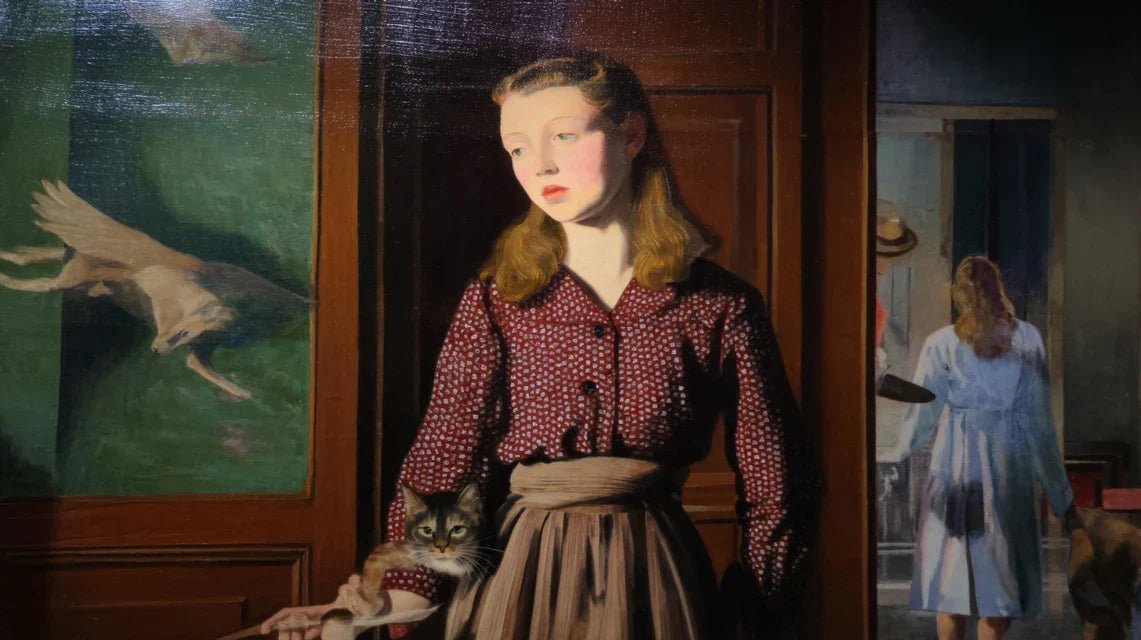
The years 1935-1950 saw Balthus develop his unique pictorial language, mixing Renaissance tradition and unsettling modernity. His technique, with almost photographic precision, serves a vision of the world imbued with mystery and sensuality.
It was during this period that he created his famous self-portrait "The King of Cats" (1935), de picturing himself surrounded by a majestic cat. This animal, omnipresent in his work, symbolizes his elusive nature and taste for secrecy.
Balthus' Guitar Lesson: analysis of a controversial masterpiece
"The Guitar Lesson" remains the most commented and most polemical work of Balthus. Beyond provocation, this canvas reveals his exceptional technical mastery and his ability to transform pictorial tradition into a disturbing contemporary language.
The composition, of perfect classicism, is directly inspired by Flemish and Italian masters. But Balthus subverts this reference in introducing an explicit erotic charge which radically transforms the reading of the work.
Balthus' revolutionary techniques: the art of suspended time
Balthus develops a unique working method, sometimes spending several years on a single canvas. He uses tempera mixed with oil, a technique inherited from Renaissance masters, which allows him to obtain these characteristic material effects.
Balthus facing Picasso and Giacometti: the solitary path of figuration
When Picasso visits his studio in 1934, he immediately recognizes the singularity of Balthus. Unlike the Surrealists who had disappointed him, the master of Guernica understands that this fidelity to figuration is a form of artistic revolution.
His friendship with Alberto Giacometti reveals two complementary approaches to modern human condition: where Giacometti expresses existential anguish through expressionistic deformation, Balthus captures the mystery of being in contemplative stillness.
OUR RECOMMENDED PRODUCTS
This period of intense experimentation establishes Balthus as one of the most original painters of his generation, a creator of a pictorial universe immediately recognizable and impossible to imitate.
The enigmatic personality of Balthus: between fantasized aristocracy and authentic genius
Balthus cultivated throughout his life a complex personality, oscillating between everyday simplicity and worldly theatricality. His marriage to Antoinette de Watteville in 1937 brings him the emotional stability necessary for his creation.
The most revealing anecdote about his character occurred during World War II: mobilized in Alsace, he is mysteriously demobilized and spends the conflict in Switzerland, continuing to paint as if nothing could disturb his art.
His habit of calling himself "Comte Klossowski de Rola" amuses and intrigues the artistic community just as much. This noble fabrication reveals his deep need to create a personal legend worthy of his artistic genius.
Behind this mysterious facade lies a man of disarming simplicity, passionate about gardening, an insatiable reader, and a caring father to his sons Stanislas and Thadée.
Balthus's global recognition: from the Villa Médicis to auction records
1961 marks a decisive turning point in Balthus’s career: André Malraux appoints him director of the Academy of France in Rome, a prestigious position he will hold for sixteen years.
This nomination, official recognition of his genius allows him to completely restore the Villa Médicis, applying his pictorial innovations to Renaissance historical settings.
The evolution of Balthus's value: from critical recognition to financial records
The art market gradually discovers the value of Balthus. From the 1950s, his paintings reach significant prices, thanks in particular to the support of the dealer Pierre Matisse in New York.
| Period | Average value | Sale record |
|---|---|---|
| 1950-1970 | $10,000 - $50,000 | "The Turkish Chamber" - $100,000 (1966) |
| 1980-2000 | $200,000 - $800,000 | "Le Rêve II" - $12 million (2003) |
| 2020-2025 | €500,000 - €3 million | "Thérèse on a bench" - €15 million |
Today, Balthus ranks among the most highly valued artists of the 20th century, his main works regularly reaching prices exceeding several million euros during international sales.
Balthus's final years: artistic testament at Rossinière (1977-2001)
In 1977, Balthus leaves Rome to settle in the Grand Chalet de Rossinière, a magnificent 18th-century residence facing the Swiss Alps. Accompanied by his second wife, the Japanese painter Setsuko Ideta, he spends his last twenty-four years there.
This period sees the birth of his latest masterpieces, among them the series of "Cat in the mirror" and the unfinished "Young girl with a mandolin", on which he is still working a few days before his death.
Balthus's revolutionary influence on contemporary art
Unlike popular belief, Balthus profoundly influences the contemporary artistic generations. His technique of the "suspended time" inspires filmmakers like Kubrick and photographers like Jeff Wall.
Contemporary painters such as Luc Tuymans or Neo Rauch openly claim his legacy, particularly his ability to create enigmatic images without resorting to abstraction.
How to recognize Balthus's legacy today: Look for these atmospheres of everyday mystery, these frozen golden lights, these characters caught in the interlude between action and contemplation in contemporary art.
Balthus’ works in international collections: where to discover them
The masterpieces of Balthus are kept in the world's leading museums: Centre Pompidou in Paris, Metropolitan Museum of New York, Tate Modern in London, and Palazzo Grassi in Venice.
For a complete approach to his universe, the visit of the Villa Médicis in Rome is essential: his restored decor still bears witness today to his total artistic vision.
🎁 Special offer for readers
Because you took the time to inform yourself, enjoy 10% discount on your first order:
⏰ Valid 72h after reading • Applicable to all our products
Frequently asked questions about the life and work of Balthus
Balthasar Klossowski was born in Paris in 1908 into a family of artists of Prussian origin. Son of art historian Erich Klossowski and painter Baladine, he grew up in European artistic circles, guided by mentors such as Rainer Maria Rilke. Contrary to his noble fabrications, he was not a count, but this mystification was part of his artistic strategy for creating a personal legend.
Balthus was entirely self-taught. He refused the School of Fine Arts to train by copying the masters at the Louvre (notably Poussin) and during trips to Italy where he studied Piero della Francesca and Masaccio. This atypical training allowed him to develop a personal technique combining Renaissance tradition and modernity, without being influenced by contemporary artistic schools.
Balthus used a mixture of tempera and oil inherited from Renaissance masters, allowing him to achieve those characteristic material effects. His revolution lay in the "art of suspended time": he painted scenes that appeared innocuous but were charged with a mysterious tension, creating atmospheres of expectation and contemplation. Each canvas sometimes required several years of obsessive work.
From 1934 with "The Guitar Lesson", Balthus deliberately chose to provoke with his ambiguous representations of adolescents. He assumed this strategy, declaring that "scandal" was the quickest way to achieve notoriety. His works, blending apparent innocence and underlying eroticism, question social taboos while remaining rooted in classical painting tradition.
Balthus’s works achieve exceptional prices: his major paintings sell for between 1 and 15 million euros, his drawings between 10,000 and 100,000 euros. Records include "Thérèse on a Settee" sold for 15 million euros and "The Dream II" auctioned for 12 million dollars. This valuation reflects his recognition as one of the essential masters of the 20th century.
Balthus profoundly influences contemporary art with his "metaphysical realism" and technique of "suspended time". Filmmakers like Kubrick, photographers like Jeff Wall, and painters like Luc Tuymans claim his legacy. He demonstrated that figuration could be revolutionary, opening the way for a new generation of artists questioning the mystery of everyday life without resorting to abstraction.
Balthus, the last magician of painting: why his art still fascinates
Beyond the controversies and mystifications, Balthus remains once of the few painters of the 20th century to have created a pictorial universe immediately recognizable and inimitable. His ability to transform everyday life into mystery, the mundane into metaphysics, makes him a profoundly modern artist despite his loyalty to ancient techniques.
His artistic message resonates particularly today: in an era of constant acceleration, Balthus reminds us of the beauty of suspended time, of contemplation, of inhabited silence. His frozen adolescents speak to all those fragile moments where life imperceptibly tips over.
Discovering Balthus today is a chance to treat yourself to a contemplative pause, a new look at the mysterious beauty of the world. It's understanding that true art has no age and that certain images cross the centuries while keeping their power of fascination intact.
Art as a permanent revelation: Each work by Balthus invites you to slow down, to really look, to discover the extraordinary hidden in the ordinary - a life lesson as much as an art lesson.