Moscow, 1895. A thirty-year-old man contemplates a canvas with shimmering colors at a French art exhibition. He scrutinizes this mysterious work, seeking to identify the subject represented.
The golden yellows sparkle under artificial light, creating a visual symphony that upsets the gaze of a lawyer destined for a brilliant legal career. This canvas by Claude Monet, entitled "Haystacks", will forever transform the artistic vision of Wassily Kandinsky.
In this moment of absolute revelation, the future father of abstract art understands that a painting can move without representing an identifiable object. This artistic epiphany marks the birth of a pictorial revolution that will forever change the history of Western art.
Discover the extraordinary journey of Wassily Kandinsky, a visionary genius who freed painting from all representation to reveal the spiritual essence of colors and forms - an artistic adventure that continues to inspire creators around the world.
Wassily Kandinsky: The Russian Revolutionary Who Reinvented Western Painting
Understanding the essence of Wassily Kandinsky requires grasping the scope of his artistic revolution. This man didn't just paint differently: he literally reinvented the codes of pictorial representation.
| Biographical Highlights | Artistic Legacy |
|---|---|
|
Full name: Wassily Wassilyevich Kandinsky Birth: December 4, 1866, Moscow, Russia Death: December 13, 1944, Neuilly-sur-Seine, France Nationality: Russian, then German, then French |
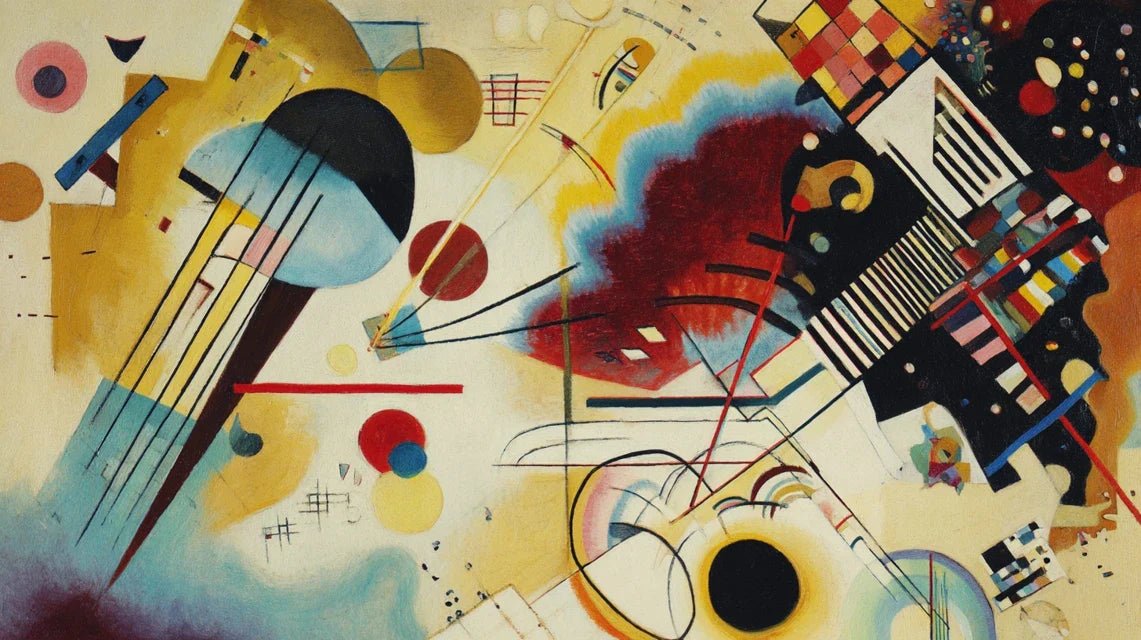
Movement: Abstract art, expressionism Style: Lyrical then geometric abstraction Key work: "Yellow-Red-Blue" (1925) Innovation: First entirely abstract painting |
This radical transformation of Western art has its roots in a privileged Moscow childhood and an exceptional sensitivity to colors. The story of Kandinsky then becomes one of spiritual as well as artistic quest.
Wassily Kandinsky: The Moscow Roots of a Visionary Genius
Little Wassily grew up in the affluent world of a Moscow tea merchant family. His father, Vasily Silvestrovich Kandinsky, and his mother, Lidia Ticheeva, move within the cultured circles of Russian bourgeois society of the 19th century.
The colorful revelation of Vologda: At 23 years old, in 1889, Kandinsky participates in an ethnographic mission in the region of Vologda, north of Moscow. Entering houses decorated with shimmering colors, he feels a mystical emotion: "I felt as if I had entered a painting." This experience reveals his synesthesia, this rare ability to perceive sounds as colors.
The principle of "inner necessity": From his earliest artistic experiences, Kandinsky develops the revolutionary idea that authentic art must spring from an "inner necessity" rather than imitation of the external world. This philosophy will guide all his future creation.
Kandinsky in the effervescence of European Belle Époque
The time of Kandinsky corresponds to one of the most fertile periods in European art history. The Belle Époque sees the birth of Impressionism, Symbolism, and the beginnings of modern art simultaneously.
Munich, where Kandinsky settles in 1896, is then an exceptional artistic laboratory. The Bavarian capital attracts avant-garde artists from all over the world, offering a unique experimentation ground in Europe. The Academy of Fine Arts in Munich shines internationally under the direction of masters such as Franz von Stuck.
His contemporaries revolutionize each in their field: Pablo Picasso invents Cubism, Henri Matisse explores Fauvism, while Paul Cézanne decomposes geometric reality. Kandinsky chooses an even more radical path: the total abandonment of figuration.
The scientific upheavals of the time - the discovery of electrons in 1897, Einstein's theories - shake traditional certainties. This scientific revolution frees art from the obligation to "copy" a reality now perceived as relative and elusive.
The revolutionary spirit of the time: Kandinsky perfectly embodies the spirit of his time: this desire to exceed traditional limits to explore new territories of human expression. His art becomes a mirror of this thirst for renewal that characterizes the beginning of the 20th century.
The Munich apprenticeship years: between tradition and revolutionary innovation
Kandinsky's arrival in Munich in 1896 is not without difficulties. At the age of 30, he has to start his artistic studies from scratch, joining the private school of Anton Ažbe before attending the prestigious Academy.
His maturity and legal experience nevertheless facilitate this late apprenticeship. He quickly founds the artistic group "Phalanx" in 1901, revealing his talents as an organizer and theorist. This association aims to introduce the public to new European art trends.
It was during a Phalanx evening that he met Gabrielle Münter, a young German painter who quickly became his student, then his companion. Their relationship lasts thirteen years and profoundly influences Kandinsky's artistic evolution. Münter accompanies him on his travels throughout Europe and participates in his aesthetic experiments.
The early works of this period reveal a style still figurative, influenced by Art nouveau and symbolism. But already, the bold use of colors and the progressive simplification of forms herald the impending abstract revolution.
The discovery of Murnau, a charming Bavarian village at the foot of the Alps, in 1908 marks a new stage. In this idyllic setting, Kandinsky develops his technique of glass painting and explores local popular artistic traditions.
Kandinsky scandalizes Munich: the revolutionary birth of abstract art
Kandinsky's growing experiments quickly create ripples in the Munich art scene. His painting evolves towards an increasingly pronounced abstraction, upsetting established aesthetic codes. Conservative critics denounce this artistic "degeneration".
The definitive break occurs with the dissolution of the "New Artists of Munich" group in 1911. The members, unable to accept Kandinsky's radical innovations, reject his abstract vision of art. This misunderstanding pushes the artist towards the creation of a more avant-garde movement.
With Franz Marc, a young German painter passionate about expressionism, Kandinsky founded the group of the "Blue Rider" (Der Blaue Reiter). This revolutionary movement advocates for total freedom of artistic expression and abandonment of academic conventions. The group's almanac becomes the manifesto of emerging modern art.
The legend behind the turned painting: Kandinsky tells of a night when, returning to his studio, he discovered a painting of striking beauty that he did not recognize. This mysterious work turns out to be one of his own canvases placed upside down. This anecdote, whether true or reconstructed, symbolizes his realization of the expressive power of pure abstraction.
The controversies surrounding his first entirely abstract works, such as his famous "First Abstract Watercolor" of 1910, fuel passionate debates about the future of Western art.
The creative explosion: Kandinsky invents the universal language of abstraction
The period 1910-1914 marks the peak of the Kandinsky revolution. The artist develops a completely new plastic vocabulary, freed from any reference to the visible world. His "Compositions," "Improvisations," and "Impressions" redefine the expressive possibilities of painting.
In 1911, he attends a concert by Arnold Schönberg in Munich and discovers atonal musical revolution. This encounter confirms his intuitions about the correspondences between pictorial and musical art. He immediately paints "Impression III (Concert)", a vibrant tribute to this sonic experience transcended into pure abstraction.
The birth of "Composition VII": masterpiece of pure abstraction
"Composition VII" (1913) represents the culmination of his pre-war research. This monumental work synthesizes years of experimentation in a visual symphony of unparalleled complexity. The swirling forms evoke both the biblical apocalypse and spiritual rebirth, recurring themes in his personal mythology.
His revolutionary technique combines plastic innovations and mystical spirituality. Kandinsky prepares his own colors, experiments with casein, plaster, and even crushed eggshells to obtain unprecedented textures. This material research accompanies his quest for a totally new pictorial expression.
Kandinsky's revolutionary theories: colors and forms as a universal language
Parallel to his creation, Kandinsky develops an exceptionally detailed theorization of abstract art. His work "Spiritual in Art" (1910) becomes the bible of nascent abstraction. He exposes his theories on the correspondences between colors, forms and emotions.
Kandinsky facing his contemporaries: the isolation of the visionary
While Picasso and Braque deconstruct reality with Cubism, Kandinsky chooses the radical option of abandoning it completely. This solitary path sets him apart from all his contemporaries and earns him misunderstanding and criticism. Even avant-garde artists struggle to follow this complete artistic revolution.
His tumultuous relationship with Paul Klee illustrates these creative tensions. Although close friends, the two artists defend different conceptions of abstraction. Klee favors a more intuitive approach where Kandinsky develops a rigorous theoretical system.
OUR RECOMMENDED PRODUCTS
The First World War brutally interrupts this creative effervescence, forcing Kandinsky to leave Munich and return to a Russia in full revolution.
Kandinsky's sensitive soul: synesthesia and passionate love transformed into art
The personality of Kandinsky is characterized by extreme sensitivity to sensory stimuli. His synesthesia makes him perceive sounds in colors and colors in music. This neurological peculiarity partly explains his revolutionary conception of art as a total sensory language.
In 1917, at 51 years old, he marries Nina Andreievskaia, a young woman of 22 years old who becomes his muse and protector. This late but passionate union revitalizes his artistic creation after the difficult years of war. Nina intuitively understands the historical importance of her husband's work and dedicates her life to its preservation.
The death of their infant son deeply marks the couple. This personal tragedy is reflected in the works of the Russian period, darker and more introspective. Kandinsky finds painting a refuge from pain, transforming his personal suffering into pure artistic expression.
His meticulous and perfectionist character contrasts with the apparent spontaneity of his abstract works. Kandinsky carefully plans each composition, establishes detailed preparatory sketches, and theorizes each plastic innovation. This intellectual rigor distinguishes his approach from pure improvisation.
Kandinsky's international rise: from scandal to artistic consecration
The recognition of Kandinsky gradually established itself from the 1920s. His integration into the prestigious Bauhaus in Weimar in 1922 marks his consecration as a major theorist of modern art. His courses on the correspondences between forms and colors influence an entire generation of artists.
The retrospective exhibition organized by Solomon R. Guggenheim in New York in 1945 definitively established his international reputation. This posthumous presentation revealed to the American public the revolutionary scope of his work. Private collectors then began to seriously consider his creations.
The spectacular evolution of Kandinsky's price on the international market
The evolution of prices for his works reflects the progressive recognition of his visionary genius. During his lifetime, his paintings were difficult to sell, abstract art remaining largely misunderstood by the general public. The sale of "Composition IX" to the French State for 5,000 francs instead of the requested 100,000 francs illustrates this initial undervaluation.
| Period | Average value | Record sale |
|---|---|---|
| During the artist's lifetime (1866-1944) | 500 to 10,000 francs15,000 francs ("Composition IX", 1937)||
| Posthumous recognition (1945-1980) | 50,000 to 500,000 dollars2.3 million dollars (1979)||
| Contemporary market (1980-2025) | 5 to 50 million dollars87.5 million dollars ("Murnau mit Kirche II", 2023)
Today, Kandinsky ranks among the most highly valued artists in the world. His major works reach peaks during international auction sales. This financial valuation accompanies the unanimous recognition of his founding role in modern art.
The death of the prophet: Kandinsky passed away in Neuilly in 1944
Kandinsky's last Parisian years (1933-1944) mark an exceptional synthesis of all his artistic research. Installed in Neuilly-sur-Seine, he developed a unique "biomorphic" style, combining geometry and organic forms. These mature works reveal a new serenity after the turmoil of exile.
He passed away on December 13, 1944, just months before the end of World War II. His death went relatively unnoticed in a devastated Europe, but marked the end of a revolutionary artistic era. Nina Kandinsky devoted the following thirty years to preserving and disseminating the legacy of her husband.
Kandinsky's revolutionary influence on contemporary art worldwide
The impact of Kandinsky on contemporary art extends far beyond the realm of abstract painting. His theories on sensory correspondences influence digital art, multimedia installations, and even virtual reality. Artists such as Olafur Eliasson, James Turrell, or Anselm Kiefer draw from his conceptual heritage.
American Abstract Expressionism of the 1950s finds its direct roots in Kandinsky's innovations. Jackson Pollock, Mark Rothko, and Willem de Kooning develop his intuitions on the expressive autonomy of color and form. This lineage establishes Kandinsky as a founding father of Western artistic modernity.
Recognizing the Kandinsky legacy today: Observe contemporary works that prioritize pure emotion over figurative representation. Whether it's digital art, street art, or contemporary installations, Kandinsky's influence is evident in this quest for a universal artistic language transcending cultural barriers.
Where to discover Kandinsky’s universe: the essential global collections
The Centre Pompidou in Paris houses the largest worldwide collection thanks to Nina Kandinsky's donation in 1976. The Guggenheim Museum in New York and the Lenbachhaus in Munich complete this exceptional triptych. These institutions offer a comprehensive panorama of Kandinsky’s artistic evolution, from his early figurative landscapes to his latest biomorphic abstractions.
Visiting these collections reveals the exceptional coherence of a work that transcends trends and eras. Each creative period dialogues with the others, illustrating the incessant quest for a universal pictorial language.
🎁 Special readers offer
Because you took the time to inform yourself, enjoy 10% discount on your first order:
⏰ Valid 72h after reading • Applicable to all our products
Frequently asked questions about the life and work of Wassily Kandinsky
Kandinsky was born on December 4, 1866 in Moscow to a wealthy tea merchant family. His father, Vasily Silvestrovich, hails from Western Siberia, while his mother, Lidia Ticheeva, belongs to the cultivated Moscow bourgeoisie. His paternal grandmother was even a Mongolian princess, Princess Gantimurova. This cosmopolitan origin and privileged background explain in part his international openness and refined artistic culture from childhood.
Kandinsky revolutionizes painting by developing the first entirely abstract language of Western art. His technique combines material innovations and psycho-sensory theories. He prepares his own colors, experiments with unprecedented materials (casein, plaster, crushed eggshells), and develops a system of correspondences between colors, shapes, and emotions. His synesthesia - the ability to perceive sounds as colors - allows him to establish revolutionary bridges between painting and music.
His recognition gradually established itself from the 1920s with his integration into the prestigious German Bauhaus. Initially misunderstood and criticized, his revolutionary art eventually finds its audience thanks to visionary collectors like Solomon R. Guggenheim. True international consecration arrives after his death in 1944, notably through exhibitions organized by his widow Nina Kandinsky and the development of American abstract art which recognizes him as its founding father.