

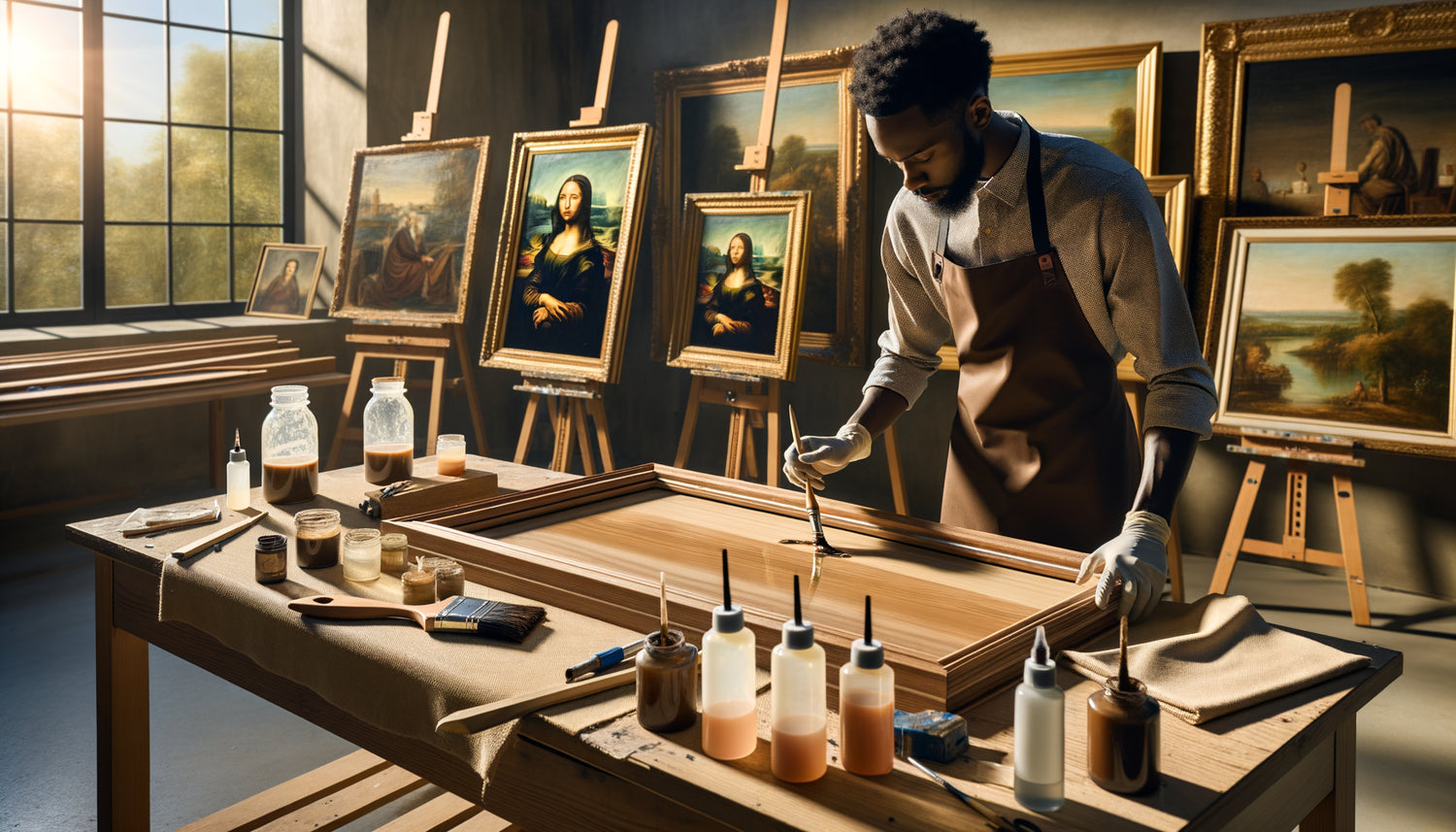
That morning, in my Parisian workshop where I have been restoring antique furniture for twenty-three years, a collector asked me this question that keeps coming up: "How do you treat this piece of furniture without damaging the paintings hanging just above it?" Her anxiety was palpable. She had inherited a Louis XV chest of drawers and owned an irreplaceable family artwork on the wall. Between water stain and alcohol stain, she didn't know which to choose. One mistake, and her paintings could be damaged by harmful vapors.
Here is what you need to know about staining without emissions near paintings: water stain offers almost total absence of toxic emissions, a gradual drying that preserves works of art, and an incomparable peace of mind in cultural spaces. Alcohol stain, although it dries faster, releases volatile fumes that can migrate to your paintings for several hours. The choice depends on your context, but one rule remains: near precious artworks, caution is never excessive.
You have probably already experienced this frustrating situation. A beautiful piece of furniture to enhance, works hanging nearby, and this constant worry: "Will the fumes reach my paintings?" You open the windows, you consult forums, you read labels anxiously. Every project becomes a source of stress rather than creative pleasure.
I reassure you immediately: understanding the characteristics of each stain transforms this anxiety into mastery. After two decades working in apartments where Picasso meets Matisse, I have developed infallible protocols. You will discover how to choose your stain according to your space, protect your works effectively, and carry out your decorative projects without any concern for your collections.
The deep nature of emissions: what really happens in the air
When I began my training with a master cabinetmaker in Le Marais, he taught me this fundamental truth: all stains release molecules into the atmosphere during drying. But not all molecules are equal.
The water stain works on a simple principle: pigments suspended in water that evaporate gradually. Imagine a light mist that slowly dissipates, leaving no aggressive chemical trace. The water evaporates naturally, carrying with it neutral humidity. Volatile organic compounds (VOCs) are practically absent. When I work with water stain near an antique engraving collection, I feel this peace of mind: the air remains breathable, almost unchanged.
Conversely, alcohol stain is based on volatile solvents – ethanol, isopropyl alcohol – which evaporate quickly releasing perceptible fumes. These vapors carry not only the solvent but also residues of pigments and additives. In a confined space, these molecules migrate, seeking surfaces to settle on. I have seen varnished paintings present a slight veil after a piece of furniture treated with alcohol dried in the same room for three days without adequate ventilation.
Exposure Time Factor
Alcohol stain dries in 15 to 30 minutes, releasing its emanations in a concentrated but brief way. Water stain takes 2 to 6 hours, diffusing a gentle humidity over an extended period. Paradoxically, this slowness becomes an asset: the emanations remain so light that they pose no threat to surrounding artworks, even over long exposure periods.
The scientific verdict: which stain really dries safely?
In my workshop, I installed a VOC detector after a minor incident – a client worried about their lithographs. The measurements were revealing.
During the application and drying of water stain, the detector displays values virtually identical to ambient levels. A few water particles, nothing more. The atmosphere remains neutral. Even applying three successive coats to a large Norman cabinet, the emanations never exceed the significant detection threshold. This is the reference solution near valuable canvases.
With alcohol stain, the detector immediately activates. Alcohol vapors saturate the space for the first thirty minutes, then gradually decrease. After two hours in a well-ventilated room, levels become acceptable again. But during those critical two hours, volatile molecules circulate freely, potentially settling on all exposed surfaces – including your canvases.
I have developed a simple rule: if my artworks remain in the room during treatment, I systematically choose water stain. If I can temporarily remove the canvases or work in an isolated space, alcohol stain becomes conceivable again for projects requiring rapid drying.

Real-world scenarios: when to favor each option
Last year, a gallery owner in the Haut-Marais entrusted me with the restoration of an 18th-century console installed under a Soulages. Impossible to move the artwork – insured for a considerable sum, complex wall fixing. I opted for a professional quality water stain. Application in three thin coats, natural drying over 48 hours with gentle ventilation. Result: a sublime patina, zero impact on the canvas. The gallery owner has since recommended my services to four collectors.
Conversely, for a piece of furniture in a separate workshop – without artworks nearby – I readily use alcohol stain when the client needs a quick turnaround. Express drying allows varnish and finishes to be applied on the same day. But I always move the furniture into the living space after 24 hours of complete ventilation, guaranteeing the total absence of volatile residues.
The particular case of multifunctional spaces
Many Parisian apartments combine a creative workshop, library and living room. Your library artworks coexist with your renovation projects. In these configurations, water stain becomes non-negotiable. It allows you to work without compromising your artistic environment, without constantly moving your collections.
I have equipped my own space in this way: my furniture undergoing restoration shares the workshop with my framed sketches and a few family oils. Water stain gives me this freedom to create without rigidly compartmentalizing my universe.
Protection protocols: beyond simply choosing a stain
Even with the safest stain, I always apply complementary measures. Protecting artworks is a sacred responsibility in my profession.
First rule: distance. I always install a buffer zone of at least two meters between the treated surface and exposed canvases. If space does not allow, I create a physical barrier – a non-fluffy cotton sheet suspended that blocks the migration of airborne particles.
Second principle: intelligent ventilation. No abrupt draft that would disperse emissions towards artworks, but a gentle circulation that directs vapors outwards. I open a window on the furniture side, I create an opposite air outlet, and I ensure that the canvases are outside this flow.
Third precaution: the schedule. With water stain, I launch my applications at the beginning of the day, allowing daytime drying with natural ventilation. In the evening, residual humidity is negligible. With alcohol stain – in the rare cases where I use it near artworks – I always wait for the initial vapors to have completely dissipated before closing the space.

Qualitative nuances: not all dyes are created equal
An important revelation from my years of practice: the quality of your dye dramatically influences the emanations.
Low-end water-based dyes sometimes contain additives – preservatives, wetting agents – that can release subtle odors. Nothing comparable to alcoholic solvents, but enough to be perceptible in a closed space. I have learned to select professional water-based dyes, formulated for sensitive environments. Their purified composition guarantees total olfactory neutrality.
With alcohol dyes, some modern formulations incorporate less volatile alcohols or odor-absorbing additives. These "low emission" versions remain more aggressive than water, but represent an acceptable compromise in contexts requiring speed and presence of immovable artworks – provided that ventilation protocols are strictly applied.
Personal olfactory test
Here is my protocol before each new product: I apply a sample to a piece of wood, let it dry in a closed jar for an hour, then open and evaluate. If the smell makes me wrinkle my nose, it will never approach my canvases. This rudimentary test has saved me from many disappointments with supposedly "odorless" products whose subtle emanations could, over time, affect sensitive works.
The sensory experience: living with your choices
Beyond the technical arguments, there is this dimension that only experience teaches: the psychological comfort of working near your treasures.
When I apply water-based dye in my workshop-living room, I remain relaxed. I can admire my canvases while the wood slowly absorbs its new hue. The atmosphere remains pleasant, conducive to contemplation. This serenity influences the quality of my work – my gestures are more precise, my attention more sustained.
The few times I have used alcohol dye near artworks (in exceptional circumstances, with maximum protection), I have felt this constant tension. The smell constantly reminds me of the risk, my gaze drifts towards the canvases to check that no visible vapor approaches them. This anxiety hinders creativity.
For a passionate enthusiast who transforms their interior while preserving their personal collection, this emotional dimension counts as much as the chemical properties. Your home must remain a sanctuary where creation and conservation coexist harmoniously.
Your artistic universe deserves uncompromising protection
Discover our exclusive collection of Library paintings that will enhance your creative spaces while harmonizing with your restoration projects. Works designed to inspire without ever fearing the technical constraints of your creative passions.
Your new practice begins now
You are now equipped to transform your furniture without ever jeopardizing your precious works. Water-based stain emerges as the natural guardian of your collections, offering that absolute peace of mind that every art lover seeks. It dries without significant emissions, preserves the atmosphere of your cultural spaces, and allows you to create in complete serenity.
The alcohol-based stain retains its place in specific contexts – isolated projects, tight deadlines, spaces temporarily emptied of their works. But near your canvases, it requires a vigilance that water-based stain simply makes unnecessary.
Start with a small project: an antique chair to restore in your library. Choose a quality water-based stain, apply it on a clear morning, windows open. Observe how the atmosphere remains neutral, how your paintings seem to watch over your work without any threat looming over them. You will then instinctively understand what two decades of practice have taught me: the best stain is the one that makes you forget its emissions so you can focus only on the beauty you create.
Your hands, your furniture, your paintings – a whole creative ecosystem that deserves informed choices. You now possess them.
Frequently Asked Questions
Does water-based stain really offer the same depth of color as alcohol-based stain?
Absolutely, and this misconception still saddens me. Modern formulations of water-based stain beautifully rival alcohol in terms of chromatic richness. I have obtained deep acajous, sumptuous golden oaks, intense ebony only with professional water-based stains. The difference lies in the technique: water-based stain penetrates more slowly, which allows for better control of nuances. You apply successive layers, gradually building the desired depth. This method offers even more subtlety than alcohol which quickly saturates the wood. For your projects near precious canvases, you therefore sacrifice nothing aesthetically by choosing the safety of water. It is precisely this nonexistent compromise that makes water-based stain so valuable: maximum protection without sacrificing the beauty of the final result.
How long should I wait before replacing my artworks after using alcohol ink in a room?
If you absolutely must use alcohol ink, follow this strict schedule that I apply in exceptional situations: minimum 24 hours of intensive ventilation after the last application, windows open at all times. Then, perform the olfactory test: enter the room after closing it for an hour. If any smell of alcohol persists, extend the ventilation by another 12 hours. Under optimal conditions – mild temperature, effective cross-ventilation – 48 hours is generally sufficient. But I have already waited 72 hours in a poorly ventilated apartment in the middle of winter. Patience becomes your best ally. Remember that volatile molecules continue to escape from the wood long after the surface seems dry. Your artworks have waited years in your collection; they can wait a few more days to return to a perfectly healthy environment. Never rush this crucial step.
Are there wood species that react better to one or the other dye in terms of emissions?
Excellent question revealing a fine understanding of the subject. Indeed, some woods influence emissions. Very resinous woods – pine, spruce – release their own volatile compounds which mix with the fumes of alcohol ink, creating a more present and lasting olfactory cocktail. On these species, water-based dye becomes doubly relevant near artworks: it avoids activating these resins with aggressive solvents. Dense and stable woods – oak, walnut, cherry – perform admirably with both types of dye, but even on these noble species, water-based dye generates less atmospheric disturbance. I have noticed that beech, particularly porous, quickly absorbs the water-based dye minimizing residual evaporation, making it an ideal candidate for projects in the presence of artworks. Overall, no wood justifies risking your artworks with alcohol when water offers equivalent results and maximum safety.


