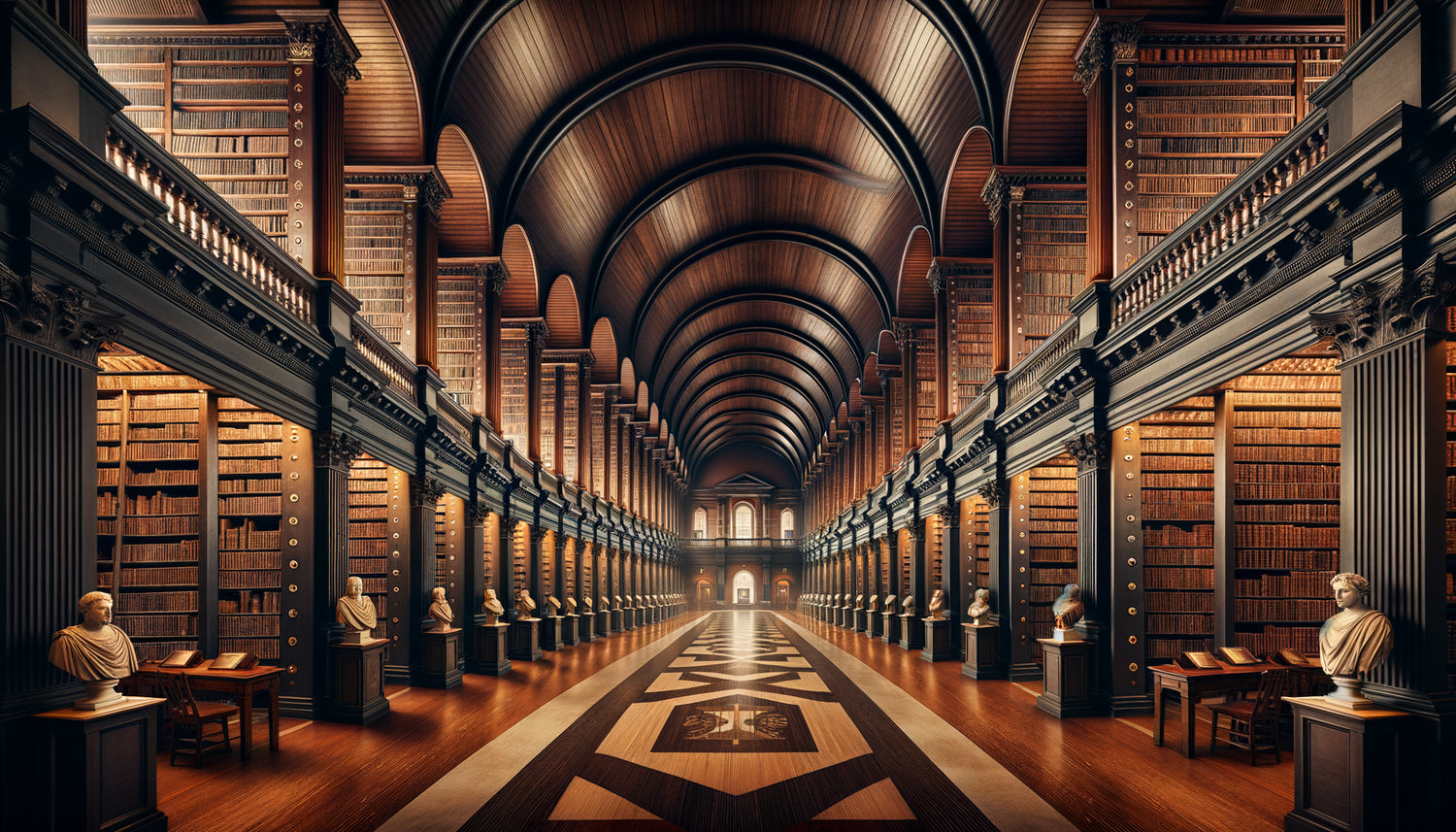
Imagine stepping into a long hall measuring 65 meters in length, where your gaze is immediately drawn to the sky. Thousands of antique volumes line the walls up to a dizzying height, but it's the celestial vault above you that takes your breath away. This sensation of vertical infinity is not accidental: it’s the result of a bold architectural transformation that metamorphosed Trinity College Dublin’s Long Room in the 19th century. Here's what this monumental ceiling brings: it creates theatrical verticality that enhances the height of the hall, it establishes a secular cathedral-like atmosphere where knowledge becomes sacred, and it resolves a major technical challenge while offering an unforgettable aesthetic experience. Many admire historic libraries without understanding why some mark the spirit more than others. Frustration often comes from this misunderstanding: why do certain spaces transport us while others leave us indifferent? Rest assured, this magic is not mysterious. It rests on precise architectural choices, and Trinity College’s ceiling is a perfect illustration. I invite you to discover the fascinating story of this transformation and the timeless principles that make this space so powerful today.
The origin of an architectural metamorphosis
When architect Thomas Burgh designs the Long Room in 1712, he imagines a space that is elegant but relatively restrained: a flat wooden ceiling topping a single gallery lined with bookshelves. For over a century, this configuration is sufficient to accommodate the growing collection of manuscripts and works. But by the mid-19th century, Trinity College Dublin’s library is literally suffocating under the weight of its acquisitions. Volumes accumulate to the point of saturating every available centimeter.
It was in 1858 that architects Deane and Woodward undertook a radical transformation. Rather than building an annex, they chose a bold solution: to raise the height of the hall by adding an upper tier of bookshelves and, above all, replacing the flat ceiling with a majestic barrel vault. This arched structure, entirely made of Irish oak, not only increases storage capacity. It completely redefines the spatial experience of the library.
The painted vault that crowns the Long Room today is therefore not a superfluous ornament added out of vanity. It’s the result of a pragmatic necessity transformed into a monumental architectural gesture. The architects understood that by modifying the geometry of the ceiling, they could simultaneously solve a functional problem and create an atmosphere conducive to intellectual elevation.
Verticality as the language of the sacred
Why a vault rather than a simple ceiling raise? The answer lies in our ancestral perception of space. From medieval cathedrals to contemporary skyscrapers, verticality has always been associated with transcendence, an aspiration towards something that surpasses us. By adopting a barrel vault, the architects of Trinity College consciously borrowed from religious architectural vocabulary.
This reference is not insignificant. In the Victorian era, the knowledge and accumulated wisdom in libraries represent a form of secular religion. Books become the new relics, and the library, the modern temple. The monumental ceiling of Trinity College functions exactly like a church vault: it directs the gaze upwards, creating a feeling of spiritual and intellectual elevation.
The sensory experience is immediate. When you look up in the Long Room, the gentle curve of the oak vault envelops you while also drawing you towards the sky. This curved geometry contrasts with the straight lines of the bookshelves, creating dynamic tension that keeps the eye constantly moving. The painted ceiling does not overlook the room: it magnifies it, transforms it.

Irish oak: materiality and light
The monumental dimension of the Trinity College ceiling is due not only to its shape, but also to its material. The choice of Irish oak to create this massive vault meets several requirements. First, a question of structural strength: supporting such a cantilevered weight requires dense and stable wood. Then, an aesthetic dimension: oak, with its honey and amber hues, captures and reflects natural light in a way that pine or beech could not equal.
Over the decades, this wood has developed a deep patina which enriches the luminous quality of the library. The veins of the oak, visible in each plank of the vault, create an organic pattern that softens the monumentality of the whole. One might fear that such an imposing ceiling would crush the space, but the opposite happens: the warmth of the wood and its living texture humanize the structure.
This materiality is constantly interacting with natural light that penetrates through the tall windows. The painted ceiling changes appearance depending on the time of day, from a bright golden hue in the morning to coppery tones in the late afternoon. This variability transforms each visit into a unique experience, as if the library breathes in rhythm with the Irish sun.
How a ceiling transforms acoustics and atmosphere
An often-neglected aspect of monumental ceilings is their acoustic impact. In a library, silence is never absolute: there's always the rustle of a page turned, the murmur of a librarian, the creak of an old parquet floor. The barrel vault of Trinity College profoundly alters how these sounds propagate.
Unlike a flat ceiling that reflects sound directly and sometimes aggressively, a curved vault diffuses sound waves in a softer, more enveloping way. The result? A muffled atmosphere where noises don't disappear but soften, creating what one might call a "lived-in silence." This particular acoustic quality reinforces the feeling of sanctuary that the Long Room provides.
The psychological effect is considerable. In a space with a low ceiling, even if spacious horizontally, one feels a certain compression. The monumental ceiling of Trinity College produces the opposite effect: a sensation of expansion, almost of breathing. This generous vertical volume naturally induces respectful, contemplative behavior. One speaks less loudly, walks more slowly, takes the time to observe.

Timeless principles to remember for your spaces
What can this exceptional ceiling teach us for our own interiors? Obviously, we don't all have 65 meters in length or the possibility of installing a solid oak vault. But the architectural principles that make this ceiling so powerful are perfectly transferable to a domestic scale.
First lesson: verticality creates emotion. In a room dedicated to reading or concentration, accentuating the height – even modestly – radically changes the perception of space. A simple painting trick between walls and ceiling can create an illusion of height: walls that are slightly darker attract the eye to a light ceiling that seems to recede.
Second principle: material warmth humanizes the monumental. Wood remains unmatched for creating this sensory connection. Exposed beams, even in a contemporary interior, introduce this organic texture that prevents a generous volume from becoming cold or intimidating.
Third lesson: the ceiling is never neutral. Too often neglected in decoration, it represents the fifth surface of any room. Treating it with care – whether through color, material or structure – multiplies the emotional impact of a space. The library of Trinity College Dublin reminds us that looking up is not just a physical movement: it's an invitation to elevation.
The Victorian legacy in our contemporary libraries
The 1858 intervention on the Long Room is part of a wider 19th-century movement: the sacralization of knowledge through architecture. This period saw the flourishing of monumental public libraries throughout Europe, each seeking to impress and inspire. The Trinity College ceiling becomes a model, a reference that influences dozens of similar projects.
What makes this monumental ceiling particularly remarkable is its ability to remain relevant today. While many Victorian spaces seem overloaded or pompous, the Long Room retains timeless elegance. Its limited palette – natural oak, white marble busts, old binding leather – and its pure geometry avoid the pitfall of decoration to achieve the architectural.
For our personal libraries, this legacy translates into a particular attention to the balance between functionality and emotion. An effective reading space is not only one where books are accessible, but one where you want to linger, look up between chapters, feel that you participate in something beyond yourself.
Transform your reading space into a personal sanctuary
Discover our exclusive collection of Library wall art that captures this magic of great literary spaces and brings elevation and inspiration to your walls.
Creating Your Own Cathedral of Knowledge
The ultimate lesson from the monumental ceiling of Trinity College Dublin goes beyond architecture: it touches on our intimate relationship with the spaces that house our intellectual life. This ceiling reminds us that the physical environment profoundly influences our ability to think, concentrate and marvel.
You don't need a 65-meter room to create this feeling of elevation. A carefully considered reading corner, where the eye can escape towards generous height, where light plays with warm materials, where every decorative element invites contemplation rather than distraction – that’s how you transpose the spirit of Trinity College into your daily life.
Start by observing your ceiling with a new eye. Is it invisible, purely functional? Or does it actively participate in the atmosphere of the room? A simple modification – a softer hue, the addition of discreet moldings, the installation of indirect lighting that reveals it – can radically transform your perception of space. The painted ceiling of the Long Room teaches us that the extraordinary often arises from attention paid to where no one usually looks.
The Trinity College Dublin library, with its dizzying ceiling, remains a pilgrimage for all lovers of books and architecture. But its true legacy is not only found within its walls: it lives in every space we design with the ambition of making knowledge a transcendent experience. Look up, always. That's where inspiration begins.
Frequently Asked Questions
When was the current Trinity College ceiling installed?
The monumental ceiling we admire today was created between 1858 and 1860, during a vast renovation campaign led by architects Deane and Woodward. Before this major transformation, the Long Room had a much more modest flat ceiling, installed during initial construction in 1712. This 19th-century metamorphosis initially aimed to solve a practical problem – the lack of storage space for the growing collection – but it profoundly redefined the library's visual identity. The addition of the barrel vault and upper shelving doubled the library’s capacity, as well as created the cathedral-like atmosphere that is now world-renowned. This Victorian intervention perfectly illustrates how a functional constraint can become an opportunity to create something exceptional.
Can this sense of height be reproduced in an ordinary home?
Absolutely, and you don't need cathedral ceilings to achieve it! The secret lies in several visual tricks inspired by the Trinity College ceiling. Firstly, use color strategically: painting the ceiling a lighter shade than the walls creates an illusion of distance and height. Secondly, incorporate vertical elements that naturally guide the eye upwards – a tall bookcase, frames arranged in columns, curtains hung close to the ceiling. Thirdly, exploit lighting: wall lights directed towards the ceiling or indirect lighting create a sense of elevation, even in a room with modest dimensions. Finally, limit visual clutter at eye level so that the vertical volume becomes the star of the space. The monumental spirit of Trinity College translates into visual hierarchy and intention, not necessarily in actual dimensions.
Why use wood rather than plaster for a library ceiling?
The choice of oak for the Trinity College vault responds to several imperatives that remain relevant today. First, a structural question: wood offers an exceptional strength-to-weight ratio, crucial for a 12-meter span without intermediate support. But beyond technique, wood brings an irreplaceable sensory quality in a space dedicated to reading and study. Its warm texture and natural variations create an organic connection that softens the monumentality. Wood also has superior acoustic properties to plaster, absorbing certain frequencies while diffusing sounds more harmoniously. In a library, this contributes to that muffled atmosphere so conducive to concentration. Finally, wood ages with elegance: its patina is enriched over time, adding visual depth. For your own spaces, even a simple addition of decorative beams or wainscoting on the ceiling radically transforms the ambiance, creating that warmth that white plaster, however perfect it may be technically, cannot equal.