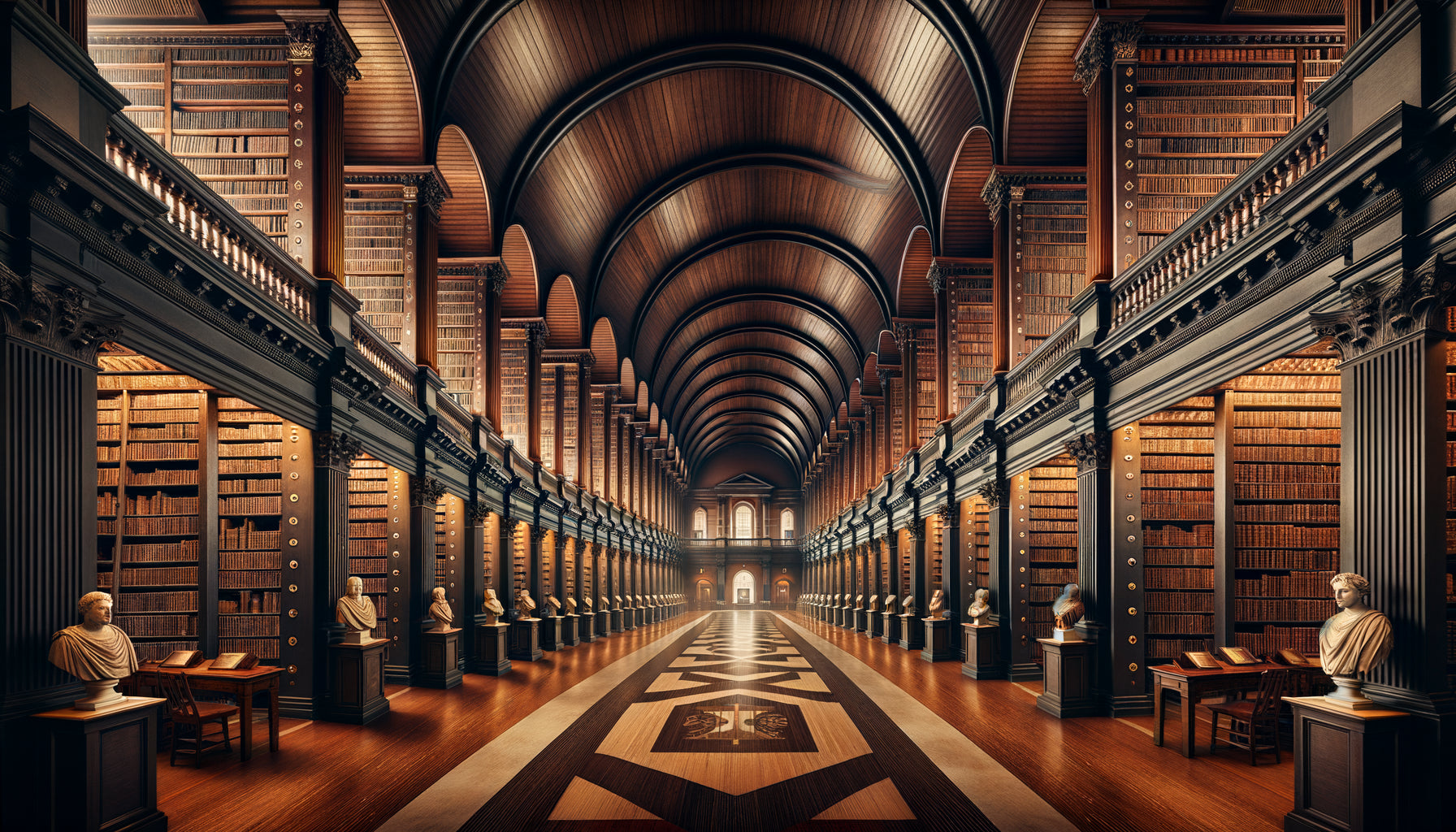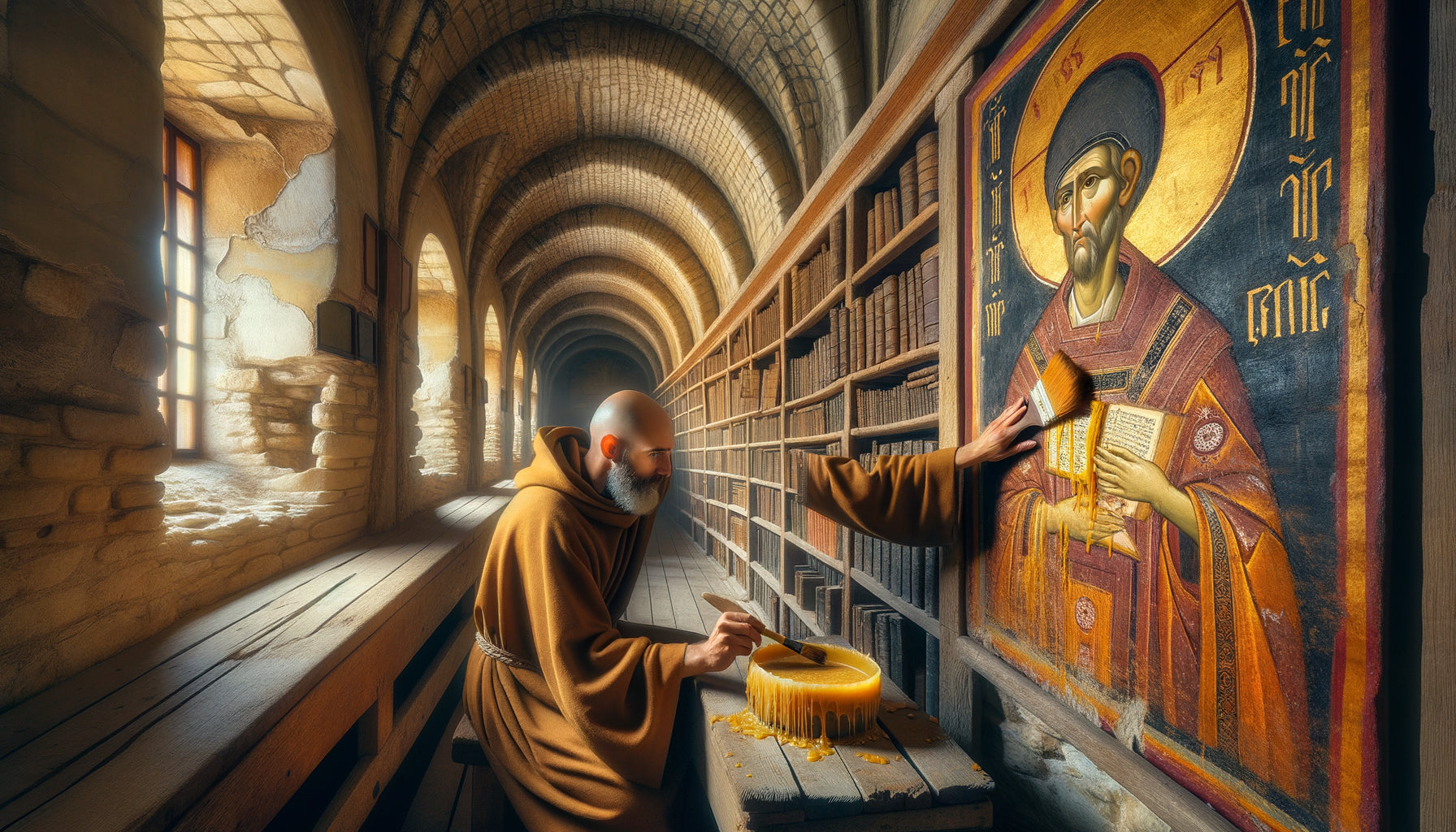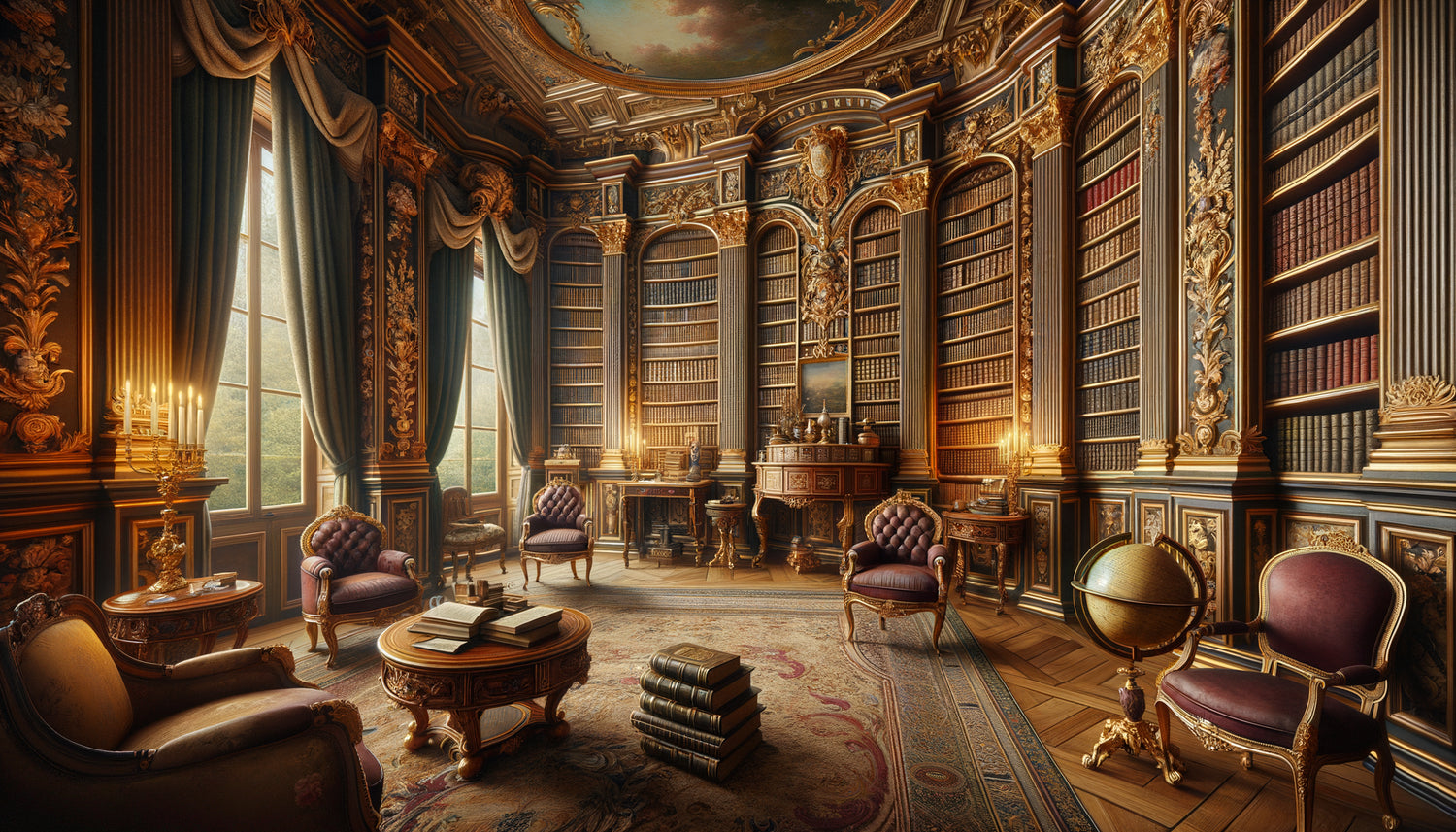
Imagine stepping through the door of a Parisian reading room in 1760. The space is barely ten square meters, yet your eyes scan what seems like an endless library. Rows of books climb shelves that stretch towards a cathedral ceiling. Marble columns frame alcoves that don't exist. This visual magic is not by chance: it is the art of trompe-l'œil, this pictorial technique that literally revolutionized the layout of private libraries during the Enlightenment.
Here's what trompe-l'œil brought to 18th-century libraries: a spectacular visual expansion of restricted spaces, a cultural affirmation of the intellectual status of owners, and an ingenious aesthetic solution to compensate for the lack of real volumes in emerging collections.
For that was the problem facing book lovers at the time: owning a library had become an indispensable social marker, but few had enough space or a sufficient collection to rival the great aristocratic libraries. How to assert one's scholarship when one only possesses two hundred books and a small room?
Fortunately, 18th-century decorators found a brilliant answer to this frustration. Thanks to trompe-l'œil paintings directly on the walls, small private libraries could now visually compete with the most prestigious, while creating atmospheres conducive to reading and reflection. Let us discover together how this pictorial illusion transformed the art of living with books.
When the eye fabricates space: the birth of an architectural illusion
At the beginning of the 18th century, architectural trompe-l'œil are not new. Inherited from the Italian Renaissance, they already adorn palaces and churches. But their application to private libraries marks a turning point. Parisian decorators such as Claude III Audran or Jean-Baptiste Oudry quickly realize that these intimate spaces offer an exceptional playground.
The technique relies on perfect mastery of linear perspective. On a flat wall, the artist paints shelves in trompe-l'œil that seem to extend into the depth. The edges of the books are reproduced with obsessive meticulousness: gold tooling, calligraphed titles, patinated leathers. Some artists even add shadows that change according to the natural lighting of the room, reinforcing the illusion at every hour of the day.
In a Parisian library of twenty square meters, a well-executed trompe-l'œil could visually double the perceived space. The walls opened onto fictitious galleries, imaginary walkways where thousands of painted volumes were aligned. The owner thus gained a dream library, without having to knock down a single wall or buy a single additional book.
The painted library: an illusory but eloquent inventory
But the trompe-l'oeil libraries were not mere abstract decorations. They told a story, that of the owner’s scholarship. Painters consulted their clients to compose fictitious libraries reflecting their intellectual interests. The titles of great authors of the time appeared on the painted shelves: Voltaire, Rousseau, Diderot's Encyclopedia.
Some trompe-l'oeil went further by integrating personal elements. A trompe-l'oeil globe resting on a fictitious console, a portrait of a philosopher slipped between two painted books, or even rolled manuscripts that seemed to protrude from shelves. These details transformed the library into a kind of intellectual self-portrait.
In the private mansions of Le Marais, one can still find remarkable examples of these illusionist libraries. The trained eye can distinguish real books from fakes, but the overall effect remains striking. The visitor enters a universe where culture literally overflows from the walls, where every surface becomes a potential receptacle for knowledge.
The visual codes of scholarship
Artists of the 18th century had developed a true visual language for these trompe-l'oeil. Large format books, supposedly precious folios, occupied the lower shelves. Calfskin brown volumes evoked ancient classics, while red and green bindings indicated contemporary works. This visual hierarchy was never random: it reflected the intellectual classification of the time.

The illusion at the service of comfort: creating an atmosphere conducive to reading
Beyond visual expansion, trompe-l'oeil libraries responded to a subtle psychological function. They created an atmosphere of studious intimacy, even in the most modest spaces. By surrounding themselves with painted books, the reader felt immersed in a sanctuary of knowledge, protected from the outside world.
The colors used contributed to this ambiance. Painters favored warm tones: deep browns of leather bindings, aged golds of gilding, dark greens of morocco bindings. These shades created a soothing visual cocoon, which contrasted with the agitation of neighboring living rooms. The library, even tiny, became a mental refuge.
Some decorators incorporated elements of fictitious architecture to reinforce this sense of recession. Painted pilasters framed the real shelves, creating a rhythmic structure. Trompe-l'œil arcades suggested imaginary reading nooks. Sometimes, a painted window opened onto a monastic library landscape, evoking medieval scholarly tradition.
In these transformed small reading rooms, owners could finally live their fantasy of erudition. Seated in his armchair, surrounded by thousands of real and painted books, the 18th-century reader experienced an early form of augmented reality, where illusion supported imagination.
The secret techniques of master illusionists
Creating a convincing trompe-l'œil required exceptional skills. Painters had to first study the actual architecture of the room: ceiling height, light sources, vanishing lines. A poorly calculated trompe-l'œil created an unpleasant visual dissonance instead of a harmonious illusion.
Wall preparation was crucial. Artisans applied several layers of smoothed plaster to obtain a perfectly flat surface. Any irregularity would betray the illusion. Then came the preparatory drawing work: perspective lines were traced with string, calculated from the ideal point of view of the seated reader.
For the books themselves, painters used a technique of successive glazes. A first layer applied the base tones, then translucent glazes created the depth of the bindings. Highlights, applied with a fine brush, brought the gold leaf to life. Some artists even added real materials: mica powder to simulate the sparkle of gold, localized varnishes to imitate the luster of leather.
The perfect point of view
Every effective trompe-l'œil has an optimal viewing angle, the one from which the illusion works perfectly. In private libraries, this point generally corresponded to the position of the reading chair or desk. Painters calculated their perspectives from this precise position, sacrificing coherence when viewed from other angles to maximize the effect from the owner's seat.

When illusion becomes reality: contemporary accounts
The writings of the 18th century are full of anecdotes about these magic libraries. In his Memoirs, Baron von Gleichen recounts how, visiting the library of a Parisian magistrate, he reached out to a volume that seemed interesting, only to realize he was touching a painted wall. The host, amused, revealed that half of his library was fictitious.
This deliberate confusion was part of the fun. Owners of trompe-l'oeil libraries organized small parlor games where guests had to distinguish real books from fakes. These intellectual entertainments reflected the spirit of the age: a mixture of fascination with optics, a love of artifice and a taste for visual puzzles.
Interior architects of the time explicitly recommended these techniques. In his 1752 treatise, architect Jacques-François Blondel devotes an entire chapter to painted decorations for libraries. He explains how a well-thought-out trompe-l'oeil can transform a simple wardrobe into a study worthy of a scholar.
The contemporary legacy: reinventing the illusion
Today, the art of library trompe-l'oeil is experiencing an unexpected revival. Decorators are rediscovering these techniques to furnish constrained urban spaces. In a 25 square meter Parisian studio, a wall adorned with a trompe-l'oeil library can create illusory depth that completely changes the perception of space.
Techniques have evolved. Traditional brushes are now complemented by high-definition digital prints on wallpaper. But the principle remains the same: use pictorial illusion to visually enrich a real, limited space. Some designers even combine real and fake books, creating hybrid compositions where the boundary becomes deliberately blurred.
This resurgence is explained by our contemporary relationship with space. In large cities where every square meter counts, visual solutions inherited from the 18th century are once again relevant. Rather than physically expanding, we expand perceptually. The eye, cleverly deceived, offers the mind the space it needs.
Want to capture the magic of illusionist libraries in your home?
Discover our exclusive collection of Library paintings that capture the timeless elegance of 18th century reading rooms and instantly create an atmosphere of refined scholarship.
Composing with illusion: your reinvented library
18th century trompe-l’oeil paintings teach us a valuable lesson: space is not just about square meters, but perception. These small private libraries, physically modest yet visually generous, proved that one could inhabit a mental palace in a room of a few square meters.
Today, whether you live in a contemporary apartment or an old house, you can draw inspiration from this ingenuity. A wall transformed into a painted library, a few real shelves complemented by illusionistic perspectives, are enough to create this immersive effect in the world of books. The important thing is not the quantity of volumes owned, but the atmosphere created.
Start by observing your current reading space. Identify the wall that would benefit most from a visual extension. Imagine how a subtle trompe-l’oeil could dialogue with your real books. And remember that the most beautiful libraries are those that invite inner journeys, whether they are real or painted.
Frequently Asked Questions about Library Trompe-l’oeils
How to recognize an authentic 18th century library trompe-l’oeil?
An authentic 18th century trompe-l’oeil has several distinctive characteristics. First, the painting is done directly on the wall or on a marouflaged canvas, never on a movable panel. The pigments used are natural: earths, ochres, true ultramarine, which gives a characteristic palette to the slightly faded tones. The titles of the painted books correspond to works actually published before 1800, and their arrangement respects the intellectual classification of the time. Finally, perspective is calculated from a single point of view, generally the position of an armchair or desk. If you observe the trompe-l’oeil from different angles, you will notice that the illusion works perfectly from a privileged position and distorts slightly elsewhere. Heritage restorers can also analyze the chemical composition of the pigments and the laying technique to precisely date the work. If you visit an old private hotel and its libraries seem disproportionate to the size of the rooms, there is a good chance that part of it is trompe-l’oeil.
Can a library trompe-l’oeil be integrated into a contemporary decor?
Absolutely, and it’s even a growing trend in interior decoration. A contemporary bookshelf illusion brings remarkable visual depth to small urban spaces while creating a refined cultural ambiance. The trick is to adapt the style to your interior: for a minimalist decor, opt for a sleek illusion depicting shelves with simple lines and books with understated bindings. In an eclectic interior, you can dare to use a baroque trompe-l'œil inspired by the 18th century to create a striking contrast. Modern techniques offer several options: mural painting created by a specialist artist for a unique and custom rendering, panoramic wallpaper in trompe-l'œil for easy and reversible installation, or high-definition digital printing on wall canvas for an interesting value-for-money compromise. The key is to play with the dialogue between real books and fake ones: place some real shelves in front of the illusion to create a progressive depth effect that pleasantly deceives the eye. This technique works particularly well in home offices, reading corners, or even narrow hallways which gain a sense of space.
Why were bookshelf illusions particularly popular in the 18th century?
The 18th century saw several factors converge that explain the enthusiasm for bookshelf illusions. First, it was the Age of Enlightenment: owning a library became an essential social marker for the rising bourgeoisie and petty nobility who wanted to assert their intellectual status. But building a real significant library cost a fortune, and space was often lacking in urban townhouses. The illusion offered an elegant solution: displaying the outward signs of erudition without the colossal investment. Secondly, this period saw major advances in understanding optics and perspective, making visual illusions particularly fascinating for the scientific spirit of the time. Intellectual salons passionately discussed the mechanisms of visual perception. Finally, the rocaille and then neoclassical aesthetics valued decorative refinement and assumed artifice: a beautiful pictorial lie was considered an artistic feat rather than a vulgar deception. Bookshelf illusions perfectly embodied this spirit: they were both a sophisticated ornament, a demonstration of technical mastery, and a cultural statement. They transformed real constraints into decorative opportunities, a philosophy very characteristic of this century of ingenuity.