

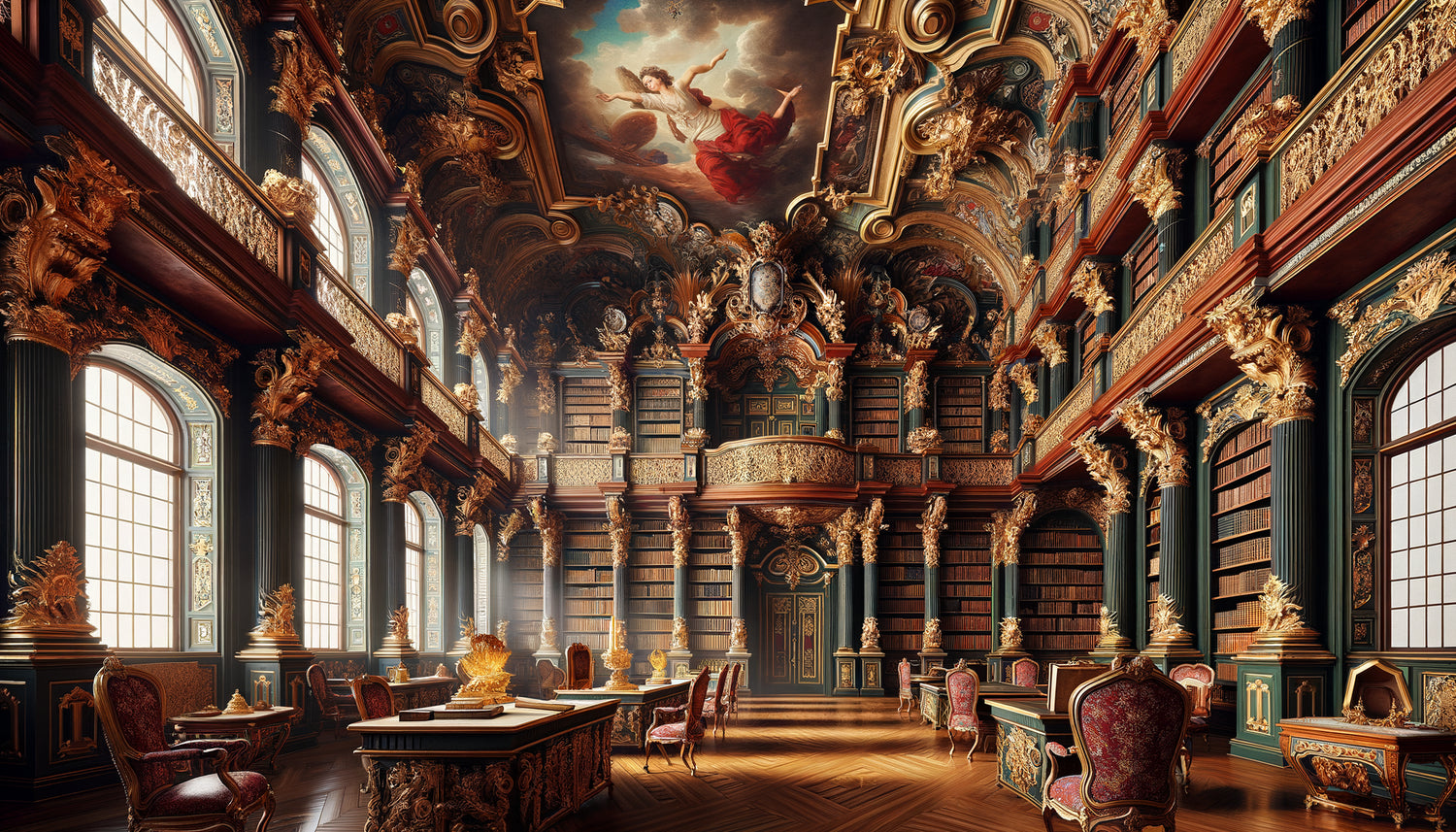
Imagine stepping through a door and being instantly transported to a frozen opera house, where every column, every vault, every binding seems staged for your dazzled gaze. The Joanina Library in Coimbra doesn't just house books: it celebrates them as sacred treasures, within a decor of breathtaking visual power. Sculpted woodwork, dizzying trompe-l'oeil, flamboyant gilding: everything here is pure spectacle. But why such extravagance? Why transform a place of study into a profane cathedral?
Here’s what this library reveals: Portuguese Baroque architecture in the service of a political message, the assertion of royal power through aesthetics, and the fusion between artistic beauty and intellectual function. This theatrical decor is not a whim: it's a calculated staging, a visual manifesto, a declaration of power engraved in wood and gold.
We often think that libraries should be sober, discreet, almost austere. It’s hard to imagine justifying so much splendor for storing books. This confusion comes from a modern vision where the book has become commonplace. But in the 18th century, possessing a monumental library was as much a political act as an intellectual one.
Rest assured: understanding this Joanina Library means grasping the codes of an era when art was never free. Where every detail carried a message. Where decor was a language in its own right. Let's delve into the backstage of this Baroque masterpiece to decode its assumed theatricality.
A Royal Patron Facing a Rival Europe
When John V of Portugal commissions the construction of the Joanina Library in 1717, the kingdom is experiencing a golden age, literally. Brazilian gold floods Lisbon, and the sovereign seeks to assert the cultural prestige of Portugal against European powers. In Versailles, Louis XIV has transformed architecture into an instrument of glory. In Vienna, the Habsburgs compete in magnificence. John V wants his Portuguese response.
The University of Coimbra's library becomes this manifesto. Every element of the theatrical decor proclaims: Portugal possesses wealth, refinement, and intellectual grandeur. Foreign ambassadors who visit Coimbra must leave impressed. The message is clear: this kingdom masters both the art of war and that of letters.
This European rivalry explains the scale of the project. It's not simply a beautiful library, but a demonstration of cultural strength. Baroque decor becomes a diplomatic weapon, an instrument of soft power ahead of its time. The gilding is not superfluous luxury: it’s Brazilian gold transformed into tangible prestige.
Three Rooms Like Three Acts of a Dramatic Play
Entering the Joanina Library is like following a theatrical progression perfectly orchestrated. The anonymous architect designed three successive rooms, each coded by a dominant color: green, red, gold. This tripartite division is not arbitrary. It evokes the three acts of a classical tragedy, with an increasing dramatic intensity.
The first room, green and relatively subdued, prepares the gaze. The Brazilian cherry wood paneling displays its ordered geometry. Reading tables invite study. But already, gold leaf infiltrates, foreshadowing what is to come. It's the exhibition, the gradual entry into another world.
The red room intensifies the spectacle. Bordeaux lacquers and golds multiply. Shelves climb to dizzying heights. Wooden ladders become stage props. The visitor feels the space concentrating, wealth accumulating. This is the development, the dramatic tension that sets in.
The third room explodes in a golden apotheosis. Here, the decor reaches its climax. Trompe-l'œil ceiling paintings open the gaze to an imaginary sky. The monumental portrait of Jean V dominates the scene like a tutelary deity. This is the climax, the final revelation: this library is a temple erected to the glory of royal knowledge.
Trompe-l'œil as Baroque Machinery
On the vaults of the Joanina Library, trompe-l'œil frescoes by several artists create a perfect illusion: the ceilings seem to open onto infinity. Painted balustrades suggest upper galleries. Allegorical figures observe readers from fictitious heights. This is exactly the technique used in Baroque theaters to create depth on a flat stage.
This visual machinery transforms the reading experience into a performance. One does not simply consult a book: one becomes an actor in a grandiose staging. The theatrical decor envelops the visitor, constantly reminding him that he is in an extraordinary place, full of symbolic meanings.

Gold, the star material of Portuguese Baroque
Visiting the Joanina Library is literally swimming in gold. More than 60 kilos of gold leaf cover the sculpted paneling. This massive use of precious metal is not just a display of wealth: it's an aesthetic code specific to Portuguese Baroque, influenced by the talhas douradas, these gilded altarpieces that adorn the country's churches.
In churches, gold symbolizes the divine presence, materialized celestial light. By transposing this vocabulary into a library, Jean V performs a fascinating transfer: knowledge becomes sacred, knowledge becomes divine. The theatrical setting borrows its codes from the sacred to elevate the book to the rank of relic.
This gilding also transforms natural light. Narrow windows let in rays of light that bounce off the gilded surfaces, creating changing effects depending on the time of day. The library becomes a living space, vibrant, almost organic. Each visit offers a different spectacle, like each theatrical performance differs from the previous one.
Sculptures that tell a story of knowledge
If you look up in the Joanina Library, you discover an entire population. Chubby putti manipulate scientific instruments. Allegorical figures embody intellectual virtues. Floral and animal motifs climb along the columns. Each sculpture participates in the theatrical setting by telling a fragment of the history of human knowledge.
These sculpted characters are not decorative: they are narrative. They form a coherent iconographic program, visually explaining what a royal library represents. Wisdom borders on Justice, Science dialogues with Theology. It is a visual encyclopedia engraved in precious wood, accessible even to illiterate visitors.
This narrative dimension reinforces the theatrical effect. As in a baroque opera, where costumes and sets tell as much as the words, the library unfolds an autonomous visual discourse. One can "read" the space without opening a single book, follow a story sculpted on the gilded walls.
Royal coat of arms in the absolute spotlight
In the center of the last room, it is impossible to miss the gigantic coat of arms of Jean V. They occupy a central position, like a heraldic sun around which everything else gravitates. This massive presence of the royal coat of arms recalls that the Joanina Library is not a neutral space: it is a place marked, possessed, dominated by the figure of the enlightened monarch.
The theatrical setting finds its ultimate meaning here: to stage power. Each reader who enters becomes a spectator of a political message. Each book consulted is under the symbolic gaze of the king. Baroque beauty serves a project of gentle, seductive, irresistible domination.

A functional scenography beyond aesthetics
But behind this flamboyant theatricality lies a remarkable practical intelligence. Exotic woodwork is not only beautiful: it naturally regulates humidity, protecting the precious works. High ceilings create an air circulation favorable to conservation. Narrow windows limit exposure to destructive light.
Even more surprisingly: the Joanina library houses a colony of bats that, at night, hunt insects threatening the books. This natural protection system has been consciously preserved. Every evening, after closing, the tables are covered with leather covers to protect them from droppings. The theatrical decor coexists with pragmatic ecology.
This fusion between beauty and utility characterizes Portuguese Baroque at its best. The library never sacrifices function on the altar of aesthetics. On the contrary, it demonstrates that magnificence and efficiency can harmonize. The visual spectacle serves the book, does not betray it.
A model that still inspires today
Centuries after its construction, the Joanina library continues to influence architects and decorators. Its chromatic boldness inspires contemporary palettes. Its dramatic management of height influences modern lofts. Its use of gilding as a luminous accent is found in high-end interior design.
This aesthetic longevity proves that theatrical decor, far from being dated, touches something universal in our relationship with space. We need places that elevate us, that transform everyday gestures into ceremonies. A domestic library can draw inspiration from this lesson: create a space where consulting a book becomes an act full of meaning.
The heritage professionals who restore the library scrupulously respect its original integrity. Each intervention preserves the Baroque palette, ancient gilding techniques, chromatic balances. It is recognizing that this decor constitutes a total masterpiece, inseparable from its function.
Inspired by the magic of historic libraries?
Discover our exclusive collection of Library paintings that capture the enchanting atmosphere of the great temples of knowledge to sublimate your interior.
Create your own domestic theatricality
You don't need to own 60,000 ancient books to create a theatrical reading space at home. The lesson of the Joanina library is elsewhere: in the courage to assume decorative intensity, in the willingness to make a reading corner a unique place, in the art of mixing beauty and function.
Start by identifying your signature color. The library uses green, red, gold: which palette resonates with your personality? Then, think vertically. Shelves that rise to the ceiling create that cathedral impression characteristic of grand libraries. Add indirect light sources that play with surfaces, creating moving shadows.
Don't be afraid of golden accents. A few frames, a brass reading lamp, slices of antique books: these warm touches are enough to evoke Baroque splendor without falling into overload. The domestic theatrical decor relies on suggestion, evocation, never literal copying.
Finally, integrate personal narrative elements. Just as the Coimbra sculptures tell the story of knowledge, your objects should tell your story. A world map of travels, a thematic collection, framed photographs: these details transform a reading corner into an autobiographical scene.
A visual testament to the power of books
Ultimately, if the Joanina library displays such a theatrical decor, it is because it carries a timeless message: books deserve palaces. In a world that values instant gratification, rapid entertainment, superficial cultural consumption, this library asserts the contrary. It proclaims that reading is a royal act, that knowledge is worth all golds, that thinking deserves absolute beauty.
This Baroque conviction resonates today with particular force. As physical libraries disappear in favor of digital files, Coimbra reminds us what we are losing: the sensory dimension, the spatial experience, the aesthetic emotion linked to knowledge. The theatrical decor is not a superfluous addition: it is constitutive of the complete intellectual experience.
Visiting the Joanina library means understanding viscerally why we still build monumental libraries in the age of Kindle. It means grasping that some places cannot be reduced to their function. They offer a total experience, an immersion, a transformation. They make us, for a few moments, actors in a grand narrative that surpasses us.
The next time you arrange a reading space, think about this Portuguese lesson. Dare the bold gesture, the assumed color, the surprising element. Transform your personal library into a small domestic scene where each book consulted becomes an event. Because ultimately, that's exactly what Jean V wanted: to remind us that reading is never trivial, always spectacular, eternally theatrical.


