


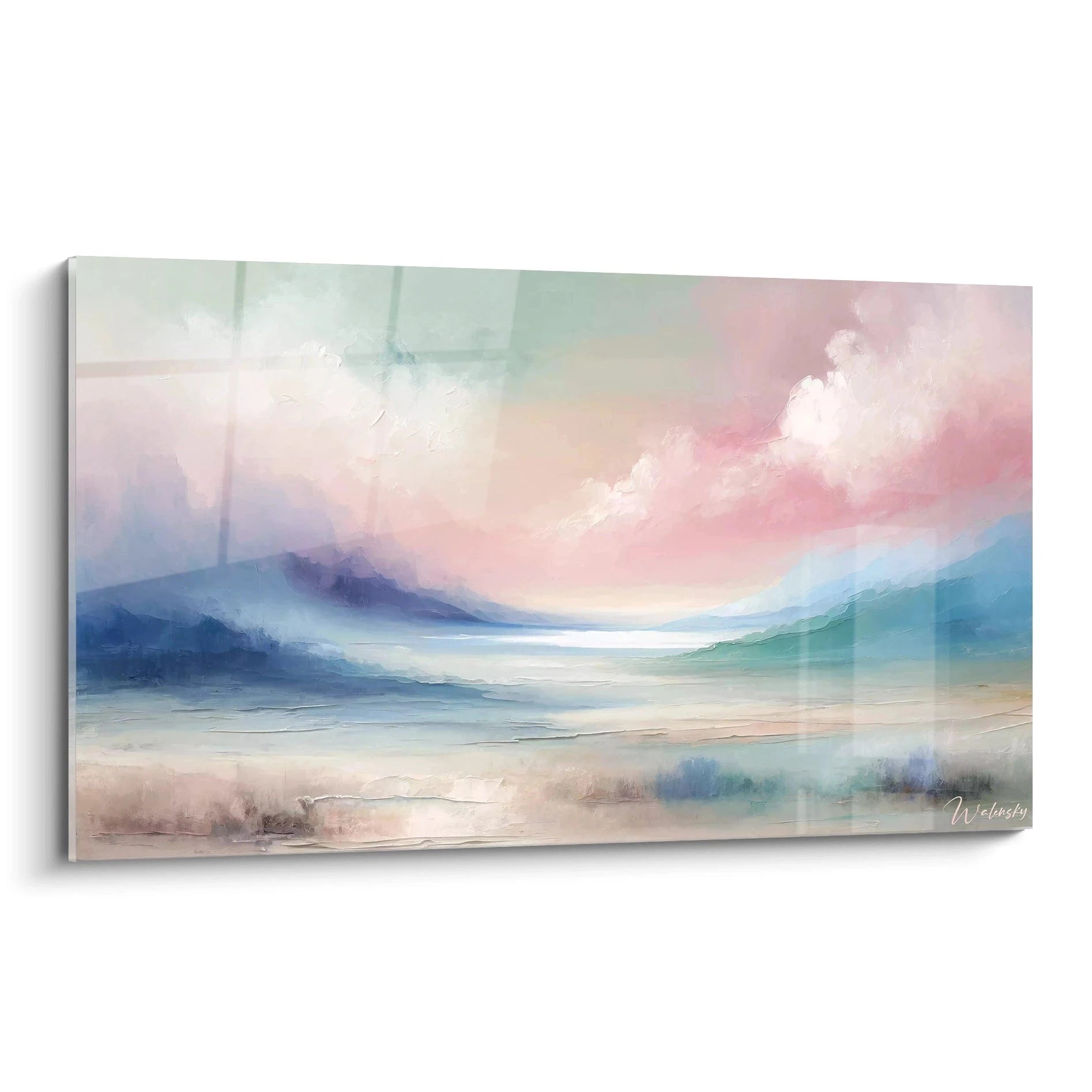

Subtle yet evocative wall art: less is more
October 11, 2025 · 17 min read · by Walensky
Subtle art creates visual intimacy: Like a delicate fragrance that reveals itself only to those close, a subtle work invites contemplation rather than forced admiration. Observable result: your guests naturally approach to better discover the details, creating an authentic moment of connection with your space in 2-3 seconds.
What is really stopping you from choosing serenely?
Do you recognize these situations? You spend 20 minutes in front of a painting wondering "Will I still like this in 5 years?". You hesitate between three completely different styles. You fear the judgment of others on your artistic choice.
What is really happening is that you are trying to make the "right" choice according to external criteria, rather than listening to your personal emotional resonance. The problem isn't your lack of confidence, but social pressure that pushes us to justify our artistic tastes.
It's like trying to choose a book by wondering what others will think of your library: you miss the essential, which is your daily reading pleasure.
The tyranny of the "statement piece" paralyzes you
Unlike decor magazines that advocate for "statement pieces", the most memorable art isn't always the most visible. True collectors know this: it is often the subtle works that reveal the sophistication of a gaze.
Imagine your living room as a conversation: subtle art whispers elegant confidences, while showy art shouts to attract attention. Which creates a more refined atmosphere?
This pressure of the "decorative coup de théâtre" makes you look for effect rather than emotion, impression rather than inspiration. As a result: you go around in circles and indefinitely postpone your decision.
🔍 Quick revelation test: Close your eyes and think back to the last interior that positively marked you. Do you remember "THE" work of art that dominated the space, or rather a general harmonious atmosphere? Most of the time, it is the subtle details that create lasting memories.
You are confusing minimalism with lack of personality
Many think that opting for artistic discretion means playing it safe or lacking decorative boldness. In reality, it takes more finesse to choose a work that will speak in nuance than to bet on immediate visual impact.
It's the difference between a chef who impresses with spectacular presentations and one who sublimates a simple product: the latter reveals a deeper mastery.
This confusion makes you hesitate between your true preferences (often more subdued) and what you think you should display to appear "interesting". The result? A default choice that doesn't look like you.
The illusion of the "artistic statement" makes you flee your instincts
You have internalized the idea that a good artistic choice must "make sense" intellectually and be able to be easily justified. Yet, art first works on intuition and emotion, not on rational analysis.
This quest for legitimacy prevents you from noticing the works that spontaneously touch you, but which you can't seem to "explain".
3 signs that you are experiencing this pressure:
- You first look for the "trendy" style: You browse Pinterest before listening to your tastes, as if your personal pleasure came after social validation
- You anticipate your guests' questions: You already imagine having to "defend" your choice, a sign that you don’t allow yourself intuitive preferences
- You prioritize explanation over emotion: You prefer a work that you know how to "analyze" to one that moves you without apparent reason
The trigger factor: your relationship with visual intimacy
What really makes the difference is your ability to create a personal dialogue with a work, rather than a show for others. It's like choosing between a close friend who understands you with a glance and a brilliant acquaintance who impresses in society: both have their place, but one nourishes your daily life, the other remains superficial. You know it when you feel that silent connection with a piece, that inexplicable feeling of "recognition".
Golden rule of art selection: If you have to convince someone (even yourself) that a work is "good", then it probably doesn't resonate with you intimately. The right piece asserts itself naturally, without argument. Immediate verification: you imagine seeing it every day without getting tired.
| ❌ "Impression" approach | ✅ "Expression" approach | 💡 Why it works | 🎯 Daily benefit |
|---|---|---|---|
| Trying to impress guests | Choosing for your personal pleasure | Authenticity is intuitively felt | Lasting satisfaction, no fleeting trend |
| Copying Instagram trends | Following your aesthetic instinct | Your personal taste creates originality | Unique decor that truly reflects you |
| Prioritizing immediate visual impact | Favoring subtle contemplation | Subtlety ages better than effect | Soothing atmosphere, no visual fatigue |
| Buying "based on the room" | Letting the work define the ambiance | Art guides decor, not the other way around | Natural coherence, harmonious evolution |

How to cultivate your eye for discreet and evocative art
Rest assured: developing this sensitivity to subtle art doesn't require artistic studies, but simply learning to look again with your emotions rather than your prejudices. It’s a three-step process, like learning to taste wine: first observe without judging, then feel without analyzing, finally choose with confidence. In the end, you will instantly recognize a work that truly "speaks" to you, and your interior will become an authentic reflection of your personality.
🎯 Overview of your journey: Step 1 - Develop your inner eye (2-3 weeks), Step 2 - Create your personal visual vocabulary (1 month), Step 3 - Master the art of intuitive selection (ongoing). Logic: we move from passive reception to active creation of your artistic identity, with more confidence and enjoyment in your choices at each step.
Starting with this step is laying the foundations of your personal artistic gaze, like a musician who first learns to hear nuances before playing. This phase reconnects you with your natural sensitivity, often stifled by the "It must be..." and "It should be..." of conventional decor. Once mastered, this base will give you the confidence to trust your instincts.
What you need to get started
- A visual notebook: Format A5 or even your phone, to capture images that touch you without knowing why. Avoid overly "artistic" notebooks that intimidate: the goal is spontaneity, not perfection. Quality criterion: you must be able to take it out anywhere without hesitation.
- 20 minutes of daily silence: No complicated meditation, just a moment where you observe your current space without trying to "improve" anything. Principle: relearn to see rather than analyze. Visible impact: you start noticing details that escaped you.
- A "slow" source of inspiration: Replace Pinterest scrolling with a visit to a museum, gallery or even an art book that you browse quietly. Benefit: your gaze learns contemplation rather than image consumption.
How to gently refine your gaze
The "fresh look" exercise: Each day, choose a wall in your home and observe it for 2 minutes as if you were discovering it. Note what you like without trying to change anything. Technical reason: your brain learns to see the existing before imagining the new, avoiding choices by rejection.
⏱️ Time: 2 minutes/day | ✅ Successful when: You notice 3 positive details that you had never realized | ⚠️ Attention: Don't fall into criticism or a "To improve" list - this reflex kills nascent sensitivity
The collection of visual emotions: Photograph or note everything that makes you feel something positive, even if it's "not your usual style". Objective: expand your emotional palette beyond your conscious tastes. The technical idea: identify your personal sensory triggers.
⏱️ Time: 1 capture per day minimum | ✅ Successful when: Your collection reveals unexpected patterns | ⚠️ Attention: Resist the urge to "sort" or categorize immediately
Judgment-free immersion: Once a week, spend 30 minutes in a place with art (gallery, decorated café, hotel lobby...) forbidding yourself any "like/dislike" evaluation. Just feel and observe your physical reactions. Technique: note your physical sensations rather than your mental opinions.
⏱️ Time: 30 minutes/week | ✅ Success when: You identify your reactions before even formulating an opinion | ⚠️ Attention: The habit of quick judgment is tenacious - be patient with yourself
✨ Validation of step 1: You know this base is acquired when you start noticing subtle works that touch you, even in places you've frequented for a long time. If it's still blurry, continue the fresh eye exercise for a few more days - everyone their own pace. The rest will be even more rewarding!

OUR RECOMMENDED PRODUCTS
Step 2: Create your personal visual vocabulary
You are now moving from passive reception to active creation of your preferences. This step reveals your unique "visual signature" - those recurring elements that reveal your aesthetic personality. It's rewarding because you begin to see a style emerge that is uniquely yours, and liberating because you no longer need to copy others.
Your new exploration tools
- A visual dashboard: Wall, corkboard or digital folder where you gather your discoveries. Avoid overly sophisticated moodboards that stifle spontaneity. Criterion: you must be able to add something in 30 seconds. Impact: visualize the patterns that emerge naturally. The "3 details" method: For each image that attracts you, identify precisely 3 concrete elements (color, texture, composition, atmosphere...). Principle: move from "I like it" to "I like it because...". Technical benefit: build your personal lexicon of preferences. A notebook of assumed contradictions: Note your favorites that seem not to go together. This is often where your originality lies. Logic: accept your paradoxes rather than forcing artificial coherence.
How to identify your aesthetic DNA
Analysis of constants: Each week, observe your image collection and identify 2-3 elements that often recur, even in different styles. Perhaps a preference for curved lines, soft contrasts, or natural materials. Reason: detect your instinctive sensitivity beyond conscious styles.
⏱️ Time: 15 minutes/week | ✅ Success when: You identify 5-6 personal constants | ⚠️ Attention: Don't force patterns - some emerge after several weeks
The daily projection test: For each artwork that attracts you, imagine it precisely in your space: where would you hang it? What time of day would you look at it? This visualization reveals your real emotional needs. Technique: identify whether you are looking for energy, calm, inspiration or contemplation.
⏱️ Time: 5 minutes per crush | ✅ Successful when: You easily visualize the integration into your life | ⚠️ Attention: Avoid overly rational projections ("it would go with my sofa") in favor of emotional ones
You are now reaching the level of aesthetic confidence where you instantly recognize what suits you. This mastery allows you to choose a work in just seconds of observation, without second-guessing or external validation. The final result: an interior that tells your personal story with subtlety and authenticity, creating that unique atmosphere that your guests talk about without knowing how to explain it.
The expertise of instinctive selection
The emotional validation protocol: Faced with a potential artwork, first observe your physical reactions for 30 seconds (relaxation, energy, unconscious smile...) before any mental analysis. Then imagine seeing it 200 times: do you keep this positive feeling? Advanced technique: trust your body before your mind.
⏱️ Time: 2 minutes per evaluation | ✅ Successful when: Your instinctive choices satisfy you durably | ⚠️ Attention: Over-analysis kills intuition - respect the 30 second timing
The composition of your personal collection: Create a harmony between 2-3 subtle works that respond to each other without repeating, like the instruments of a jazz trio. Each brings its nuance to the whole. Expert principle: coherence comes from emotional resonance, not stylistic similarity.
⏱️ Time: Evolving process over several months | ✅ Successful when: The ensemble creates a unique and recognizable atmosphere | ⚠️ Attention: Avoid accumulation - better 2 perfect works than 5 approximate ones
Law of artistic progression: You are ready for the next step when you stop doubting your choices and start enjoying the selection process itself. Objective criteria: you no longer feel the need to ask others for their opinion on your crushes. The perfect balance: patience to let your tastes mature, ambition to dare your authentic choices.
You now master the subtleties that distinguish the informed amateur from the impulsive consumer. These expert nuances give you a rare advantage: the ability to create a sophisticated atmosphere with fewer elements but more intention.
🎨 Secret of seasoned collectors: True finds are often hidden in works that you can't immediately "categorize." If a piece attracts you but defies usual boxes (neither modern, nor classic, nor figurative, nor abstract), it often possesses that rare quality of subtle originality. A concrete example: this engraving that mixes traditional technique and contemporary vision often becomes the piece your guests talk about the most.
"How do I know if I won't get tired of my understated choices?"
"I’m afraid that by choosing subtle works, I’ll get bored after a few months..."
This concern is very understandable and reveals a common confusion between stimulation and satisfaction. In reality, it's exactly the opposite that happens: understated works improve over time as they reveal new details according to your mood, the light, the seasons. A client recently told me that she was still discovering nuances in her botanical engraving after 3 years, while she had removed her former colorful painting after 8 months. The difference? Subtle art nourishes, flashy art stimulates then exhausts.
🧪 Anti-boredom test: Place a reproduction of the work that tempts you in your space for 15 days. Observe whether you continue to notice it positively or if it becomes "invisible." A successful understated work remains present without overwhelming.
— Our selection


The 5 pitfalls that sabotage your artistic selection
Now that you are developing your artistic sensibility, some classic mistakes could spoil your efforts. I point them out not to worry you, but because they are so common that avoiding them gives you a huge advantage over most enthusiasts.
- 🎭 The trap of the "impulse buy" in a gallery: The hushed atmosphere and professional lighting transform any work into a masterpiece. Result: disappointment once you're home. Solution: always ask to see the artwork in natural light, or failing that, take a photo with your phone to break the "staging" effect. It’s normal to fall into this trap, galleries bank on it! 📏 The error of proportions due to lack of measurement: You mentally visualize the perfect size, but without a measuring tape, your estimate is wrong 90% of the time. Consequence: artwork too small that gets lost or too large that overwhelms the space. Antidote: always measure the location AND check the exact dimensions of the work. A difference of 10cm changes the entire visual impact. 🏠 Over-adaptation to your current decor: Choosing exclusively based on your existing furniture boxes you in and limits your future decorative evolution. Your new sofa in 3 years? A possible move? Durable art transcends temporary decor. Instead, look for resonance with your personality rather than with your wall colors. 👥 Social validation compulsion: Systematically sending photos to loved ones before buying reveals a lack of confidence in your tastes. Their comments, even well-intentioned, pollute your instinct. Remember: it’s YOUR daily space, not theirs. A work that touches you sincerely will always find its audience.
- 💰 The "high price = artistic quality" equation: Confusing market value and emotional value makes you miss affordable gems and pushes you towards “investments” that don’t really speak to you. A €50 work that inspires you every day is better than a €500 “collector's item” that you look at out of obligation.
🛡️ Your safety checklist before any purchase: 1) Have I observed this work under different lighting conditions? 2) Do I still visualize it positively in 2 years? 3) Does my decision come from my emotions or my reason? 4) Am I ready to own up to it when faced with questions/criticism? Warning signs: complex justifications, comparisons with other works, need to convince someone else.
— You may also like


Your essential questions about discreet wall art
Between €50 and €200 for your first quality discreet artwork, depending on the format and technique. To optimize: prioritize engravings, lithographs or art photographs rather than original paintings, which offer the same aesthetic impact for a budget 3 to 5 times lower. Concrete example: a beautiful 40x30cm botanical engraving can transform your living room for €80, where an equivalent painting would cost at least €300.
Allow 3-4 weeks to begin identifying your real preferences, 2-3 months to have confidence in your choices. The accelerator: visit an exhibition or gallery per month, without any purchase pressure, just to educate your gaze. You will know that your sensitivity is maturing when you start noticing details that escaped you before, even in familiar places.
Use modular suspension systems (rails + cables) that are fixed to the ceiling with special plasterboard dowels. Budget: €30-50 for a 3 meter system. Advantage: easy movement of artworks, no holes in the walls, and you take everything when moving. Alternative for lightweight formats: ultra-resistant adhesive frames (tested up to 2kg per fixing point).
Your transformation into an informed art enthusiast
In a few weeks, you'll enter your home with a subtle smile: that wall which worried you so much now welcomes a work of art that perfectly resembles you. Your guests will immediately notice this new atmosphere without being able to precisely define what has changed - it’s exactly the effect sought. This newfound confidence in your artistic choices will be felt throughout your decor, and you'll discover the rare pleasure of living in a space that authentically tells your story.
This transformation goes far beyond decoration: you develop an aesthetic sensibility which will enrich all your future choices, from your wardrobe to your vacation destinations. This ability to recognize and choose the "subtle beauty" becomes an asset in your relationship with the world, a skill that accompanies you everywhere and helps you create meaning and harmony around you.
You now have all the keys to get started: your eye is sharpening, your confidence grows, there’s only one thing left to do: dare to trust your instinct. The first step? Carefully observe your space today with this new perspective you've just acquired. You'll see: possibilities that previously eluded you will naturally reveal themselves.
🌟 Your new artistic power: You now know how to create this subtle magic which transforms a house into a home, a space into a personal refuge. It's more than a decor skill, it’s an art of living. Your first choice of subtle art will be the beginning of a unique collection that grows with you.
— In the same vein


Explore our collections


