Florence, 1517. In the bright workshop of San Gallo, Andrea del Sarto sets down his brush. Before him,
Here's what Andrea del Sarto’s technique in
You admire the masterpieces of the Renaissance in museums, captivated by this perfection that seems inaccessible? You wonder how these masters managed to create such depth, such presence in their works? This feeling of mystery facing technical genius is not a fatality.
Understanding the techniques of Andrea del Sarto is accessing the secrets of manufacturing an era where art reached peaks of refinement. It's discovering that behind apparent beauty lie precise, reproducible, transmissible technical choices. Choices that transform a simple image into a memorable visual experience.
In this article, we delve into the workshop of the Florentine master to dissect his method. You will discover the specific techniques used in
Del Sarto’s sfumato: Leonardo's perfected legacy
When we observe
But del Sarto does not simply copy. In
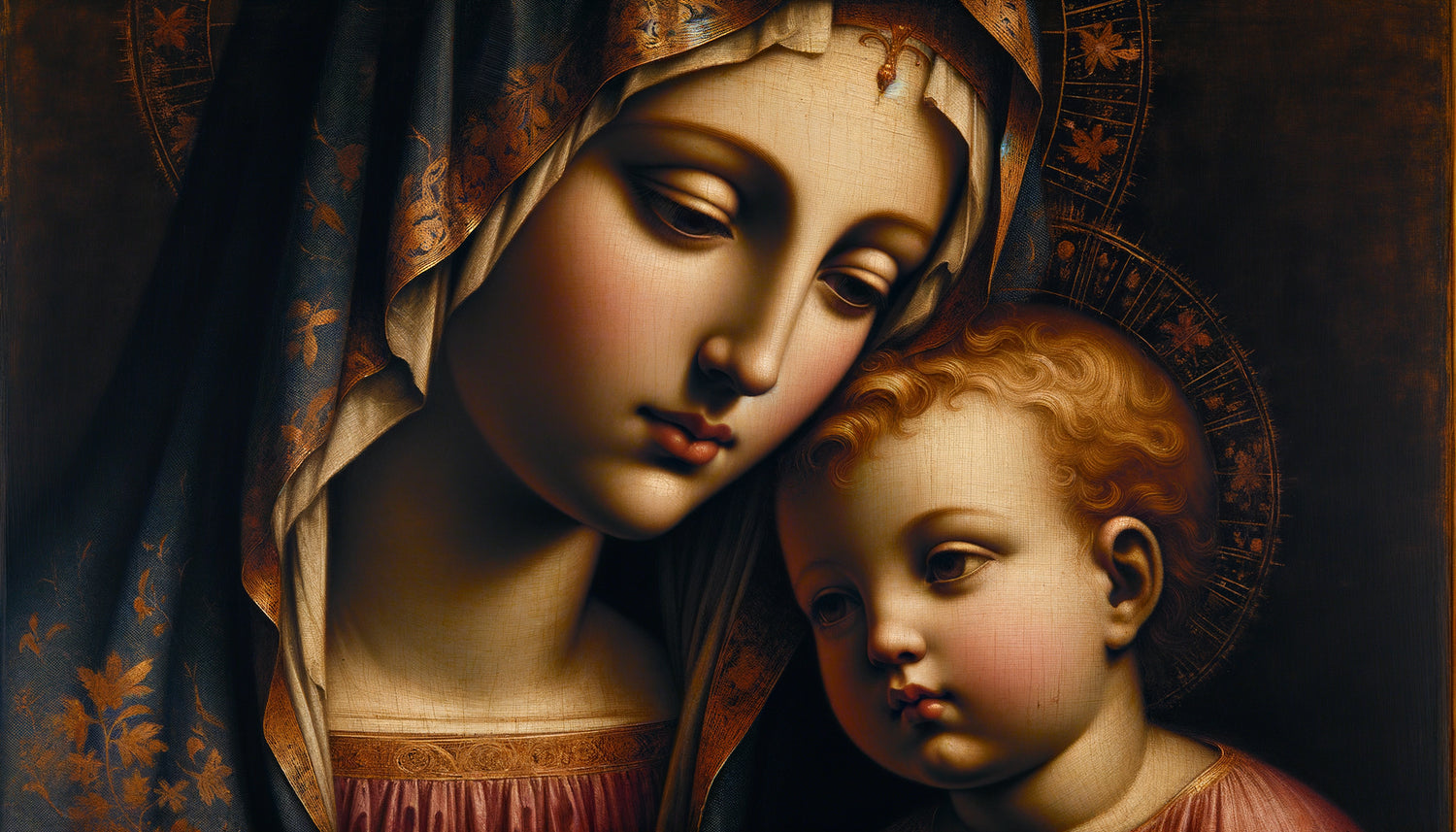
The secret lies in the superposition of translucent glazes. Del Sarto applies extremely thin layers of oil paint, diluted with turpentine essence. Between each layer, he allows it to dry completely - sometimes for several days. This patience allows colors to overlay without mixing, creating an optical depth impossible to obtain otherwise.
On the face of the Virgin, this technique reaches its peak. The rosy cheeks are not painted directly: they result from the accumulation of vermilion glaze on a light ochre base, all modulated by veils of lead white. The result? A living complexion, which seems to breathe in the changing light.
The pyramidal composition: architecture of harmony
Andrea del Sarto structures The Madonna with the Harpies according to a rigorous geometric principle: the pyramidal composition. This is no accident. This triangular structure, popularized by Raphael in his madonnas, offers immediate visual stability and naturally guides the viewer's gaze.
In this work, the Virgin occupies the top of the pyramid. Her head constitutes the main focal point, while the figures of Saint John the Evangelist and Saint Francis of Assisi form the base angles. This triangulation creates a perfect balance: no part of the painting unduly dominates attention.
But del Sarto adds an extra subtlety. He inscribes a second inverted pyramid within the first: that formed by the gazes. The Virgin looks down, John looks up at her, Francis contemplates the open book. These invisible lines of sight create a visual circulation that keeps the viewer in the space of the painting.
The pedestal adorned with harpies - which gives its name to the work - is not merely decorative detail. It physically anchors the composition, creating an architectural base that elevates the scene into a monumental register. Del Sarto thinks like an architect as much as a painter, building the pictorial space as one erects a temple.

When color becomes light
Andrea del Sarto's chromatic approach in The Madonna with the Harpies reveals an intuitive understanding of principles that physicists will not theorize for centuries. For him, color does not exist independently of light - it is light.
Observe the red cloak of the Virgin. Instead of using a uniform red modulated by additions of white and black to create volumes and shadows, del Sarto employs an extended chromatic palette. The illuminated areas turn orange and salmon pink, while the shadows plunge into deep purples and reddish browns. This variation in hue, and not just value, gives the drape extraordinary light vibration.
The technique is based on complementary color theory, applied empirically. Del Sarto strategically places touches of green-gray in the shadow folds of the red cloak. These complements enhance each other, creating a chromatic intensity that defies time. Five centuries after its creation, the painting retains an astonishingly fresh coloration.
The blue of the Virgin's veil illustrates another technical feat: the use of lapis-lazuli. This precious pigment, more expensive than gold at the time, was reserved for the most important sacred elements. Del Sarto grinds it himself, mixing the powder with purified linseed oil. He applies it in semi-transparent layers over a white undercoat, creating this characteristic luminous azure that seems to emit its own light.
The underlying drawing: the invisible foundation
Even before touching the paint, Andrea del Sarto spends weeks on the preparatory drawing. For The Madonna of the Harpies, recent X-ray analyses reveal preliminary work of astonishing precision.
Del Sarto begins with separate anatomical studies for each character. He draws hands, faces, draperies on individual sheets, seeking the perfect pose, the ideal angle. These studies, made in sanguine and black stone, show multiple corrections: a hand repositioned, a fold of fabric reworked.
Once satisfied, he transfers these studies to the prepared wooden panel using the spolvero technique. He pierces tiny holes along the contours of his drawing, then taps a bag of powdered charcoal onto these perforations. The result: a precise dotted tracing which he then connects with a fine brush and diluted ink.
This underlying drawing serves as a roadmap for the entire pictorial execution. Del Sarto never completely abandons it: even in the final layers of paint, he respects these initial contours. This fidelity to the drawing explains the structural clarity of his composition, where each form remains legible despite the complexity of the whole.

Del Sarto's innovation: the Florentine synthesis
What makes Andrea del Sarto’s technique unique in The Madonna of the Harpies is his ability to synthesize innovations from his predecessors while adding his personal signature.
From Michelangelo, he borrows the monumentality of the figures. The characters of del Sarto possess a sculptural presence, an anatomical solidity that evokes the frescoes of the Sistine Chapel. But where Michelangelo favors dramatic power, del Sarto seeks harmonious balance.
From Raphael, he retains the compositional grace and elegance of the poses. His characters organize themselves in space with a natural fluidity that seems obvious, although it is the result of careful calculation. But del Sarto avoids Raphael's sometimes excessive softness, retaining a certain Florentine gravity.
From Leonardo, as we have seen, he inherits the sfumato. But he tempers it with a structural clarity that is his own. The forms in del Sarto are never completely dissolved into the atmosphere - they retain a definition, a tangible presence.
This synthesis makes del Sarto the perfect representative of mature Florentine classicism. His technique in The Madonna of the Harpies achieves a balance between drawing and color, between structure and flexibility, between clarity and subtlety that few artists have equaled.
Why this technique still resonates today
Andrea del Sarto's method in The Madonna of the Harpies transcends its historical context to touch something universal. In our contemporary interiors, a reproduction of such a work does not merely decorate - it structures space by its balanced presence.
The technical principles of del Sarto - pyramidal composition, chromatic harmony, softness of transitions - correspond to constants of human visual perception. Our brain naturally finds soothing an image constructed according to these geometric and chromatic rules. That is why these ancient works retain an immediate power of attraction.
For art lovers who want to enrich their environment, understanding these techniques allows them to choose with knowledge. A quality reproduction of The Madonna of the Harpies brings into a living room or office this quality of thoughtful harmony, this discreet sophistication that characterizes the great classics.
The technical legacy of del Sarto can also be found in contemporary portrait photography, graphic design, even digital animation. The principles remain identical: structure space, guide the gaze, create depth through color and light. Knowing these fundamentals develops one's eye, refines one's taste, enriches one's relationship with the images that surround us.
Let the reawakening perfection transform your daily life
Discover our exclusive collection of famous artist inspired paintings that bring the harmony of ancient masters into your modern interior.
Andrea del Sarto’s technique in *The Madonna of the Harpies* reminds us that there are no shortcuts to excellence. Each glaze painstakingly applied, each preparatory study drawn and redrawn, every considered chromatic choice - all contribute to this final impression of harmonious evidence.
You will now look at Renaissance works with a new eye. You will perceive compositional pyramids, recognize sfumato passages, appreciate chromatic subtleties. This technical knowledge does not diminish the aesthetic emotion - on the contrary, it enriches it with an intellectual dimension that deepens pleasure.
Start simply: next time you visit a museum or leaf through an art book, take the time to observe how ancient masters built their images. Look for triangles, follow gazes, note where the light focuses. You will discover that behind every masterpiece lies an invisible architecture, the result of accumulated know-how over decades.
Frequently Asked Questions about Andrea del Sarto’s Technique
How long did Andrea del Sarto take to paint The Madonna of the Harpies?
Andrea del Sarto worked on *The Madonna of the Harpies* for approximately 18 months, from 1517 to 1518. This time may seem long for a medium-sized painting (207 × 178 cm), but it is explained by his meticulous method. Del Sarto devoted several weeks to preparatory drawings, testing different compositions before starting to paint. Then, his technique of superimposed glazes required prolonged drying times between each layer - sometimes three to five days. It was not uncommon for him to work simultaneously on several areas of the painting, applying a glaze here while another dried there. This methodical patience is precisely what gives the work its characteristic luminous depth. For contemporary artists who want to understand this approach, it is reassuring to know that even masters were not looking for speed but for the perfection of the final result.
Why is this work called The Madonna of the Harpies when it depicts grasshoppers?
It’s a misinterpretation that has become tradition! The pedestal on which the Virgin stands is adorned with creatures that Vasari, the first biographer of del Sarto, identified as harpies - these mythological creatures half-women and half-birds. This identification gave the painting its popular name. More recent studies suggest that they are probably grasshoppers or crickets, a biblical reference to the Book of Revelation. These insects symbolize the demonic forces crushed under the feet of the Virgin, representing the triumph of good over evil. But the name “Madonna of the Harpies” has remained, illustrating how a work of art accumulates layers of interpretation over the centuries. For art lovers, this example recalls that understanding a painting sometimes requires going back to the sources, beyond conventional appellations.
Was del Sarto’s technique considered innovative in his time?
Yes and no. Andrea del Sarto was not a revolutionary like Leonardo or Michelangelo, but rather a genius synthesizer. At the time, in the 1510s-1520s, Florence had already seen the emergence of major innovations of the High Renaissance. What del Sarto brought new was a technical perfection in execution rather than conceptual breakthroughs. His contemporaries recognized him as the best painter in Florence for the purity of drawing and the harmony of colors - Vasari nicknamed him “the painter without errors.” His sfumato technique was considered the culmination of Leonardo’s, more mastered, less experimental. For artists of the time, del Sarto represented the ideal of mature Florentine classicism: neither archaic nor revolutionary, but perfectly balanced. Today, this technical mastery continues to inspire painters and restorers who study his methods to understand the secrets of Renaissance oil painting.