Imagine yourself facing a canvas where bodies seem to defy all anatomical logic, where colors explode in almost supernatural nuances, where the composition deliberately refuses classical harmony. This is exactly the visual shock that The Descent from the Cross by Rosso Fiorentino provokes, painted in 1521 in Volterra. This masterful work marks a radical turning point in art history: the moment when a young Florentine painter dared to break all the codes of the Renaissance to invent something entirely new. Here's what this pictorial revolution brings: an intense emotional expression that goes beyond simple realism, a creative freedom that liberates the artist from conventions, and a visual sophistication that fascinates even five centuries later. You may be disconcerted by these paintings where nothing seems 'normal', where traditional beauty gives way to a captivating strangeness. Rest assured: understanding how Rosso Fiorentino developed mannerism in this work is discovering the backstage of an exciting artistic revolution. I propose that we explore together the visual boldness that changed painting forever.
The explosive context of an artistic rupture
In 1521, Florence was living its last hours of artistic glory before political turmoil. Giovanni Battista di Jacopo, known as Rosso Fiorentino for his flamboyant red hair, was only 27 years old when he received the commission for The Descent from the Cross for the chapel of the Compagnia della Croce di Giorno in Volterra. The young artist had been trained in the workshop of Andrea del Sarto, alongside Pontormo, but he refuses to follow in his masters' footsteps.
Where Michelangelo and Raphael brought the Renaissance to its peak – perfect balance, ideal proportions, divine harmony –, Rosso Fiorentino felt a different creative urgency. The sack of Rome is approaching (1527), Italy is going through a period of collective anxiety, and the humanist optimism of the Renaissance suddenly seems naive. In The Descent from the Cross, the painter does not seek to reassure: he wants to translate the emotional chaos, the violence of the sacred drama, the impossibility of rationally understanding suffering.
This canvas thus becomes the involuntary manifesto of mannerism, this movement that privileges the maniera – the manner, the personal style – over faithful imitation of nature. Rosso Fiorentino develops a radically new visual language, made up of voluntary distortions and chromatic boldness.
Bodies that defy classical anatomy
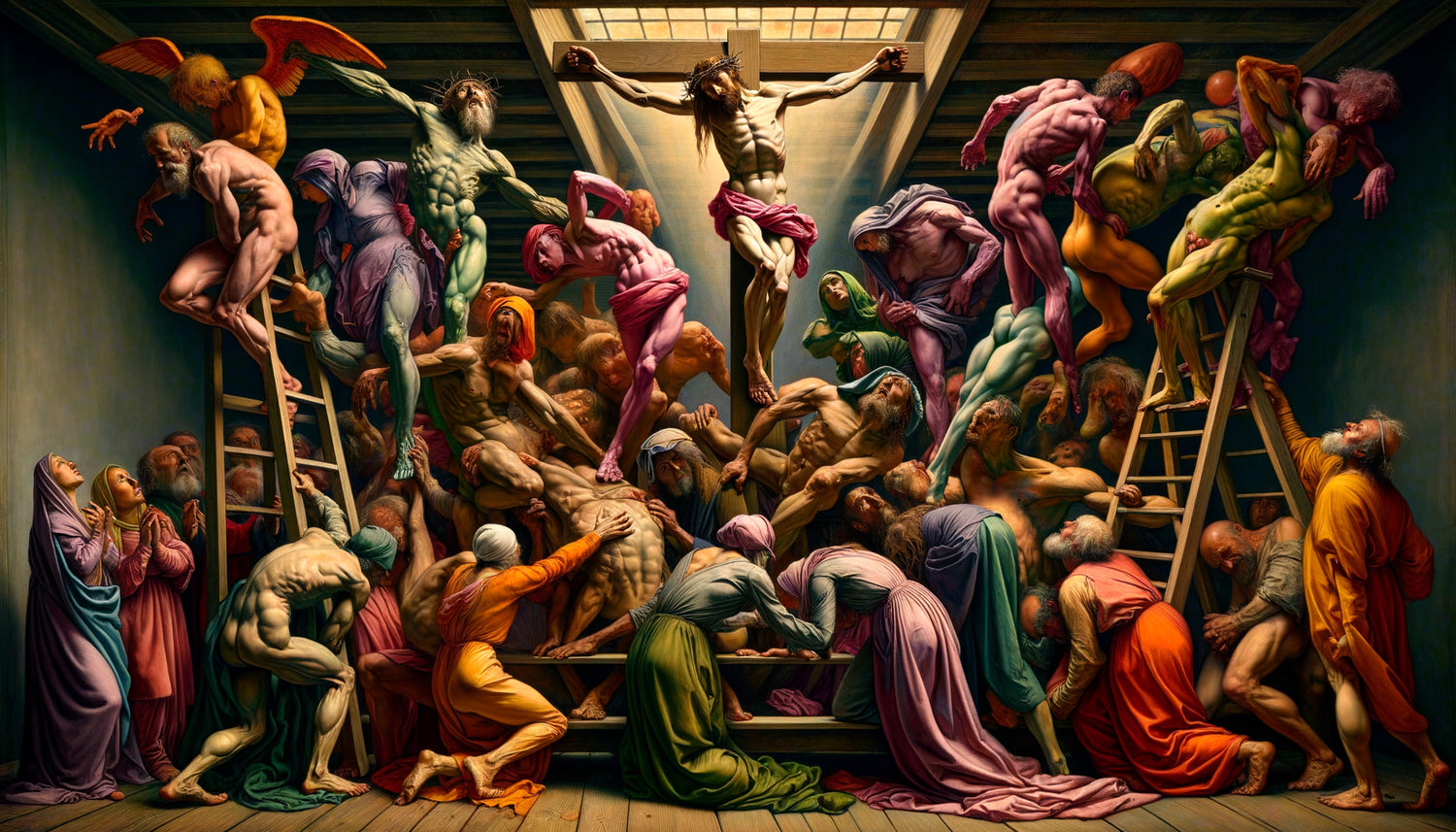
The first thing that strikes you in The Descent from the Cross is the strangeness of the proportions. The dead Christ presents a disproportionately elongated body, almost unreal in its spectral whiteness. His limbs seem stretched like rubber, creating a figura serpentinata – this S-shaped sinuous line characteristic of mannerism.
Rosso Fiorentino deliberately abandons the rigorous anatomy favored by Michelangelo. The figures descending Christ from the cross adopt impossible postures: improbable angles, extreme twists, precarious balances. The man in bright red, perched on the ladder, seems to defy gravity. This anatomical distortion is not a clumsiness – it's a radical artistic choice to express the emotional intensity of the scene.
In the development of Mannerism, these elongated and artificial bodies become a signature. They create a strange elegance, a sophisticated beauty that moves away from naturalism to reach something more stylized, almost mannered – hence the name of the movement. Rosso Fiorentino transforms human representation into a vehicle for pure expression, where form serves emotion rather than verisimilitude.

A destabilizing color palette
If you look closely at The Descent from the Cross, you will immediately notice the acidic and discordant colors that electrify the composition. Rosso Fiorentino abandons the gentle harmonies of the Renaissance for violent contrasts: strident pinks, metallic greens, glacial blues, incandescent reds.
The emotional power of unnatural colors
These artificial hues create an almost hallucinatory atmosphere. The sky is not azure blue but a worrying stormy gray. The flesh is not rosy and alive, but milky, almost cadaverous for Christ. This anti-naturalistic color palette constitutes one of the major innovations of Mannerism developed by Rosso Fiorentino.
Where Renaissance masters used color to reinforce the illusion of reality, the Florentine painter uses it as an independent expressive element. These strange colors generate a productive malaise: they signal to the viewer that he is not witnessing an ordinary scene, but a shocking cosmic event. Color becomes pure emotional language, anticipating pictorial developments that will not fully blossom until centuries later.
A composition that rejects classical balance
Let's now analyze the spatial structure of The Descent from the Cross. Rosso Fiorentino rejects the stable pyramidal composition favored by Raphael. Instead, he creates a deliberate instability: the figures crowd into a compressed space, with no clear depth, forming a tangle of bodies and draperies.
The cross itself does not occupy a reassuring central position. Ladders create aggressive diagonals that cut across the pictorial surface. The figures do not distribute themselves harmoniously but accumulate in dense clusters, creating visual tensions. This unbalanced composition conveys the chaos of the dramatic moment: nothing is resolved, everything remains suspended in anguish.
The development of Mannerism thus goes through this rejection of spatial evidence. Rosso Fiorentino constructs a scene where the eye never finds rest, where each element conflicts with others. It is precisely this visual sophistication, this complexity that refuses ease, which defines the Mannerist approach. The artist prioritizes intellectual and emotional effect over narrative clarity.

Exaggerated expression of emotions
Beyond pure technique, The Descent from the Cross marks a revolution in the representation of emotion. The faces painted by Rosso Fiorentino do not show the noble and restrained pain of the Renaissance, but a raw, almost unbearable suffering.
Mary Magdalene, in the lower right corner, displays an expression of distorted anguish. The features are exaggerated, the eyes wide, the mouth twisted. This expressive intensification characterizes Mannerism: the artist deliberately amplifies affects to the limit of what is bearable. Nothing is tempered by propriety or idealization.
In the development of this Mannerist language, Rosso Fiorentino discovers that exaggeration can be truer than realism. By pushing each element beyond normality – anatomy, color, composition, expression –, he reaches a deeper emotional truth. This assumed theatricality will influence all European painting, from El Greco to Italian Baroque.
The legacy of a visual revolution
The Descent from the Cross remains today in the Volterra municipal art gallery, a striking testimony to the moment when an artist dared to question everything. Rosso Fiorentino did not develop Mannerism in a theoretical manifesto, but directly on canvas, through bold experimentation.
This artwork proves that there is no single path to beauty. Alongside classic harmony, there's room for expressive dissonance, sophisticated strangeness, and complexity that defies the eye. The maniérisme that Rosso Fiorentino develops here will become an international language, embraced by Parmigianino, Bronzino, Pontormo and many others.
In our contemporary interiors, the spirit of this revolution still resonates. We seek works that do more than just decorate; they question, surprise, and reject ease. Rosso Fiorentino's lesson remains relevant: artistic authenticity sometimes requires breaking conventions to invent your own maniera.
Let the power of great masters transform your spaces
Discover our exclusive collection of famous artist inspired paintings that bring this timeless sophistication and visual boldness to your interior decoration.
When audacity becomes heritage
Five centuries after its creation, The Descent from the Cross by Rosso Fiorentino continues to fascinate with its refusal of compromise. This canvas embodies the precise moment when an artist decides that personal expression takes precedence over any established rule. The development of mannerism in this work is not an abstract theory but a visceral visual experience.
For those of you seeking to enrich your artistic culture or understand what makes works that cross centuries so powerful, here's the essential lesson: radical authenticity always creates more impact than conventional perfection. Rosso Fiorentino reminds us that art progresses through bold ruptures, through those moments when a creator dares to say 'no' to everything that precedes it in order to invent their own language.
The next time you visit a museum or choose a work for your interior, think of this silent revolution painted in Volterra in 1521. Look for that spark of singularity that makes an image unlike any other, that unique maniera that signs the presence of a true artistic vision.
Frequently Asked Questions
What is mannerism exactly?
Mannerism is an artistic movement that developed in Italy between 1520 and 1600, succeeding the High Renaissance. The term comes from maniera, meaning 'manner' or 'style'. Rather than faithfully imitating nature like the masters of the Renaissance, Mannerist artists prioritize artifice, sophistication, and personal expression. They elongate proportions, use unnatural colors, create complex and unstable compositions. Rosso Fiorentino, with The Descent from the Cross, is one of the pioneers of this approach that values technical virtuosity and emotional intensity. Mannerism is not a decadence of the Renaissance, but an evolution towards greater subjectivity and creative freedom.
Why are the bodies so strange in Mannerist paintings?
The elongated proportions and impossible postures of Mannerist bodies are a deliberate artistic choice, not a technical error. In The Descent from the Cross, Rosso Fiorentino deliberately distorts anatomy to create an artificial elegance and express intense emotions. These stretched bodies, with their endless limbs and extreme twists, create an effect of sophisticated refinement while translating the drama of the scene. This distortion also allows breaking away from the harmonious balance of the Renaissance, considered too wise and predictable. For Mannerists, beauty does not lie in the perfect imitation of reality, but in the ability to create a distinctive and memorable style that strikes the imagination.
How to recognize a Mannerist work?
Several characteristics allow you to identify a Mannerist work like The Descent from the Cross by Rosso Fiorentino. Look for elongated proportions in the characters, often with small heads and endless limbs. Observe acidic or artificial colors – strident pinks, metallic greens – rather than natural tones. Note the complex and unbalanced compositions, where space seems compressed and figures crowd together. Spot exaggerated emotional expression, almost theatrical. Finally, feel this general impression of sophisticated elegance and assumed artifice. Mannerism favors visible technical virtuosity, creating works that draw attention to their own refined construction rather than seeking to disappear into naturalistic illusion.