Imagine a 73-year-old man, deaf, isolated from the world, who transforms the walls of his own home into a theater of nightmares. No canvas, no commission, no audience. Just him and his demons, painted directly onto the plaster of his Quinta del Sordo, his Madrid residence. Francisco de Goya, tormented genius of the turn of the 19th century, created his black paintings in absolute intimacy, never imagining they would be seen. Here's what this radical gesture reveals: total creative freedom when you no longer create to please, the cathartic power of art as a personal outlet, and the raw authenticity that is born when the artist dialogues only with himself. We are fascinated by works destined for museums, salons, posterity. But what happens when an artist paints only to survive his own darkness? Rest assured: this story is not just a macabre anecdote. It speaks to us, of our intimate spaces, of what our walls could tell if we dared to project our truths onto them. Let's explore together why Goya chose this path of no return, and what it changes about our view of art and decoration.
The Quinta del Sordo: when the house becomes a mirror of the soul
In 1819, Goya acquired this property on the banks of the Manzanares, nicknamed House of the Deaf long before his arrival – a disturbing coincidence for a man who became deaf after a serious illness in 1792. At this time, the artist has already experienced everything: royal court painter, witness to the horrors of the Napoleonic war, survivor of political repression. He retires, bitter and disillusioned, to this two-story residence where he will live until 1823.
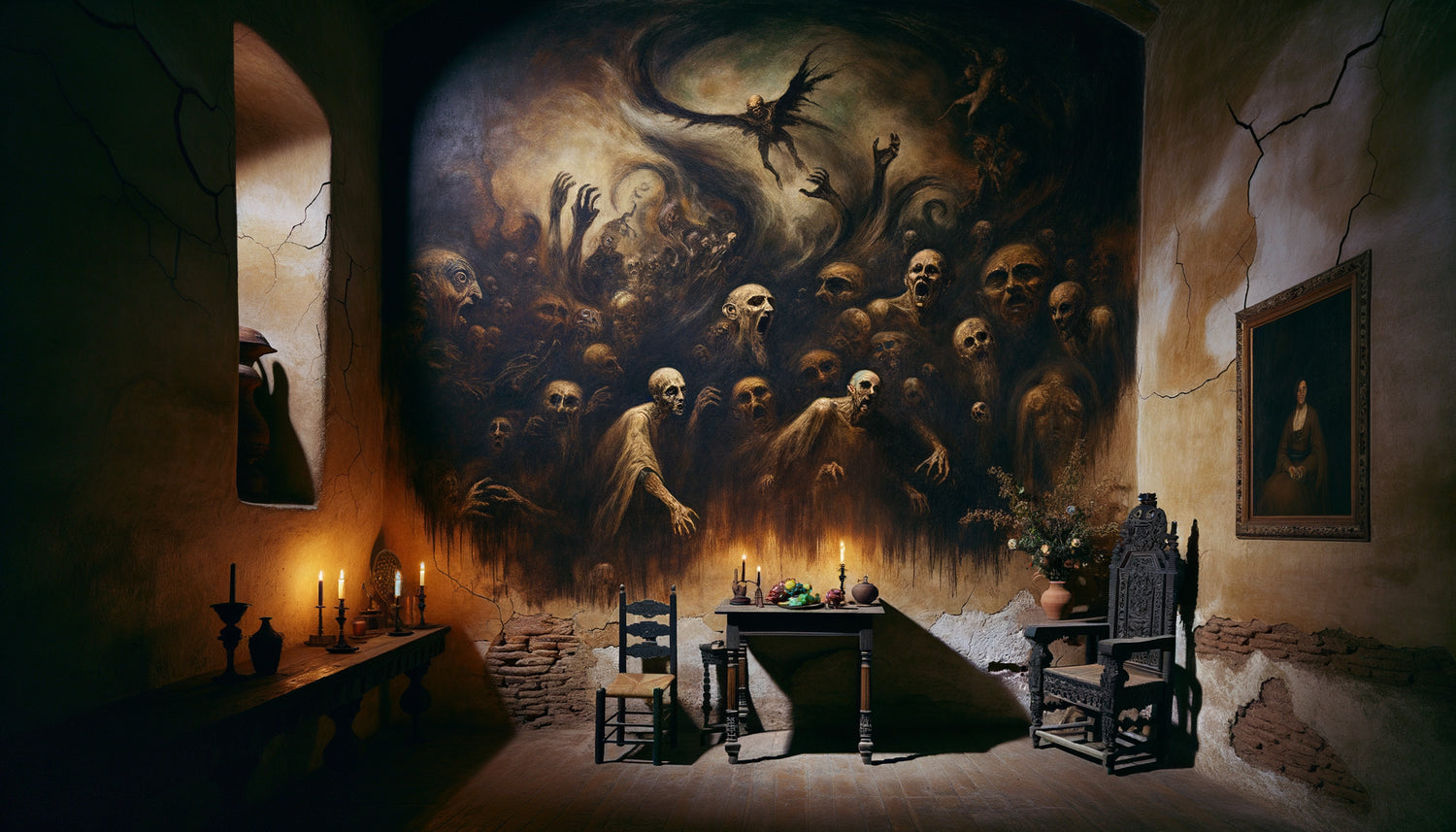
Unlike the luxurious apartments where he created his aristocratic portraits, the Quinta is not a place of representation. It's a refuge, a personal sanctuary. And it is precisely this radical intimacy that explains his gesture. The walls of his dining room and living room become his silent confidants. No need for frames, meticulous preparation, calculations for exhibition lighting. Just plaster, oil paint, and visceral urgency.
A permanent support for ephemeral visions
Painting on walls was not a calculated aesthetic choice, but a fusion between the artist and his habitat. Goya no longer separated his life from his art. His black paintings – Saturn Devouring His Son, The Witches' Sabbath, Two Old Men Eating Soup – literally enveloped his daily life. Imagine eating your meal under the hallucinated gaze of spectral figures. This total immersion reveals a desire to live with one’s obsessions, not to expose them.
Absolute freedom: creating without constraint or spectator
Here lies the heart of the mystery: Goya never mentioned these works. No letter, no inventory from his hand documents them. They were only discovered after his death, during the sale of the property in 1823. This total lack of communication reveals that these black paintings were not meant to be seen, let alone sold or criticized.
For an artist who had spent his life navigating between the demands of the court, ecclesiastical commissions and public expectations, this is a total liberation. No more censorship, no more self-censorship. The themes he explores – madness, death, violence, despair – are those that no patron would have accepted. By painting on his walls, Goya freed himself from the art market and regained a primitive creative purity.
The wall art as an act of permanence
Unlike a canvas that can be turned over, hidden or destroyed, painting on a wall is an irreversible commitment. Goya anchored his visions in the very structure of his house. It was a way of saying: “These images are part of me, my living space, I can no longer separate them from my existence.” This physical permanence contrasts with the psychological fragility of the subjects depicted.

The historical context: a decaying Spain
The black paintings do not emerge from nothingness. Between 1808 and 1814, Spain experienced the war of independence against Napoleon, followed by fierce repression under Ferdinand VII. Goya documented these atrocities in his series The Disasters of War, engravings of unprecedented violence. In 1819, he is 73 years old, having just survived a serious illness again, and Spain is a broken country.
His house then becomes a mental theater where collective and personal traumas are played out. Grotesque figures, scenes of cannibalism, processions of ghosts reflect a society that has lost its bearings. Painting these visions on his walls was for Goya a way to contain them, to domesticate them, to live with the horror rather than deny it.
Deafness: a sensory isolation that amplifies interiority
His deafness, which has been present for nearly three decades, plays a crucial role. Cut off from conversations, music, and the sounds of the world, Goya lives in a deafening silence where his thoughts take on immense proportions. The walls of his house become the projection screen of this inner turmoil. There is no longer a need for dialogue with the outside world: the dialogue is now between him and these painted figures who observe him.
A technique adapted to creative urgency
Technically, painting in oil on dry plaster (the a secco technique) is unorthodox. Unlike traditional fresco (a fresco), where the paint penetrates the wet plaster, Goya's technique was more rapid, more spontaneous, but also more fragile. The black paintings suffered before being transferred to canvas in 1874 by restorer Salvador Martínez Cubells.
This technique reveals a creative urgency. Goya did not meticulously prepare his surfaces. He painted directly, with broad brushstrokes, thick impasto, and brutal contrasts. The compositions are off-center, the perspectives distorted, the proportions exaggerated. Everything breathes the immediacy of the gesture, as if the artist had to exorcise his visions before they devoured him.

When our interiors become personal manifestos
The story of Goya and his black paintings strangely resonates with our time. We decorate our interiors with care, but do we dare to project our deepest truths onto them? The walls of the Quinta del Sordo remind us that our living spaces can be much more than just decorations: they can become places of radical expression, an intimate dialogue with ourselves.
Of course, we are not all tormented geniuses of the 19th century. But the lesson remains: creating for oneself, without concern for the gaze of others, releases an authenticity otherwise impossible. Whether through a personal fresco, a collection of works that tell our story, or simply a bold color that no one else would understand, we can transform our interiors into spaces of truth.
The legacy of the black paintings today
Transferred to the Museo del Prado in Madrid, the black paintings fascinate millions of visitors each year. They have influenced expressionism, surrealism, and art brut. But their greatest legacy may not be aesthetic: it is the legitimization of art as an intimate process, not intended for public consumption. They remind us that some creations should never leave our interior walls, literally and metaphorically.
Transform your walls into personal narratives
Discover our exclusive collection of wall art inspired by famous artists, which captures this emotional intensity. Each work is an invitation to dialogue with the masters of the past in the intimacy of your home.
What Goya teaches us about creative authenticity
Goya's black paintings are not just a historical curiosity. They embody a universal truth: the most powerful creation often emerges when we stop creating for others. By painting on his walls, without witnesses, without hope of recognition, Goya produced what is perhaps his most modern, radical, and human work.
Your own space may deserve this same radical honesty. Not necessarily in darkness – Goya had his reasons – but in authenticity. What images, colors, or objects truly reflect who you are, far from trends and external gazes? The Quinta del Sordo whispers this invitation to us: dare to make your interior a space of truth, even if it is uncomfortable, rather than a showcase.
Goya's walls finally spoke, despite himself. And they continue to question us about what we accept to reveal – or hide – in our own homes.
FAQ: Understanding Goya's black paintings
Why are these works called the “black paintings”?
The term “black paintings” (or Pinturas negrasdominant dark palette used by Goya: deep blacks, browns, and ochres, with very few bright colors. But beyond the technique, this name also reflects the emotional content of these works: scenes of madness, violence, despair, and death. It is a darkness that is both visual and thematic. These fourteen mural paintings, created between 1819 and 1823, mark the culmination of the artist's darkest and most personal period. They received this name only after their discovery; Goya never commented on or titled these works during his lifetime.
Can we still see the black paintings at Quinta del Sordo?
No, the original paintings are no longer on the walls of Goya's house. In 1874, more than fifty years after the artist's departure, a French banker named Baron Frédéric Émile d'Erlanger bought the property and had the murals transferred to canvas by restorer Salvador Martínez Cubells. This delicate operation, using a « strappo » technique, made it possible to save the works from certain deterioration. Since 1889, the fourteen black paintings have been exhibited at the Museo del Prado in Madrid, where you can admire them in dedicated rooms. The original Quinta del Sordo was destroyed at the beginning of the 20th century during urbanization work. Only the memory remains, crystallized in these ghostly canvases.
What is the most famous black painting by Goya?
Without a doubt, Saturn Devouring His Son is the most iconic work in this series. It depicts the titan Saturn (Cronos in Greek mythology) devouring one of his children, with a distorted face, bulging eyes, and the child's body already half-shredded. This image of primal violence has inspired countless artists and often becomes a symbol of destruction, time consuming everything, paternal madness. But other black paintings deserve attention: The Witches' Sabbath (or The Great Goat), Two Old Men, Judith and Holofernes, or The Dog, this minimalist and heartbreaking composition where only the head of a dog emerges from an ochre void, perhaps the most modern of all. Each tells a fragment of Goya's inner torment, and together they form a mental theater of power rarely equaled in art history.