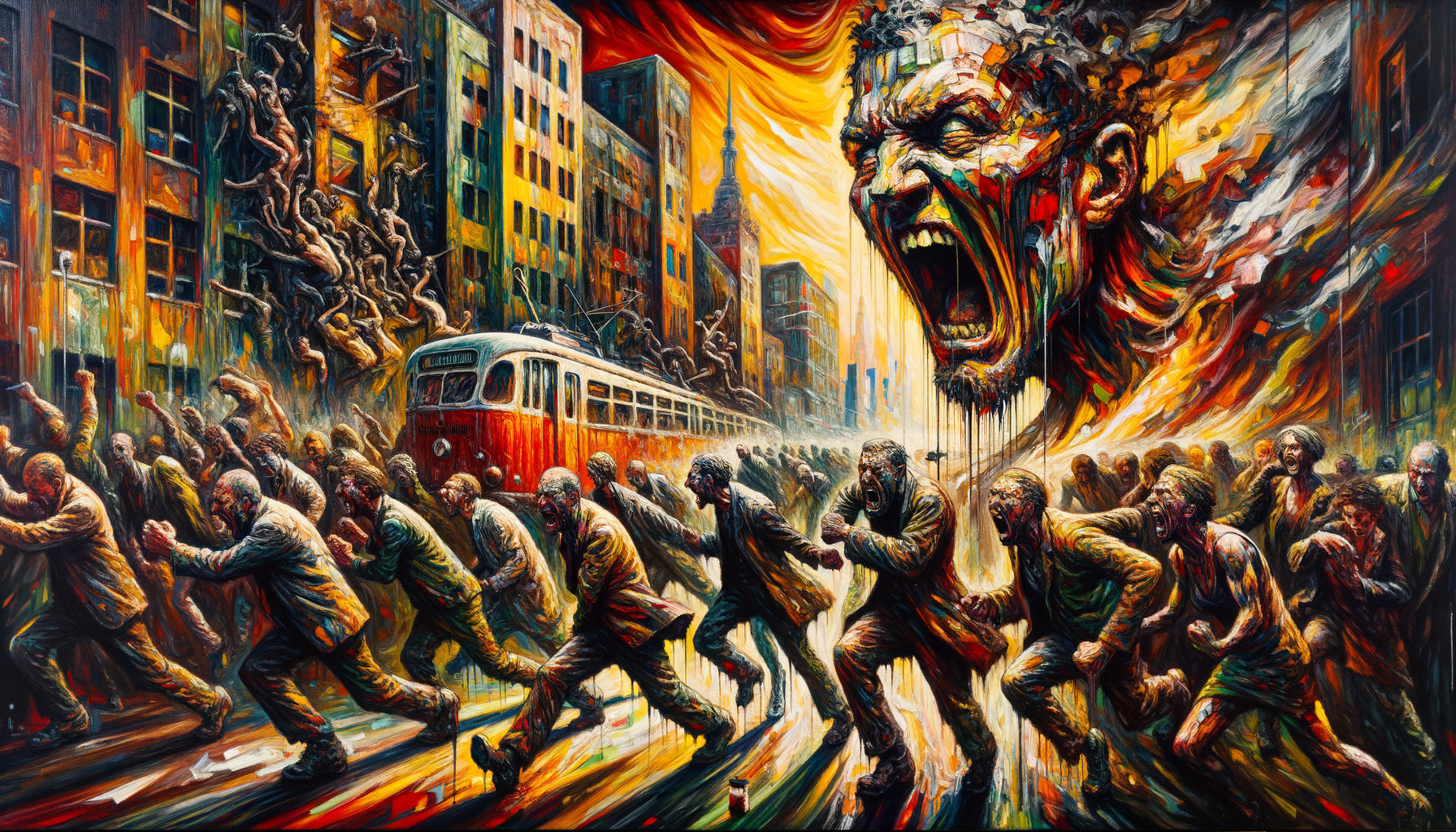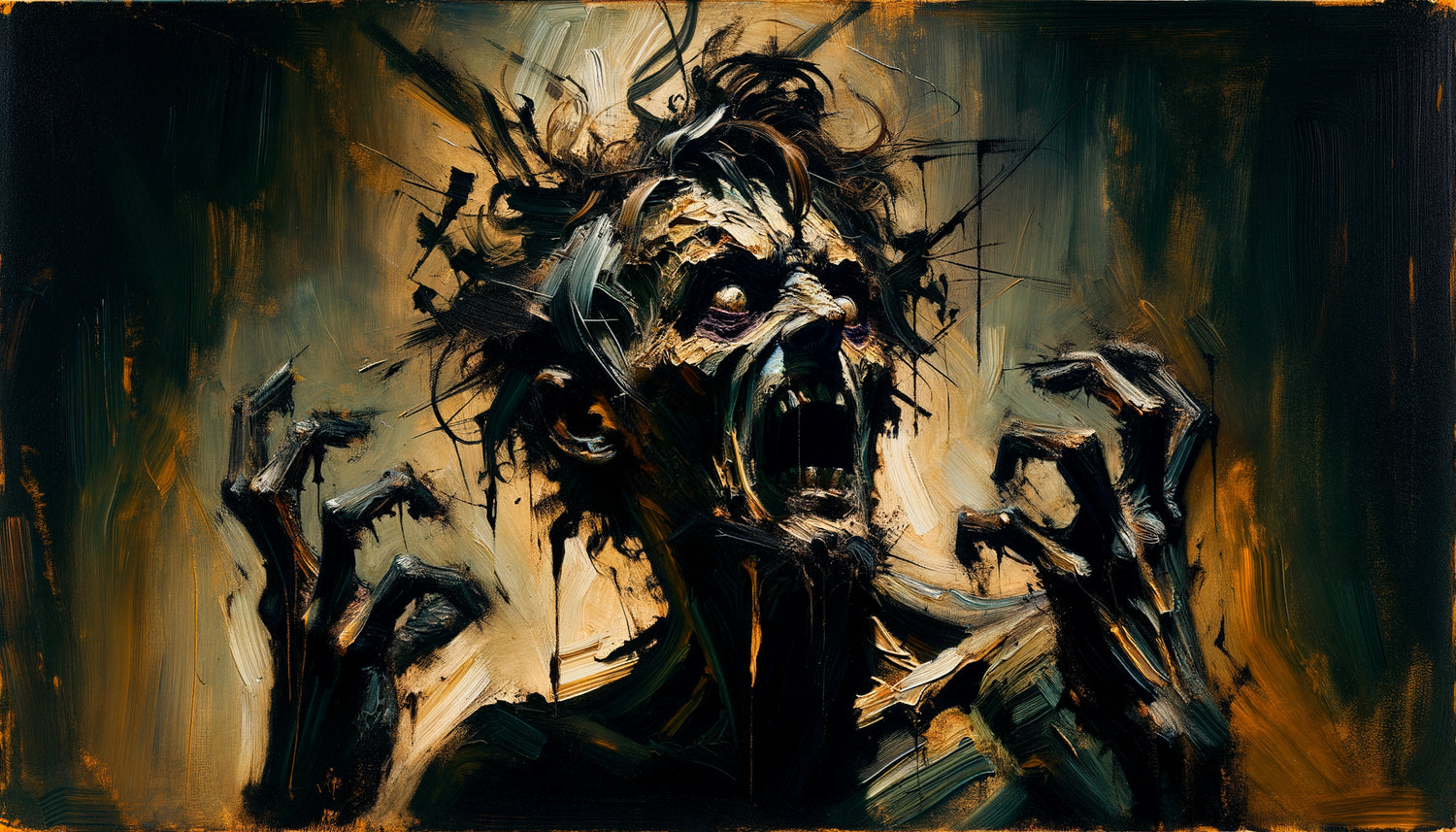
In the hushed silence of a gallery, facing certain works, something shifts. The gaze falters. These paintings do not merely decorate: they captivate, disturb, reveal. From Goya painting his nocturnal visions on the walls of his Quinta del Sordo, to Artaud's hallucinatory drawings scribbled in the urgency of suffering, madness in painting is not an accident. It is a gateway to the unspeakable, a language for what transcends words.
Here’s what madness in painting brings to your interior: an emotional intensity that electrifies the space, a narrative depth that multiplies conversations, and an aesthetic courage that defines a true decorative personality. These works transform a living room into a place of questioning, a hallway into a sensory experience.
Perhaps you hesitate to welcome these disturbing images into your home. Too strong, too dark, too charged? This fear is legitimate. We have learned to decorate to soothe, harmonize, reassure. But true art does not always seek comfort. It confronts us, awakens us, makes us grow.
Rest assured: integrating the power of madness in painting does not mean transforming your interior into a psychiatric museum. It's about dosage, dialogue, creating counterpoints. A reproduction of Goya’s Black Paintings in an office inspires creativity without tipping into oppression. An Artaud drawing in a library intensifies reflection without darkening the atmosphere.
In this article, I will take you to explore how these artists who brushed against the abyss created works of unparalleled visual force, and how you can, with discernment, bring their tormented genius into dialogue with your living space.
When Goya plunged into his inner darkness
Francisco de Goya did not always paint madness. Court painter celebrated, he immortalized Spanish nobility with elegance. Then came deafness. Isolation. Illness. And in 1819, retired to his house near Madrid, the Quinta del Sordo (the House of the Deaf), Goya undertook something unprecedented: to cover the walls of his own home with fourteen hallucinatory murals.
Not intended to be sold. Not created to please. Painted directly on plaster, these Black Paintings are a raw testament to a mind grappling with its demons. Saturn devouring his son, this titanic figure with bulging eyes tearing apart a human body, does not decorate: it transits. The Sabbath of the Witches and its grotesque faces summon a world where reason has yielded.
Madness in painting, in Goya, is not a clinical representation. It’s visceral embodiment. The furious brushstrokes, earthy ochres, deep blacks create a thick, almost palpable pictorial matter. These works exude a primal energy that continues to fascinate two centuries later.
In a contemporary interior, a framed reproduction of Saturn or the Dog (this isolated head emerging from an ocher void) creates a focal point of magnetic power. Placed facing a dark velvet sofa or on a polished concrete wall, it establishes a dialogue between ancient brutality and modern sleekness.
Asylums of the 19th Century: When Madness Became a Subject
In the 19th century, emerging psychiatry fascinated artists. Théodore Géricault visited the Salpêtrière asylum and painted his famous series of portraits of monomaniacs around 1820. These faces of the alienated, captured with a disturbing dignity, neither fall into caricature nor pity. Géricault captures something rarer: intact humanity under mental distress.
The Monomania of Envy, with its averted gaze and ambiguous smile, possesses an almost unsettling presence. These clinical portraits become, through the grace of painting, meditations on psychological fragility. Madness in painting ceases to be grotesque to become a mirror of our own vulnerability.
In an interior, these portraits work remarkably well in series of three or four, creating an intimate gallery. On a modern kitchen wall with clean lines or in a dressing room with neutral tones, they bring historical depth and restrained emotion that counterbalances functional coolness.
Van Gogh: Madness as Creative Fuel
It is impossible to evoke madness in painting without Vincent van Gogh. His stays at the Saint-Rémy-de-Provence asylum, after the ear-cutting episode, produced some of his most dazzling canvases. The Starry Night, with its swirling sky and twisted cypresses, does not represent madness: it translates its movement, spiral, devouring energy.
Saturated colors, nervous brushstrokes, expressive distortion of reality create a visual language where emotional intensity becomes form. Van Gogh did not paint on madness, but from it, transforming psychic suffering into convulsive beauty.
A reproduction of The Bedroom in Arles or the Irises in a contemporary bedroom brings this particular vibrant color. Deep blue tones dialogue beautifully with natural textiles, white linen, light woods, creating a balance between creative fever and domestic serenity.

Munch and the Scream of Modern Anguish
Edvard Munch, haunted by the early death of his mother and sister, by depression and alcoholism, turned his work into an outlet for existential anguish. The Scream, an absolute icon of madness in modern painting, transcends personal anecdote to become a universal symbol of contemporary anxiety.
This distorted face, this silent scream against a blood-red sky, these undulating lines that contaminate the landscape: Munch invents a visual grammar for the unspeakable. Madness is no longer an individual pathology but a human condition, vertigo in the face of the void.
Surprisingly, The Scream in reproduction works wonderfully in a minimalist Scandinavian interior. The paradox created – this screaming anguish in a purified space – generates a productive tension, a stimulating questioning. Simply framed, on a white wall between two windows, it becomes a daily meditation on our own domesticated torments.
Artaud : when madness becomes the brush itself
Antonin Artaud occupies a unique place in the history of madness in painting. Poet, actor, theorist, he was also a draftsman, particularly during his years of confinement in Rodez between 1943 and 1946. His spellbinding portraits, scribbled with a hallucinated violence, seek no physical resemblance.
Artaud draws faces like battlefields. Features repeated relentlessly, gaping holes in place of eyes, screaming mouths, the paper sometimes pierced by the pressure of the pencil. These drawings are conjurations, attempts to give form to the forces that tore him apart. Madness in painting reaches its paroxysm here: the creative act becomes therapeutic, magical, vital.
Artaud's self-portraits, with their graphic intensity and technical austerity, blend remarkably well into industrial or artistic interiors. On a brick wall, framed under anti-reflective glass in black metal frames, they create a ghostly and powerful presence, like a window open onto inner abysses.
The line as a primal cry
What strikes you about Artaud's drawings is the brutality of the gesture. No aesthetic complacency, no search for conventional beauty. The line is a scream, the paper becomes tormented skin. This radical honesty fascinates and disturbs.
In a creative office or an artist's studio, a framed Artaud drawing reminds us that creation often arises from chaos, that authenticity requires confronting one's own demons. This madness in painting then becomes a source of inspiration for boldness, the rejection of conformity.

How to Tame the Madness in Painting at Home
Integrating these powerful works into your interior requires a thoughtful approach. Here are some proven principles for creating a harmonious dialogue between artistic intensity and domestic comfort.
The principle of counterpoint: A strong work gains strength when it dialogues with sobriety. An Artaud drawing on an immaculate white wall, between two minimalist shelves, concentrates all the attention without saturating the space. Madness in painting needs to breathe.
The protective frame: A simple frame, matte black or natural wood, creates a reassuring boundary between the work and your space. It's not about domesticating madness but offering it a setting that contains it without stifling it.
Dramatic lighting: An angled sconce or spotlight creates a theatricality that highlights the exceptional character of the work. The surrounding dimness reinforces its impact, like a scene in the dark.
Spatial dosage: One strong piece is better than an accumulation. Choose the work that resonates most with you, place it strategically, let it shine. Madness in painting doesn't need company to assert itself.
Dare the intensity that transforms gazes
Discover our exclusive collection of paintings inspired by famous artists that bring depth and character to your interior with a selection designed to dialogue with your living space.
Beyond decoration: living with vertigo
Welcoming madness in painting into your home is not an ordinary decorative gesture. It's accepting that art isn't always comforting, that beauty can be born of turmoil, that your interior becomes a place of questioning and not just a refuge.
Every morning, catching the hallucinated gaze of Saturne or the tormented features of an Artaud self-portrait, is to remember the fragility of psychic balance, the power of the forces that traverse us, the courage it takes to create despite everything. These works become existential companions, not just decorative objects.
They spark unexpected conversations with your guests, reveal your readings, your view of the world, your rejection of the superficial. An interior that dares to embrace madness in painting affirms a complex, cultivated personality, capable of embracing shadow as much as light.
Start modestly if the exercise intimidates you. A small framed reproduction of Goya in a corner of the library. Observe how it changes the energy of the room, how your gaze returns to it, how it resists or dialogues with the rest. Then, if the experience nourishes you, dare more.
Madness in painting, from Goya to Artaud, teaches us that true art often arises at the borders of reason, where control yields, where the unconscious surfaces, where truth emerges unfiltered. Welcoming these works into your home is opening a window onto that part of the unspeakable that constitutes us all, and transforming your interior into a space of truth.
Frequently Asked Questions
Isn't it too dark to have Goya’s Black Paintings in your home?
This concern is understandable, but experience proves the contrary. Goya’s Black Paintings, despite their intensity, do not weigh down an interior if they are well placed. In a study, they stimulate creativity and concentration. In a living room with light contemporary furniture, they create a striking contrast that energizes the space rather than darkening it. The secret lies in balance: a light wall, good natural lighting, light textiles around. The work then becomes a dramatic anchor point that enhances the whole. Many collectors testify that living with Goya daily produces an effect opposite to what is feared: a stimulating presence that awakens rather than oppresses. Madness in painting, when embraced, releases creative energy in the habitat.
How do I explain these disturbing works to my children?
Children have an amazing ability to welcome the strange without judgment. Rather than hiding or sweetening, consider these works as opportunities for dialogue. With Goya, you can talk about nightmares, nocturnal fears that everyone knows, and how artists transform them into images. With Van Gogh, evoke strong emotions, sometimes sadness, and how painting helps express them. The essential thing is to adapt your vocabulary to their age without lying about the nature of the work. Madness in painting then becomes a pedagogical tool for addressing complex emotions, difference, creativity. Many children growing up with these images develop remarkable artistic sensitivity and ease when dealing with difficult subjects. Never underestimate their emotional intelligence.
What decorative styles best complement these intense works?
Paradoxically, minimalist and contemporary interiors beautifully welcome madness in painting. Scandinavian austerity, with its white walls and light woods, highlights the power of Goya or Artaud without creating visual cacophony. The industrial style – exposed brick, metal, polished concrete – naturally dialogues with the brutality of these works. The contrast between the coolness of the materials and the feverishness of the images creates a productive tension. To be avoided: already cluttered, baroque, multicolored interiors that would compete. The art of madness requires space to breathe, neutral walls to shine, an ambient sobriety that offers it all the stage. Think theater: a spotlight on a lone actor rather than a crowded scene. Modern furniture with clean lines, muted colors (grey, beige, taupe), natural materials (linen, wool, raw wood) create the ideal setting for these controlled visual explosions.