I've spent fifteen years wandering through auction houses and artists’ studios, and each time a work stops me in my tracks, it’s because it carries that invisible force: freedom. Not the freedom of political speeches, but the kind that vibrates in an angry brushstroke, in an impossible color, in a gesture that defies established order. From Delacroix's romantic barricade to street artists covering our city walls, art has never ceased being a cry for freedom. Here’s what freedom in art brings to your interior: a presence that affirms your values, an energy that transforms the space, and a conversation with living history. Perhaps you think these committed works belong in museums, that they are too political or too charged for your living room. Think again. Welcoming a reproduction of Liberty Leading the People or an engaged contemporary creation means choosing to live with a work that breathes, questions, and refuses to be just a simple ornament. I will show you how this artistic freedom has traversed the centuries and how it can enhance your everyday life.
The Delacroix Moment: When Freedom Takes Shape
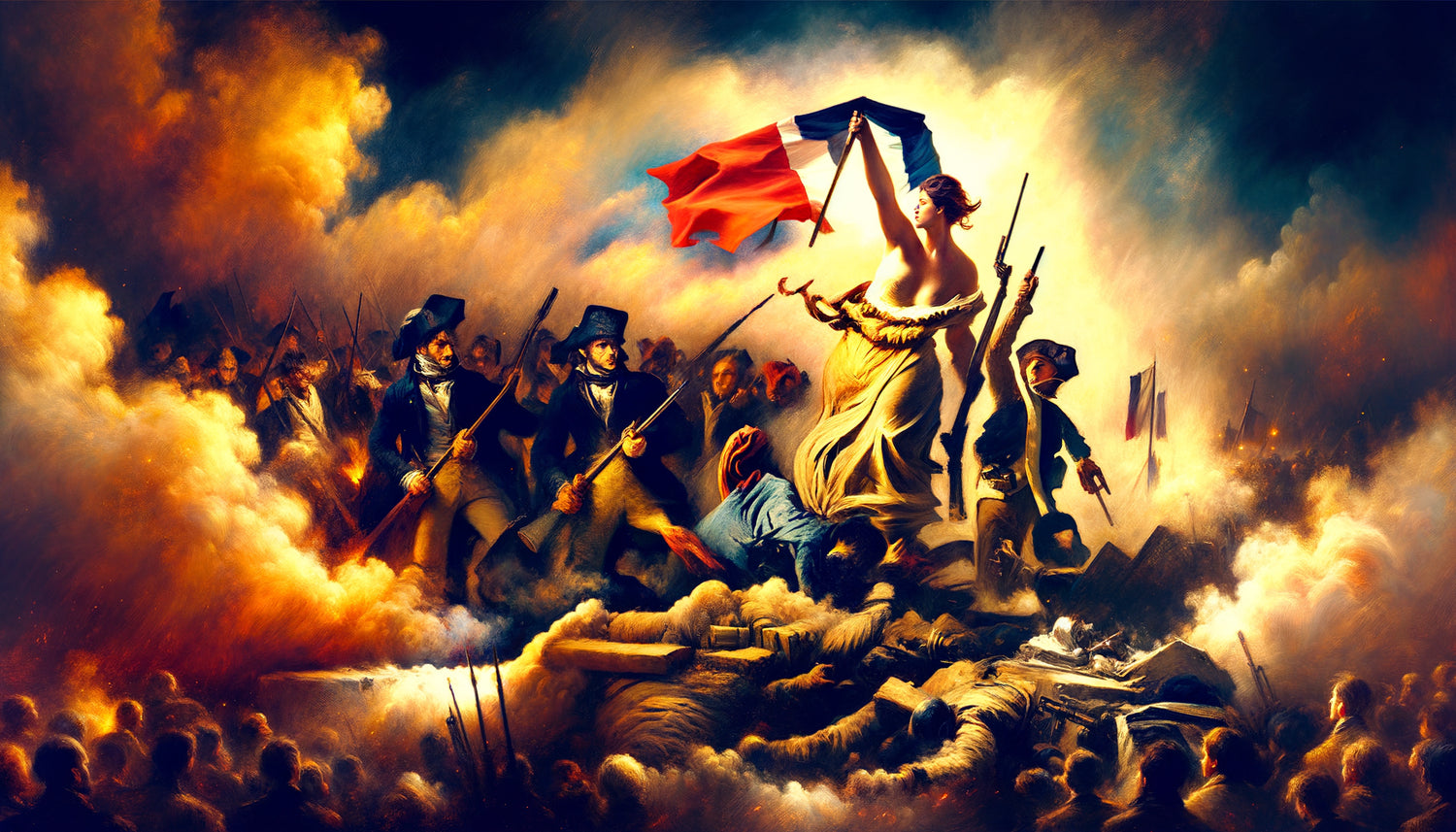
1830. Eugène Delacroix observes Paris in revolution from his window. In a few weeks, he creates what will become the very embodiment of freedom in art: a woman with bare breasts, holding a tricolor flag, striding over barricades. This is not a cold allegory from mythology, but a figure of flesh, her feet in mud and gunpowder. This work shakes everything up: classical pyramidal composition meets the violence of the present, corpses coexist with ideals. Delacroix doesn't paint freedom; he makes it surge forth in all its brutal and magnificent complexity.
What fascinates me about the Romantics is their absolute refusal of neutrality. Théodore Géricault had paved the way before him with The Raft of the Medusa, transforming a political scandal into a human epic. These artists understood that freedom is not a comfortable idea: it disturbs, it demands, it confronts us. In your interior, a reproduction of these works does not decorate; it affirms. It says that you reject blandness, that you choose intensity over indifference.
The Avant-Gardes: Liberating Form Itself
At the turn of the 20th century, freedom changes ground. It’s no longer just about representing political struggles but liberating art itself from its academic chains. Pablo Picasso shatters perspective with Cubism, Vassily Kandinsky frees color from any figurative obligation, Marcel Duchamp proclaims that an urinal can be art if the artist decides it. This formal revolution is also a revolution of freedom: who decides what is beautiful? Who imposes the rules?
When Color Becomes Militant
German Expressionists, French Fauves transform freedom into a chromatic explosion. Henri Matisse uses strident greens, violent reds that do not exist in any real nature. It's a sensory liberation: art no longer has to imitate, it can create its own world. In a contemporary interior, these bold colors retain their subversive power. A Matisse above your Scandinavian sofa creates a delightful friction, a rejection of overly wise harmony.
I have seen collectors completely transform the atmosphere of their apartment by introducing a single Fauvist work. The chromatic freedom contaminates the space: suddenly, one dares to use a bright orange cushion, one accepts that raw wood meets gilded brass. The committed artwork itself becomes a catalyst for decorative freedom.

Guernica: the timeless cry against barbarity
How can one talk about freedom in art without mentioning Guernica? In 1937, Picasso responded to the bombing of a Basque city with a monumental black and white fresco. No color, no realism, yet: the universal pain of war, the horror of dismembered bodies, the screaming horse. This work embodies the artist's freedom to refuse, to bear witness, to transform horror into awareness.
What makes Guernica eternally relevant is its rejection of propaganda. Picasso glorifies nothing: he shows suffering, period. This critical freedom runs through all contemporary struggles. When you welcome a reproduction of this work into your home, you create a space for memory and reflection. It's not morbid, it's necessary. Committed art reminds us that comfort has a price, that freedom must be defended.
Contemporary struggles: street art and visual activism
Today, freedom in art is written on the walls of our cities. Banksy stencils a girl with a red balloon that flies away, symbolizing innocence and fragile hope. Shepard Fairey creates the iconic HOPE poster for Obama, then RESIST under Trump. JR posts giant portraits of anonymous people on facades, making the invisible visible. Street art brings art back into public space, where everyone can see it, without paying an entrance fee, without permission.
Art as a peaceful weapon
Contemporary artists use creative freedom to advance human rights, climate justice, and equality. Ai Weiwei stacks life jackets from refugees on the facades of Berlin museums. Kara Walker confronts America with its slave past with cut-out silhouettes of striking violence. This militant freedom is not comfortable, but it is vital.
In your interior, integrating these contemporary voices creates a dialogue between eras. A Banksy screen print near a Delacroix reproduction shows that the fight for freedom has never ceased, that it reinvents itself with each generation. It affirms that your home is not a refuge cut off from the world, but a place where consciousness remains awake.

How to live with these works of freedom
Many hesitate to hang politically charged artworks in their homes, fearing they will be too heavy or that they will become dated. This misunderstands the freedom in art. These works are not leaflets; they are living presences. They evolve with you, your gaze changes according to world events, according to your own journey.
I saw a collector install Liberty Leading the People in her entrance hall. Every morning, when leaving for work, she met this determined gaze. She confided in me that this artwork reminded her never to compromise on her values, in a professional world that constantly pushed her to do so. Another placed a print by Frida Kahlo – an artist of personal freedom and self-affirmation – in her bedroom, as a totem of resilience.
Create engaged visual dialogues
The trick is to create constellations of meaning. Associate a classic work of freedom with a contemporary photograph of a demonstration, or with a colorful abstraction that evokes formal emancipation. The mixing of eras shows that freedom is an ongoing struggle, not a fixed achievement. Your wall then becomes a space for reflection and combative beauty.
Consider also transitional spaces: a hallway, a staircase. These transition areas are perfect for works that challenge, that create a moment of pause in everyday life. Artistic freedom is best expressed in movement rather than static contemplation.
Dare to art that refuses to be silent
Discover our exclusive collection of wall art inspired by famous artists that transform your walls into manifestos of beauty and conviction.
Freedom as the common thread in your interior
Deep down, choosing artworks on freedom for your interior is refusing to make your home neutral. It's asserting that decoration can have meaning, that beauty and commitment are not mutually exclusive. From Delacroix to Banksy, from the romantic barricade to the wall of Gaza, artists show us that freedom is never guaranteed, that it must be defended, reinvented, celebrated.
Imagine your living room as a space where the history of freedom continues to be written. Where the struggles of yesterday dialogue with the battles of today. Where your guests stop, question, debate. That's what it means to live with engaged art: transforming your interior into a living territory, where thought circulates as much as light.
Start with a work that speaks to you viscerally. Not the one you find pretty, but the one that bothers you a little, that questions you, that refuses to disappear into the decor. It is this creative friction that brings artistic freedom into your daily life. And once it's there, you won't be able to do without it.
Frequently Asked Questions
Won't political artworks divide my guests?
This is a legitimate concern, but quality engaged art transcends partisan divisions. Liberty Leading the People or Guernica are not right-wing or left-wing works: they are works on the human condition, dignity, resistance to oppression. They create dialogue rather than conflict. I have seen magnificent conversations born in front of these works, where people of different sensibilities discovered their common values. Art of freedom brings people together around the essential: the rejection of injustice, the aspiration for justice. If a work provokes a respectful discussion, it is doing its job. Your interior then becomes a space of civilization in the noble sense: a place where we think together.
How to integrate these powerful artworks without overwhelming the decor?
The secret lies in the balance of visual masses. A powerful work like Liberty Leading the People needs space around it to breathe. Avoid overloading it with other frames or decorative objects. Instead, create a main wall with your impactful artwork, and keep the rest of the space uncluttered. Simple furniture, natural materials (raw wood, linen, stone) perfectly balance the emotional density of the work. Also consider lighting: a directional spotlight creates a museum-like staging that magnifies the work while delimiting it in space. Freedom in art is better expressed in space than in accumulation. A clean interior with a powerful artwork is infinitely more striking than an overloaded wall.
Are these themes of freedom suitable for all rooms in the house?
Absolutely, but with discernment. Works of combative freedom (battles, demonstrations) work beautifully in social spaces: living room, office, entrance hall. They create a dynamic energy conducive to exchanges. For bedrooms, prioritize artists of personal freedom: Frida Kahlo with her self-portraits of resilience, Georgia O'Keeffe and her formal emancipation, or abstractions by Kandinsky that liberate color. In a child’s room, a playful reproduction of Miró or Calder (joyful freedom of forms) accompanies the imagination without oppressing it. The kitchen can accommodate engaged pop artworks, lighter in form but not in substance. Each room can express a different facet of freedom, creating a coherent journey through your interior.