I spent twenty-three years exploring contemporary art galleries throughout Europe, and one thing strikes me at every vernissage: fear remains the most magnetic emotion in painting. That tension that seizes you before certain canvases, that shiver that runs down your spine, that inability to look away. Since the day I discovered The Scream by Munch at the Oslo museum, when I was twenty years old, I understood that painted anguish possesses a unique hypnotic power.
Here's what fear in painting brings to your space: it creates a powerful emotional presence that transforms a simple wall into a visceral experience, it sparks deep conversations with your guests, and it reveals your aesthetic boldness by embracing the uncomfortable.
You may be looking to move beyond the perennial soothing landscapes and decorative florals. You want your interior to tell something more raw, more true. But how do you integrate these unsettling works without turning your living room into a morbid cabinet of curiosities? Rest assured: artistic fear, mastered, becomes sophistication. It testifies to a rare emotional maturity. I will guide you through a century of painted anxieties, from Nordic expressionism to contemporary tensions, so that you understand how these works can sublimate your interior decoration.
The silent scream that still resonates
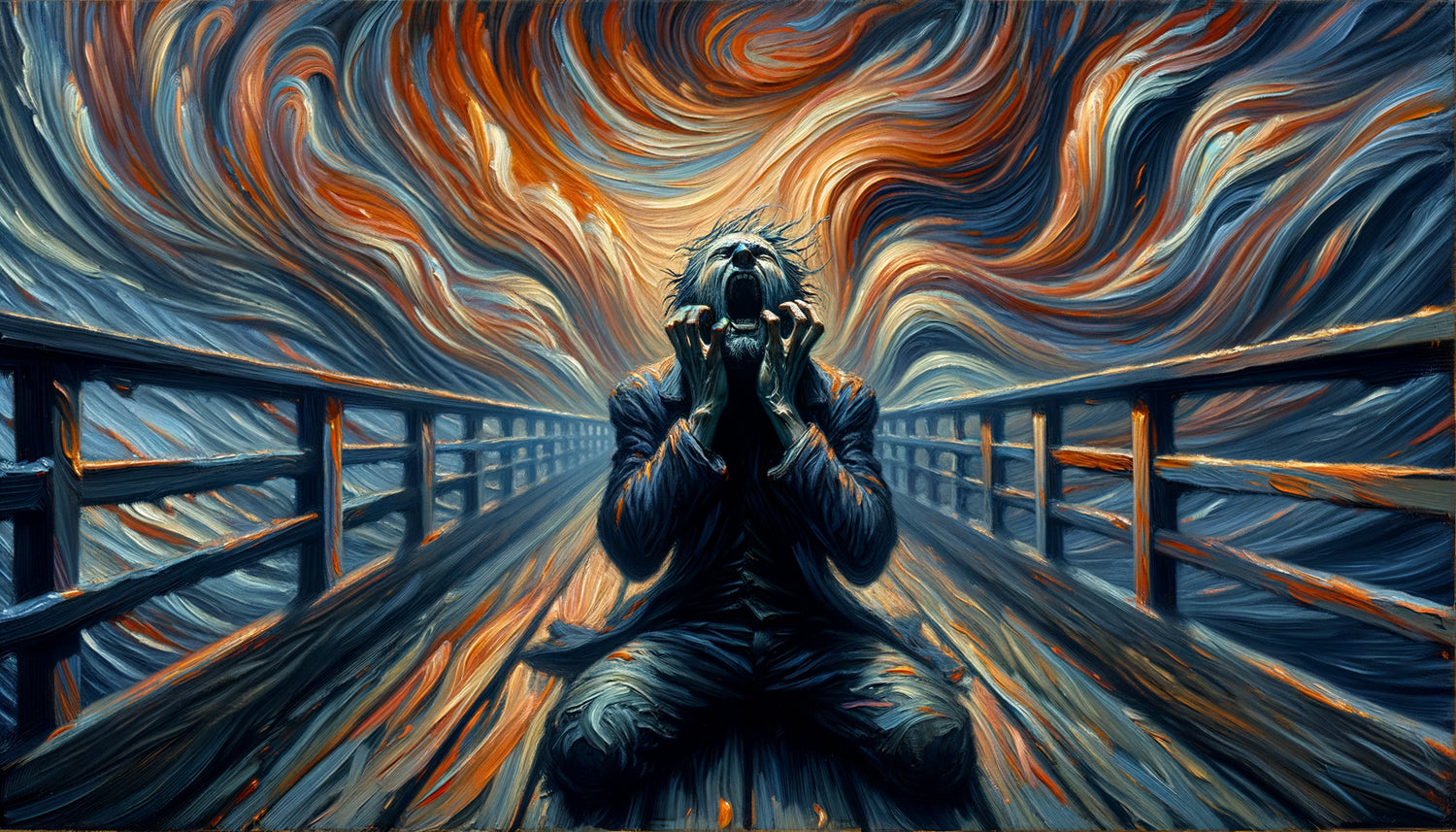
When Edvard Munch paints The Scream in 1893, he doesn't realize that he is creating the absolute icon of modern anguish. This ghostly silhouette on a bridge, mouth open in a silent scream, hands pressed to the ears, with that blood-red sky that undulates like a hallucination. I have observed hundreds of visitors in front of this canvas: all stop abruptly. All feel this existential vibration.
What is fascinating about this representation of fear is its universality. Munch captures something deeply human: that absolute solitude facing existence, that moment when the world becomes hostile and incomprehensible. The garish colors, the distorted lines, this dizzying perspective create a physical malaise in the viewer.
In a contemporary interior, a quality reproduction of The Scream works remarkably well in a hallway or entrance. It creates an emotional airlock between the outside world and your intimacy. I saw this installation at a Brussels collector's: the work welcomed visitors with extraordinary theatrical intensity, setting the tone for a home that did not shy away from emotional complexity.
German Expressionism: when fear becomes prophetic
After Munch, German expressionists amplified this aesthetic of anguish. Ernst Ludwig Kirchner, with his fragmented urban scenes and angular figures with green faces, captures the social fear of nascent modernity. His Berlin prostitutes, painted between 1913 and 1915, exude a palpable tension, an aggressive vulnerability.
Otto Dix pushes even further with his nightmarish visions of World War I. His trench paintings, broken faces, and dismembered bodies bear witness to a visceral, documentary, unbearable fear. This pictorial violence is nothing gratuitous: it denounces, warns, refuses oblivion.
George Grosz, for his part, transforms fear into acerbic satire. His grotesque bourgeois, his scenes of 1920s Berlin decadence reveal the anguish of a society on the brink of an abyss. With historical hindsight, these paintings become prophetic: they sensed the impending catastrophe.
In an office or library, these expressionist works bring a rare intellectual depth. They stimulate reflection, recall that art can be a lucid witness to its time. I accompanied the installation of a Kirchner in the study of a Parisian lawyer: the effect was strikingly appropriate.
Francis Bacon : the screaming flesh
It is impossible to evoke fear in painting without dwelling on Francis Bacon. His twisted figures, imprisoned in geometric structures, his bodies that seem to melt or explode, his faces deformed by silent screams. Bacon directly inherits from Munch, but radicalizes the approach.
What fascinates me about him is his ability to make pure existential anguish visible. Not the fear of a specific danger, but this muffled terror of being a mortal body, aware of its own fragility. His monochrome backgrounds in orange, violet or ochre create enclosed spaces, psychological torture chambers where his figures agonize.
His triptychs work beautifully in large contemporary spaces. I saw a reproduction of his Triptyque d'août 1972 in a converted industrial loft: the brutality of the work dialogued perfectly with the raw architecture, creating a powerful aesthetic coherence. Baconian fear paradoxically sublimates space through its dramatic intensity.

Modern anxieties : new faces of fear
Contemporary art has not abandoned the representation of fear, it has updated it. Anxieties have changed face: generalized surveillance, ecological disaster, dissolution of identity in the digital age, hyper-connected solitude.
Artists like Anselm Kiefer paint historical and memorial fear, with his apocalyptic landscapes laden with ashes and lead. His monumental canvases evoke ruins, collective guilt, the crushing weight of the past. Jenny Saville, with her massive and distorted bodies, explores contemporary body anxieties, the tyranny of aesthetic norms.
Marlene Dumas paints ghostly faces, between life and death, which capture a diffuse anxiety, without a specific object. Her portraits seem to float in an unsettling in-between space. Adrian Ghenie revisits historical figures of totalitarianism with an expressionist gesture that makes political terror visible.
These contemporary works blend remarkably well into current minimalist interiors. Their emotional intensity creates a perfect counterpoint to the neutrality of purified spaces. I advised a Kiefer canvas for a completely white Scandinavian apartment: the contrast effect was electrifying.
How to integrate fear into your decoration
Hanging an unsettling work at home is not a trivial decorative act. It requires boldness, but above all spatial strategy. First rule: choose the location according to the emotional intensity. The most violent works (Bacon, Dix) work best in passageways or semi-private spaces: hallways, staircases, personal offices.
More subtle representations of anxiety (Munch, some Kiefer) can invest the living room or dining room, where they become catalysts for conversation. I noticed that these works radically change the atmosphere of dinners: discussions become deeper, more authentic.
Second tip: lighting is crucial. An anxious work requires directional, dramatic lighting that accentuates its shadows. Avoid diffused lighting that would soften it. An adjustable spotlight, slightly lateral, creates contrasts that amplify the emotional impact.
Third point: the color environment. These intense works work best on neutral walls (white, dark gray, even black) which leave them all the space. Avoid surrounding them with other works that are too present: they require breathing room around them.
The emotional balance of your interior
A frequent mistake would be to multiply these anxiety-inducing works throughout the space. Fear in painting works like a strong emotional accent, not as a dominant tone. In a house, I recommend a maximum of two or three works of this register, balanced by spaces of visual rest.
Think of your interior as a musical score: moments of tension must alternate with pauses. A Munch in the entrance finds its counterpart in a bedroom with soothing tones. A Bacon in the office dialogues with a more serene living room.
I have accompanied collectors who lived surrounded only by disturbing works: the effect became oppressive, saturating. Artistic fear reveals its full power when it contrasts with other emotional registers. It is this dialectic that creates the richness of a cultivated interior.
Dare to emotional intensity on your walls
Discover our exclusive collection of wall art inspired by famous artists that will transform your interior into a space for reflection and authentic emotion.

Fear as an act of decorative courage
Ultimately, hanging a representation of fear in your home is a remarkable gesture of aesthetic maturity. You reject the ease of consensual and reassuring images. You accept that your interior reflects the complexity of human existence, with its shadows and vertigoes.
I have seen this transformation in initially hesitant clients: once the work is installed, their relationship to their space changes completely. They rediscover their living room, their hallway becomes a place of experience and not just a passage. Artistic fear awakens dormant spaces.
These works also age remarkably well. Unlike ephemeral decorative trends, a Munch, a Bacon, a Kiefer cross fashions without ever becoming obsolete. They carry a timeless human truth that defies the ages.
Perhaps start modestly: an expressionist engraving in a simple frame, a small format Munch in your office. Observe how this presence changes your perception of space. Listen to the reactions of your visitors. You will find that these works create unexpected emotional bridges, release words usually held back. Fear shared artistically paradoxically becomes a space for deep human connection.
Frequently asked questions
Won't an unsettling work darken the atmosphere of my interior?
It’s the most common fear I hear, and it’s legitimate. But experience shows otherwise: a work with intense emotional impact paradoxically gives more depth and character to your space. It doesn't darken it; it enriches it with a sophisticated dramatic dimension. Think of the most beautiful interiors you have visited: they often feature powerful, even disturbing works. The key is overall balance. If your decor remains bright, clean, with noble materials and light colors throughout the rest of the space, an anxiety-inducing work creates a magnetic focal point without weighing down the general atmosphere. I’ve seen living rooms bathed in natural light, furnished with light woods and natural textiles, enhanced by a Munch or German Expressionist who brought that emotional counterpoint preventing the space from falling into blandness. Artistic angst, dosed intelligently, becomes sophistication.
Are these works appropriate if I have children?
An essential question that I fully understand. My experience has taught me that children react differently than adults to these representations. They are often fascinated rather than frightened because they don't yet have all our cultural filters. The
How to choose between a reproduction and an original work by a contemporary artist exploring fear?
This question touches on the heart of your collector's approach. Museum-quality reproductions of masterpieces (Munch, Bacon, German Expressionists) offer a remarkable quality-emotion ratio. Current printing technologies faithfully reproduce textures, chromatic nuances, and the visual impact of the original. For a few hundred euros, you bring home a masterpiece that has marked art history. This is an excellent starting point for exploring this emotional register. On the other hand, if your budget allows and you wish to support living creation, investing in an original work by a contemporary artist exploring anxiety becomes both an aesthetic and ethical act. You participate in today's artistic economy, you own a unique piece that will potentially increase in value. In contemporary art galleries, many young artists are working on these anxiety-inducing themes with original approaches. My advice: start with a beautiful reproduction of a classic to understand how you live with this emotional intensity, then if the experience convinces you, invest in a contemporary original that will extend this exploration.