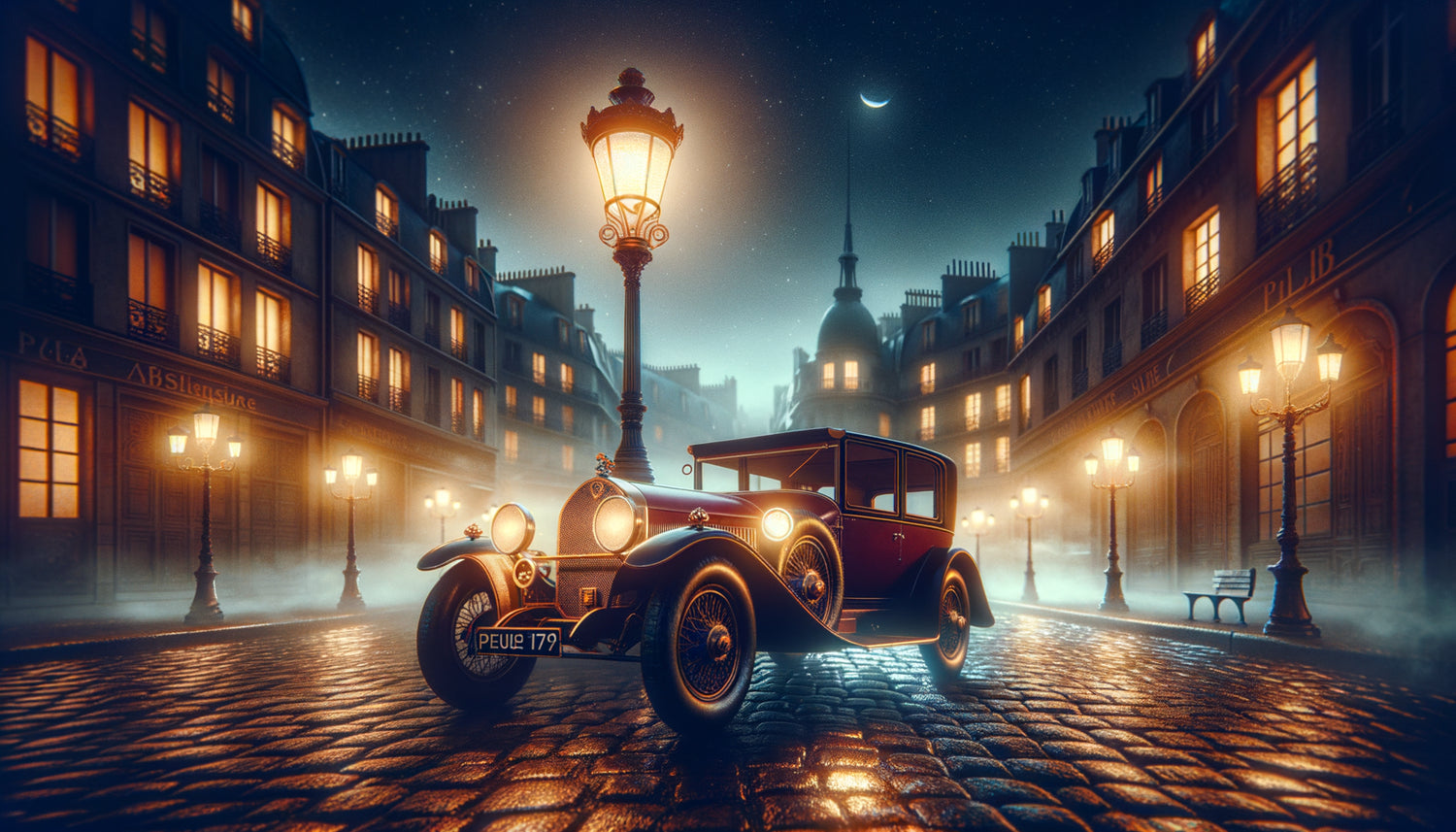
It's midnight. The streetlights of the Place de la Concorde draw golden halos on the wet pavement. A Peugeot Type 176 slows down beside you. The door opens. Fitzgerald beckons you to get in. You hesitate for a second, then plunge into the Parisian night of the 1920s. This feeling of stepping back in time, Midnight in Paris offers it to each viewer as an unexpected sensory journey.
Here's what Midnight in Paris brings: a poetic reinvention of the Roaring Twenties Paris, a meditation on creative nostalgia, and a visual celebration of the golden age of art that continues to inspire decorators, creators, and dreamers today.
We all seek this fantasized Paris, that of sepia prints and literary cafes. We hang vintage posters above our sofas hoping to capture something timeless. But how do we transform this diffuse nostalgia into concrete inspiration for our interiors?
Midnight in Paris shows us the way. Not that of a museum reconstruction, but that of an emotional resonance between two eras. Woody Allen's film then becomes much more than a romantic comedy: it is a visual manifesto for all those who seek to infuse the spirit of the Roaring Twenties into their contemporary daily lives.
When images awaken a bygone era
From the first minutes, Midnight in Paris unfolds a visual love letter to the French capital. But the real magic happens when Gil, played by Owen Wilson, crosses the temporal threshold at midnight. Woody Allen doesn't simply recreate the 1920s: he reinvents them through the golden filter of collective memory.
This nostalgia for the Roaring Twenties first manifests itself in the light. Director of photography Darius Khondji bathes each nighttime scene in amber, copper, almost sepia tones. The interiors of clandestine balls and literary salons breathe a tactile warmth that contemporary LED screens seem to have forgotten.
Look at how the lamps with shades diffuse their light in Gertrude Stein's apartment. Observe the reflections of chandeliers on the dark wood paneling of the bar where Hemingway toasts. These details are never gratuitous: they build an atmosphere that every decoration enthusiast immediately recognizes as authentically Parisian.
Color as a temporal marker
The chromatic contrast between contemporary Paris and that of the Roaring Twenties structures all the visual narrative. The day belongs to the present: saturated colors, harsh light, cold tones that recall tourist postcards. But as soon as midnight strikes, the film switches to an ochre, burgundy, aged gold, and bottle green palette.
This color scheme visually translates what Gil feels: the present seems bland to him, the past incandescent. For our interiors, this lesson is valuable. Recreating the spirit of Midnight in Paris doesn't mean accumulating antique furniture, but understanding how warm colors and multiple light sources transform the atmosphere of a space.
Decor as Characters in Their Own Right
In Midnight in Paris, each location tells a story. The apartment rented by Gil and his fiancée illustrates modern bourgeois comfort, impersonal despite its moldings. In contrast, the salons of the 1920s are full of personality: overflowing libraries, walls covered with paintings, mismatched armchairs that invite conversation.
Gertrude Stein receives guests in a space where every horizontal surface supports books, manuscripts and works of art. This cultivated disorder reflects an era when interiors expressed the passions of their inhabitants. Woody Allen captures this fundamental difference: the film's contemporary spaces seem designed to be photographed, those of the Roaring Twenties to be lived.
The film's speakeasies deserve special attention. Dark wood paneling, worn velvet banquettes, tarnished mirrors that multiply the silhouettes of dancers. These compact and smoky spaces exude more sensuality than vast minimalist lofts. The lesson for our contemporary interiors? Intimacy trumps space, texture over surface.
Furniture as a Temporal Anchor
Observe the chairs around the table where Fitzgerald, Hemingway and Zelda are discussing. None perfectly match each other. This heterogeneity reflects how interiors were actually built in the 1920s: through accumulation, inheritance, flea market finds.
Today, this approach resonates with the trend towards vintage furniture and mixing eras. Midnight in Paris reminds us that the most memorable interiors are never those from a catalog, but those that bear the traces of a personal history.

Nostalgia as a Creative Engine
At the heart of Midnight in Paris lies a crucial question: does our fascination with the past prevent us from fully living in the present? Woody Allen explores this paradox with tenderness. Gil idealizes the Roaring Twenties, but discovers that Adriana, for her part, dreams of the Belle Époque, which itself fantasized about the Renaissance.
This mise en abyme of nostalgia directly speaks to anyone seeking to recreate the atmosphere of a bygone era in their decor. The film does not condemn this desire; it refines it. True inspiration lies not in servilely reproducing the past, but in extracting its essence to nourish our present.
For an interior, this means embracing the spirit of Parisian Roaring Twenties rather than transforming your living room into a museum reconstruction. Integrate an authentic Art Deco lamp next to a contemporary sofa. Frame lithographs from the 1920s in modern frames. Mix eras with the same freedom as the characters in the film cross time.
Art as a connecting thread between eras
Works of art punctuate every scene of the 1920s in Midnight in Paris. We see Cubist paintings at Gertrude Stein's, Modigliani drawings in Adriana's studio, Toulouse-Lautrec posters on the walls of the cabarets. Woody Allen understands that art was not merely a backdrop in the Roaring Twenties, but the common language of a generation.
This omnipresence of art structures the visual identity of the era that the film resurrects. The characters do not just talk about art; they live surrounded by creation, they breathe the aesthetics of their time. Each interior becomes an informal gallery where paintings, sculptures and found objects dialogue.
For our contemporary interiors, Midnight in Paris offers a valuable lesson: art should never be relegated to the status of decorative accessory coordinated with the sofa. It should challenge, question, create conversations. Just like in Parisian living rooms where Hemingway debated with Picasso.
The literary salon revisited
The scenes at Gertrude Stein's embody the ideal of the Roaring Twenties literary salon. A space where art, literature and ideas blend naturally. The walls are overflowing with paintings, the shelves are laden with books, the seats invite prolonged discussion.
Transposing this spirit today does not require a Haussmann apartment. It is enough to design a generous reading corner, to hang works that really speak to you, to prioritize comfortable seating that encourages conversation. The contemporary living room inspired by Midnight in Paris then becomes a living space, not a frozen staging.
Transform your interior into a journey through time
Discover our exclusive collection of famous artist inspired paintings that capture the essence of the roaring twenties and infuse your daily life with this timeless Parisian magic.

The rituals that build the atmosphere
Beyond the decor, Midnight in Paris shows how the roaring twenties were lived through specific social rituals. Aperitifs that last forever, improvised dinners, heated discussions about art and literature that go on until dawn. These moments shape the atmosphere as much as the furniture or lighting.
Woody Allen films these scenes with palpable nostalgia, but also lucidity. He shows that the magic of Parisian roaring twenties was not only due to sumptuous decor or elegant outfits. It resided in a certain way of inhabiting time, prioritizing conversation over efficiency, aesthetic experience over productivity.
This temporal dimension of the film inspires our relationship with our interiors. A space inspired by Midnight in Paris is not only visually consistent, it encourages certain practices: receiving without haste, creating corners conducive to prolonged reading, installing a bar where slowly preparing a cocktail becomes a ritual in itself.
From nostalgia to living inspiration
The genius of Midnight in Paris lies in its nuanced treatment of nostalgia. The film never falls into blind celebration of the past. Through Gil's journey, Woody Allen suggests that our fascination with a bygone era can become sterile if it prevents us from investing in our present.
The final scene, where Gil chooses to remain in his own time while retaining his sensitivity as an artist, summarizes this wisdom. The nostalgia for the roaring twenties then becomes productive: it is no longer a flight from the present, but a source of inspiration to transform it. Gil does not abandon his love for the 1920s, he learns to sublimate it in his contemporary creation.
For our interiors, this conclusion offers a clear direction. Drawing inspiration from Midnight in Paris and the aesthetics of the Roaring Twenties doesn't mean recreating a domestic museum. It’s more about drawing on that era for elements that resonate with our current sensibilities, and integrating them in a lively, organic, personal way.
Imagine your living room transformed. A vintage Art Deco lamp casts its warm light on a contemporary armchair. On the wall, a reproduction of a work from the 1920s dialogues with a modern photograph. On the console, a few bound books coexist with a contemporary sculpture. You have created a space that honors the past without being imprisoned by it, that breathes nostalgia without melancholy. A place where it is good to receive, read, dream. A space both rooted in your time and nourished by the magic of Paris that Midnight in Paris captures so well.
Woody Allen's film ultimately reminds us that eras never really disappear. They continue to live on in the objects we cherish, the spaces we create, the rituals we perpetuate. The Roaring Twenties are not locked away in history books: they simply await our reinvention, in our interiors, today.