I spent fifteen years touring European auction houses, appraising canvases in the dusty reserves of great collectors, and I can tell you: nothing transforms a space like a gaze. Not just any gaze. The one that follows you, questions you, seems to guess your thoughts as you walk through your living room early in the morning. Rembrandt's psychological portraits possess this rare intensity, this ability to create an almost palpable presence in a room. Unlike smooth decorative portraits that adorn so many contemporary interiors, these works become true silent interlocutors of your daily life.
Here is what the Rembrandtesque gaze art brings to your decoration: an emotional depth that transcends trends, a human presence that warms modern spaces, and that touch of psychological authenticity that makes an interior truly tell a story.
You may have already felt this frustration: your interior is impeccably arranged, the colors blend perfectly, the furniture is high quality, and yet... something is missing. That soul, that particular vibration that transforms a well-decorated space into a truly inhabited place. Many think that integrating classical artworks into a contemporary interior creates a mismatch, that dark 17th century portraits have no place in our bright lofts or Scandinavian apartments.
Let me reassure you: I've seen reproductions of Rembrandt portraits enhance minimalist interiors as much as traditional bourgeois living rooms. The secret lies not in the style of your decoration, but in understanding what these gazes bring to your space. In this article, I will reveal how psychological portraits can become the missing element of your interior, and how to integrate them properly to create that emotion you are looking for.
The gaze revolution: when Rembrandt invents the psychological portrait
In the 1630s, as Dutch portrait painters excelled at faithfully reproducing the features and costumes of Amsterdam's bourgeoisie, Rembrandt van Rijn made a radical break. Instead of painting frozen social masks, he began to capture the inner life of his models. I was fortunate enough to study his Self-Portrait at the Age of 34 closely at the National Gallery in London, and what struck me was this unsettling impression that the painter evaluates you as much as you look at him.
This approach completely transforms the decorative function of a portrait. Where a classic portrait affirms a social status or embellishes a wall, the psychological portrait creates a relationship. It questions, moves, intrigues. In an interior, this changes everything: instead of a simple visual element, you install a presence.
The chiaroscuro technique at the service of emotion
What Rembrandt masters like no one else is the use of chiaroscuro to direct the gaze towards the essentials: the eyes, the hands, the expression on the face. The dark backgrounds are not a free aesthetic choice, but a psychological strategy. By plunging the background into shadow, he concentrates all attention on the humanity of the model. For your decoration, this means that such a portrait does not need to be immense to have an impact. A reproduction of medium format, well lit, will create more presence than a large impersonal decorative canvas.
Why psychological portraits transform your living spaces
I have advised dozens of collectors and art lovers in the arrangement of their interiors. What consistently comes back is this observation: rooms where a psychological portrait inspired by Rembrandt is installed become the favorite spaces in the house. Not necessarily the most beautiful on Instagram, but those where you like to linger, read, converse.
There is a scientific reason for this. Neuroscience has shown that our brains react to human faces, even painted ones, by activating areas related to empathy and social cognition. A painted gaze of quality unconsciously stimulates our attention and well-being. That's why a living room with an expressive portrait always seems warmer, more lived-in, even in your absence.
The antidote to contemporary coldness
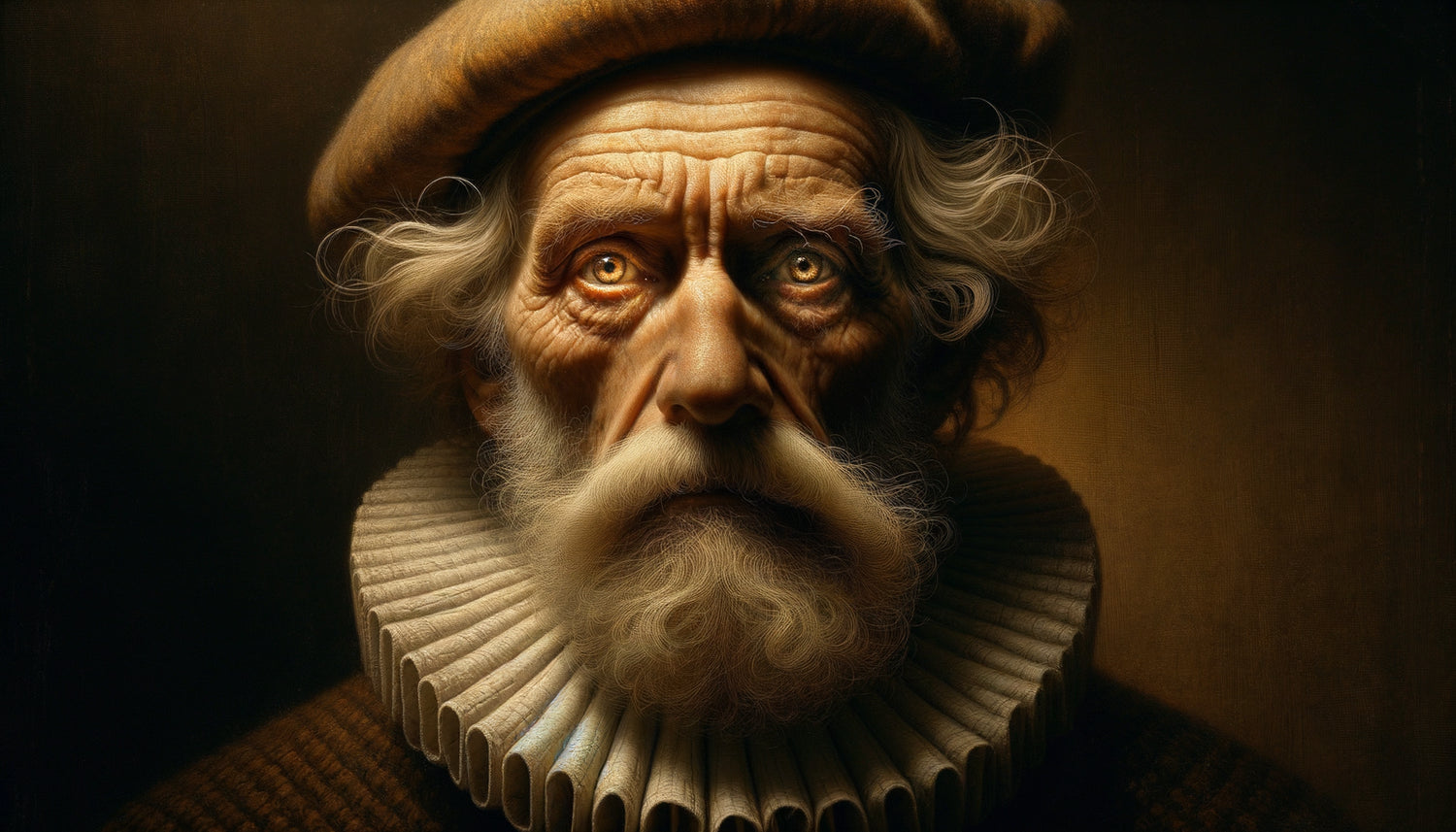
Modern interiors, with their clean lines and neutral palettes, gain enormously from the addition of this pictorial humanity. I have seen an industrial loft in Brussels completely transformed by the installation of a reproduction of Rembrandt's Portrait of an Old Man. The polished concrete, steel and glass created a sophisticated but distant setting. The portrait, with its ochre warmth and melancholic gaze, instantly brought that missing emotional dimension. The contrast between the modernity of the materials and the timelessness of the gaze created a fascinating aesthetic tension.

How to integrate a psychological portrait into your decoration
The most common mistake I see? Treating a Rembrandt portrait like any other decorative work. You hang it above the sofa, between two symmetrical wall lights, and wait for the magic to happen. But these works require a different approach.
First, consider the conversational placement. A psychological portrait works best in a space where you spend time contemplatively: an office, a reading corner, a dining room rather than a kitchen. The idea is to create a possibility of visual dialogue, not simply a decorative background.
The crucial question of lighting
If you invest in a quality reproduction of a Rembrandt-esque portrait, lighting will determine 50% of its impact. Forget halogen spotlights that crush the nuances. Opt for indirect, slightly lateral lighting that recreates the original chiaroscuro effect. A table lamp with an adjustable lampshade, placed at mid-height, can enhance a canvas by giving it that almost three-dimensional depth characteristic of Rembrandt.
I've developed a simple rule: if you see reflections on the surface of the painting, your lighting is poorly positioned. The portrait’s gaze must remain accessible, never obscured by parasitic glare.
Psychological portraits in different rooms of the house
Each space in your interior offers different opportunities to welcome a psychological portrait. In an office or study, the gaze of a philosopher or scientist painted by Rembrandt creates an atmosphere of concentration and reflection. I myself have a reproduction of his Philosopher in Meditation in my workspace, and I assure you that this silent presence favors deep thought.
In a bedroom, a more delicate approach: avoid gazes that are too intense or questioning which could disrupt rest. Opt for portraits with gentle, contemplative expressions. Saskia’s Portrait, with its melancholic tenderness, is perfect for this intimate space.
For a living room or library, you can dare to use the most powerful portraits. It is here that a late Self-Portrait by Rembrandt, with all its emotional charge and existential depth, will fully deploy its power. These reception and conversation spaces benefit from this strong presence which naturally becomes a subject of exchange with your guests.
The art of wall composition
Contrary to popular belief, a psychological portrait can quite integrate into a wall composition, but with caution. It must remain the focal point, the dominant element. Around it, you can arrange smaller frames, studies, engravings, but never other faces that would compete. The desired effect is that of a main portrait surrounded by its cultural context, not a gallery of conflicting gazes.

Choosing the right reproduction for your interior
After fifteen years of evaluating artworks, I can assure you that an excellent reproduction is infinitely better than a mediocre original. What matters for the decorative impact of a psychological portrait is the fidelity of nuances, the depth of shadows, the subtlety of chromatic transitions. High-end digital prints on canvas, with protective varnish, remarkably restore these essential qualities.
Always check the quality of the eye details. That's where everything happens. The eyes of a Rembrandt portrait contain dozens of nuances, tiny but essential reflections of light. A reproduction that flattens these subtleties loses 90% of its psychological power. Ask for close-up photographs before buying, or prioritize suppliers specializing in reproductions of classical art.
Beyond Rembrandt: the legacy of the psychological portrait in decoration
If Rembrandt remains the undisputed master of the psychological portrait, his approach has inspired generations of artists whose works also work wonderfully in our contemporary interiors. Frans Hals brings a complementary dynamism and spontaneity. Vermeer, with his colder light and more enigmatic psychology, creates a different atmosphere, even more meditative.
The important thing is to understand the principle: you are not simply looking for a beautiful painting, but a gaze that dialogues with your space. This distinction completely transforms your approach to artistic decoration. You no longer ask "will it go with my sofa?" but rather "what presence do I want to invite into this room?
Transform your interior with the power of a gaze
Discover our exclusive collection of paintings inspired by famous artists that will bring this emotional depth and unique presence to your living spaces.
Conclusion: inviting humanity into your decoration
Rembrandt's psychological portraits are not mere decorative elements, but true presences that transform the way you inhabit your spaces. In a world where our interiors sometimes become impeccable but cold Instagram backdrops, these gazes filled with humanity remind us of what really matters: emotion, connection, depth.
Start simply. Choose a portrait whose gaze touches you personally, install it in a space where you spend time contemplating, and take care of its lighting. Then observe how your relationship to that space evolves. You will probably discover what so many collectors have experienced before you: a psychological portrait does not simply decorate a wall, but transforms the entire atmosphere of a room by imbuing it with that rare and precious quality of authentic human presence.
Frequently Asked Questions
Will a dark Rembrandt portrait darken my bright interior?
It's a legitimate concern, but my experience proves exactly the opposite. Rembrandt’s portraits, with their chiaroscuro technique, actually create points of visual depth that enrich light spaces rather than darkening them. The contrast between a white or light wall and the warm ochre-brown tones of a Rembrandt portrait generates a fascinating aesthetic tension. What matters is balance: in a very bright Scandinavian or minimalist interior, a psychological portrait becomes an emotional anchor that prevents the space from feeling impersonal. Just ensure proper lighting for the painting itself, and you will find that it brings warmth and character without visually weighing down the room. Some of my most satisfied clients have installed reproductions of Rembrandt in their all-white lofts, creating this perfect dialogue between refined modernity and classical depth.
How do I know which psychological portrait will suit my personality and interior?
Selecting a psychological portrait is deeply personal and should never be reduced to a simple chromatic agreement with your decor. I always recommend a two-step approach. First, explore the different Rembrandt portraits without thinking about your interior: which one touches you emotionally? In front of what gaze do you feel challenged, moved, intrigued? This instinctive connection is fundamental because you will live with this presence daily. Only then consider the suitability for your space: the atmosphere you want to create (contemplative, warm, intellectual), the function of the room, and the intensity of the gaze (a very intense gaze for an office or library, softer for a bedroom). Don't hesitate to live with temporary printed reproductions for a few days before investing. Some portraits speak to us immediately, others reveal their power gradually. Trust your feelings: if a gaze accompanies you in thought after discovering it, it is probably the right choice for your interior.
Do psychological portraits suit contemporary and minimalist interiors?
Absolutely, and I would say that they find their most powerful expression there. Minimalist interiors sometimes suffer from an excess of formal perfection which makes them cold and unwelcoming. A Rembrandt psychological portrait brings exactly what is missing: humanity, imperfection, emotional depth. The contrast between the geometric simplicity of contemporary furniture and the psychological complexity of a Rembrandt gaze creates an extraordinary visual dynamic. I have seen Japanese design interiors, industrial lofts, Scandinavian apartments transformed by the addition of a single well-chosen portrait. The key is to treat it as the unique focal point of the room, which perfectly corresponds to minimalist principles: few elements, but each significant and powerful. In a clean decor, the psychological portrait is not a decorative addition, but the emotional heart of the space. Simply avoid overloading: if your interior is minimalist, a single quality portrait will have infinitely more impact than an accumulation of works.