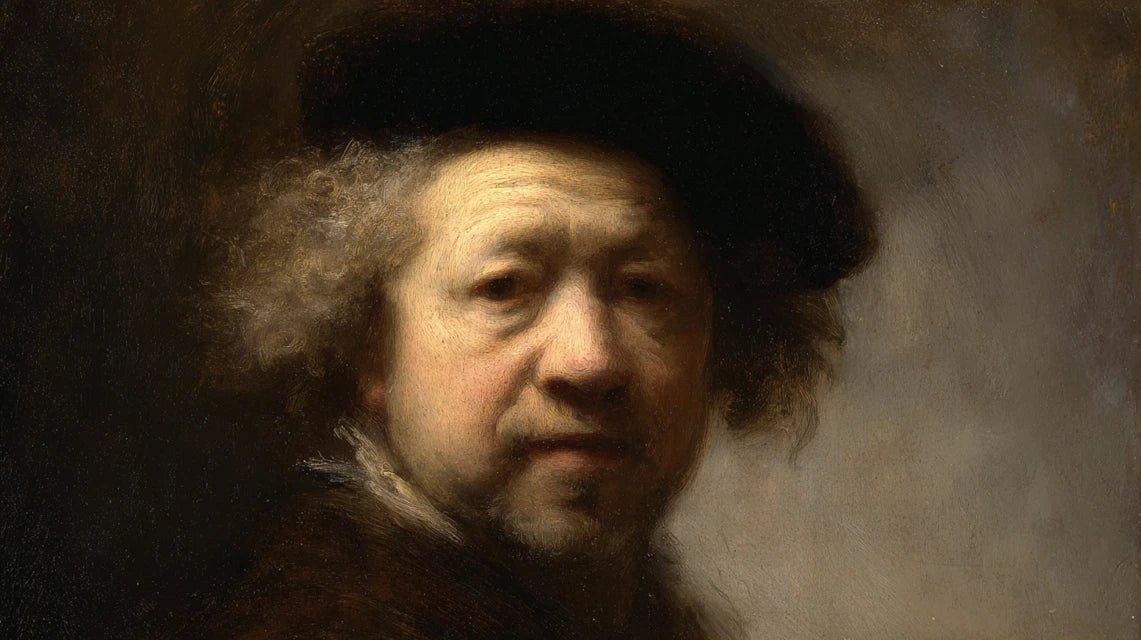
In the silent workshop of Amsterdam, a man stands before his mirror, brush in hand, scrutinizing each wrinkle that carves into his aging face. For the hundredth time perhaps, Rembrandt van Rijn is about to paint himself, transforming his own image into an eternal witness of a revolutionary era.
This obsession with self-portraiture reveals far more than a simple artist's vanity. It unveils the tormented soul of a genius who revolutionized Western art, invented the psychology of portraiture, and mastered like no other the language of light and shadow. His brush captured the essence of humanity with an intensity that four centuries have not managed to equal.
But who was this man who painted more than 90 self-portraits, experienced glory and ruin, and bequeathed to humanity some of the greatest masterpieces of all time? His story goes far beyond that of a simple painter: it is the tale of an artistic revolution led by a man grappling with his inner demons.
Discover the man behind the myth, his revolutionary innovations, his personal dramas and the timeless legacy that makes him the undisputed master of chiaroscuro.
Rembrandt van Rijn: The Painter Who Revolutionized Portrait Art
Understanding Rembrandt means grasping how one man transformed European painting by inventing a new way of seeing humanity. His revolutionary approach to psychological portraiture and technical mastery of chiaroscuro defined artistic codes for centuries to come.
| Biographical Highlights | Artistic Legacy |
|---|---|
|
Full name: Rembrandt Harmenszoon van Rijn Born: July 15, 1606, Leiden, Netherlands Died: October 4, 1669, Amsterdam Nationality: Dutch |
Movement: Dutch Golden Age school
Rembrandt van Rijn as a Child: The Roots of Artistic Genius in Leiden
In the prosperous city of Leiden, at the heart of the Dutch Golden Age, grows a child destined to shake up art history. Son of Harmen Gerritszoon van Rijn, a miller by profession, and Neeltgen Willemsdochter van Zuytbrouck, daughter of a baker, young Rembrandt is immersed from an early age in the laborious and prosperous atmosphere of Dutch bourgeois life.
The awakening of artistic talent in van Swanenburgh's workshop: At the age of fourteen, his parents noticed his exceptional drawing skills and enrolled him with Jacob van Swanenburgh, a renowned painter from Leiden. It is in this workshop filled with the scents of pigments and linseed oil that Rembrandt discovers the mysteries of oil painting and develops his fascination for plays of light and shadow.
The revelation of artistic individuality: From his earliest works, Rembrandt distinguished himself by refusing to idealize his models. Unlike his contemporaries who systematically embellished their subjects, he chose to reveal the psychological truth of each face, including its imperfections.
Rembrandt and the Dutch Golden Age: An artist at the heart of the Dutch age of glory
The time of Rembrandt corresponds to the peak of Dutch power. The United Provinces dominate world trade, Amsterdam becomes the financial capital of Europe, and a prosperous bourgeoisie emerges, eager for artistic representations of its social success.
This economic boom creates an unprecedented art market. Unlike Italy or France where art remains dominated by religious and royal commissions, the Calvinist Netherlands develop a bourgeois art, intimate, centered on daily life and family portraits.
Rembrandt evolves alongside giants such as Johannes Vermeer, Frans Hals, and Jacob van Ruisdael. Each excels in their specialty: Vermeer masters domestic light, Hals captures the instantaneity of gesture, Ruisdael sublimates landscapes. But Rembrandt transcends these categories by creating a total art.
The influence of the Protestant Reformation profoundly marks his work. Calvinism, which rejects ostentatious religious art, pushes artists towards more human, more introspective subjects. This spiritual revolution nourishes the psychological research that characterizes Rembrandt's art.
The alchemy between prosperity and spirituality: Rembrandt succeeds in synthesizing perfectly the bourgeois demand for prestige portraits and the spiritual requirement of inner truth. His works satisfy social vanity while revealing the depth of the human soul.
Rembrandt in Amsterdam in the 1630s: The arduous conquest of the artistic capital
In 1631, at twenty-five years old, Rembrandt permanently leaves Leiden to settle in Amsterdam. The economic capital of the Netherlands represents the Holy Grail for any ambitious artist, but competition is fierce. The young painter must establish himself against established masters in a city where every street corner houses a workshop.
His first months are marked by financial uncertainty. He shares the workshop of art dealer Hendrick van Uylenburgh, an arrangement that allows him to save on rent while accessing a wealthy clientele. It is in this precarious context that he paints some of his finest commissioned portraits, honing his technique of psychological modeling.
The meeting with Saskia van Uylenburgh, niece of his protector, transforms his personal and professional life. Their marriage in 1634 opens the doors to Amsterdam's high bourgeoisie for him, but also access to an expensive lifestyle that will tragically mark his financial destiny.
These years of Amsterdams training shape his artistic character. Confronted with the demands of a sophisticated clientele, he develops this unique ability to flatter the ego of his models while revealing their true nature. Each commission becomes a laboratory for psychological experimentation.
This formative period will lead him to create his most controversial masterpiece, which will simultaneously consecrate his genius and precipitate his social downfall.
Rembrandt and the scandal of The Night Watch: when genius defies conventions
The year 1642 marks a dramatic turning point in Rembrandt's career. The delivery of "The Night Watch" provokes an unprecedented outcry in Amsterdam’s bourgeois circles. This revolutionary work breaks all the codes of traditional group portraiture.
Commissioned by the Company of Frans Banning Cocq, this collective portrait was to celebrate the civic guard according to established canons: egalitarian arrangement of characters, uniform lighting, poses frozen in bourgeois dignity. Rembrandt delivers a dynamic composition where some characters emerge from the shadows while others disappear into the gloom.
The commissioners feel betrayed. Several members of the civic guard, relegated to obscurity, demand a partial refund. This controversy reveals the fundamental conflict between Rembrandt's artistic vision and the social expectations of his time.
The philosophy of true art: Asked about his artistic choices, Rembrandt is said to have declared: "I paint what I see, not what you want to see. Art that flatters is nothing more than decorative lie." This uncompromising position illustrates his revolutionary conception of art as a revealer of truth rather than an instrument of social prestige.
Far from discouraging him, these criticisms strengthen his determination to explore new artistic territories, particularly in the art of self-portraiture where he will reach unparalleled heights.
Rembrandt's revolutionary art: master of chiaroscuro and inventor of psychological portraiture
From the 1640s, Rembrandt develops a completely unprecedented artistic language that revolutionizes European painting. His mastery of chiaroscuro surpasses that of all his contemporaries, creating dramatic effects of an intensity never before equaled.
His creative laboratory focuses on exploring the human soul through his numerous self-portraits. From 1629 to 1669, he paints himself more than ninety times, transforming his own face into a field of artistic and psychological experimentation.
Rembrandt's "The Pilgrims on the Road to Emmaus": masterpiece of spiritual emotion
"The Pilgrims on the Road to Emmaus" (1648) perfectly illustrates his artistic revolution. In this work, Rembrandt abandons baroque theatricality for a revolutionary intimate approach. The moment of divine revelation becomes a bourgeois genre scene, humanizing the sacred with an unprecedented boldness for the time.
The impasto technique he develops allows him to literally sculpt the pictorial matter. His thick, visible touches give the painting a tactile texture that breaks with the polished finish of official art. This technical innovation serves an artistic vision: to reveal the materiality of human existence.
Rembrandt's revolutionary technique: impasto and dramatic light
His workshop becomes a veritable laboratory of experimentation. He mixes precious pigments - ultramarine, vermilion, terre d'ombre - with less noble materials, creating unprecedented textures. His palette, deliberately restricted to browns, ochres and golds, generates a chromatic harmony of infinite richness.
Rembrandt versus Rubens and Van Dyck: three giants, three visions
Compared to Peter Paul Rubens and Antoine van Dyck, his Flemish contemporaries, Rembrandt develops a diametrically opposed approach. Where Rubens favors color exuberance and Van Dyck aristocratic elegance, Rembrandt chooses bourgeois introspection and psychological truth.
A revealing anecdote: visiting Rubens' workshop in Antwerp, Rembrandt is said to have commented: "Master Peter paints for palaces, I paint for souls." This philosophical difference explains why his art, less spectacular than that of his rivals, touches the universal human experience more deeply.
OUR RECOMMENDED PRODUCTS
This artistic revolution was accompanied by a personal tragedy that would profoundly mark the last decades of his creation.
Rembrandt's complex personality: between creative genius and fragile man
Behind the artistic genius lies a man struggling with personal dramas that paradoxically nourish his creation. The death of Saskia in 1642, after only eight years of marriage, plunged Rembrandt into deep melancholy which permeates his mature works.
His tumultuous relationships with Hendrickje Stoffels, his common-law partner, reveal a passionate but unstable personality. Their liaison, socially reprehensible at the time, earned him the wrath of the Reformed Church and the ostracism of the conservative bourgeoisie. These personal trials enrich his emotional palette and give his late portraits an unparalleled psychological depth.
His impulsive financial behavior precipitated his ruin. A compulsive collector of Oriental artworks, ancient armor, and rare objects, he accumulated debts leading to bankruptcy in 1656. This economic catastrophe, far from breaking his creativity, freed his art from all commercial constraints.
The portraits of his later years reveal a man appeased, reconciled with his human condition. His late self-portraits show a face etched by hardship but illuminated by painfully acquired wisdom.
This profound humanity, nurtured by personal trials, explains the universal resonance of his work through the centuries.
Rembrandt's posthumous glory: from misunderstanding to universal veneration
Paradoxically, the recognition of Rembrandt as an absolute genius only occurs after his death. During his lifetime, apart from his early years of success in Amsterdam in the 1630s, he experienced a progressive decline in popularity with the bourgeois public, destabilized by the evolution of his style towards introspection and less decoration.
The decisive turning point in his posterity began in the 19th century with the Romantic movement. Artists such as Eugène Delacroix and Théodore Géricault rediscovered in him the precursor of modern art, who dared to prioritize emotion over ideal beauty.
Rembrandt's market value: record prices on the international market
The evolution of his price perfectly illustrates this progressive recognition. Today, Rembrandt ranks among the most highly valued artists in the world, with his works reaching dizzying heights at international auctions.
| Period | Average value | Record sale |
|---|---|---|
| Rembrandt's era (1606-1669) | 500 to 2000 Dutch guilders | 3000 guilders for a commissioned portrait |
| 18th-19th century | Progressive rediscovery, prices rising | £50,000 in 1890 |
| Contemporary market | €15 to €50 million for a major work | $180 million for "Portrait of Marten Soolmans" (2015) |
This exceptional valuation reflects the universal recognition of his revolutionary contribution to Western art and the lasting influence of his work on generations of contemporary artists.
Rembrandt's death in 1669: the end of a genius, the birth of a myth
Rembrandt passed away on October 4, 1669 in the modest house on the Rozengracht in Amsterdam, far from the splendor of his years of glory. His later works, with their astonishing technical freedom, foreshadow modern art by over a century.
His funeral, almost anonymous, tragically contrasts with the immense posterity that awaits him. Only a few faithful accompany his remains to his final resting place, unaware that they are losing one of the greatest geniuses in Western artistic history.
Rembrandt's influence on contemporary art: from Van Gogh to Lucian Freud
His legacy permeates modern painting. Vincent van Gogh sees him as the master of pictorial emotion, Pablo Picasso draws inspiration from his revolutionary compositions, Francis Bacon draws on his portraits to reveal existential anguish.
More recently, Lucian Freud and Jenny Saville perpetuate his approach to psychological truth in contemporary portraiture. His impasto technique directly influences the School of London and the new realists of the 21st century.
Recognizing the Rembrandt legacy in current art: Look for works that prioritize psychological truth over ideal beauty, introspection over spectacle, and the materiality of painting over a smooth finish. These characteristics reveal the direct influence of the Dutch master.
Discovering Rembrandt today: the Rijksmuseum and world collections
The Rijksmuseum in Amsterdam holds the largest worldwide collection with "The Night Watch" as an absolute jewel. The Louvre, the Hermitage Museum in Saint Petersburg, and the National Gallery in London also possess major works accessible to the public.
For a complete approach, the Rembrandt House (Museum Het Rembrandthuis) in Amsterdam faithfully reconstructs his studio and presents his engraving techniques, offering a unique immersion into the master's creative universe.
🎁 Special offer for readers
Because you took the time to learn, enjoy 10% discount on your first order:
⏰ Valid 72h after reading • Applicable to all our products
Frequently Asked Questions about Rembrandt van Rijn: everything you need to know about the Dutch master
Rembrandt Harmenszoon van Rijn (1606-1669) was a Dutch painter, miller’s son who revolutionized Western art. He became famous for his innovations in psychological portraiture, his mastery of chiaroscuro, and his more than 90 self-portraits which constitute a unique intimate journal in the history of art. His fame rests on his ability to reveal the human soul in his paintings.
Rembrandt began his apprenticeship at 14 with Jacob van Swanenburgh in Leiden, then perfected his skills under Pieter Lastman in Amsterdam. Lastman taught him the art of historical painting and dramatic composition. This classical training, which he subsequently revolutionized through his personal approach, gave him the technical foundations necessary for his artistic innovations.
Rembrandt perfectly mastered impasto (thick paste) and chiaroscuro (play of shadows and light). His revolutionary technique consisted of modeling the pictorial matter to create texture effects while using light to reveal the psychology of the characters. Unlike his contemporaries who favored a smooth finish, he left his gestures visible, foreshadowing modern art.
The evolution of Rembrandt’s style towards introspection and less decorative elements baffled his usual bourgeois clientele accustomed to flattering portraits. The scandal of "The Night Watch" in 1642, where he prioritized art over social conventions, marked his progressive marginalization. His bankruptcy in 1656 and his uncompromising artistic choices distanced him from commercial success, although this period produced his deepest works.
Rembrandt’s works are among the most expensive in the world. A major painting can be worth between 15 and 50 million euros, with records exceeding $180 million like for "Portrait of Marten Soolmans" in 2015. Original prints are more accessible, between 5000 and 100000 euros depending on rarity. For enthusiasts, quality reproductions offer an affordable alternative to discover his universe.
Rembrandt still massively influences contemporary art through his conception of psychological truth in portraiture. From Van Gogh to Lucian Freud, and Francis Bacon, modern artists draw on his approach to introspection and his impasto technique. His refusal to idealize his models paved the way for modern realism and contemporary conceptual art.
Rembrandt van Rijn: The Eternal Modernity of the Master of Shadows and Light
More than three centuries after his disappearance, Rembrandt continues to fascinate with his unique ability to reveal the universality of the human condition. His genius lies in this perfect alchemy between revolutionary technique and psychological depth that transcends eras and touches directly on pure emotion.
In the age of digital imagery and conceptual art, his lesson remains strikingly relevant: true art does not lie in technical perfection or ideal beauty, but in the ability to reveal the authenticity of human beings in all their complexity. His self-portraits, an unrelenting chronicle of the passage of time, remind us of our common fragility and our universal thirst for truth.
Discovering Rembrandt today is embarking on a journey into oneself, guided by an artist who dared to show that authentic beauty is born from accepting our imperfections. His legacy extends far beyond the artistic realm: he teaches us the art of looking beyond appearances to touch the essential human.
Art as a mirror of the soul: Let yourself be carried away by the Rembrandt universe and discover how a 17th-century painter can still illuminate your own quest for truth and personal authenticity.