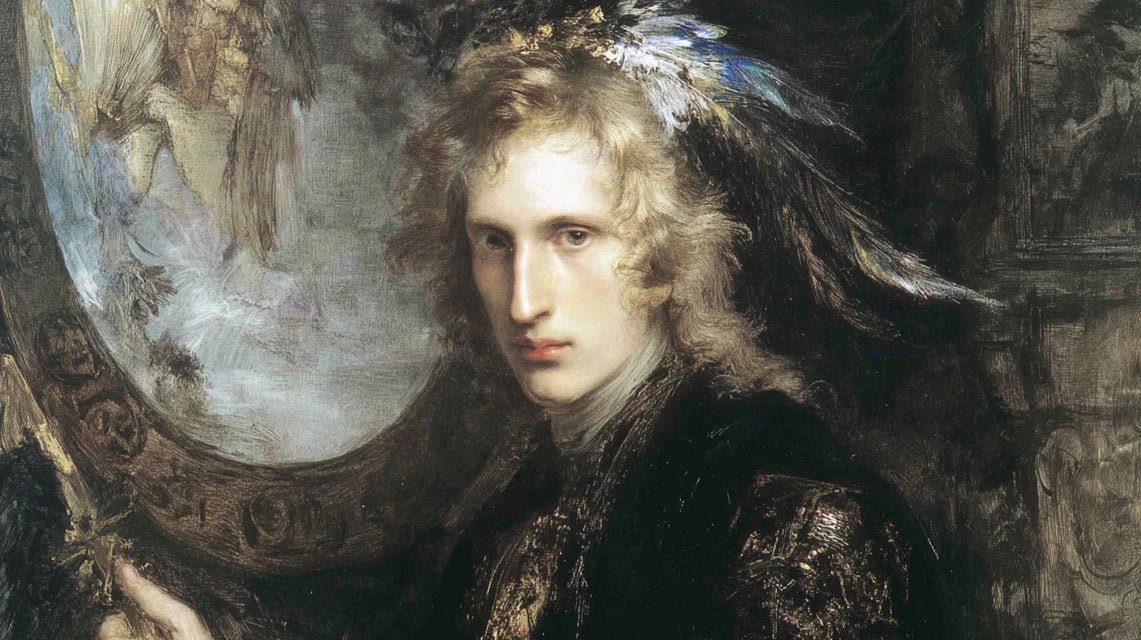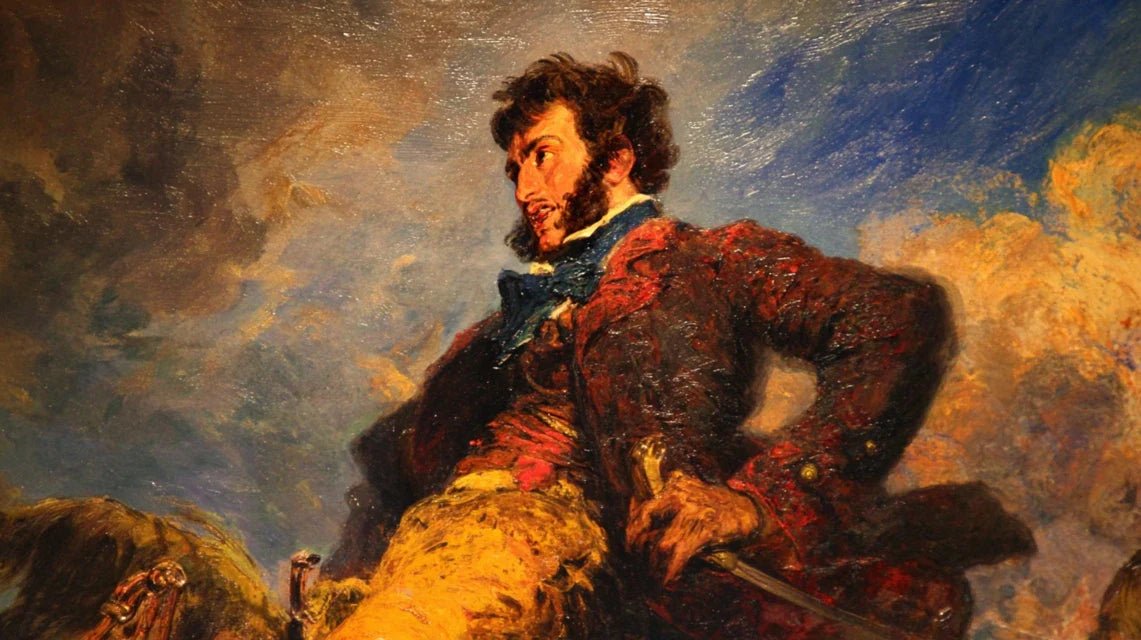
Imagine a brush that ignites the canvas, colors exploding like fireworks, and at the heart of this creative storm, a man with fiery eyes painting revolution with the same passion he lives his artistic life.
In the hushed salons of 19th-century Paris, where art was expected to be wise and measured, Eugène Delacroix makes an impact like a bomb. His paintings vibrate, his characters seem ready to leap out of the frame, and his colors sing a melody that no one had dared compose before.
Why does this man, born in the shadow of Napoleon and dying under the Second Empire, continue to fascinate art lovers around the world? How did a painter considered scandalous during his lifetime become one of the absolute references of French Romanticism?
Discover the fascinating story of Eugène Delacroix, the master of color who freed painting from its academic chains to give birth to modern art - an artistic revolution that still resonates today.
Eugène Delacroix: The Master of French Pictorial Romanticism
Knowing the true story of Eugène Delacroix means understanding how one man managed to radically transform the art of his time by giving passionate soul to French painting. Far from legends and simplifications, his biography reveals a complex creator, torn between tradition and innovation.
| Biographical Highlights | Artistic Legacy |
|---|---|
| Full name: Ferdinand Victor Eugène Delacroix Birthdate: April 26, 1798, Charenton-Saint-Maurice Death date: August 13, 1863, Paris Nationality: French |
Movement: Pictorial Romanticism Style: Colorist Expressionism Flagship work: Liberty Leading the People Innovation: Revolution of pure color |
Eugène Delacroix: From Mysterious Origins to Artistic Revelation
The childhood of Eugène Delacroix is steeped in a mystery that will haunt him throughout his life. Born into an educated bourgeois family, he grew up with doubt about his true paternity. His official father, Charles Delacroix, minister of the Republic, may not be his biological father.
The creative spark is born from a drama: At age seven, young Eugène loses his father. This early loss shapes his melancholic character and heightened sensitivity. It is by obsessively drawing that the child tames his pain, revealing precocious talent that amazes those around him.
The founding principle of his art : From his earliest works, Delacroix understood that emotion should take precedence over technical perfection. This revolutionary conviction radically distinguished him from his contemporaries and heralded modern art.
Delacroix and His Time : Art at the Heart of 19th Century Revolutions
Eugène Delacroix evolves in a France undergoing profound change. Born under the Directory, trained under the Empire, revealed under the Restoration, he experiences all the political upheavals of the nascent 19th century. This instability fuels his tumultuous artistic vision.
The artistic climate of the time is dominated by the neoclassicism of David and Ingres. Official art promotes pure lines, ancient subjects, and formal perfection. In this context, Delacroix's passionate approach causes a scandal: his free brushstrokes and vibrant colors defy the established order.
His contemporaries Géricault, Corot, and Daumier share some of his concerns, but Delacroix pushes the revolution further. Where Géricault remains attached to dramatic realism with The Raft of the Medusa, Delacroix transcends reality to reach the pure expression of emotion.
The revolutions of 1830 and 1848 shake French society and find in Delacroix their passionate chronicler. His paintings become the ardent mirror of an era in turmoil, capturing the revolutionary spirit in compositions of striking modernity.
Delacroix's genius facing his time : He achieves the feat of creating art deeply rooted in the concerns of his time while developing a timeless pictorial language that still influences contemporary artists.
The Years of Struggle of Delacroix : When Genius Faces Misunderstanding
The professional beginnings of Eugène Delacroix are marked by a fierce struggle against the artistic establishment. In 1822, his first major painting, Dante and Virgil in Hell, provokes outrage at the official Salon. Critics denounce his "barbaric" technique and his "screaming" colors.
An illuminating episode of his determination unfolds in 1824. Rejected by several collectors for The Massacres of Scio, Delacroix persists despite scathing criticism. Stendhal himself described the work as a "massacre of painting." Yet, the artist refuses to yield to pressure and maintains his vision.
His pivotal meeting with Théodore Géricault transforms his artistic perception. The master of The Raft of the Medusa encourages his search for expressiveness and transmits his passion for English colorists, particularly Constable. This influence will be decisive in the evolution of his palette.
These difficult years forge his indomitable artistic character. Each rejection, each acerbic criticism reinforces his conviction that art must move rather than seduce. This philosophy, misunderstood by his contemporaries, will become the foundation of modern art.
But it is precisely this intransigence that will soon trigger the most resounding controversies of his career...
Delacroix the Scandalous: When Art Challenges Bourgeois Conventions
Eugène Delacroix does not simply paint differently: he revolutionizes the very conception of art. His works provoke resounding scandals in 19th-century bourgeois Paris, where art must be moral and edifying.
The most significant controversy erupts with The Death of Sardanapale in 1827. This orgy of violence and sensuality deeply shocks. Critics denounce a work as "immoral" and "barbaric." The bourgeois public, accustomed to neoclassical virtues, does not understand this explosion of passions.
Delacroix fully embraces his revolutionary artistic vision. For him, art must reveal human passions in their raw truth, without embellishment or complacency. This conception clashes with a society that prefers art as decorative entertainment rather than as a disturbing revelation.
His artistic philosophy in one sentence: "One must be of one's time and paint what one sees," he declared, rejecting rigid academicism in favor of a living art, pulsating with contemporary emotions.
These passionate debates paradoxically transform the reception of his art. Each controversy increases his notoriety and attracts the attention of enlightened collectors. Negative criticism inadvertently becomes an instrument of promotion for an art that rejects mediocrity.
This tumultuous period prepares for the emergence of his most emblematic masterpiece, a work that will synthesize all his artistic revolution...
Delacroix's Revolutionary Art: Master of Color and Movement
From 1830, Eugène Delacroix reaches full artistic maturity. The political revolution that shakes France finds in him its most passionate interpreter. It is in this seething context that he creates his most famous and symbolic work.
The inspiration for Liberty Leading the People comes from observing the Parisian barricades of July 1830. Moved by popular heroism, he transforms this emotion into a universal allegory of freedom. The work is born from this alchemy between realism and idealism.
Liberty Leading the People: A Masterpiece by Eugène Delacroix
This revolutionary canvas synthesizes all of Delacroix's art: dramatic movement, vibrant colors, powerful symbolism. The figure of Liberty, both an ancient goddess and a woman of the people, perfectly embodies his vision of popular and noble art. The three national colors structure the composition with unparalleled pictorial genius.
His signature technique relies on color complement theory which he develops before the Impressionists. Rather than mixing hues on his palette, he juxtaposes them directly onto the canvas, creating chromatic vibrations of striking modernity.
Delacroix's Technical Innovations: A Revolution of Pure Color
Delacroix revolutionizes painting practice by abandoning traditional modeling in favor of pure color. His vigorous impastos, transparent glazes and scumbles create unprecedented material effects. He uses wide brushes and often paints with a palette knife, techniques considered vulgar by academicism.
Delacroix versus Ingres: Two Opposing Visions of Art
The rivalry with Jean-Auguste-Dominique Ingres symbolizes the conflict between two artistic conceptions. Where Ingres favors pure line and a polished finish, Delacroix defends expressive color and free handling. This opposition structures all of 19th century French art.
A story illustrates this difference perfectly: visiting Ingres' studio, Delacroix exclaims at the technical perfection, but later confides that this art "freezes his blood". For him, perfection without emotion is equivalent to the death of art.
OUR RECOMMENDED PRODUCTS
This artistic revolution is accompanied by a complex personality that shines through in each of his creations...
The Fascinating Personality of Delacroix: The Artist and the Man
Unlike the image of the bohemian painter, Eugène Delacroix leads a bourgeois and cultivated life. A refined dandy, an admirer of classical music and literature, he frequents the most prestigious Parisian salons. This duality between private wisdom and creative fervor fascinates his contemporaries.
The most significant event in his private life remains his trip to Morocco in 1832. This discovery of the Orient radically transforms his palette and vision. Dazzled by African light and shimmering costumes, he fills his notebooks with sketches that will nourish his inspiration until his death.
His personality reveals a man of contradictions: shy in society but bold on the canvas, conservative in politics but revolutionary in art, refined epicurean but hardworking. These paradoxes give his work its unique psychological richness.
This human complexity explains the emotional depth of his creations and prepares for the late but brilliant recognition of his genius...
Delacroix's Recognition: From Scandal to Artistic Glory
The official recognition of Eugène Delacroix gradually arrives from the 1840s. The French State begins to entrust him with prestigious commissions: the decorations for the Palais Bourbon library (1838-1847) and the Salon de la Paix at the City Hall mark his institutional consecration.
The decisive success comes with the Universal Exhibition of 1855. An entire room is dedicated to him, presenting 35 of his major works. The public finally discovers the coherence and power of his artistic universe. This retrospective definitively transforms his reputation.
The Value of Delacroix's Works: Evolution of the Art Market
The evolution of his price reflects the change in artistic tastes. Long shunned by traditional collectors, his art gradually finds its audience among enlightened enthusiasts and visionary dealers like Paul Durand-Ruel.
| Period | Average Value | Record Sale |
|---|---|---|
| During his lifetime (1820-1863) | 500 to 5,000 francs | 15,000 francs (state orders) |
| Posthumous period (1863-1950) | 10,000 to 100,000 francs | 2 million francs (1920s) |
| Contemporary market (1950-2024) | 500,000 to 5 million euros | 16.2 million euros (2018) |
This constant valuation is a testament to the timeless relevance of his art and prepares for the major influence he will exert on future generations...
Delacroix's Death in 1863: Testament of a Revolutionary
The last years of Eugène Delacroix are marked by intense creativity despite declining health. Until his death on August 13, 1863, he paints with the same passion, leaving French art a creative testament of unparalleled richness: more than 850 paintings and 1500 drawings.
His disappearance symbolically coincides with the emergence of modern art. The modern School of Fine Arts is born that same year, and future Impressionists begin to develop the innovations he initiated. This perfect timing makes him the bridge between classical art and modernity.
Delacroix's Influence on Contemporary and Modern Art
His direct legacy is found with the Impressionists: Monet, Renoir and Cézanne take up his research on pure color. Van Gogh copies his works and Picasso draws inspiration from his Women of Algiers for his own variations. This lineage runs through all modern art.
Contemporary artists like Gerhard Richter or Anselm Kiefer perpetuate his expressive approach to pictorial matter. His conception of art as a direct emotional language still influences creators of the 21st century, proving the universality of his artistic message.
Recognizing the Delacroixian legacy today: Observe in contemporary art the primacy of expression over representation, the expressive use of color and gestural freedom - as many innovations as he initiated more than 150 years ago.
Where to Discover Delacroix's Works: Guide to Worldwide Collections
Amateurs can admire his masterpieces at the Louvre (Liberty Leading the People, The Death of Sardanapale), at the Delacroix Museum place Furstenberg, and in major international collections: the Metropolitan Museum of New York, the National Gallery of London, the Pushkin Museum of Moscow.
This worldwide distribution of his work is a testament to the universality of his artistic language and brings us back to the essence of his message...
🎁 Special offer for readers
Because you took the time to inform yourself, enjoy 10% discount on your first order:
⏰ Valid 72h after reading • Applicable to all our products
Frequently Asked Questions about Eugène Delacroix's Biography
Ferdinand Victor Eugène Delacroix was born on April 26, 1798 in Charenton-Saint-Maurice in a cultured bourgeois family. His official father, Charles Delacroix, is minister under the Republic, but doubts persist about his real paternity. Orphaned by his father at seven years old, he grew up in a stimulating intellectual environment that nurtured his early artistic vocation.
Delacroix entered 1815 in the workshop of Pierre-Narcisse Guérin, a renowned neoclassical painter, but mainly trained by studying the masters at the Louvre. He particularly admires Rubens, Véronèse and Rembrandt. His meeting with Théodore Géricault and the discovery of English colorists such as Constable definitively transform his artistic vision.
Delacroix revolutionized painting by abandoning traditional modeling in favor of pure color applied directly. He developed the theory of complementary colors before the Impressionists, used vigorous impastos and transparent glazes. His free and expressive style radically opposed the polished technique of academic art.
Delacroix's late recognition can be explained by the opposition of his art to the tastes of the time. His "garish" colors and "barbaric" technique shocked an audience accustomed to wise neoclassicism. It was only from the 1840s that the State entrusted him with prestigious commissions, and the Exposition universelle of 1855 definitively consecrated his genius.
Delacroix's works achieve exceptional prices on the international market. Important canvases sell for between €500,000 and €5 million, with a record of €16.2 million in 2018. His drawings and watercolors remain more accessible, between €10,000 and €100,000 depending on importance and provenance.
Delacroix is considered the father of modern art. The Impressionists (Monet, Renoir, Cézanne) take up his chromatic innovations, Van Gogh copies his works, Picasso draws inspiration from his compositions. His conception of art as direct expression of emotion still influences contemporary artists of the 21st century.
Eugène Delacroix: The Eternal Modern Who Freed Art from Its Chains
More than 160 years after his death, Eugène Delacroix continues to fascinate because he managed to create an art that is both deeply rooted in its time and resolutely timeless. His pictorial revolution transcends fashions and schools to touch the essential: the ability of art to move and transform.
The modernity of his message lies in this conviction that emotional authenticity takes precedence over technical perfection. In our era saturated with perfect but often empty images, Delacroix reminds us that true beauty is born of the sincere expression of human sensitivity.
Discovering Delacroix today means rediscovering this capacity for wonder at color, this pure enjoyment of the creative gesture, this conviction that art can still change our view of the world. His legacy invites us to go beyond appearances to reach true emotion.
Delacroix's art, a school of freedom: Let yourself be carried away by the fervor of his brushstrokes, the generosity of his colors and the sincerity of his emotion. For it is by understanding his artistic revolution that we learn to see beauty differently, more intensely, more freely.