

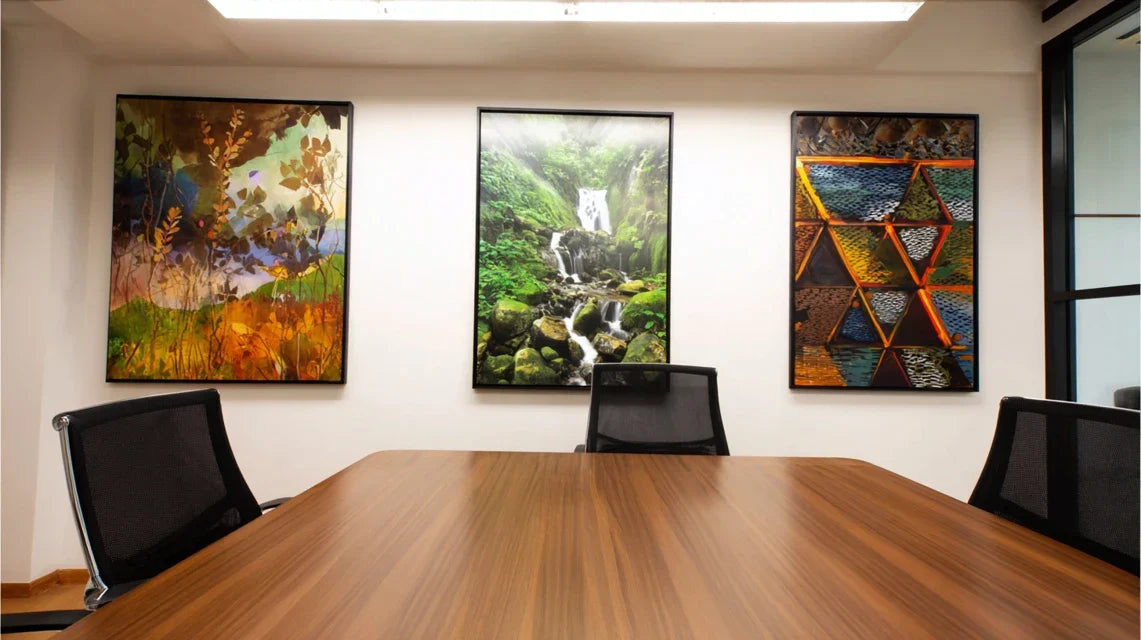
You've just launched your new meeting room, you’ve invested in designer furniture, perfect lighting... and yet, your employees are looking at their phones, the atmosphere remains cold, the creative ideas aren't flowing as expected.
This feeling of emptiness, these blank walls that seem to suck the energy out of your teams, this impression that something is missing to transform this functional space in a true place of inspiration and productivity.
You may have already tried some motivational posters or green plants, but the effect remains superficial. The problem isn't your choice, but the approach: you are decorating instead of creating an atmosphere.
It’s perfectly normal! Most decision-makers think “decoration” when they should think “psychological impact”. A wall art piece is not just an ornament, it's a catalyst for emotions and energy.
By the end of this article, you will know exactly how to choose the artwork that will transform your meetings into inspiring and productive moments, according to the precise use of your space.
Why does wall art in a business setting influence your results so much?
Every minute spent in an unsuitable visual environment costs your teams creativity. Imagine a chef working in a tasteless kitchen: even with the best talent, inspiration fades. Acting now is seizing the opportunity to permanently transform the dynamics of your meetings.
📊 Case study: The Bluebird creative agency installed an abstract triptych in orange tones in its brainstorming room. Result: +40% of ideas proposed during creative sessions according to their quarterly report. Their secret? They chose energy over neutrality.
💬 Conversation with a decor expert
Wall art acts as an emotional thermostat: it subconsciously regulates the mood of your employees. In 15 days, you will observe more fluid interactions and more spontaneous speaking.
Let's decode what’s really happening in your meeting room
Three signals may be talking to you: participants avoiding eye contact, superficial exchanges despite your efforts, and this feeling that “something is wrong” without being able to identify it.
It’s not your animation or your collaborators that are the problem, but rather the lack of visual anchoring that would allow brains to relax and open up. Your space lacks a soothing "focal point".
Imagine your eyes as explorers: in a bare environment, they constantly search for somewhere to settle, creating a micro-fatigue that depletes the attention available for exchanges.
The illusion of "professional neutrality"
Contrary to popular belief, "neutrality" doesn't exist in psychology of spaces. A white wall generates as much emotion as a colored wall: anxiety, impatience, sometimes distrust.
It’s like offering a “flavorless” dish: even the absence of flavor is a gustatory experience, often unpleasant. Your bare walls are already "speaking" to your guests.
This false neutrality explains why your meetings start slowly and why some participants seem “on the defensive” as soon as they enter. Wall art will release this invisible tension.
🔍 Immediate test: Enter your room and focus on the wall for 30 seconds. If your gaze "glides" without finding where to stop, you have identified the problem!
The myth of “personal tastes”
Many think that it is necessary to please everyone, sometimes choosing the most consensual possible. In reality, effective art in business works like a signature fragrance: it positively brands without seeking unanimity.
A statement artwork acts like a charismatic host: it relaxes the atmosphere by giving the space a "personality", allowing true personalities to express themselves more freely.
Result: instead of enduring participants “on defense”, you get collaborators more spontaneous and creative, because the space itself inspires confidence and openness.
The invisible impact of artistic luminosity
Few notice that wall art influences the perception of light to a greater extent than technical lighting. A painting with the right tones can "warm" a cold room or “soothe” a space that is too stimulating.
Observe your team: do they instinctively seek places near the windows? Do they avoid certain areas of the table? These micro-behaviors reveal the "dead zones" of your space.
Strategically placed art will redistribute visual energy, creating a light balance that naturally invites to occupy all available space.
3 signs that your room lacks inspiring art:
- The fleeting gaze: participants look at their screens even when they are not taking notes
- The "first come" effect: everyone chooses the same area of the table, leaving empty spaces
- The initial silence: it is always necessary to “break the ice” while the space should break it naturally
The trigger factor: emotion before logic
What really transforms a meeting is the emotion felt within the first 10 seconds. Like a domino effect, this initial impression conditions the quality of all subsequent exchanges. A well-chosen artwork becomes that "positive emotional trigger" you are looking for.
The 10-second rule: The atmosphere of a meeting is determined before participants even sit down. Test it by observing the faces entering your room.
| ❌ Neutral, classic room | ✅ Room with inspiring art | 💡 Psychological mechanism | 🎯 Measurable benefit |
|---|---|---|---|
| Participants look for where to focus their eyes | Gaze naturally drawn and relaxed | Soothing focal point for the brain | Attention available for discussions |
| Slow start, need to "break the ice" | Spontaneous conversations upon arrival | Art generates micro-discussion topics | Gain of 5-10 minutes per meeting |
| An atmosphere like an "interrogation room" | Warm and inspiring atmosphere | Colors and shapes influence mood | Visible reduction in stress and defensiveness |
| Creativity stifled by a cold environment | More daring and original ideas | Visual stimulation activates creative thinking | Improved quality and quantity of ideas |
The method of 3 atmospheres to choose the perfect artwork
Rest assured, choosing is not a question of artistic taste but of atmosphere strategy. Just as an architect designs space, you will "program" the emotion of your meetings. The result? A space that works for you instead of hindering you.
🎯 Overall vision: First identify your main use (step 1), then select your style of impact (step 2), and finally optimize the visual integration (step 3). Each step brings you closer to the ideal atmosphere.
Step 1: Identify your main use
Let's start with the most important thing: WHAT mainly happens in this room? Just as solid foundations support a house, this initial analysis determines everything else. You will immediately feel the clarity of this approach.
The 3 usage profiles and their visual needs
- Strategic meetings and decision making: You need credibility and concentration. Favor works with clean lines, subdued tones (deep blues, anthracite gray, ochres). Absolutely avoid "acidic" colors that scatter attention. The goal is to inspire confidence and seriousness.
- Creative sessions and brainstorming: Seek stimulation and open-mindedness. Opt for colorful abstracts, dynamic shapes, energizing contrasts (oranges, reds, bright greens). The principle is to provoke unexpected neural connections. Visible impact on the spontaneity of ideas.
- Client meetings and presentations: Focus on elegance and memorability. Choose refined pieces that tell your identity without dominating (balanced warm tones, harmonious compositions). The goal: to make a positive impression without distracting from your message.
Now, let's look at your space in concrete terms
How to analyze your room in 15 minutes
Map out your actual usage: List your 10 last meetings with their type and desired "energy". This step reveals your dominant need, not the one you imagine. Simple but revealing!
⏱️ Time: 5 minutes | ✅ Successful when: A meeting type represents 60%+ of your usage | ⚠️ Attention: Don't confuse "what you would like to do" with "what you actually do"
Test the current lighting impact: Photograph your room at 3 times (morning, noon, late afternoon) from the “decision maker” position. You will discover areas of shadow and reflections that unconsciously influence the atmosphere.
⏱️ Time: 3 photos, 1 minute each | ✅ Successful when: You identify the dominant light during your meetings | ⚠️ Attention: LED lighting changes color perception
Identify your “impact wall”: It's the one naturally seen by most participants. Not necessarily the largest, but the one that “welcomes” the gaze. Often opposite the entrance or perpendicular to the table.
⏱️ Time: 3 minutes of simulation | ✅ Successful when: 70% of seats naturally “see” this wall | ⚠️ Attention: The wall behind you (presenter) is not necessarily the right choice
✅ Validation of step 1: You have identified your main usage AND your impact wall. If you are still hesitating between two usages, choose the one that generates the most business stakes. Step 2 will refine your exact style.
OUR RECOMMENDED PRODUCTS
Step 2: Select your impact style
You are now moving to the “ambiance strategist” level. Finish with chance: you will program the emotion that your participants will feel. The effect is seen from the first meeting, and then amplified by habit.
The 3 impact styles according to your profile
“Inspiring Authority” style (strategic meetings): Choose works that evoke stability and vision. Architectural landscapes, geometric abstracts in earth/marine tones, or photographs of inspiring monuments. The subliminal message: “Here, we build something lasting.”
⏱️ Effect: 2-3 meetings | ✅ Successful when: Participants naturally adopt a more "decision-maker" posture | ⚠️ Caution: Avoid overly "decorative" works that reduce credibility
"Creative Energy" Style (brainstorming): Opt for dynamic compositions, contrasting colors, and shapes in motion. Expressive abstracts, colorful contemporary art, or photographs of nature in action. The message: "Here, anything is possible."
⏱️ Effect: Immediate on the first session | ✅ Successful when: Unusual ideas emerge more easily | ⚠️ Caution: Too much stimulation can be distracting - dose according to room size
"Relational Excellence" Style (clients): Focus on discreet sophistication. Quality figurative art, art photography, or elegant abstracts with harmonious tones. The goal: show your refinement without overshadowing your commercial message.
⏱️ Effect: From the first impression | ✅ Successful when: Your clients spontaneously mention your "beautiful space" | ⚠️ Caution: Art should never compete with your presentation
Step 3: Optimize Visual Integration
You now master the art of professional ambiance. This final step transforms a good choice into the perfect solution. Your visitors will notice the difference without being able to explain it: it's the signature of a truly well-thought-out space.
Strategic Installation
Calculate psychological height: Place the center of the artwork at 5.2 ft (1.60m) from the floor (average seated eye level). Not too high (feeling of domination), nor too low (sensation of being crushed). This rule transforms a painting into a "silent partner" in your meetings.
⏱️ Time: 5 minutes with a measuring tape | ✅ Successful when: The artwork seems "naturally placed" | ⚠️ Caution: Adjust according to the height of your table
Manage impactful lighting: Check that no reflections disrupt readability, and that indirect lighting reveals colors. A directed spotlight creates a "gallery effect" that subconsciously enhances the entire space.
⏱️ Time: Test under real conditions | ✅ Successful when: The artwork remains visible and attractive at all times | ⚠️ Caution: LED lighting alters colors - test before purchasing
Rule of progression: Start with one piece, observe the impact for 2-3 weeks, then adjust if necessary. It's better to have one perfectly chosen artwork than three "average" pieces.
You now master the art of transforming the ambiance of your meetings with visuals. Here are the subtleties that only true experts know, to move from "good" to exceptional.
🏆 Business Decorator's Tip: Change your artwork seasonally (every 6 months) rather than investing in a definitive piece. This keeps your teams curious and allows you to adapt the energy to your business cycles. Companies that apply this rotation observe more consistent motivation.
💬 Question from a Business Leader
"Will my employees really notice the difference?"
It's precisely this subtlety that makes well-chosen art so powerful! Your teams won’t say "I love this artwork," but rather “we feel good in this room” or “I have better ideas here.” The impact is measured in behaviors: more spontaneity, less tension, meetings that “start better.” Observe the micro-signals: smiles when entering, less evasive gazes, more natural speaking out.
📊 Concrete Test: Film (with consent) 10 minutes of your next meeting, then compare after installing your artwork. You will be surprised by the difference in body language!
The 5 Mistakes That Ruin Your Investment's Impact
Because I’ve seen too many spaces spoiled by avoidable details, Here are the classic pitfalls that turn an excellent choice in a costly disappointment. These mistakes are normal but totally preventable!
- 🖼️ Choosing Too Small Out of Fear: A "shy" artwork goes unnoticed and generates no impact. Like a weak handshake, it weakens rather than strengthens. Simple rule: the work should occupy 1/3 to 1/2 of the width of the wall. Dare to be present!
- 🎨 Prioritizing “Decorative” Over “Psychological”: A generic pretty landscape doesn't activate any specific emotion. Prefer a piece that "speaks" to your usage: energy for creativity, elegance for sales, strength for strategy. Art decorates, corporate art transforms.
- 💡 Neglecting Artwork Lighting: Even the most beautiful artwork becomes dull under an aggressive neon light. Invest in warm LED lighting (3000K) directed at the work. This quintuples its visual impact for a negligible cost.
- 📏 Installing “By Feel” Without Measuring: 10 cm too high or too low creates an unconscious imbalance that disrupts all harmony. Use the 1.60m rule (center of the artwork) and adjust according to your furniture. Precision makes the difference.
- 🔄 Trying to Please Everyone: There's no such thing as consensus art! A choice that doesn’t bother anyone also inspires no one. Assume a clear direction according to your main usage. 80% positive impact is better than 100% indifference.
🛡️ Safety Checklist: Does your artwork attract the eye in 3 seconds? Is it visible from 70% of the places? Does the lighting reveal it without creating reflections? Does the atmosphere correspond to your main meetings? If one answer is “no,” adjust before finalization.
🎁 Special offer for readers
Because you took the time to learn more, enjoy 10% discount on your first order:
⏰ Valid 72h after reading • Applicable to all our products
Your practical questions about wall art in business
Allow 150-400€ for a quality work (minimum 60x80cm) that will lastingly mark your meetings. It's less than a screen, for a permanent psychological impact! Optimize by choosing standard sizes which reduce framing costs, and always prioritize quality over quantity.
The impact is immediate on the atmosphere, but behavioral changes stabilize in 2-3 weeks. Your collaborators will unconsciously get used to this new energy, creating a positive "threshold effect" each time they enter the room.
A strong work is more effective than three average ones! Start with a central impact, even if you add complementary elements later. Business art works better by "subtle theatrical effect" than by decorative accumulation.
Prioritize prints on rigid supports (aluminum, high quality PVC) or professional stretched canvases. Avoid paper prints under glass which yellow. A good business artwork keeps its visual impact for a minimum of 10-15 years.


