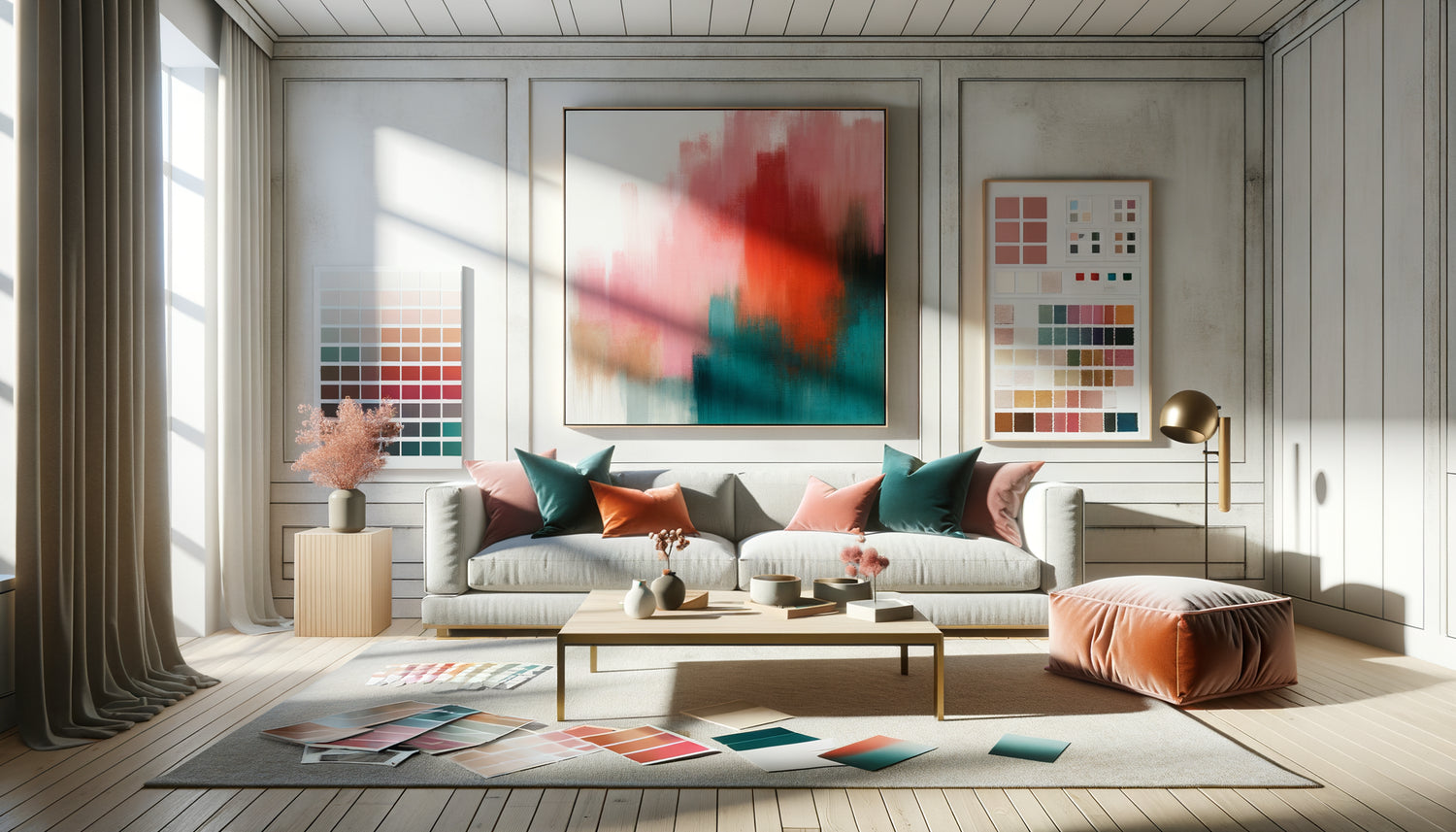
Three years ago, I accompanied a client in decorating her new Parisian apartment. Before even choosing a sofa or wall color, she fell for an abstract oil painting with ochre and navy blue tones in a Marais gallery. This painting became the soul of her interior. Every decorative choice that followed - from the flooring to the cushions - dialogued with this work. That's when I understood the foundational power of a first painting in a home.
Here’s what a first painting brings to your home: It sets your dominant color palette, imposes an aesthetic level of sophistication, and creates a narrative coherence that guides all your future choices. It is your decorative cornerstone.
Many people start by furnishing their homes functionally, then try to add art as a simple finishing touch. The result? A disjointed interior, without a common thread, where elements coexist without really speaking to each other. The space lacks identity. You feel that something is wrong without being able to identify what.
But when you reverse the approach - when you let a first painting define the aesthetic direction of your home - you create a visual foundation upon which to build an authentic harmony. Each element naturally finds its place in a coherent narrative.
In this article, I will show you how this first painting becomes the silent conductor of your decoration, how it translates your identity into visual language, and above all how to exploit it to create a home that truly resembles you.
The Painting as a Color Palette Generator
The first magic of a foundational painting lies in its ability to extract a complete color palette for your entire home. Unlike a paint chart that confronts you with thousands of paralyzing choices, a painting offers you an already balanced harmony by the artist.
Observe the dominant colors of your work: this deep blue, this sandy beige, this touch of rust. These shades form your color vocabulary for the entire home. The main nuances can inspire your walls and large pieces of furniture. Secondary colors will guide your choices of textiles and accessories. Accents - those vibrant touches that give character to the painting - will become your decorative punctuation marks.
I saw a client transform her living room around an abstract painting with terracotta and sage green hues. She translated these colors into a moss green sofa, terracotta cushions, and a rug in an intermediate shade. The harmony was immediate, natural, as if the home had always been designed that way.
Extract Colors Strategically
To fully leverage the color palette of your first artwork, photograph it and use tools like Adobe Color or Coolors to precisely identify its chromatic codes. Create a physical or digital mood board where you associate these colors with samples of fabrics, wall paint, wood. This document will become your guide de cohérence for each future purchase in your home.
This method eliminates the anxiety of choice. You no longer wonder if this cushion will go with the rest: you simply compare it to your palette derived from the artwork. The answer becomes obvious.
How the style of the artwork dictates the overall aesthetic
Beyond colors, the artistic style of your first artwork establishes the level of sophistication and the aesthetic language of the entire home. A minimalist painting calls for a clean decor. A baroque work suggests a richness of textures and ornaments. A contemporary abstract composition encourages boldness in furniture shapes.
The painting acts as an contrat esthétique tacit agreement. If you hang a delicate watercolor with pastel tones in your entrance, you create an expectation: the rest of the home should reflect this softness, this lightness. Introducing industrial-style furniture would then create cognitive dissonance for your visitors - and for yourself.
I observed this in a loft where the owner had acquired a large vibrant street art painting. This initial choice legitimized his desire for contemporary design furniture, sculptural lighting fixtures, raw materials such as polished concrete and steel. The painting gave permission to dare.
Stylistic consistency as a narrative thread
Your first artwork tells a story. It says something about you, your influences, your sensitivity. Each element you add next should enrich this narrative rather than contradict it. An Impressionist painting evokes a certain poetry, a connection to nature, a sensitivity to light. This aesthetic direction naturally translates into natural materials, organic textures, and soft shapes throughout the home.
This consistency is not a creative prison. It's a liberté guidée guided freedom. Rather than navigating the infinity of decorative possibilities, you evolve in a defined aesthetic territory, which paradoxically stimulates your creativity by setting fertile constraints.

The strategic placement of the foundational artwork
If your first artwork is to define the aesthetic direction of the entire home, its placement becomes crucial. It cannot be relegated to a bedroom or secondary hallway. This artwork deserves the most strategic position in your interior.
Ideally? The wall you see when entering your home, or the one facing your sofa in the living room. This constant visibility reinforces its role as a visual reference. Whenever you hesitate about a decorative choice, you can literally look at your artwork and find the answer in its colors, shapes, energy.
In open spaces, place your foundational artwork in the main living area - the one where you spend most of your time. Its daily presence permeates your perception of space and naturally influences your future layout decisions. It becomes the heart of your home, the element around which everything revolves.
Create a powerful focal point
Your first artwork should function as a focal point, immediately attracting the eye. This influences sizing: prioritize a generous size work that asserts its presence. A small painting, even beautiful, will not have the necessary structuring impact to define the aesthetics of an entire home.
Think proportions: for a living room wall, aim for a width equivalent to 60-75% of the sofa below. This scale creates a architectural presence sufficient for the artwork to dialogue with the volumes of the room, not just its decorative details.
Decorative progression by concentric circles
Once your foundational artwork is in place, the decoration of your home naturally unfolds in concentric circles. Start with the room that houses the work, then gradually extend its influence to adjacent spaces.
In the room of the artwork, directly repeat its main colors for the large elements: flooring, central furniture, curtains or major textiles. Then, in neighboring rooms, retain the tones but allow yourself variations. A bedroom can adopt a softer version of the living room palette, a kitchen can extract accents from it for accessories.
This approach creates a fluid chromatic circulation throughout the home. You move from one space to another without abrupt breaks, with a sense of unity that elevates the overall perception of your interior. The foundational artwork remains the generator of this harmony, even in rooms where it is not visible.
Variations that enrich without betraying
Defining an aesthetic direction does not mean mechanically repeating the same choices. Your artwork gives you a visual grammar - it is up to you to compose different sentences in each room. If your work mixes blue and gold, your living room can be dominated by blue with golden touches, while your office reverses this hierarchy.
This flexibility within the unit creates a dynamic living space, where each area has its personality while belonging to a consistent aesthetic family. This is the difference between a monotonous interior and a harmonious one.

When the artwork reveals your hidden identity
The most subtle power of a first piece of art is its ability to reveal aspects of your personality that you were not fully aware of. By choosing a work based on feeling rather than decorative calculation, you allow your true aesthetic affinities to express themselves.
I have seen clients surprised to discover their attraction to atmospheres they thought they didn't like. A person convinced of being minimalist falls in love with a baroque colored artwork - and realizes that they are finally allowing the fantasy they repressed. Another, thinking they preferred cold contemporary art, cracks for a warm figurative scene and rediscovers their need for softness.
The artwork acts as an authenticity catalyst. It forces you to assume a strong personal choice, then to build a living space that honors this choice. This approach creates much more personal interiors than those resulting from the simple application of decorative trends.
Dare to follow your heart rather than calculation
For your first artwork to truly fulfill its foundational role, it must be chosen with the heart, not with a checklist. Don't first ask yourself if it will go with your current furniture - ask yourself if it touches you deeply. Furniture can change, but an artwork that resonates with your being will remain relevant through the evolutions of your life and tastes.
This approach reverses conventional decorative logic, but this is precisely what creates memorable interiors. Your living space looks like no other because it is built on a unique emotion - yours in front of this particular work.
Ready to find the artwork that will define your living space?
Discover our exclusive collection of wall art for Apartment that will become the cornerstone of your interior aesthetic.
Build around the artwork: the practical method
Let's move on to the concrete implementation. You have chosen your foundational artwork, it is hung in its strategic place. How do you orchestrate the rest of your decor now?
Step 1: Color analysis. Identify the 3-4 main colors of your artwork. Assign them roles: dominant color (60% of the room), secondary color (30%), accent (10%). This classic distribution guarantees visual balance.
Step 2: Material translation. For each color, find its variation in materials: fabrics, paints, woods, metals, ceramics. Create a library of physical samples that you can manipulate and compare directly with your artwork.
Step 3: Purchase hierarchy. Start with the heavy and durable investments - sofa, rug, curtains - in the dominant colors. Then integrate the secondary colors via accent furniture. Finally, punctuate with accents in easily changeable objects: cushions, vases, books.
This systematic method transforms the intimidating task of decorating an entire home into a series of guided and logical decisions. The artwork remains your permanent compass, eliminating doubt and hesitation.
Managing mistakes and adjustments
Sometimes, a choice doesn't work as expected. A cushion seemed perfect in the store but clashes with the artwork once you are home. That's normal. The difference with a decor without direction? You immediately know why it doesn’t work and how to correct it. You return to your artwork, reanalyze the colors, and the solution appears clearly.
This ability to self-correct is valuable. It transforms decorative mistakes into simple adjustments rather than demotivating failures. Your home evolves through successive refinements towards an increasingly fine harmony.
The evolution of the home with the artwork as a constant
A less obvious but crucial advantage of the foundational artwork: it allows your home to evolve without losing its identity. Your tastes will change, trends will pass, you will want to refresh your interior. The artwork remains the stable anchor that ensures continuity.
You can change your sofa, curtains, accessories - as long as they dialogue with the artwork, your home retains its coherence. It's like a melody that accepts different arrangements while remaining recognizable. This structured flexibility is economically advantageous: you don’t have to redo everything at each whim of change.
I have clients who have lived with the same foundational artwork for ten years, but their decor has considerably evolved. They have moved from a rather traditional style to something more contemporary, but always in harmony with their initial work. The artwork has accompanied their aesthetic maturation rather than constrained it.
This longevity transforms the purchase of a painting from a one-off expense into a lasting investment. Unlike a trendy sofa that you'll tire of, a painting chosen with sincerity remains relevant because it reflects something deep within you - something that may evolve, but doesn't disappear.
Visualize your home transformed
Imagine entering your home in six months. Your gaze falls on that painting which moved you so much, now magnified by an environment that perfectly embodies its spirit. The colors of the cushions pick up its warm tones. The rug on the floor dialogues with its textures. The lighting you carefully chose reveals its nuances at different times of the day.
Every element in your home seems to have always been in place. Your guests immediately feel the coherence of the whole without necessarily being able to explain why. You know: everything stems from that first painting, from that foundational decision that guided all the others.
Your space looks like no showroom or online inspiration photo. It resembles you, deeply, because it was born from an authentic emotion in front of a work that spoke to you. This authenticity is felt in every corner.
Start today. Find that painting that stops you in your tracks, that creates that inexplicable click. Hang it in the place of honor it deserves. Then let it guide your choices, one by one, until your entire home tells the same story - your story.
Frequently Asked Questions
What to do if I change my mind about my painting after decorating the whole home?
This is a legitimate concern, but rare in practice when the painting was chosen by genuine infatuation rather than calculation. If this happens, first ask yourself this question: is it the painting that I no longer like, or simply the way I translated it into my decor? Often, it's the second option. You can then reinterpret the painting differently - extract other colors, change its location, modify the lighting. If you really don’t speak to the painting anymore, it is probably because you have experienced a major personal transformation. In this case, consider changing the painting and redecorating as an opportunity to reflect this new version of yourself. But give yourself at least a year before making that decision - our perceptions fluctuate with the seasons and our moods. A painting that you find bland in February may enchant you again in June.
How to choose between several paintings that I all like?
When you're torn between several artworks, apply the long-term impact test. Live with their photos displayed as your phone wallpaper or printed on your wall with tape for a few days. The one that continues to move you after this familiarization period is the right one. Also analyze their generative potential: which painting offers the richest and most versatile color palette for your home? Which best corresponds to the atmosphere you want to create - energizing, soothing, sophisticated, warm? If hesitation really persists, choose the boldest. We rarely regret bravery in artistic matters, but often timidity. A painting that scares you a little with its intensity or originality is often the one that will truly transform your home and make you grow aesthetically. Comfortable choices create forgettable interiors.
Should I absolutely start with the painting before buying furniture?
Ideally, you should choose the painting first, but reality is often more complex. If you're moving into an empty home, you need immediate functionality: a bed, a table, seating. In this case, prioritize neutral and timeless furniture for these essential initial purchases - pieces that will adapt to various aesthetic directions. Then, as soon as possible, acquire your foundational painting and let it guide all your subsequent purchases: textiles, decorative objects, lighting, and eventually gradual replacement of overly neutral furniture. If you've already furnished your home without a clear direction, it’s not lost. Choose your painting taking into account the heavy elements that you cannot change immediately, then work in layers: first change textiles and accessories to create consistency between the painting and what exists, then gradually replace large pieces of furniture during natural renewals. The transformation will be slower, but just as effective.