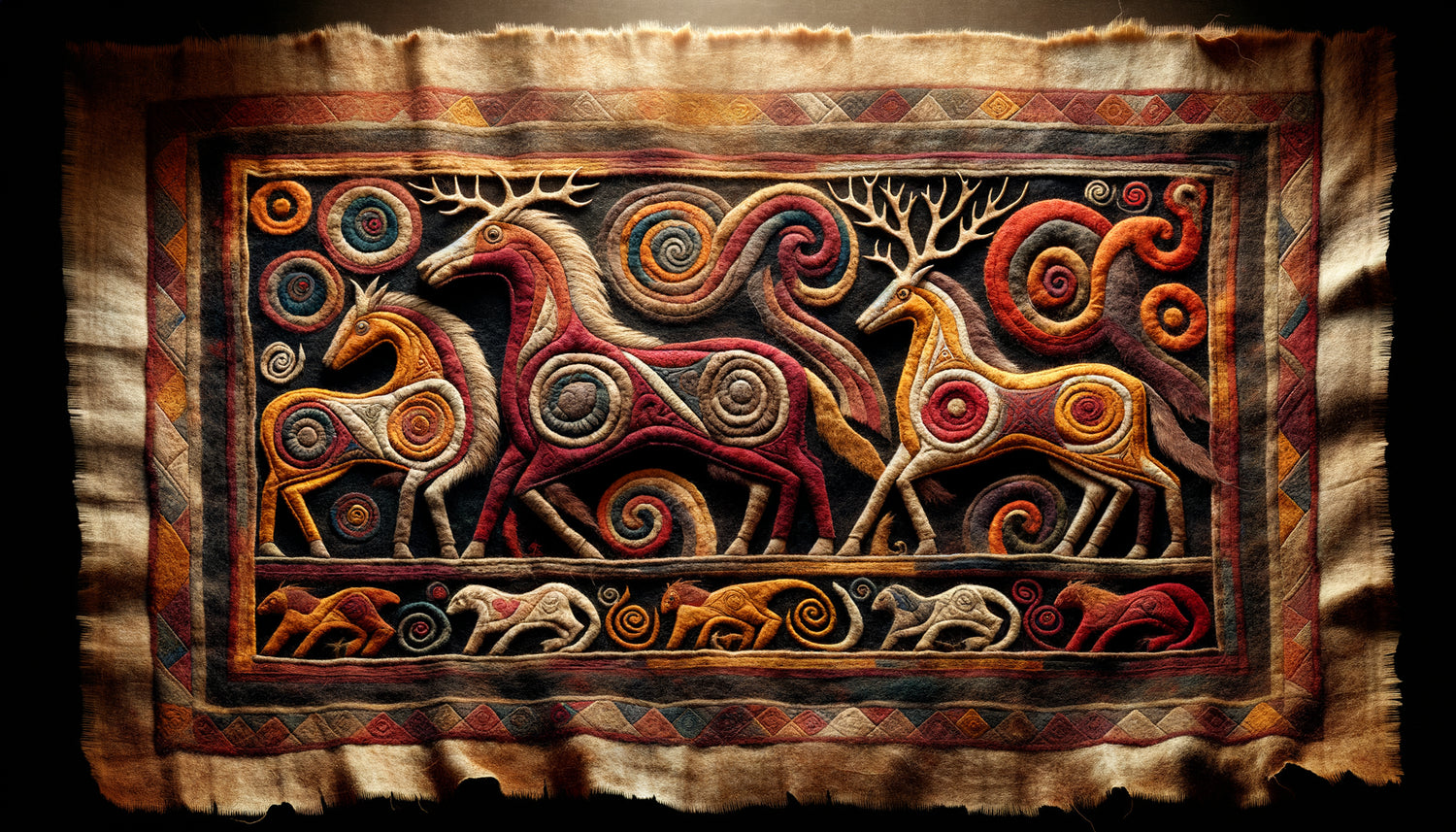
Imagine a moment: we are in 1949, in the frozen mountains of Altai, Siberia. The archaeologist Sergei Rudenko clears from the permafrost a burial shroud perfectly preserved for 2,500 years. Colors explode before his eyes: vermilion red, cobalt blue, saffron yellow. Deer leap, griffins spread their wings, tigers roar in a felt of extraordinary finesse. How did these textiles survive twenty-five centuries without losing their luster? The answer lies in an ancestral technique that our contemporaries are only just rediscovering: felt appliqué from the steppes.
This is what the art of the steppes reveals to us: a profound understanding of natural fibers, a chemical mastery ahead of its time, and conservation secrets that modern interiors can embrace. These ancestral wall pieces defy our conception of ephemeral decoration and offer valuable lessons for those seeking authenticity and durability.
You may admire these reproductions of stylized animals in museums, but you think this chromatic vibrancy is due to modern restoration? Do you imagine that only contemporary synthetic pigments guarantee the colorfastness? Think again. The Scythian, Pazyryk, and Hun artisans possessed a textile science that our laboratories still struggle to equal.
Let me take you into the yurts of nomads, where every technical gesture was an act of resistance against time. Because understanding how these felts preserved their colors is accessing a philosophy of matter that will transform your view of animal art in your own interior.
Felt from the steppes: much more than just fabric
In the vast expanses of Central Asia, felt was not just another textile. It was THE primary material. Obtained by felting sheep's wool, yak or camel hair, it offered a non-woven structure of exceptional density. This natural compactness already constituted a first barrier against color degradation.
Artisans selected wool according to its fineness and absorption power. Wool that was too coarse would never have retained pigments with such intensity. Wool that was too fine would have disintegrated under climatic rigors. Applied felt therefore required perfect balance: dense enough to trap dyes, flexible enough to be cut and superimposed in complex patterns.
Animal representations — deer, felines, birds of prey, horses — were not simply embroidered or painted. They were constructed from successive layers of colored felt, cut according to precise templates, then applied to a natural felt backing. This relief technique created not only visual depth but also mechanical protection of the pigments. Each layer acted as a natural organic varnish.
The secret chemistry of nomadic dyes
But the true magic lay in the vegetal and mineral dyes that these peoples mastered with scientific precision. Contrary to popular belief, the vibrant colors of the steppes did not come about by chance, but from a sophisticated botanical pharmacopoeia.
To obtain this intense red found in Pazyryk pieces, artisans used madder (Rubia tinctorum) or kermes, a parasitic insect of the oak. Alum mordanting — a mineral salt naturally present in some mountainous regions — chemically fixed these pigments to the wool fibers. This molecular bond created an almost indelible dye, resistant to light and humidity.
Blues came from imported indigo or local woad, fixed with iron salts. Bright yellows were born from saffron, weld, or turmeric. But here's the secret: these dyes were never applied pure. The nomads added tannins extracted from tree bark, which acted as natural color stabilizers. Oak, walnut, sumac: each essence brought its specific preservative properties.
The little-known role of animal fats
A detail that few historians emphasize: after dyeing, some applied felt received a final treatment based on slightly worked sheep fat. This thin lipid film partially waterproofed the textile while nourishing the fibers. It prevented the oxidation of organic pigments — this process which turns colors brown over time.
This technique strangely recalls our modern varnishes, but with remarkable subtlety: the fat never formed an airtight film that would stifle the textile. It penetrated the structure of the felt to create a breathable protection, adapted to nomadic life where textiles were subjected to significant variations in humidity.

Animals of the steppes: a symbolic bestiary with coded colors
The animal representations that adorned these felt pieces were not decorative in the way we understand it. Each creature carried a symbolic charge, and its color amplified this spiritual message.
The golden stag, the ultimate solar animal, appeared in ochre, yellow and red tones - warm hues obtained by particularly stable dyes. The griffin, a mythological guardian, sported deep blues and blood reds. These chromatic choices were not aesthetic but ritualistic, which explains why artisans invested so much energy in the permanence of colors.
Felines — stylized tigers, panthers, lions — dominated the funeral compositions. Their stripes and rosettes were rendered by layering felt-tip pens of different shades, creating plays of light and shadow with astonishing modernity. This multi-layered technique offered a decisive advantage: if the surface deteriorated slightly, the underlying colors preserved the visual integrity of the work.
Animal motifs that tell of the climate
What these felt pens from the steppes also reveal is a chromatic adaptation to the environmental context. In wetter regions, artisans favored tannins-based dyes, naturally fungicides. In arid areas, they exploited mineral pigments (ochres, earths) which are intrinsically more resistant to photodegradation.
Reindeer and yaks from Siberia often appeared in deep browns and creamy whites - colors directly derived from undyed or slightly mordanted wools. This economy of means testified to an ecological understanding ahead of its time: why dye what nature already offers in the ideal palette?
Permafrost and preservation: an unexpected alliance
Of course, let's talk about the elephant in the room - or rather the permafrost in the tomb. The exceptional conservation conditions of the Altai kurgans played a crucial role. These burial mounds, once sealed, created micro-environments where infiltrated water froze permanently, forming a protective ice gangue.
But — and this is essential — not all textiles found in these tombs have survived with the same magnificence. Some felts disintegrated, others lost their colors. Only those that had benefited from the most sophisticated dyeing and treatment techniques have crossed the millennia in their original splendor.
The cold acted as a conservator, certainly, but above all it revealed the intrinsic quality of craftsmanship. Poorly prepared felts, dyed with fugitive dyes or poorly mordanted, disappeared despite the frost. Permafrost only amplified the differences in know-how: it preserved excellence and allowed mediocrity to perish.
What this matter-environment alliance teaches us
For our contemporary interiors, this lesson is invaluable. A quality textile, dyed with stable pigments and properly treated, will last much better than a cheap digital print — even without permafrost to protect it. Discerning collectors are now seeking pieces inspired by these ancestral techniques: handcrafted felt, vegetable dyes, animal motifs applied rather than printed.
These works are not just decorative. They carry within them an enduring quality that gradually transforms our living spaces into places of living memory.

Reinventing heritage: applied felt in contemporary decoration
You may be wondering how to integrate this millennial aesthetic into a modern interior? The answer lies in understanding what made the felt of the steppes so strong: material authenticity, chromatic depth, and visual storytelling.
Today, a few artisans perpetuate these techniques in Mongolia, Kazakhstan and Kyrgyzstan. Their creations — wall carpets, decorative panels, cushions — still use traditional felting and vegetable dyes. Hanging one of these pieces in your home is installing a fragment of history that will continue to evolve subtly over time, developing the noble patina that only natural materials possess.
The animal representations inspired by this art particularly find their place in interiors seeking a connection with nature and history. A stylized stag in applied felt in a minimalist living room creates a striking contrast — the tactile roughness of the ancestral textile dialogues with the purity of contemporary lines.
For those who cannot acquire authentic pieces, prioritize reproductions using similar techniques: printing on natural textiles (linen, thick cotton, wool), lightfast pigment inks, matte finishes that recall the texture of felt. Avoid synthetic canvas prints — they immediately betray the spirit of these works which drew their strength from the absorbent dullness of felted wool.
Transform your space with the timeless power of animal art
Discover our exclusive collection of animal paintings that capture the spirit of great nomadic civilizations while seamlessly integrating into your contemporary decor.
Eternity is not an accident: lessons for our interiors
What the applied felt from the steppes ultimately reveal to us is a philosophy of creation that rejects obsolescence. Every technical gesture—from the choice of wool to the mordanting of dyes—was designed to defy the wear and tear of time.
In our interiors saturated with disposable objects, this approach resonates with a disturbing relevance. Investing in a quality textile piece, with stable colors and noble materials, is refusing the logic of constant renewal. It's also offering yourself the luxury of seeing a work mature with you, develop the richness that only time confers on authentic materials.
The animals of the steppes—bounding deer, majestic felines, soaring raptors—continue to fascinate us not only for their graphic stylization but because they embody this successful alliance between art and durability. Their presence on our walls becomes a silent manifesto: it is possible to create beauty that lasts.
Imagine your living room in twenty years. Cheap digital prints will have faded, their colors turning pinkish. But this representation of a felt deer—or its quality contemporary equivalent—will have gained depth, its shades slightly patinated telling the story of your home. It is this vision that the artisans of the steppes leave us: decoration as heritage, not as consumption.
Conclusion: when color becomes memory
The applied felt from the steppes have preserved their colors over millennia thanks to a subtle alchemy: excellence of materials, chemical mastery of natural dyes, organic protection techniques, and—let us not forget—the profound intention of the creators. These artisans were not simply decorating: they were engraving stories in wool destined for eternity.
Today, in your search for decorative authenticity, remember this lesson. Prioritize materials that age well, colors that resist, and techniques that respect the inherent nature of fibers. Let these stylized animals enter your home, carrying centuries of textile wisdom.
And next time you contemplate an animal representation in your interior, ask yourself this question: in twenty-five centuries, what will remain of our own creations? The nomads of the steppes have already answered.
Frequently Asked Questions
What sets applied felt apart from other ancient textile techniques?
Applied felt is based on a technique of layering colored felt, cut and assembled to create relief patterns. Unlike weaving or embroidery where threads are interlaced or sewn, felt is a non-woven material obtained by compacting wool fibers. This dense structure literally traps pigments in the heart of the fibers, creating exceptional color stability. The artisans of the steppes also mastered the art of precise cutting, creating animal silhouettes of remarkable finesse which they fixed on a natural felt backing. This method offered mechanical protection for dyes: successive layers acted as natural varnishes. It is this combination - compact material, mordant dyes, multi-layer construction - that explains the exceptional longevity of colors in the art of the steppes.
Are vegetable dyes really more durable than modern pigments?
This is a complex question that deserves nuance. Traditional vegetable dyes, when properly mordanted (chemically fixed to the fibers), can indeed rival many modern synthetic colorants in terms of light resistance. The secret lies in the mordançage process using metal salts (alum, iron, copper) which creates stable molecular bonds between the pigment and the wool fiber. Nomads of the steppes also used vegetable tannins as natural color stabilizers. However, not all vegetable pigments are equal: madder and indigo are exceptionally stable, while others (such as some yellows) are more fleeting. High-quality modern synthetic pigments generally offer better resistance, but the best natural dyes, applied according to the rules of art, can last for centuries - as proven by the Pazyryk felt carpets. For your decoration, always favor works using lightfast certified pigment inks, whether they are natural or synthetic.
How to integrate the aesthetics of steppe felt into a modern interior without falling into folklore?
The common mistake is to accumulate traditional motifs, creating an ethnographic museum effect. The key lies in rigorous selection and integration by contrast. Choose a centerpiece — a large wall panel depicting a stylized animal, for example — and let it converse with a clean environment. The geometric lines of Scythian animal representations (deer with enormous antlers, curled felines) possess a graphic modernity that blends perfectly with contemporary design. Favor shades that resonate with your existing palette: ochres and deep reds warm up a gray or white minimalist space, while indigo blues create a meditative depth. Avoid overly literal reproductions; prefer contemporary interpretations that capture the spirit rather than the letter. Finally, play on textures: the roughness of felt or a thick textile contrasts beautifully with the smoothness of polished concrete, glass, or metal. The goal is to create a bridge between ancestral memory and contemporary expression, not a historical reconstruction. Your space should tell your personal story, enriched by these millennial echoes.