



Why Do Marine Animals Possess Terrestrial Features in Romanesque Art?
December 2, 2025 · 9 min read · by Walensky
In the twilight of a Burgundian church, I once looked up at a sculpted vault from the 12th century. What I discovered there left me speechless: a fish with clawed paws, a sea serpent sporting a lion's mane, a whale endowed with wolf ears. These hybrid marine creatures, neither entirely ocean beasts nor truly land animals, populate Romanesque art with fascinating strangeness. Why do these marine animals exhibit terrestrial characteristics in medieval sculptures and illuminations?
Here's what this unexpected fusion reveals: a sacred cosmology where earth and sea are one, a symbolic vision of the invisible world, and a pedagogical method for transmitting faith to the faithful. These hybrid creatures are not anatomical errors, but theological messages sculpted in stone.
Faced with these strange bestiaries, one feels lost. How did medieval artisans, some of whom had never seen the ocean, dare to represent marine creatures with such freedom? Why distort nature so?
Rest assured: this apparent fantasy hides a profound logic, a system of thought that I will reveal to you. By understanding these codes, you will look differently not only at Romanesque art, but also at our contemporary way of representing living things.
Let's plunge together into this universe where dolphins walk and fish roar.
When the sea was just a distant idea
To grasp these hybrid representations, it is first necessary to understand the relationship of 11th and 12th century men with the ocean. Most Romanesque sculptors worked in abbeys and monasteries located hundreds of kilometers from the coast. The sea was for them only an abstract concept, nourished by biblical tales and illuminated bestiaries copied from generation to generation.
In these medieval manuscripts, marine animals were described not through naturalist observation, but through the prism of Christian symbolism. A fish was never simply a fish: it represented Christ, baptized souls, or sometimes demons from the depths. This symbolic approach took precedence over any zoological accuracy.
Romanesque artisans mainly drew inspiration from the Physiologus, this ancient bestiary christianized which attributed a moral meaning to each creature. In this founding text, aquatic animals often had terrestrial behaviors: the whale served as a deceptive island for sailors, the dolphin saved shipwrecked people like a shepherd his sheep.
This geographical and conceptual distance explains why Romanesque sculptures represent marine creatures with terrestrial anatomy: artisans translated spiritual concepts rather than biological realities.
The theology of hybrid creatures
At the heart of Romanesque art lies a powerful theological conviction: God created a unified world where every element reflects divine order. In this vision, the boundaries between earth, sea and sky are porous, as all Creation sings the glory of the Creator.
The marine animals with terrestrial characteristics embody this cosmic unity. A fish with legs recalls that all creatures share a common origin in the creative act. These hybridizations are not monstrosities but revelations of the interconnectedness of living things.
Medieval theologians developed an allegorical reading of the world: every natural being contained a spiritual lesson. When a sculptor depicted a marine serpent with a lion's head, he was not seeking zoological accuracy but creating a composite symbol. The serpent evoked temptation, the lion Christ's royalty – their fusion represented divine victory over evil.
This Romanesque symbolism allowed artists to freely combine the attributes of different animals to create complex theological messages. A dolphin with wings was not an anatomical error, but a representation of the saved soul rising to heaven after crossing the baptismal waters.
Mermaids: women-fish with bird legs
Observe the mermaids in Romanesque iconography: these creatures fascinate by their unlikely combinations. Unlike the modern image of a mermaid with a fish tail, Romanesque versions often have clawed paws, wings, or even hooves. This multiplicity of terrestrial attributes on an aquatic body served to illustrate the deceptive and multiple nature of sin, capable of taking all forms to seduce the faithful.

The legacy of ancient bestiaries
The medieval representations of marine animals draw abundantly on the Greco-Roman heritage, itself nourished by Eastern traditions. Romanesque artists inherited a repertoire of fantastic creatures where hybridizations were commonplace.
The ancient cetus – that sea monster who threatened Andromeda – was already depicted with lion paws and a wolf's mouth in Hellenistic art. Late Roman mosaics show aquatic creatures with terrestrial limbs, a tradition perpetuated and Christianized by monastic workshops.
Travelers and merchants also reported fabulous tales from the Orient, where Persian and Byzantine miniatures had long depicted winged fish and sea serpents with legs. These influences circulated via trade routes and crusades, enriching the visual vocabulary of Romanesque sculptors.
This transmission of motifs explains why similar marine creatures, endowed with identical terrestrial characteristics, can be found in Romanesque churches separated by hundreds of kilometers: from Catalonia to Burgundy, from Saintonge to Auvergne, artisans copied and adapted a common repertoire.
— Our selection


A visual pedagogy for the illiterate
Let us never forget that Romanesque art primarily served as a stone Bible for a largely illiterate population. The sculptures of capitals, tympanums and corbels functioned as a visual catechism.
In this pedagogical context, endowing marine animals with familiar terrestrial characteristics made these distant creatures more understandable. A Burgundian peasant had never seen an octopus, but he knew snakes and spiders. Representing the marine monster with reptile or insect legs immediately identified it as a dangerous creature.
This strategy of familiarization allowed preachers to use sculptures as sermon supports. Pointing to a hybrid marine creature, the priest could explain: "See how the demon takes the appearance of a fish to lure you into the depths, but has claws like a wolf to tear you apart."
The sculpted bestiaries thus functioned as visual memory aids, where each anatomical attribute – whether aquatic or terrestrial – carried a precise moral meaning that the faithful learned to decode.
The Leviathan with dragon legs
The quintessential biblical monster, the Leviathan, perfectly illustrates this hybrid pedagogy. Described in the Book of Job as an invincible marine creature, it appears in Romanesque art with dragon legs, bat wings, and sometimes a flaming mane. These terrestrial additions transformed it into the total incarnation of Evil, combining all the frightening aspects of the bestiary to represent Satan himself.

Medieval imagination facing the unknown
It is also important to recognize the role of pure imaginative creativity in these representations. Medieval oceans were spaces of absolute mystery, populated according to beliefs with wonders and monsters. Marine charts still bore the inscription "Hic sunt dracones" – here are dragons.
In this mental universe where the boundaries of the possible remained blurred, Romanesque artists enjoyed considerable creative freedom when it came to representing the unknown. No one could contradict them on the exact anatomy of a creature that no one had observed closely.
This creative freedom allowed sculptors to express their technical virtuosity and inventiveness. Historiated capitals became laboratories of forms where daring combinations were tested: fins transforming into wings, fish tails ending in clawed paws, scales becoming fur.
Some art historians also see a playful dimension here: stonemasons working in inconspicuous areas such as the corbels under the roofs sometimes amused themselves by creating increasingly extravagant fantastic creatures, defying conventions and giving free rein to their imagination.
— You may also like


Contemporary echoes in our decor
This tradition of hybrid marine animals strangely resonates with our current sensibilities. At a time when we are rediscovering the interconnectedness of ecosystems and where the boundary between terrestrial and aquatic environments is blurring due to climate change, these Romanesque creatures speak to us again.
In contemporary decoration, representations of fantastic animals blending marine and terrestrial attributes are experiencing a resurgence of interest. They embody our fascination with living beings in all their diversity, our recognition of the fundamental unity of the natural world – exactly what Romanesque artists sought to express.
Integrating these motifs into our interiors is reconnecting with a millennial tradition that saw nature not as a collection of separate species, but as a continuum of forms where everything transforms and responds. It is also inviting mystery and wonder into our daily spaces.
Let medieval imagination transform your interior
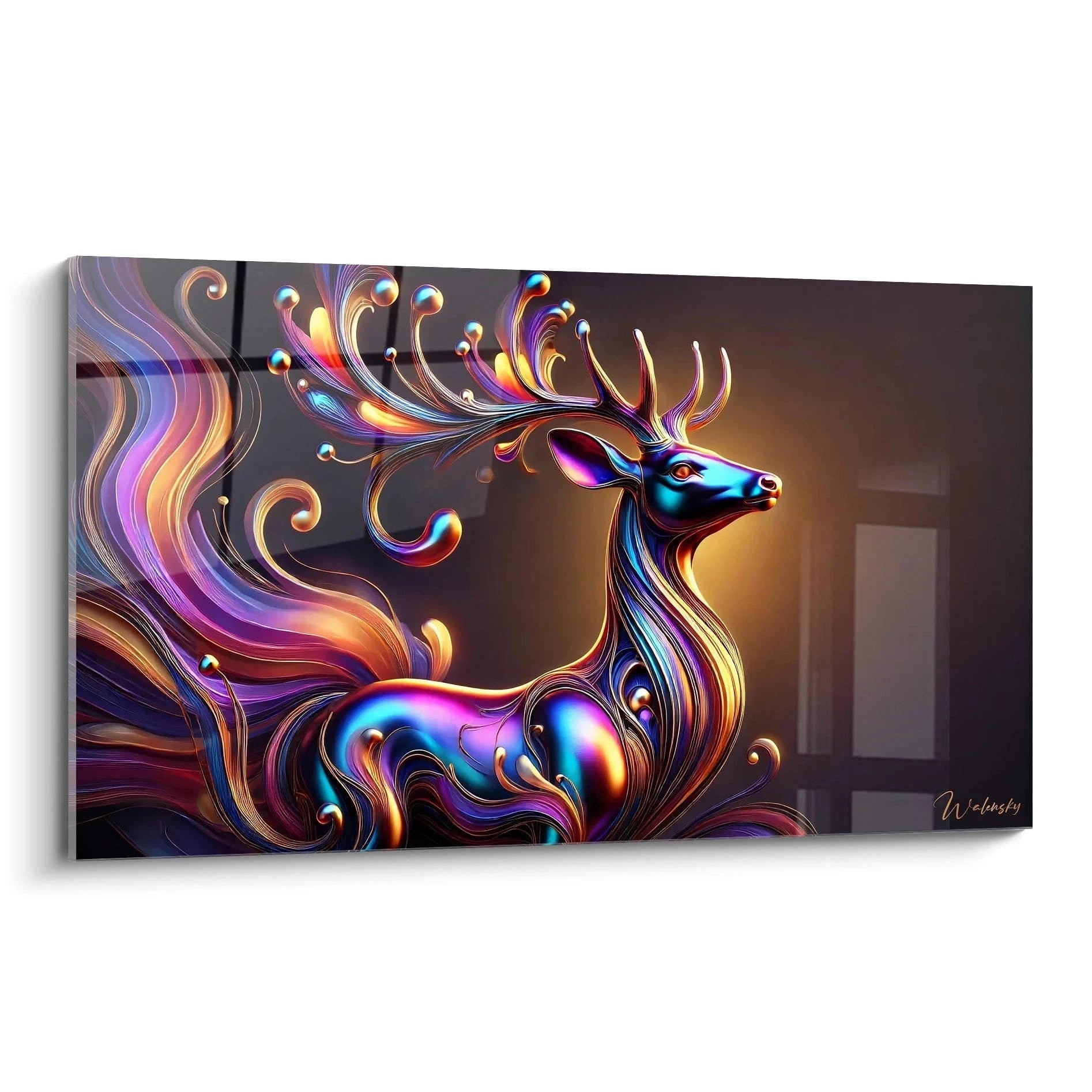
Discover our exclusive collection of animal paintings that celebrate the symbolic richness of the living world and bring a touch of timeless mystery to your walls.

The strangeness that awakens the gaze
At the end of this exploration, marine animals with terrestrial characteristics from Romanesque art reveal their true nature: they are bridges between worlds, sculpted metaphors, enigmas intended to awaken curiosity and reflection.
These hybrid creatures teach us that artistic representation has never been a simple copy of nature. It has always been interpretation, symbolization, transformation. The Romanesque sculptors were not mistaken in giving their fish legs – they expressed a deeper truth than anatomy: that of the mysterious unity of Creation.
The next time you come across, in a church or museum, one of these impossible beings, half-earth and half-sea, do not smile at the supposed ignorance of its creator. Admire instead their imaginative boldness and their ability to coexist in stone what nature separates, to reveal in the visible the mysteries of the invisible.
Perhaps you will even feel like inviting this fertile strangeness into your own universe, as a reminder that the world remains, fortunately, larger and more mysterious than our categories would have us believe.
Frequently Asked Questions
Did Romanesque sculptors really know what marine animals looked like?
Most Romanesque artisans had never seen the ocean or its inhabitants. Their knowledge of marine animals came exclusively from ancient texts, illuminated bestiaries and travelers' accounts. They were not seeking naturalist accuracy either: their goal was to create theological symbols understandable to their community. This distance from the subject represented paradoxically gave them immense creative freedom. The terrestrial characteristics added to marine creatures served to make them familiar and decipherable for an audience that knew wolves and lions, but not octopuses or rays. Far from being mistakes, these hybridizations were deliberate choices in service of a spiritual message.
Do all marine creatures in Romanesque art possess terrestrial attributes?
No, but a significant proportion of them exhibit these hybridizations. Simple fish, often used as symbols of Christ or Christians, generally retain their recognizable anatomy. On the other hand, creatures associated with danger, sin or mystery – sea serpents, monsters of the deep, mermaids – almost systematically display terrestrial characteristics: legs, claws, wings, manes. This distinction is not random: the more a creature had to embody a complex or negative concept in Romanesque symbolism, the more artists endowed it with multiple and contradictory attributes. Hybridization served as a visual marker of the extraordinary and the dangerous.
Can we find these motifs in other artistic styles than Romanesque art?
Absolutely. This tradition of hybrid marine animals runs throughout the history of Western art. Gothic art perpetuates these representations, albeit with greater naturalism. The Renaissance rediscovers Greco-Roman creatures and their medieval versions in grotesques and marginalia. 19th-century Symbolism and Art Nouveau reinvent these hybridizations with a new sensibility. Today, contemporary art and interior decoration regularly revisit these motifs, fascinated by their evocative power and poetic strangeness. These impossible creatures seem to respond to a fundamental human need: to represent the mysterious unity of life beyond the boundaries we impose on it. Each era reinterprets these hybrids according to its own cosmology and aesthetic concerns.
Explore our collections


