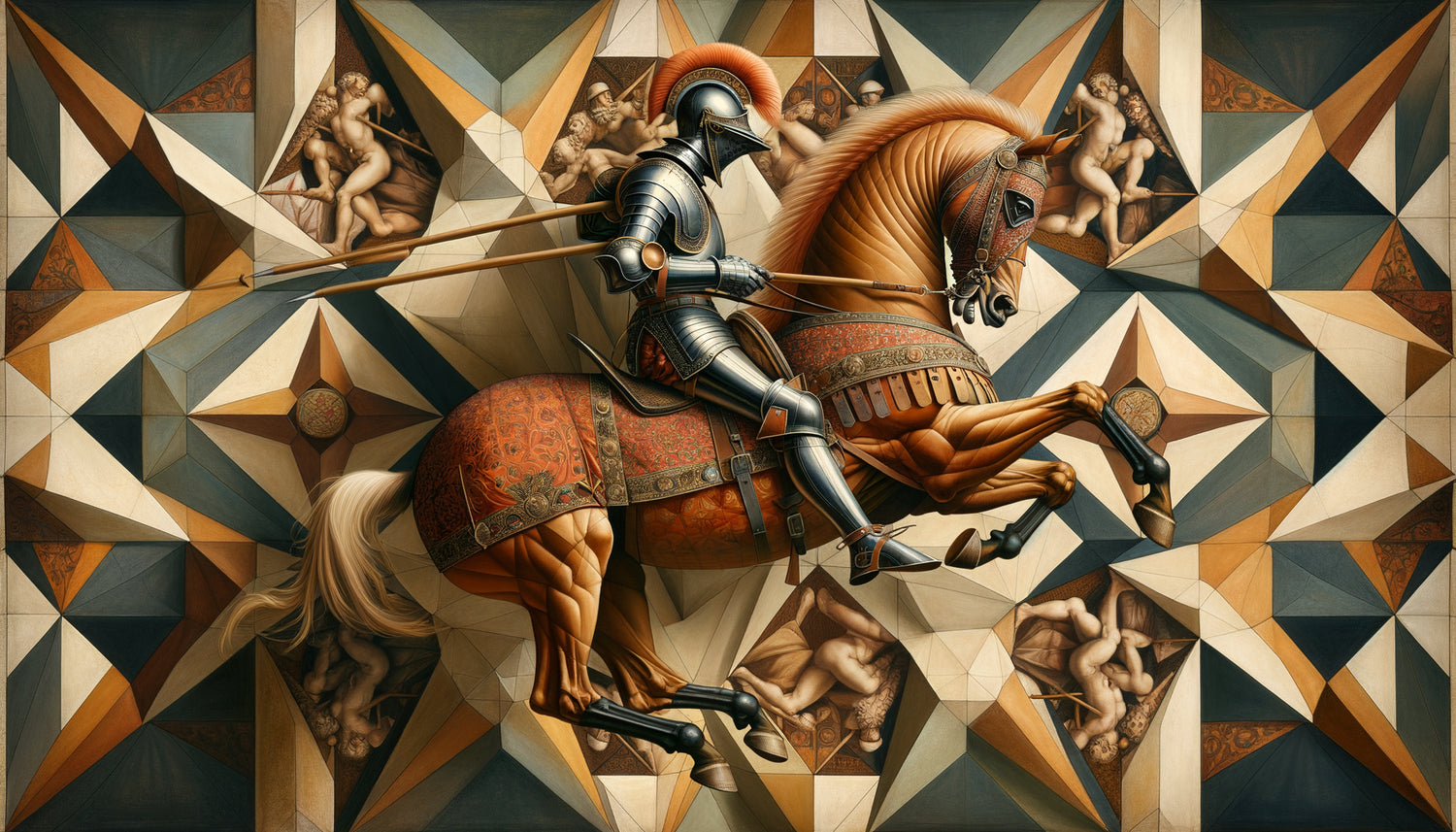
In the effervescent Florentine Quattrocento, a painter obsessed with perspective revolutionized the representation of equestrian subjects. Paolo Uccello, this tormented genius, spent his nights drawing horses from every possible angle, seeking to capture their power in three-dimensional space. But faced with the anatomical complexity of these war steeds, he developed a bold visual trick: anatomical foreshortening, this technique that consists of visually reducing the proportions of a body in depth to create a spectacular illusion of volume.
Here's what this innovation brings: it transforms static horses into dynamic creatures that seem to leap off the canvas, it solves the challenge of representing depth on a flat surface, and it creates a visual tension that immediately captivates the eye. Today, this technique still fascinates interior designers looking for equestrian works capable of giving movement and depth to their spaces.
You may have noticed that some representations of horses in ancient art seem flat, without relief, almost naive. This frustration was precisely that of the 15th-century patrons who wanted to immortalize their battles with realism. How to render the majesty of a galloping destrier when medieval artistic codes still favored static profiles?
Rest assured: Uccello solved this enigma with an ingenuity that still inspires our contemporary decorative choices. In this article, I take you behind the scenes of his workshop to understand how this Florentine master transformed equine anatomy into pure perspective magic, and why this technique resonates particularly in our modern interiors.
The Battle of San Romano: laboratory of foreshortening
In his legendary triptych of The Battle of San Romano, Uccello deploys his arsenal of anatomical foreshortenings with astonishing boldness. Observe these horses: their bodies seem compressed, their rumps shortened in an almost geometric way, their front limbs disproportionately large compared to the hind legs. This distortion is not a blunder – it's a calculated feat.
The painter applied what theorists call scorcio, literally the « foreshortening » in Italian. Specifically, he voluntarily reduced the apparent length of the horse’s body when viewed from the front or three-quarters, while exaggerating the elements in the foreground. A horse charging towards the viewer thus sees its rump compressed to the extreme, while its chest and head occupy a disproportionate space.
This technique created a illusion of depth revolutionary for the time. Horses are no longer just side silhouettes – they occupy space, they advance, they retreat, they pivot in a complex ballet that gives the viewer the impression of standing at the heart of the battle. For a contemporary interior, this spatial dynamics transforms a wall into a window onto another world.
The geometric obsession behind anatomy
Uccello did not work instinctively. Vasari, the great biographer of the Renaissance, recounts that the painter spent entire nights in his studio, drawing complex geometric geometric forms: spheres, cones, cylinders. For him, each part of the horse – the head, neck, chest, rump – corresponded to an elementary geometric form that had to be projected into space.
This mathematical approach to anatomical shortening explains the sometimes strange appearance of his horses. Their bodies seem sculpted from simplified volumes, their outlines traced with a compass. The artist deliberately sacrificed organic naturalism in favor of perspective coherence. The result? Mounts that defy the laws of classical anatomy but create a hypnotic spatiality.
To understand his process, imagine a cylinder representing the body of the horse. Viewed from profile, this cylinder shows its entire length. Viewed from front, it is reduced to a circle. Uccello applied this logic with rigor: a galloping frontal horse became a geometric compression where depth was expressed by the progressive reduction of volumes. In our living spaces, this tension between geometry and movement brings a unique graphic sophistication.

Fallen horses: the ultimate feat
The most spectacular element of Uccello's shortening? These fallen horses that litter his battlefields. Observe them carefully: their body is seen from above, in perspective plunging, with a vertiginous anatomical shortening. The folded legs, the compressed belly, the head turned over – each element obeys an implacable logic of spatial reduction.
This representation of dead or dying horses constituted a technical virtuosity exercise. Few artists before him dared to represent horses other than in profile. Uccello, on the other hand, multiplies them from all angles: frontally, from behind, overturned, rearing. Each posture required a new study of shortening, a new solution to compress equine anatomy without losing its readability.
The very texture of these horses reveals his approach: the harnesses, saddles, and armor follow the same principles of perspective distortion. The decorative bands curve, widen or narrow according to their position in space. This coherence between body and ornaments creates a fascinating visual unity, particularly sought after in current decorative compositions where every detail must dialogue with the whole.
Between science and poetry: the decorative legacy
What makes Uccello's anatomical shortcut so valuable for our contemporary interiors is this constant tension between mathematical rigor and visual lyricism. His horses are neither totally realistic nor purely abstract – they inhabit that intermediate space where science meets emotion.
In a living room or office, a reproduction of these equestrian battles brings architectural depth. The eye doesn't glide over the image – it penetrates it, follows the vanishing lines, explores the different planes. This spatial dynamic is particularly valuable in small spaces where one seeks to create an impression of amplitude.
The earthy tones that Uccello favored – ochres, muted reds, deep blues – blend beautifully into current natural palettes. The geometric character of his horses dialogues with the clean lines of contemporary furniture, while their contained energy infuses life and movement into the most minimalist compositions.

How to recognize a Uccello shortcut
If you are exploring reproductions or works inspired by this technique, look for these characteristic clues. First, the exaggeration of elements in the foreground: a disproportionate horse head, oversized front legs. Then, the visible compression of the croup and hindquarters, which seem huddled together.
Also observe the angular contours. Unlike the flowing curves of Leonardo da Vinci or the realistic anatomies of his contemporaries, Uccello's horses have almost cubist facets. This geometrization is the signature of his perspective approach to anatomical shortcut.
Finally, note the multiplication of viewpoints. Within the same composition, Uccello mixes horses in profile, from the front, three-quarter view, creating a complex choreography. This diversity of angles, far from causing confusion, generates a captivating visual rhythm. For an accent wall, this complexity offers a focal point that never tires.
Integrating this Renaissance boldness into your decor
The spirit of Uccello's anatomical shortcut transcends the simple reproduction of the era. It is about inviting into your space this tension between order and movement, between geometry and life. A large canvas inspired by his battles can structure a contemporary living room, bringing historical sophistication without falling into pastiche.
Favor generous formats that allow you to appreciate the complexity of the shortcuts. A small format does not do justice to these compositions where every detail counts. The work must breathe, allowing the eye to travel from one horse to another, gradually discovering the subtleties of spatial compression.
In terms of associations, these equestrian representations marry wonderfully with raw materials: natural stone, aged wood, patinated metal. The geometric rigor of the horses contrasts with the organic nature of the materials, creating a rich dialogue. Illuminate the work laterally to accentuate the impression of relief that the anatomical shortcut naturally generates.
Let the equestrian power transform your spaceDiscover our exclusive collection of animal paintings that capture the same dynamic energy and spatial depth inherited from the Renaissance masters.
Uccello's vision for your walls
Five centuries later, the genius of Uccello's anatomical shortcut still speaks to us. These compressed, geometric horses, projected into space with mathematical audacity, paved the way for all modern representations of movement. From Géricault to Picasso, every artist who wanted to capture equine power has dialogued, consciously or unconsciously, with this Florentine innovation.
For your interior, choosing a work inspired by this technique is asserting a taste for intellectual sophistication. It's not just decoration – it’s a window onto the history of art, a testament to that fascinating period when artists were reinventing how to see the world. It is also a celebration of the horse, an animal that has carried our civilizations and which art has never ceased to magnify.
Imagine yourself in your space, facing these steeds that seem to want to cross the frame. In the morning, the grazing light accentuates the compressed volumes. In the evening, artificial lighting reveals new details in the geometric harnesses. Every day, you rediscover this alchemy between science and beauty that Uccello patiently developed in his Florentine workshop. That is true decorative luxury: living with a work that continues to question you, amaze you, transport you.