Imagine a moment: you admire a work representing a majestic phoenix, its wings spread in a golden blaze. But did you know that behind this universal symbol of rebirth lie two radically different creatures? The Egyptian phoenix and the Greek phoenix, although linked by their legend of resurrection, embody profoundly distinct philosophies, aesthetics, and symbolism.
Here's what this distinction brings to your interior: a cultural depth that transforms a simple painting into a portal to millennia of wisdom, an aesthetic consciously chosen between sacred solemnity and flamboyant dynamism, and the ability to convey precisely the energy you want to infuse into your space.
Too often, we believe that a phoenix remains a phoenix. This aesthetic confusion deprives our interiors of extraordinary narrative richness. Choosing between these two mythological incarnations without understanding their nuances is like hanging a work for its color without grasping its soul.
Rest assured: by understanding these ancestral differences, you will develop a keen eye for mythological animal art and know exactly which version of the phoenix resonates with your inner world.
I propose a journey through the centuries, from the temples of ancient Egypt to Greek tales, to discover how these two visions of the phoenix can transform your decoration into a true statement of intent.
The Benou: The solar ancestor of the Nile shores
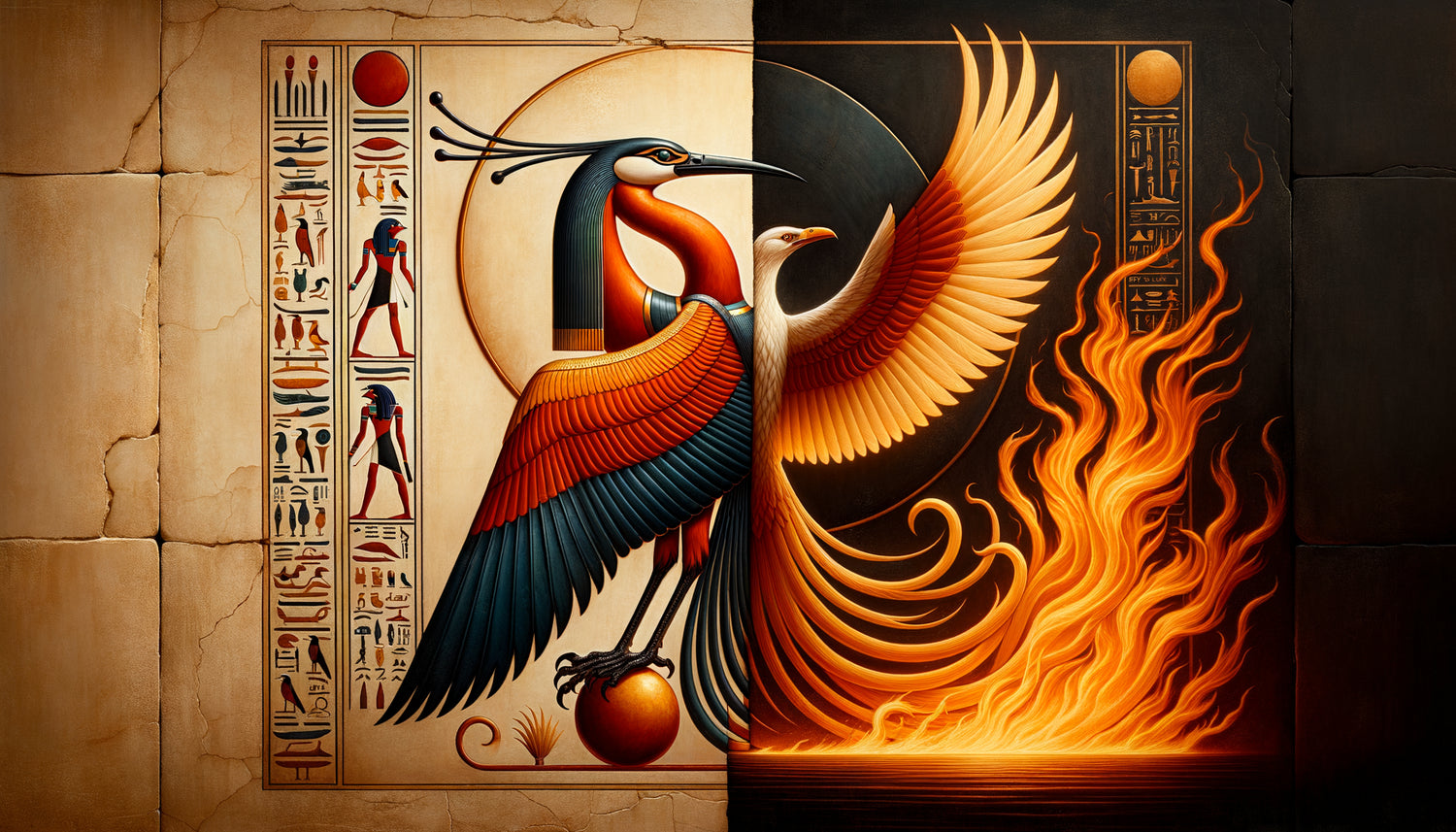
Before the Greek phoenix ignited the Western imagination, ancient Egypt already venerated the Benou, the primordial bird that embodied the cyclical rebirth of the sun. This sacred creature was not the flamboyant raptor we know today, but rather a grey heron, an elegant wading bird with long legs, often depicted with white and gray plumage.
In Egyptian cosmology, the Benou emerged from the primordial waters of chaos, perching on the benben, the sacred stone that symbolized the first land to emerge. Its piercing cry tore through the original silence, marking the very first sunrise. This creative dimension is fundamental: the Egyptian phoenix is not simply a bird that is reborn, it is the living manifestation of the cosmic cycle itself.
The Egyptians intimately associated the Benou with Re, the sun god, but also with Osiris, divinity of resurrection. In the temples of Heliopolis, a sacred city of the sun, mural representations showed this hieratic bird, often crowned with the atef crown of two plumes, a symbol of divine legitimacy. Its attitude is always contemplative, almost meditative.
What strikes in the aesthetics of the Benou is its architectural solemnity. No devouring flames, no excessive dramatization. Egypt preferred to evoke rebirth through the bird's vertical posture, its gaze turned towards the horizon where the sun rises every morning. A work representing the Benou brings to your interior this quality of timeless presence, this connection to natural rhythms that goes beyond decorative anecdote.
When Greece transforms the heron into a fire raptor
When Greek travelers, notably Herodotus in the 5th century BC, discovered accounts of the Egyptian Bennu, they reinterpreted them through their own cultural lens. Thus was born the Greek phoenix, a spectacular creature that differed considerably from its Nile ancestor.
Goodbye elegant heron: the Greek phoenix becomes a magnificent raptor, often described as an eagle with purple and gold feathers, with amethyst and azure hues. Its gigantic size impressed ancient storytellers, some evoking a wingspan comparable to that of a golden eagle. But above all, the Greek phoenix introduced the element that would make it immortal in our collective imagination: purifying fire.
According to Greek legend, after living five hundred years (some versions speak of a thousand years), the phoenix built a nest of aromatics – myrrh, cinnamon, incense – on which it immolated itself in a self-generated blaze. From its ashes, a new bird was reborn, perpetuating the eternal cycle. This pyrotechnic dimension, totally absent from the Egyptian tradition, transforms the phoenix into a symbol of radical transformation rather than cyclical continuity.
Greek and then Roman artists represented this phoenix in all its flamboyant glory: wings spread amidst flames, defiant gaze facing death, dynamic posture evoking victorious ascent. This version conveys a combative energy, that of rebirth conquered by voluntary sacrifice.
The color palette: sacred gold versus royal purple
One of the most striking differences between the Egyptian Bennu and the Greek phoenix lies in their color palettes. The Bennu displays natural tones – white, ashen gray, sometimes touches of discreet gold evoking sun rays. This sobriety reflects Egyptian aesthetics where color always carried a precise and measured meaning.
The Greek phoenix, on the other hand, explodes into a festival of warm colors: scarlet red, imperial purple, flamboyant gold, incandescent orange. Each feather seems to capture a fragment of sunset. This chromatic exuberance corresponds to Greek aesthetics which celebrated visible beauty and immediate visual impact.

Two philosophies of rebirth for two interior ambiances
Beyond appearance, these two versions of the phoenix convey distinct existential philosophies that will profoundly influence the atmosphere of your living space.
The Egyptian Bennu embodies rebirth as a natural continuity. In Egyptian thought, death is merely a transition, a stage in an eternal cycle as predictable as the rising sun. Choosing a representation of the Bennu for your interior invites this cyclical serenity, this peaceful acceptance of time passing and renewing itself. Ideal for an office where you cultivate patience for long-term projects, or a bedroom to promote restorative rest.
The Greek phoenix, on the other hand, dramatizes rebirth as a heroic rupture. One must die spectacularly to be reborn gloriously. This vision corresponds to Greek values of surpassing oneself, excellence (aretê), and the hero who confronts his destiny. A work representing the Greek phoenix in your common areas infuses an energy of active transformation, voluntary reinvention. Perfect for a creative space or a living room where you entertain, affirming your ability to constantly renew yourself.
This philosophical distinction is also reflected in life's moments when each symbol resonates more strongly. The Bennu accompanies natural transitions: moving house, changing seasons, gradual professional evolution. The Greek phoenix, on the other hand, celebrates assumed ruptures: radical retraining, rebirth after a trial, chosen identity transformation.
The legacy in contemporary art: recognizing influences
When you explore contemporary works representing the phoenix, this historical understanding allows you to instantly identify the influences and therefore the message conveyed.
Creations inspired by the Egyptian Bennu privilege: a vertical and hierarchical composition, backgrounds evoking Egyptian architecture (pyramids, obelisks, lotus), a subdued palette dominated by pale golds and bright whites, and often a crown or solar disc. The graphic style tends towards simplicity, geometric stylization, and symmetrical balance characteristic of pharaonic art.
Works inspired by the Greek phoenix display: a dynamic composition with ascending diagonals, omnipresent flames creating movement and contrast, an explosion of warm and saturated colors, and often a visible nest of aromatic herbs. The style is more dramatic, playing on contrasts of light, evoking power and movement.
Some contemporary artists brilliantly fuse these two traditions, creating hybrid phoenixes that combine Egyptian solemnity and Greek energy. These dialogic works are particularly fascinating for eclectic interiors seeking to reconcile contemplation and dynamism.
Pairing the phoenix with your decorative palette
The choice between the Egyptian Bennu and the Greek phoenix directly influences your decorative associations. A Bennu harmonizes beautifully with earthy tones, deep beiges, golden ochres, olive greens reminiscent of the banks of the Nile. It dialogues with natural materials such as linen, papyrus, driftwood.
The Greek phoenix, with its fiery colors, pairs with contrasting palettes: deep blacks that make the flames explode, pure whites that amplify brightness, touches of turquoise or emerald green creating refreshing counterpoints. It thrives near reflective materials: copper metals, mirrors, crystal.

The phoenix in modern symbolism: what message for your space?
Beyond the ancient story, these two incarnations of the phoenix carry distinct contemporary messages that resonate with our current aspirations.
The Egyptian Bennu powerfully speaks to our era of seeking meaning and reconnecting with natural cycles. In a world of constant acceleration, it reminds us that authentic rebirth requires time, patience, trust in organic rhythms. It embodies a form of gentle resilience, not spectacular but deeply rooted. It is the perfect symbol for those who cultivate the slow life, meditation, a holistic approach to well-being.
The Greek phoenix responds to our contemporary fascination with personal transformation, self-development, and the ability to reinvent oneself. It celebrates boldness, assumed rupture, the courage to self-destruct in order to be reborn better. In an entrepreneurial culture valuing pivoting, iteration, and rebooting, it becomes the emblem of creators, innovators, and disruptors. Its presence in an interior affirms: I do not fear change, I embrace it.
This distinction also influences how the phoenix dialogues with other symbols in your decor. The Bennu naturally pairs with other totemic animals of wisdom: owls, elephants, turtles. The Greek phoenix vibrates in resonance with symbols of strength and courage: eagles, lions, dragons.
Ready to invite rebirth into your interior?
Discover our exclusive collection of animal paintings that capture all the majesty of these mythological creatures, from the Egyptian Bennu to the Greek phoenix, to transform your space into a sanctuary of meaning.
Choosing your phoenix: an intimate and powerful decision
Now that you understand the depth of this millennial distinction, how do you choose between the Egyptian Bennu and the Greek phoenix for your interior?
Ask yourself these essential questions: What is my current relationship with change? Am I in a phase of gradual transformation or radical metamorphosis? The Bennu accompanies gentle evolutions, while the Greek phoenix celebrates personal revolutions.
What energy do I want to cultivate in this space? A place of contemplation and rejuvenation will call for the Bennu and its architectural serenity. A creative, action-oriented, stimulating space will benefit from the conquering energy of the Greek phoenix.
What cultural connection resonates within me? Ancient Egypt evokes mystical wisdom, cosmic cycles, a connection to the divine through nature. Ancient Greece speaks of heroism, self-transcendence, dramatic beauty.
Certain periods of life naturally call for one or the other. A convalescence, a reconstruction after mourning, can find comfort in the cyclical promise of the Bennu. A new professional start, an identity rebirth will resonate with the glorious sacrifice of the Greek phoenix.
There is no wrong choice, only a conscious versus unconscious choice. By understanding these ancestral nuances, you transform a simple decorative purchase into an intentional gesture, an affirmation of your personal trajectory.
Visualize your daily rebirth
Now imagine yourself each morning, meeting the gaze of this consciously chosen phoenix. The Bennu reminds you, in its serene posture, that you are part of a larger cycle, that every end carries within it a new beginning as natural as dawn. The Greek phoenix challenges you silently: embrace the fire of transformation, do not be afraid to consume what prevents you from flying higher.
This profound understanding transforms your relationship with mythological animal art. You are no longer simply decorating a wall: you are anchoring in your daily life a symbolic companion that dialogues with your deepest aspirations.
The Egyptian phoenix and the Greek phoenix are not interchangeable. They carry distinct legacies, opposing aesthetics, complementary philosophies. By consciously choosing between these two visions of rebirth, you affirm not only your decorative taste but also your way of inhabiting time, welcoming change, designing your own metamorphosis.
Your interior then becomes a reflection not of ephemeral trends, but of your personal mythology, those ancestral archetypes that continue to nourish us through the millennia.
Frequently asked questions about the differences between the Egyptian and Greek phoenix
Do the Egyptian and Greek phoenixes represent the same creature?
No, and that's the richness of these symbols! The Egyptian Bennu is a distinct creature that predates the Greek phoenix by several millennia. Physically, the Bennu resembles an elegant grey heron, while the Greek phoenix is described as a raptor with flamboyant feathers. Their most fundamental difference lies in their symbolism: the Bennu embodies natural cyclical continuity – like the sun rising each morning without particular drama – while the Greek phoenix dramatizes rebirth through sacrifice by fire and spectacular resurrection. The Greeks drew inspiration from the Egyptian Bennu during their travels to Egypt, but profoundly transformed it according to their own worldview, creating a new creature with its own mythological identity. For your decoration, understanding this distinction allows you to intentionally choose the message you want to convey: serene acceptance of life cycles or heroic celebration of radical transformation.
Which version of the phoenix best suits a contemporary interior?
Both versions blend beautifully into a contemporary interior, but they create radically different atmospheres! The Egyptian Bennu, with its clean aesthetic, vertical lines and subdued palette, harmonizes perfectly with minimalist, Scandinavian or zen styles. Its hieratic presence brings a touch of mystery and depth without ever visually saturating the space. It is particularly suitable for bedrooms, meditation spaces or offices where you seek concentration and serenity. The Greek phoenix, with its explosive colors and dynamic composition, thrives in eclectic interiors, assumed maximalisms or industrial styles where it creates a powerful focal point. It electrifies a living room, stimulates a creative workshop, asserts a personality in an entrance hall. My advice: for a first apartment or a professional space, prioritize the Bennu which ages better visually and is less tiring on the eye. For a character piece where you want to create an immediate impact, dare the Greek phoenix in all its flamboyant glory.
Can we mix Egyptian and Greek phoenix symbols in the same room?
It's a fascinating question that touches on the art of composing a consistent visual narrative! Technically, yes, you can combine these two versions of the phoenix, but it requires a clear and assumed decorative intention. If you are creating a themed gallery wall on the renaissance or ancient mythologies, juxtaposing Benu and the Greek phoenix can create an enriching cultural dialogue – provided they are presented consciously as two different responses to the same existential question. On the other hand, in a small room or without a unifying concept, this association risks creating visual and symbolic confusion. A more subtle approach is to choose contemporary works that fuse both traditions – some artists create hybrid phoenixes combining Egyptian verticality and Greek flames. Personally, I recommend dedicating each space to one version: Benu in rest and contemplation areas, the Greek phoenix in action and creativity spaces. This conscious distribution transforms your interior into a true map of your different energies, each room resonating with a distinct facet of your personality.