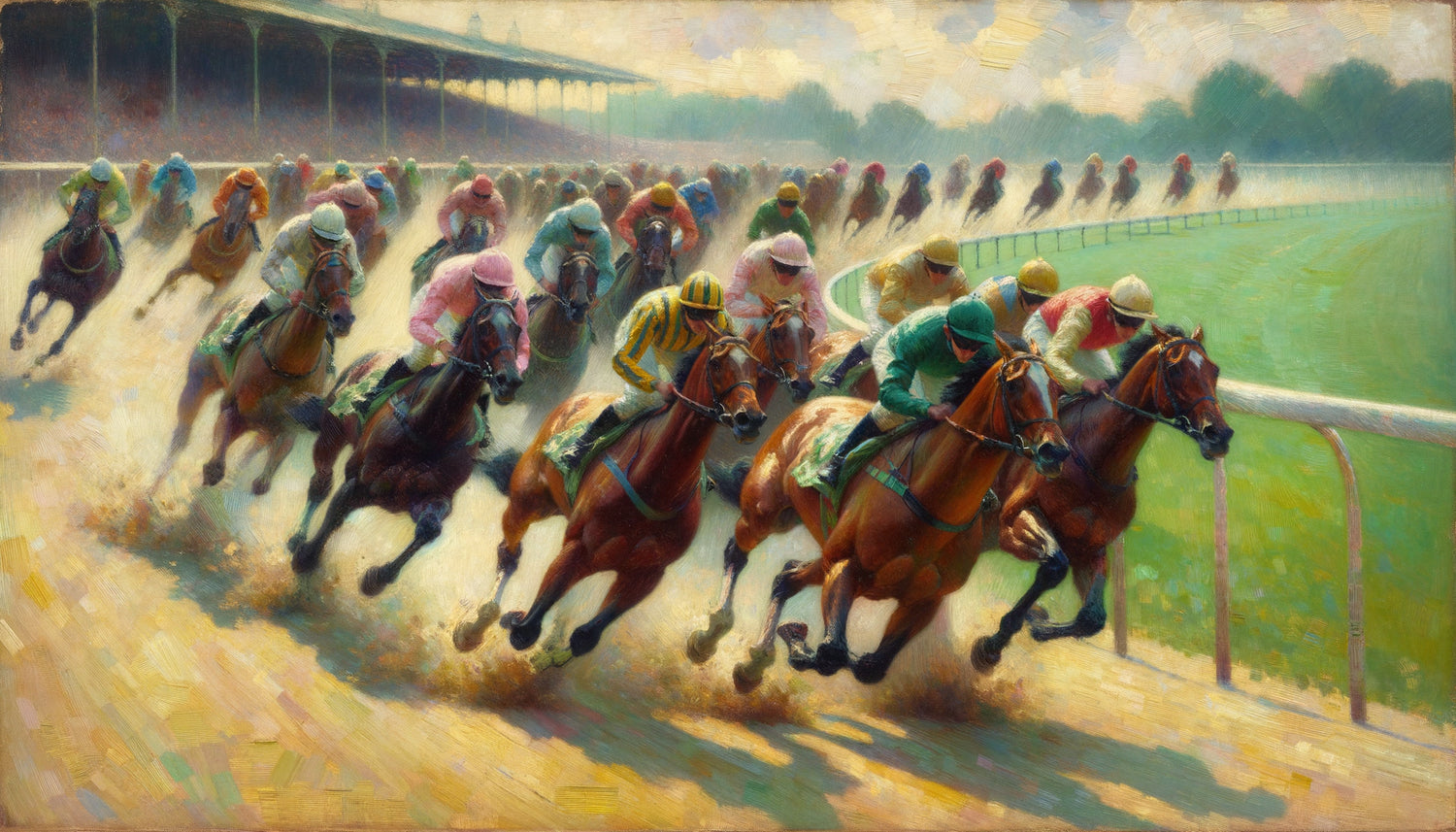
Imagine a golden afternoon at the Longchamp racecourse in 1872. The lustrous coats of the racing horses catch the changing light, their muscles tremble in anticipation of the start, and suddenly, the bell rings. For centuries, academic painters had frozen these magnificent creatures in rigid, almost sculptural poses. Then came the Impressionists, who dared to capture what no one had ever truly seen: authentic movement, the vibration of the moment, the golden dust raised by the hooves.
Here's what this artistic revolution brought: a radically new vision of the horse in motion capturing the raw energy of racing, a revolutionary approach to light on animal coats creating reflections never imagined before, and an unprecedented intimacy with these equine athletes showing their true nature rather than their idealized silhouette.
For too long, equestrian representations remained prisoners of convention. Racehorses looked like bronze statues, their stylized gallops defying all anatomical logic. Art lovers found themselves facing works that were technically perfect but lacking the palpable electricity that makes hearts beat on racecourses.
Yet, from the 1860s onwards, a handful of visionary artists understood something fundamental: to capture the soul of a racehorse, it was necessary to abandon the studio and plunge into the arena of modern life. They transformed our gaze forever.
This article reveals how Impressionists revolutionized the representation of racehorses, creating a visual legacy that still inspires our interiors and our passion for animal art today.
The shock of modernity: when racecourses become artistic temples
In the 1860s, Paris underwent a spectacular transformation. Baron Haussmann redrew the capital, and with it, the leisure activities of the bourgeoisie were reinvented. The Longchamp and Auteuil racetracks became fashionable theaters where elegance and equestrian passion mingled.
Impressionist painters, fascinated by contemporary life, saw an extraordinary opportunity. Edgar Degas, in particular, frequented these places assiduously since 1860. Unlike battle painters who glorified heroic steeds, he observed racehorses with a quasi-scientific curiosity. He noted their postures before the start, the visible anxiety in their mobile ears, the tension of their hocks.
This approach marked a radical break. Where academics painted idealized horses in impossible poses - all four hooves simultaneously detached from the ground in a fanciful gallop - Impressionists sought the truth of movement. They intuitively understood what photography would soon reveal: the real gallop follows a precise sequence, each phase having its own beauty.
The little-known influence of equestrian photography
In 1878, Eadweard Muybridge published his famous chronophotographs showing the breakdown of a gallop. This revelation confirmed what Degas suspected: the traditional flying trot, with all four legs extended horizontally, does not exist in reality. Impressionists gradually incorporate this anatomical truth, creating more authentic representations where racehorses reveal their true bodily mechanics.
Light as a revealer: painting the coat in motion
The most spectacular contribution of the Impressionists lies in their revolutionary treatment of light on horse coats. Before them, a chestnut coat was uniformly brown, a dapple grey meticulously detailed but static.
Impressionists discover that natural light constantly transforms the appearance of racehorses. A bay thoroughbred in midday sun looks nothing like the same animal in the slanting light of evening. Claude Monet, though less prolific than Degas on this theme, applies to equestrian scenes his masterful understanding of variations in light.
Their canvases show coats covered with bluish, violet, orange reflections depending on the time and atmosphere. This chromatic approach creates a sensation of vibrant life. The horse is no longer an inert object but a creature vibrating, reacting to its luminous environment. Quick, visible brushstrokes add to this impression of constant trembling.
The jockey and his mount: a colorful symbiosis
Impressionists also revolutionize the visual relationship between the jockey and his horse. Colored jackets – scarlet red, royal blue, lemon yellow – are no longer simply painted in solid blocks. They dialogue with the reflections on the equine coat, creating bold chromatic harmonies. Degas particularly excels in these compositions where the riders' dazzling silks seem to respond to the subtle nuances of racehorses.

Capturing the suspended moment: the art of pre-race
Contrary to expectation, Impressionists do not primarily paint the race itself in its climax. Their genius lies in capturing moments of anticipation – those instants charged with electricity where anything can still happen.
Degas favors paddock scenes, horses at a walk, delayed starts. In these compositions, the contained energy of racehorses becomes almost palpable. A horse pawing nervously, an arched neck, an ear pointed towards the track - every detail tells of the imminence of a sporting explosion.
This narrative approach creates dramatic tension absent from academic representations. The viewer does not simply see a beautiful animal; they feel the collective anticipation, that stretched second before everything tips into the controlled chaos of the race. Nervous brushstrokes and sometimes blurred outlines amplify this feeling of fleeting moment.
The revolutionary angle of view: at the heart of the action
The Impressionists also overturn traditional perspective. Where academic painters opted for panoramic and theatrical views, placing the viewer in a distant witness position, the Impressionists plunge the gaze into the heart of the equestrian scene.
Degas uses bold framing, sometimes inspired by photography and Japanese prints. A horse can be cut off by the edge of the painting, creating an impression of spontaneity, as if the artist had captured the moment without preparation. These asymmetrical compositions give the illusion that the viewer is actually standing on the racetrack, jostled by the movement of preparations.
Some works adopt unexpected overhead or low-angle shots. From above, the muscular mass of a racehorse takes on a new sculptural scale. From below, its silhouette stands out dramatically against the sky, magnifying its athletic power. These innovative angles create an unprecedented intimacy with the animal, removing it from its mythological pedestal and making it almost accessible.
The crowd as a narrative element
The Impressionists masterfully integrate the racing public into their compositions. Unlike classic representations centered solely on the glorious horse, they show the complete ecosystem of the racetrack. Spectators in top hats, colorful umbrellas, the grandstand in the background - all these elements contextualize racehorses within their real social environment, anchoring the work in Parisian modernity.

From pastel to oil: techniques at the service of movement
The Impressionist revolution of racehorses also goes through technical innovation. Degas, in particular, favors pastel for many equestrian scenes. This medium offers considerable advantages for capturing the dynamism of animals.
Pastel allows for quick color overlays without drying time, ideal for restoring subtle variations in light on a moving coat. The strokes can remain visible, creating that vibrant texture so characteristic. A horse in pastel seems to tremble before our eyes, its musculature suggested by colored hatching rather than meticulously detailed.
In oil paint, the Impressionists adopt a fragmented touch, applying color in small juxtaposed commas. From afar, the eye reconstructs the shape of the racehorse, but up close, we discover a vibrant mosaic of complementary hues. This optical technique creates a sensation of perpetual movement, as if the animal breathes on the canvas.
The contemporary legacy: from racetracks to our interiors
More than a century after these innovations, the influence of Impressionists on the representation of racehorses remains vibrant. Their approach freed animal artists from rigid academicism, opening the way for countless personal interpretations.
In contemporary decoration, equestrian works inspired by Impressionism bring a sophisticated energy. Unlike hyperrealistic representations that can seem static, a canvas where the horse vibrates with colored touches infuses dynamism and elegance. These pieces work beautifully in modern interiors, creating a bridge between equestrian tradition and contemporary sensibility.
The bold chromatic nuances of the Impressionists - these unexpected blues in the shadows, these violets on the flanks, these yellows in the reflections - perfectly dialogue with current decorative palettes. A painting of a horse treated in this spirit becomes much more than an animal representation: it is a celebration of movement and light, fundamental values of contemporary design.
Let yourself be seduced by the timeless elegance of the equestrian world
Discover our exclusive collection of animal paintings that capture the nobility and dynamism of the finest specimens, to transform your interior into an inspiring gallery.
Conclusion: see differently to feel more
The Impressionists did not simply change the way racehorses were painted - they transformed our way of perceiving them. By abandoning rigid idealization to embrace the fleeting truth of the moment, they revealed the authentic beauty of these equine athletes.
Today, when you admire an equestrian representation that pulsates with life, capturing the light dancing on a gleaming coat, immersing you in the heart of the action rather than keeping you at a respectful distance, you benefit from this revolutionary heritage. This sensitive and vibrant approach resonates particularly in our contemporary living spaces, where authenticity and emotion take precedence over simple decoration.
The next time you contemplate a racetrack or an equestrian work, look for these impressionistic touches: unexpected colorful reflections, contained energy before the start, the silent complicity between jockey and mount. It is in these details that true magic lies - the one that transforms a simple subject into an emotional experience, and an image into a window onto a vibrant world.
Frequently Asked Questions
Why were the Impressionists so interested in racehorses?
The Impressionists were passionate about Parisian modern life, and racetracks represented one of the most elegant pastimes of the time. Racing brought together all the elements that fascinated them: movement, changing light outdoors, contemporary social life, and the technical challenge of capturing speed. For artists like Degas, the racetrack also offered the opportunity to study equine anatomy in motion in an authentic context, far from the artificial poses of the studio. These scenes perfectly embodied their ambition to paint the world as it was truly lived, with its energy and spontaneity, rather than reproducing mythological or historical subjects distant from their daily reality.
How to integrate an equestrian work inspired by Impressionism into a modern interior?
An impressionistic equestrian work integrates wonderfully into contemporary interiors thanks to its chromatic dynamism and vibrant touch. Choose a location where natural light can dialogue with the colorful nuances of the painting, ideally in a living room or entrance hall. The often soft and bright tones of Impressionist works - these subtle blues, greens, and ochres - harmonize perfectly with modern neutral palettes, creating an elegant focal point without overwhelming the space. For maximum effect, frame the work simply, in a clean frame that does not compete with the visual richness of the painting. The energy suggested by the fragmented touches of color just brings that breath of life sought by minimalist interiors, proving that equestrian tradition and design modernity can dialogue harmoniously.
What is the main difference between a horse painted in an academic way and an Impressionist horse?
The fundamental difference lies in the philosophical approach to the subject. An academic horse is painted with meticulous anatomical precision, every detail carefully rendered, the coat uniformly treated, in a pose often idealized and static. The result is technically impressive but may seem frozen, like a magnified scientific illustration. Conversely, an Impressionist horse prioritizes the sensation of a lived moment: outlines can be blurred, the touch remains visible and fragmented, colors are applied by juxtaposition rather than meticulously mixed. The animal seems to breathe, move, react to its luminous environment. This approach captures emotional essence rather than formal perfection. For an art enthusiast, the academic work evokes technical admiration, while the Impressionist work creates an immediate emotional connection - one feels the living presence of the horse rather than observing its representation.