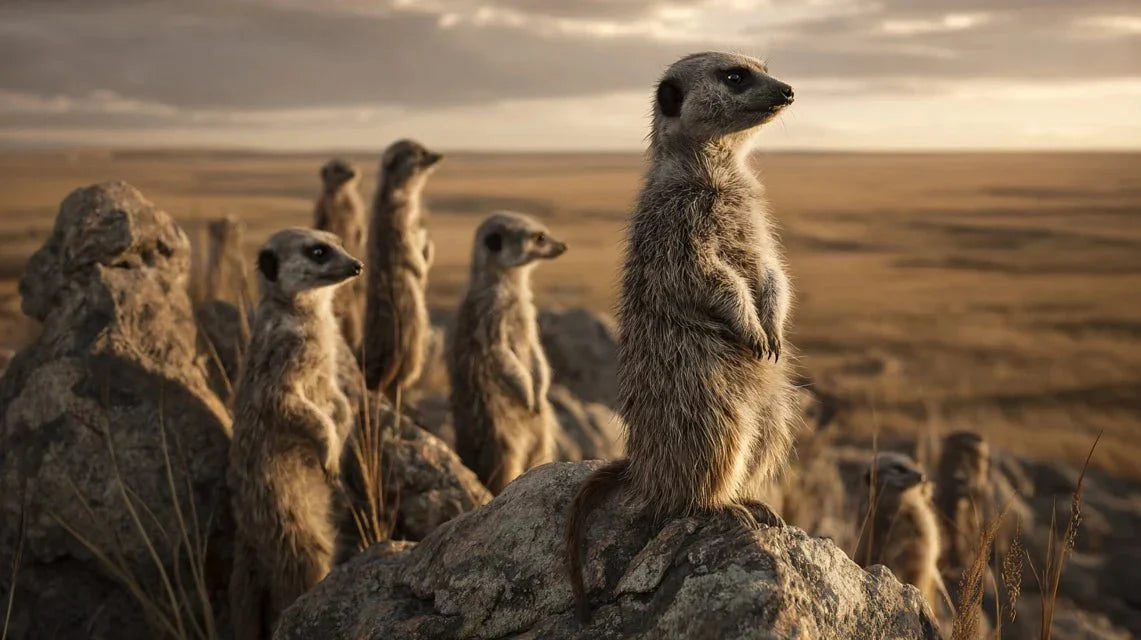
Imagine a small mammal, weighing less than one kilogram, standing on its hind legs in the vastness of the Kalahari Desert. Its eyes scan the horizon for any sign of danger. It's not a solitary hero, but a dedicated member of a community where everyone looks out for each other. Here is the fascinating story of meerkats, true desert sentinels and masters of community vigilance.
Meerkats and their Community Vigilance Organization
In the arid lands of southern Africa, meerkats have invented something extraordinary in terms of animal cooperation. Rather than struggling alone for survival, they have created a society of 20 to 40 individuals where community vigilance becomes a way of life (Source: Larousse Encyclopedia).
Each morning, as the sun rises over the savanna, these desert sentinels emerge from their burrows with a precise plan. One of them climbs onto a rock or tree. Its mission? To become the eyes and ears of the entire family while others search for food. This social organization is not by chance, but the result of remarkable evolution forged over millennia of adaptation.
The community vigilance of meerkats works like a Swiss watch thanks to their sophisticated animal social behavior. An experienced individual takes position in height, scans the environment and emits regular signals to reassure the group (Source: Animal Blog). Meanwhile, its companions can search the sand for insects without fear of a surprise attack by a predator.
This collective strategy proves remarkably effective against the many threats in their hostile environment. Birds of prey, venomous snakes, hungry jackals: the list of predators is long, but their collective surveillance system allows them to survive and thrive where other species fail.
How Meerkats Embody the Collective Surveillance Model
Meerkats embody the perfection of collective surveillance thanks to a system that would make our modern security services envious. Their secret? The rotation of sentinels and an animal alert system developed over evolution.
Picture this: while one sentinel watches, it emits a regular "lookout song." This signal reassures the group and confirms that all is well. But as soon as danger appears, everything changes in this model of animal cooperation (Source: Science in School). The alert sounds, and within seconds, the entire colony disappears into underground burrows.
What makes these desert sentinels exceptional is their authentic altruism that transcends personal interests. Individuals who are not even parents of the young accept to sacrifice their feeding time to protect the youngsters of the group (Source: Wikipedia). This solidarity goes beyond family ties and creates a true community of destiny based on an exemplary social organization.
The effectiveness of this system also relies on a clear but flexible hierarchy. The alpha female coordinates the group's activities, but each member can become a sentinel depending on circumstances and their particular skills.
To discover the fascinating world of these exceptional animals and their natural beauty, explore our collection of animal paintings that captures the essence of their animal social behavior.
Suricate alert system: vigilance and community communication
The story becomes even more captivating when you discover the animal alert system secret of suricates. These little geniuses of communication have developed a system that rivals our modern technologies of collective surveillance.
Each type of predator has its own alarm call in this sophisticated animal alert system. An eagle soaring overhead? A specific sound rings out. A snake slithering through the grass? Another warning signal resonates (Source: Soy un Caballo). This precision allows the group to react appropriately according to the identified threat.
But their community vigilance doesn't stop there. Suricates have built a veritable network of underground tunnels that extends over several square kilometers. These interconnected galleries form a natural subway system where the group can take refuge instantly (Source: Blog Animal). Each burrow has multiple entrances and exits, allowing for quick evacuations and escape routes in case of attack.
Here's how their animal alert system works:
- Threat detection by the sentinel
- Emission of the specific alarm signal
- Coordinated reaction of the entire group
- Refuge in the appropriate burrow network
The sophistication of their communication rivals that of primates. Scientists have identified more than 30 different vocalizations, each transmitting precise information about the type, proximity and urgency of the detected threat.
Why suricates embody the effectiveness of group vigilance
Suricates embody excellence in community vigilance because they have solved a problem that many species fail to overcome thanks to their exceptional animal social behavior. How to reconcile individual needs and collective security? Their answer revolutionizes our understanding of animal cooperation.
Their solution is brilliant and relies on a social organization perfectly honed by generations of adaptation. In the Kalahari desert, a solitary suricate is doomed to death (Source: Wikipedia). But together, these desert sentinels transform this weakness into extraordinary strength. Their collective surveillance allows everyone to feed safely while another provides protection for all.
Young meerkats learn this system of animal cooperation from a very young age. They observe, imitate and gradually integrate the codes of community vigilance (Source: Soy un Caballo). This cultural transmission ensures that each generation refines the inherited system from its ancestors.
This collective education begins as early as six months old, when youngsters start participating in guard rotations. They progressively develop their observation and communication skills, becoming active contributors to the group's safety.
The story of meerkats teaches us a valuable lesson about animal social behavior and the benefits of collaboration. In a world where dangers are everywhere, individual surveillance is not enough. These desert sentinels have understood that true strength lies in collective vigilance and shared awareness. That's why they so perfectly embody community vigilance and continue to inspire our own modern models of collective security.
FAQ: Everything you need to know about meerkat community vigilance
Q: How long can a meerkat sentinel stay in position?
A: A meerkat sentinel typically maintains its surveillance position for 15 to 60 minutes before being relieved by another group member. This rotation prevents exhaustion and maintains optimal vigilance throughout the day.
Q: Can meerkats survive alone without their group?
A: No, a meerkat isolated from its group has very little chance of survival in the Kalahari desert. Without the community vigilance system, it becomes vulnerable to predators and cannot feed safely. That's why their social organization is vital for their survival.
Q: How do young meerkats learn the alert system?
A: Young meerkats learn by observation and imitation from a few weeks old. They begin actively participating in guard rotations around 6 months, progressively developing their detection and communication skills under the supervision of experienced adults.