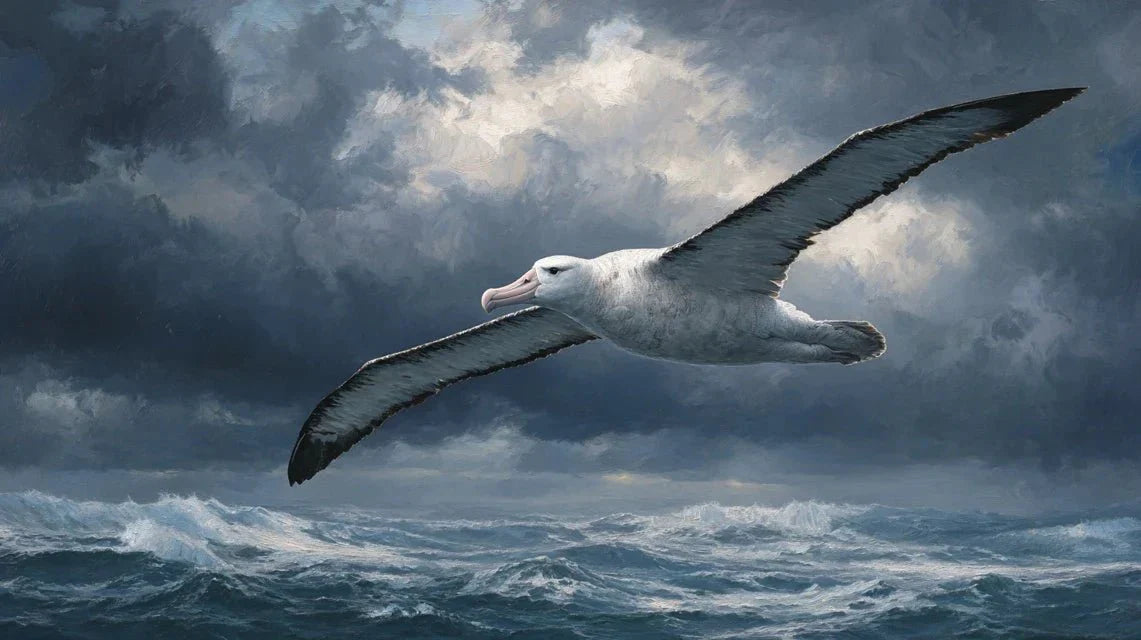
Imagine facing the ocean, observing this majestic silhouette gliding effortlessly above the waves. The albatross embodies pure freedom, and painting its grace in flight represents one of the most fascinating challenges for any artist passionate about nature and ornithological art. These giants of the seas, true symbols of oceanic majesty, offer a striking spectacle that has inspired poets and painters for centuries.
Deciphering the exceptional anatomy of the albatross
The wandering albatross impresses with its record dimensions. With a wingspan of 11.8 feet (Source: National Museum of Natural History), it holds the title of the largest flying bird in the world. Its wings function like natural gliders, equipped with an ingenious tendon locking system that allows it to fly without fatigue for hours.
This marvel of evolution presents unique characteristics:
- Ultra-long wings designed to capture even the slightest breeze
- A streamlined body that cuts through the air with remarkable efficiency
- Specialized feathers creating maximum lift
- A weight that can reach 26.5 pounds (Source: Wikipedia) distributed optimally
The albatross spends 95% of its life in flight (Source: National Museum of Natural History), a figure that reveals how much this bird is born for the air and constitutes a privileged subject of naturalistic observation. This extraordinary adaptation is the result of millions of years of evolution in the most hostile marine environments on the planet.
The secret to their endurance lies in their ability to exploit oceanic air currents. Their aerodynamic finesse, between 22 and 23, means they can travel 22 meters horizontally for every meter of vertical descent. This exceptional performance surpasses that of many gliders designed by humans.
Mastering the pictorial techniques of albatross flight
Painting an albatross in flight is first and foremost understanding its unique way of moving within the context of animal painting. Unlike other birds, it almost never flaps its wings. It literally surfs on air currents, adopting that famous S-shaped trajectory which is its aerodynamic signature.
Here's how to capture this natural elegance in your artistic composition:
- Trace fluid lines that follow the movement of the air
- Respect the proportions: the wingspan is three times the length of the body
- Show the perfect stability of outstretched wings
- Play with perspective to create a sense of grandeur
The key lies in meticulous observation. These navigators of the air use a technique called gradient flight, exploiting the difference in wind speed between the surface of the ocean and altitude. This method, studied by modern aeronautical engineers, now inspires the design of long-range drones. Get inspired by animal paintings that perfectly illustrate this natural aerial grace.
The study of albatross movement reveals fascinating technical subtleties. Their wings are never perfectly still: constant micro-adjustments allow them to optimize their trajectory. These nuances, invisible to the naked eye, can be suggested by subtle variations in the orientation of feathers and wing angle.
Translate the nobility of gliding onto canvas
The albatross's glide defies the laws of classical physics. It can cover 22 horizontal kilometers for every meter of descent (Source: ISAE-SUPAERO), a performance that allows it to cross oceans with seemingly effortless ease. This flight technique, called dynamic soaring, exploits wind gradients present above the waves.
To render this majesty with a realistic rendering:
- Maintain a gentle angle of flight, never abrupt
- Show this characteristic sensation of weightlessness
- Use light to sculpt the relief of the feathers
- Suggest the invisible interaction with masses of air
These birds possess an extraordinary ability: they perceive the infrasound produced by distant storms, allowing them to navigate towards favorable wind zones located thousands of kilometers away. This infrasonic perception, long a mystery, has recently been elucidated by modern science.
Albatross flight also includes phases of hovering, particularly during foraging. At these times, the bird adopts a different posture, wings slightly raised, exploiting the updrafts generated by the waves. This behavioral variation offers artists a diversity of postures to explore.
Tame the color palette of the albatross
The albatross's plumage tells a story of fascinating transformation. The young bird exhibits brownish tones that gradually evolve into the immaculate white of the adult, a process that can take twenty years and constitutes a technical challenge for modern pictorial techniques.
Your color palette should include:
- The dominant pearly white of mature plumage
- The delicate gray shades of the wing edges
- The characteristic rose-orange of the adult beak
- The golden reflections that the ocean projects onto the plumage
The marine environment profoundly influences these colors. The albatross lives only in the southern seas, and this particular light from high latitudes gives its plumage unique reflections that only an attentive eye can reproduce. The quality of this polar light, colder and more contrasted, creates chromatic effects impossible to observe at other latitudes.
Seasonal variations also affect the bird's appearance. During the breeding season, the plumage has a particular sheen, while outside this period, the colors may appear duller. These temporal subtleties considerably enrich artistic possibilities.
Reveal grandeur in the details
A well-painted albatross is recognized by the specific anatomical details. These birds belong to the Procellariiformes family, recognizable by their very particular tubular nostrils. Their hooked beak testifies to their diet, mainly composed of squid and fish that they catch on the surface.
The distinctive elements that make the difference:
- Tubular nostrils, a hallmark of their family
- Piercing eye capable of spotting prey from kilometers away
- Webbed feet, usually folded in flight
- Varied feather texture according to its aerodynamic function
These giants of the seas can live between 50 and 80 years (Source: National Museum of Natural History), an exceptional longevity that testifies to their perfect adaptation to their hostile environment. This remarkable longevity is accompanied by late sexual maturity, the bird not reaching adulthood until around 10 years old.
The expression of the albatross varies depending on its activity. During foraging, its gaze constantly scans the horizon. During courtship displays, behavior changes radically, adopting spectacular postures with the neck stretched towards the sky and wings spread. These behavioral variations offer artists a wealth of expressions to capture.
Mastering their representation opens the doors to marine animal painting and understanding the very essence of oceanic freedom. The albatross remains one of the most noble and technically demanding subjects in contemporary ornithological art.
Frequently Asked Questions
How to start painting an albatross in flight?
Start by studying the bird's anatomy and watching videos of albatross flight. First master the proportions: the wingspan is three times the length of the body. Favor fluid line techniques to capture the natural movement of gliding flight.
What colors to use to paint an adult albatros?
The palette mainly consists of pearly white for the plumage, delicate gray shades on the wing edges, and rose-orange for the beak. Don't forget the golden reflections projected by ocean light on the immaculate plumage.
How to represent the characteristic gliding flight of the albatross?
Respect the gentle angle of flight (never abrupt) and show the perfect stability of extended wings. The albatross travels 22 kilometers horizontally for every meter of descent, creating this sensation of weightlessness that must be translated by harmonious lines.