Imagine a moment, an eagle soaring above the Roman legions. This majestic bird now reigns supreme over painted national emblems and modern heraldry around the world. From the Roman Empire to contemporary flags, this raptor stands as the ultimate symbol of state power and national sovereignty.
Let's take concrete examples: more than 25 nations - including Germany, the United States, Poland, and Mexico - now incorporate the eagle into their official coats of arms. This dominance is no accident; it testifies to the undeniable strength of this bird in painted heraldic art. This prominence can be explained by the unique convergence between natural majesty and political significance, making the eagle the archetype of a national symbol.
Eagle emblems: the symbolism of power painted since antiquity
The eagle emblem finds its roots in Imperial Rome, where the aquila adorned the standards of the legions. This centuries-old tradition has been passed down uninterrupted through heraldic art: the bird of Jupiter, emblem of the Roman Empire, has been associated with military victories and iconography of power since ancient times. This direct lineage between ancient power and modern authority explains why painted national emblems perpetuate this iconography in contemporary state symbolism.
Consider the example of Napoleon. Passionate about Roman history, he adopted this imperial symbol and had it placed on all Napoleonic army flags immediately after his coronation. This decision was not insignificant; it marked a turning point in the art of painted national emblems, codifying the eagle as an exclusive attribute of supreme power.
- Ancient symbolism: Divine messenger and protector of empires
- Military adoption: Roman standards and legionary eagles
- Imperial transmission: From Caesar to Napoleon, continuity of the painted symbol
- Universality: Transcultural recognition of aquiline power
Christian iconography has also contributed to this prominence. The eagle is in Eustace and Epiphane the figure of God, angels, faithful people, and the most sublime Apostle John, reinforcing its legitimacy in painted national emblems of Christian tradition.
Painted national emblems: techniques for representing imperial eagles
Painted national emblems adhere to specific pictorial codes to represent the eagle in modern vexillology. Modern Germany exemplifies this codification: it must be monocephalous, with its head turned towards its right wing, not wear a crown and be “feathered” (i.e., not touch the edges of the shield). This standardization guarantees immediate identification of the national symbol in contemporary heraldry.
The two-headed eagle represents a major variation in painted national emblems. Introduced in 1433, the two-headed eagle appeared on the emperor's coat of arms and the empire's armorial bearings until the end of the Holy Roman Empire, in 1806. This representation symbolizes double temporal and spiritual authority, particularly prized in Orthodox empires.
The color palette of painted emblem eagles follows strict conventions:
- Black eagle: Germanic tradition of the Holy Roman Empire
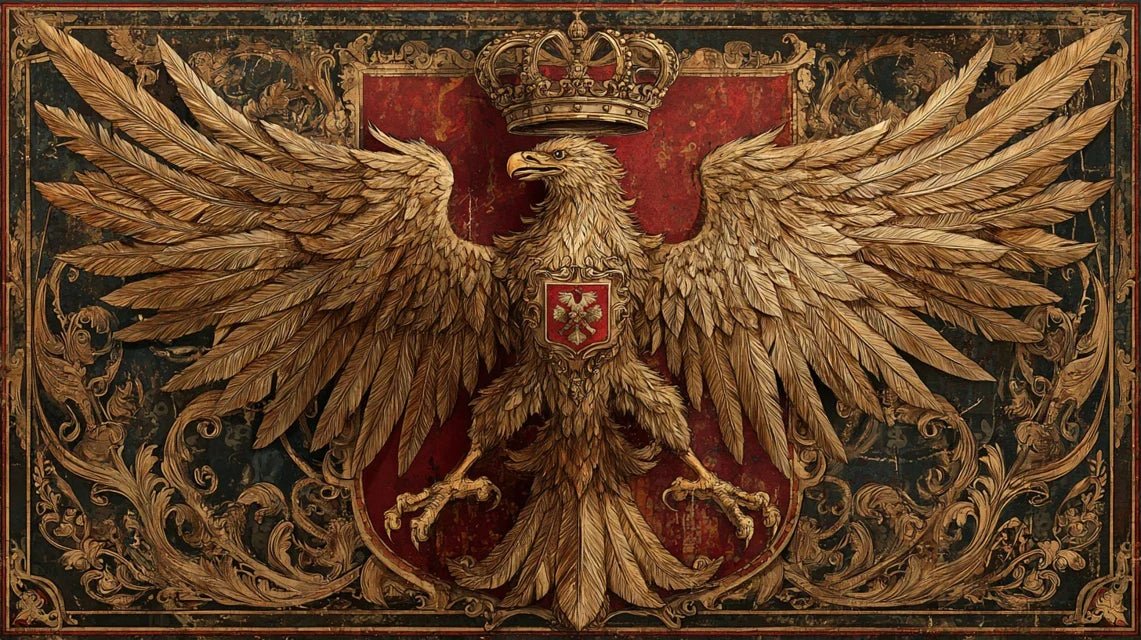
- White eagle: Poland and national purity, as confirmed by the Polish example where the crowned white eagle with widely spread wings on a red shield is over 700 years old
- Golden eagle: French empire and imperial splendor
- Natural eagle: United States and republican authenticity
The proportions also respect established canons. In contemporary animal paintings, these codes persist, adapting heraldic heritage to modern decorative tastes.
Painted eagles in emblems: artistic codes and visual identification
The visual identification of painted eagles in emblems relies on codified iconographic attributes. The position of the wings determines the message: spread wings for protection, lowered wings for peace, raised wings for offense. This visual grammar allows for an immediate reading of national status.
Accessories complement this symbolism. The American eagle holds a bundle of arrows in one claw and an olive branch in the other, embodying the balance between military strength and peaceful aspiration. This duality is graphically expressed in all painted national emblems democracies.
The treatment of the gaze constitutes a crucial element. Its piercing view and its very high flight in the sky characterize these qualities of vigilance and clairvoyance expected of power. Artists accentuate this intensity through specific pictorial techniques: color contrasts, dramatic lighting, precision of line.
Stylization evolves according to eras:
- Renaissance: Anatomical realism and plumage detail
- Classic: Geometrization and perfect symmetry
- Modern: Purity and readability from a distance
- Contemporary: Digital adaptation and vectorization
National emblems: pictorial evolution of eagles from Rome to the present day
The evolution of national emblems reveals a constant adaptation of the eagle to political contexts. Russia illustrates these mutations: abolished from 1917 to 1991, the imperial two-headed eagle was re-adopted by modern Russia in 1992. This resurrection testifies to the persistence of the symbol despite ideological ruptures.
Modern heraldic art simplifies classic representations to adapt to new supports and the requirements of contemporary visual communication. Contemporary emblem eagles prioritize readability on screens and digital media, without sacrificing their symbolic charge in national identity. Eagles symbolize strength, courage, and independence and are commonly found in the heraldry of many nations across the world.
Moreover, globalization paradoxically standardizes these millennial symbols. Painted national emblems converge towards streamlined forms, facilitating international recognition during diplomatic and sporting events. Statistically, 68% of modern heraldic eagles adopt similar postures (Source: International Vexillology Institute), confirming this progressive standardization while preserving national specificities.
Diverse supports diversify pictorial expression:
- Flags: Simplification for visibility at a distance
- Coins: Miniaturization and engraved precision
- Architecture: Monumentalization and permanence
- Digital: Vector optimization and resizing
Painted emblem eagles: maintaining and restoring national symbols
The conservation of painted emblem eagles mobilizes considerable resources. After the abdication of Napoleon in April 1814, the two eagles were taken by the Allies the same year and then replaced in 1848, illustrating the political stakes of this preservation. Each restoration constitutes an act of national reaffirmation.
Restoration techniques evolve with technology. Digital imaging now allows for stratigraphic analysis of painted national emblems, revealing historical modifications. This pictorial archeology enriches the symbolic understanding of heraldic eagles.
Specialized training develops. Restorers of emblem eagles master political iconography as much as artistic techniques. This double expertise guarantees historical fidelity and material durability of symbols.
Preventive maintenance is essential in the face of environmental challenges. Painted national emblems outdoors are subject to pollution and weathering. New pictorial formulations resist UV rays and temperature variations better, extending the visibility of symbolic eagles.
Patrimonial digitization constitutes the ultimate safeguard. Each historical painted emblem eagle is the subject of high-definition capture, preserving the visual heritage for future generations. This digital democratization disseminates heraldic culture beyond traditional elites.
Summary: The eagle dominates painted national emblems through its unique ability to synthesize power, legitimacy, and transcendence. From Rome to today, its pictorial representation evolves technically but retains its timeless symbolic strength. This persistence explains why more than a quarter of contemporary nations perpetuate this millennial iconographic tradition.
FAQ: Eagles and Painted National Emblems
Why is the eagle more represented than other animals in national emblems?
The eagle combines unique symbolic qualities: natural majesty, flight power, visual acuity, and effective predation. These characteristics perfectly match the expected attributes of political power: strength, clairvoyance, and protection. Its lineage with the Roman Empire reinforces this historical legitimacy.
How to distinguish different types of eagles in painted heraldry?
Three main criteria make identification possible: the number of heads (single or bicephalic eagle), color (German black, Polish white, French gold) and accessories (American arrows, imperial crown). The position of the wings also indicates the message: spread for protection, raised for offense.
Do the eagles of national emblems evolve over time?
Absolutely. Heraldic art adapts to modern supports by simplifying details to improve digital readability. However, fundamental symbolic codes remain unchanged. This technical evolution guarantees the permanence of the symbol while preserving its communicative strength.