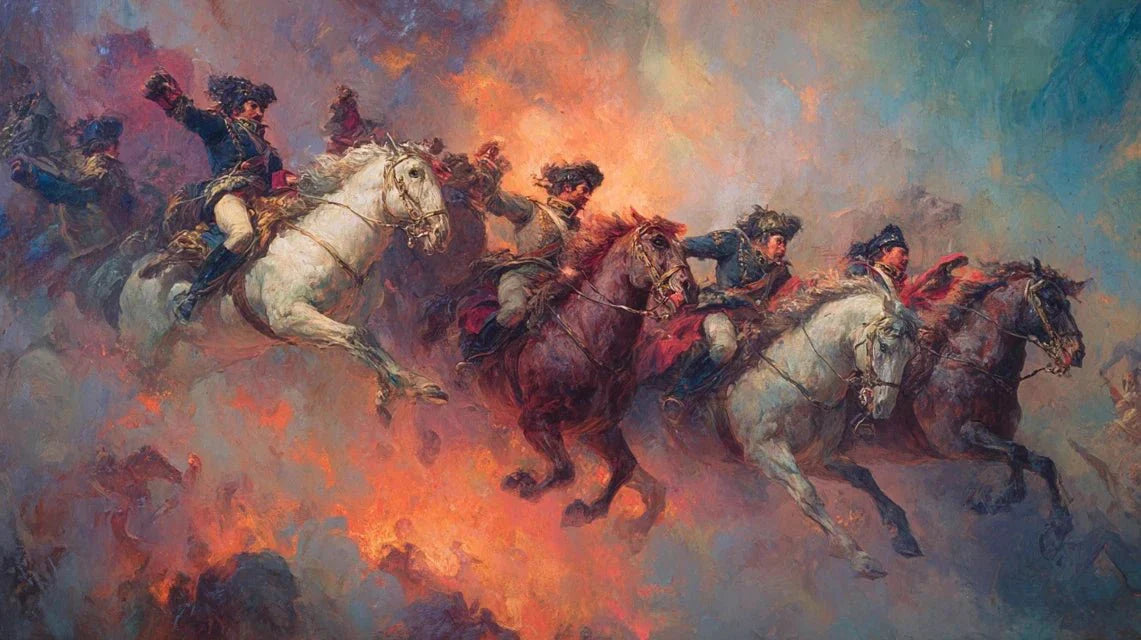
Imagine yourself facing a rearing horse, muscles tense, fiery gaze, ready to charge into battle. That's exactly the intensity that Théodore Géricault and Eugène Delacroix managed to capture in their romantic works. These two giants of French Romanticism revolutionized equine art by transforming simple war horses into true heroes of their canvases.
Géricault: when the horse becomes a mirror of the era
In 1812, Géricault made a big splash with his "Imperial Guard Horse Hunter". The painter, only 21 years old at the time, presents a striking sight: a war horse rears up with impressive force. This military painting marks a turning point. Gone are the stiff equestrian portraits of yesteryear! Géricault infuses new energy, capturing the precise moment when the animal and its rider become one in action.
But the story doesn't end there. Two years later, the same artist shows us the other side of the coin with his "Wounded Cuirassier Leaving the Fire". Here, no more martial glory. The war horse carries its wounded rider, perfectly embodying the disillusionment that follows major Napoleonic defeats.
This duality reveals Géricault's genius:
- He studies equine anatomy with the precision of a scientist
- He gives horses almost human expressions
- He subtly criticizes war through his brushstrokes
Géricault's technical innovation goes even further. His "Five Horses Seen from the Hindquarters" revolutionizes traditional perspective, anticipating the bold framing of modern photography.
Delacroix: The Fantasized Orient at a Gallop
Delacroix takes a different path. His approach to war horses is tinged with painterly orientalism and violence. "The Death of Sardanapale" (1827) constitutes a real visual shock. In this destructive chaos, the horses suffer the same tragic fate as the other creatures of the Oriental tyrant.
A trip to Morocco in 1832 radically transforms his vision. Delacroix discovers another equestrian reality, wilder and more authentic. His "Arab Horses Fighting in a Stable" testifies to this revelation. These animals now embody a primitive violence that is fascinating.
Delacroix's technique is distinguished by:
- Flamboyant colors that express passion
- Swirling movements creating explosive energy
- An expressionist style that goes beyond simple realism
This revolutionary aesthetic allows us to rediscover animal paintings that capture the wild essence of these noble creatures.
Two Masters, Two Revolutionary Techniques
The comparison between these two giants reveals fascinating approaches. Géricault, trained in the stables of Versailles, favors direct observation. His painterly gesture energetic retains all the spontaneity of the creative moment.
Delacroix, heir to the Rubenesque tradition, emphasizes chromatic boldness. His vibrant colors literally sculpt the equine volumes in a striking theatrical light.
The exhibition "The Horses of Géricault" reveals the extent of this obsession: 97 works bear witness to his devouring passion (Source: Musée de la Vie Romantique). Their common training with Pierre-Narcisse Guérin explains some similarities despite their differences.
Face to face: two visions of the world
This artistic confrontation reveals two opposing philosophies. Géricault remains rooted in his time. His war horses reflect current events, carrying the hopes and disillusionments of Napoleonic France.
Delacroix escapes to an imaginary Orient. His steeds transcend immediate history to embody universal truths about the human condition.
The differences crystallize as follows:
- Géricault: emotional realism, social criticism, anatomical precision
- Delacroix: expressive symbolism, tragic universalism, coloristic mysticism
Théophile Gautier pays tribute to this revolution in 1848: "Since the friezes of the Parthenon, no artist has rendered like Géricault the ideal of equine perfection" (Source: Théophile Gautier).
A revolution that crosses centuries
This artistic transformation reflects the profound changes in French society. Géricault, a direct witness to the Napoleonic wars, develops a disenchanted vision. His "Return from Russia" is a poignant testimony to the horrors of war.
Delacroix belongs to the next generation. His war horses break free from eventfulness to explore timeless themes. This evolution heralds modern art by freeing painting from its simple documentary function.
The influence endures: Manet draws inspiration from Géricault's framing, while expressionist painters update the Delacroix heritage.
Géricault and Delacroix’s war horses thus accomplish a major aesthetic revolution. They transform a traditional decorative motif into modern expressive language, definitively opening the way to contemporary art.
FAQ: War horses in Romantic painting
Q: Why are war horses so important to Géricault and Delacroix?
R: War horses allow these Romantic painters to express both the grandeur and tragedy of humanity. In Géricault, they embody a critique of Napoleonic wars, while in Delacroix, they symbolize universal violence and oriental passions.
Q: What are the main technical differences between Géricault and Delacroix in their equestrian representations?
R: Géricault favors precise anatomical realism based on direct observation, with more measured colors. Delacroix opts for a bold coloristic expressionism, using impasto and a flamboyant palette to create dramatic effects.
Q: How did these works influence modern art?
R: These painters revolutionized equestrian art by transforming a traditional decorative motif into a modern expressive language. Their technical and compositional innovations directly influenced the Impressionists, Fauves, and contemporary art.