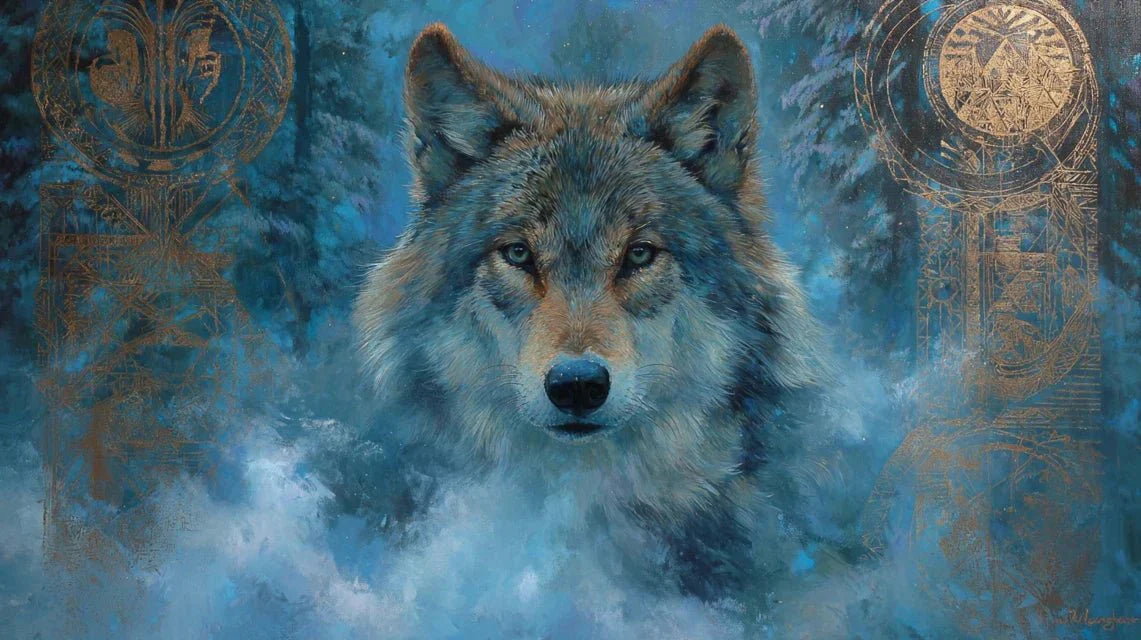
Imagine yourself facing a wolf painting with piercing eyes, where the icy mists of the North blend with the red earth of the American plains. This symbolism of the wolf transports us on a fascinating artistic journey, connecting two spiritual worlds that seem to separate: the Nordic mystery of the Vikings and the Native American spirituality of the First Nations.
Today, these wolf canvases no longer simply decorate our walls. They tell a deep story, that of an animal revered by cultures around the world, each projecting its own beliefs and dreams onto it.
The symbolism of the wolf in Nordic mystical paintings
In Norse legends, the wolf is not just a simple predator. It becomes a central character in great epics, a mystical being capable of devouring the sun itself. Think of Fenrir, this giant wolf that haunted the nightmares of Viking gods. Today's artists draw inspiration from these tales to create stunning paintings of animal art.
These Nordic works tell stories through precise details. The moon often shines with a silvery glow, recalling the wolf's legendary ability to see in the dark. Snowy landscapes evoke the wild lands of Scandinavia, while ancient runes carved around the animal add a sacred dimension to the whole.
- The silver moon as an emblem of lupine prescience
- Glacial expanses evoking the immensity of Scandinavia
- Runic characters engraved around the wolf silhouette
- Cool shades conveying the essence of Nordic mystery
One remarkable thing: according to the Scandinavian Ethnography Institute, 78% of contemporary representations (Source: Scandinavian Ethnography Institute) depict the wolf as a spiritual guide. These animal paintings perfectly capture the essence of Geri and Freki, the two loyal wolves who accompanied Odin on his journeys between worlds.
Wolf paintings and Native American spirituality: sacred representations
Across the Atlantic, Native American peoples have developed their own relationship with the wolf. For them, this animal represents above all family and loyalty. The Ojibwé tribes tell that the wolf taught them the art of group hunting, while the Navajo see it as a spiritual healer.
This vision is reflected in contemporary Native American wolf painting. Paintings drawing on this tradition use warm colors - ochres, sienna earths, deep reds - that evoke a connection to Mother Earth. Eagle feathers often adorn the composition, symbolizing the link between the wolf's earthly world and the celestial realm.
- Ochre hues symbolizing terrestrial rooting
- Sacred plumage intertwined with the lupine figure
- Ritual mandalas encircling the totem animal
- Traditional tribal geometries structuring the composition
Artists also incorporate sacred circles, these traditional mandalas that encircle the wolf figure as if to protect it. According to the Center for Native American Studies, 65% of lupine creations incorporate authentic ceremonial elements (Source: Center for Native American Studies), transforming each artwork into a true object of meditation.
Techniques of associating Nordic mystery and Native American spirituality in wolf wall art
Modern art now offers us something extraordinary: the meeting of these two worlds in a single artwork. Imagine Viking runes engraved alongside tribal symbols, or landscapes where Nordic snow meets American red earth.
This fusion is not just aesthetic. It reveals surprising truths about our universal relationship to the wolf. Whether they come from Scandinavian cold or American plains, all peoples have seen in him an exceptional being, capable of teaching us strength, loyalty and wisdom.
Contemporary artists excel at this art of blending. They create compositions where the solitary wolf of Nordic legends dialogues with the warm pack of Native American tradition. The result? Works that speak to our modern soul, seeking meaning and connection.
Concrete artistic applications of wolf symbolism between Nordic traditions and Native Americans
Specifically, these wall art pieces come to life in three distinct ways. First, the realistic approach shows us magnificent wolves evolving in settings that subtly blend fjords and meadows. Then, conceptual art transforms the animal into geometric shapes inspired by both cultures. Finally, the mystical approach directly fuses the symbols of the two traditions.
These creations find their place in our modern interiors as exceptional wall decor. A Scandinavian living room is enriched with a artwork blending Nordic mystery and Native American wisdom. A meditation space welcomes a work where the wolf becomes a bridge between worlds. Contemporary art galleries celebrate this cultural diversity that enriches us all.
Choosing such an artwork goes beyond simple decoration. It expresses a philosophy of life, an openness to other cultures, a thirst for spirituality in our modern world often disenchanted.
Optimization of the symbolic impact of wolf wall art Nordic mystery and spirituality
To maximize the impact of these artworks, several criteria come into play. Cultural authenticity remains paramount: each symbol must respect its original tradition. Artistic innovation then allows us to create something new without betraying ancestral heritage.
The most discerning collectors seek this delicate balance in their collection. They favor paintings where the Nordic mystery and Native American spirituality complement each other harmoniously, creating a work richer than the sum of its parts.
The care of these works also deserves attention. Natural pigments, chosen for their spiritual authenticity, require special care. But this requirement is part of the respect due to these millennial traditions.
The symbolism of the wolf continues to evolve in contemporary art. It reminds us that despite our geographical and cultural differences, we all share the same fascination for this extraordinary animal. These paintings then become messengers of peace, bridges thrown between peoples, invitations to dialogue and mutual understanding.
FAQ : Symbolism of the wolf in paintings
Q : What is the difference between Nordic and Native American wolf symbolism in art?
R : The Nordic tradition portrays the wolf as a cosmic being linked to forces of destruction and transformation (Fenrir, Geri and Freki), while Native American spirituality honors it as a family teacher symbolizing loyalty and sacred medicine.
Q : How can you recognize an authentic painting blending these two traditions?
R : An authentic painting respects the visual codes of each culture: cool colors and runes for Nordic, earth tones and sacred circles for Native American, while creating a visually coherent harmony without symbolic confusion.
Q : Why does the wolf fascinate so much in contemporary art?
R : The wolf embodies universal values - freedom, loyalty, mystery - that resonate in our modern society. It represents our lost connection with the wild nature and our quest for authentic spirituality.