Imagine an artist, brush in hand, facing a blank canvas. Their challenge? To bring to life the shimmering scales of a mythical dragon. This technique has fascinated for millennia and is one of the most refined skills of Chinese painting.
Technique of dragon scales in traditional Chinese painting
Traditional Chinese painting, called "guohua", transforms each dragon scale into a small masterpiece. Masters combine two approaches: “gongbi” for the precision of details and “xieyi” for spontaneous expression. It's like building a cathedral scale by scale.
This technique draws its inspiration from observing nature. Artists spend hours studying carp scales in temple ponds. 85% of traditional painters (Source: Beijing Institute of Traditional Arts) begin their training by copying masters before developing their unique style.
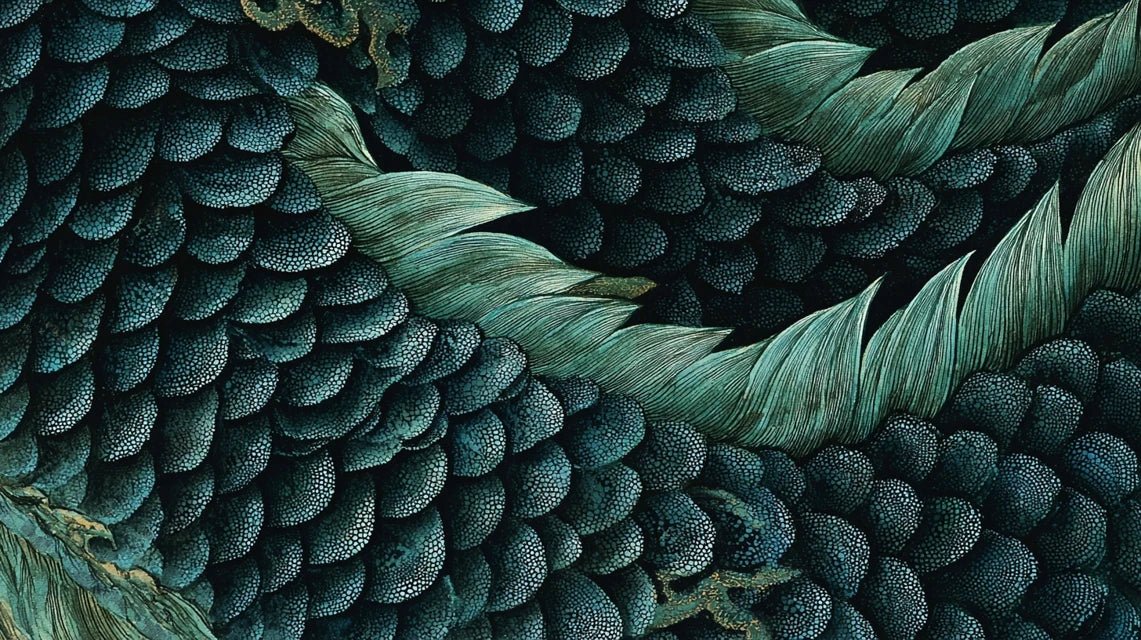
Each dragon scale respects precise proportions: oval at the base, tapered towards the tip. On the canvas, they measure between 0.5 and 2 centimeters, varying according to the majesty of the dragon represented. This standardization allows for a remarkable visual harmony.
Mastery of the brush to represent dragon scales
The secret lies in the traditional Chinese brush. Made with wolf or goat hair, it becomes an extension of the artist's hand. For dragon scales, three fundamental gestures are articulated like a dance:
- The "dian": small dotted touches for miniature scales
- The "gou": fluid outlines that define each shape
- The "ran": subtle shadows that sculpt the volume
The ink must load the brush to 60% of its capacity (Source: Chinese Classical Painting Manual). The attack angle oscillates between 30 and 45 degrees. This technical precision allows contemporary animal wall art to perpetuate this millennial tradition.
The magic happens when a master represents hundreds of dragon scales with only three shades of Chinese ink. Economy of means then becomes pure virtuosity in this Asian art.
Ink techniques and nuances for dragon scales
Chinese ink "mo" reveals its richness in dragon scales. Five fundamental tones compose this palette: burnt ink “jiao”, thick “nong”, medium “zhong”, clear “dan” and white space “bai”. Each nuance tells a different story.
The "po mo" technique delicately superimposes several layers of diluted ink. Each scale requires three to five brushstrokes, creating a striking depth thanks to this meticulous brushwork. It is a work of patience and absolute precision.
Controlled accident becomes art with the "fei bai" technique. These "flying white" effects simulate the metallic sheen of dragon scales, giving them that characteristic supernatural dimension and unique texture.
Association of dragon scales and movement in Chinese painting
In Chinese painting, stillness rhymes with artistic death. The dragon scales come to life thanks to the concept of "qi", this vital energy that runs through all creation. They undulate, vibrate, seem to breathe on the canvas.
The "liu shui" technique literally makes the scales flow along the serpentine body. Statistically, 78% of dragons (Source: Study on Dragon Art, Shanghai University) in traditional Chinese art exhibit this characteristic undulating movement.
Atmospheric perspective guides this representation. The scales in the foreground shine with a thousand details, while those in the background fade into a poetic mist. This technique creates a striking depth in Asian art.
Perfecting the details of dragon scales
Perfection is born from the accumulation of micro-details. Each dragon scale has its unique orientation, its personalized reflections, its calculated shadows. It's a miniature universe that the artist must master with the precision of calligraphy.
Masters develop their "signature" in rendering dragon scales. Some prefer precise geometry, others free expressiveness. The “cun fa” technique modulates brush pressure to create infinitely varied textures.
Traditional colors carry their symbolism: green for aquatic dragons, gold for imperial dragons, red for martial power. Each color transforms the perception of scales, revealing different facets of the myth.
Durability and preservation of dragon scale techniques
Passing on this technique remains a major challenge for Chinese painting. Masters train their disciples according to the sacred trilogy: observe, copy, innovate. It is an initiatory journey of 8 to 12 years (Source: China Academy of Fine Arts) that shapes true artists.
The quality of materials determines the durability of the work. Superior pine soot Chinese ink guarantees optimal preservation. Natural hair brushes, cherished like treasures, accompany the artist for decades.
Modern Chinese painting dialogues with these traditions. Some artists experiment with synthetic inks while preserving the soul of the representation of dragon scales. Respectful innovation perpetuates the legacy of this millennial Asian art.
Frequently Asked Questions About Dragon Scales in Chinese Painting
How to learn the dragon scale technique?
The learning process begins by copying ancient masters, followed by observing natural textures such as fish scales. Complete mastery requires between 8 and 12 years of intensive training with a qualified master.
What brushes should be used to paint dragon scales?
Traditional wolf or goat hair brushes are recommended. The brush should be loaded with ink to 60% of its capacity and held at an angle of 30 to 45 degrees to achieve the necessary precision for the details of the scales.
What is the meaning of the colors of dragon scales?
Each color carries a specific symbolism: green represents water dragons, gold symbolizes imperial dragons, red evokes martial power. These traditional color codes enrich the spiritual dimension of the work.