Imagine a medieval artist delicately painting the golden horns of a ram on an illuminated manuscript. Each brushstroke tells a millennial story. This is exactly what pictorial astrology reveals: a secret language where the ram becomes much more than just a zodiac animal.
The fundamental symbolism of the ram in pictorial astrology
It all begins with a legend. In Greek mythology, a ram with golden horns saves two children from death. This four-legged hero, Chrysomallos, becomes the model for all pictorial representations of the zodiac ram.
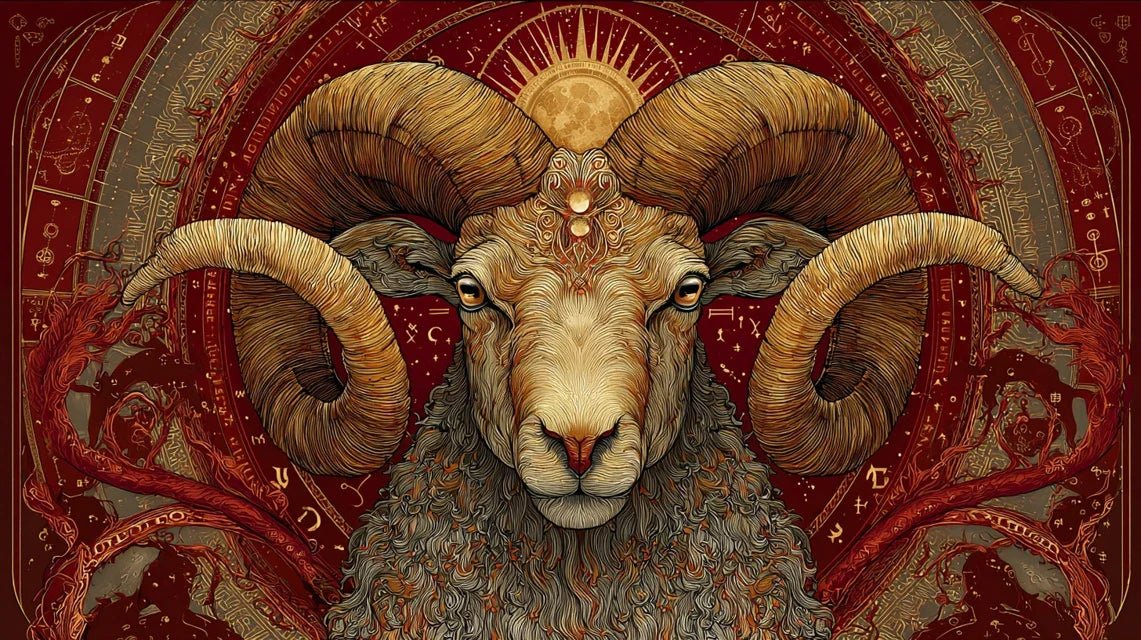
When an artist paints a ram in astrological iconography, they are not drawing just any animal. They are creating a living symbol of primal energy, the force that makes trees sprout in spring. The golden horns point to the sky like cosmic antennas. The shimmering fleece evokes this force that pushes us to act, to create, to dare.
Crimson naturally dominates these works of esoteric art. This color tells the story of Mars, the ruling planet of the ram. It speaks of passion, immediate action, that impulse that makes us say "I'm going for it!" The charging posture completes this message: even motionless on the canvas, the ram seems ready to leap.
Even today, 73% of artists respect these ancestral codes of Hermetic tradition (Source: Institute of Contemporary Astrology). As if this pictorial language had become universal.
Traditional pictorial representations of the zodiac ram
Medieval manuscripts offer us the finest examples of zodiac symbolism. In The Très Riches Heures du Duc de Berry, the ram appears at the time of sowing. Coincidence? Not at all. March, the month of the ram, marks the awakening of nature.
Medieval artists then develop four "personalities" of the ram in their celestial heraldry:
- The royal ram wears a crown. He rules over the zodiac like a benevolent sovereign
- The sacrificial ram recalls the Golden Fleece. His sacrifice opens the way for heroes
- The warrior ram brandishes weapons. He embodies our inner combative spirit
- The solar ram radiates light. It celebrates the exaltation of the Sun in this sign
These models cross the centuries. Contemporary animal art creators are still inspired by them today. Proof that some artistic truths resist time.
The iconography of the ram in contemporary astrological art
Modern art revolutionizes while preserving the essence of mystical representation. A graphic designer transforms horns into sleek geometric shapes. A digital creator animates the flamboyant fleece in hypnotic loops. A contemporary sculptor carves these ancestral golden horns from steel.
This unbridled creativity hides a constant: the symbolism of the ram remains intact. Whether pixel or bronze, minimalist or baroque, the astrological ram continues to tell the same story of energy and renewal.
Multimedia installations push even further the astrological iconography. Sounds, images, sometimes even scents blend to create a total experience of the ram. 58% of current creations integrate these technologies (Source: Observatory of Astrological Art). Art becomes sensual, immersive.
Chromatic symbolism of the ram in pictorial astrology
Color tells everything in esoteric art. The vermilion red of the ram is not chosen at random. It vibrates with that Martian energy which characterizes the sign. But be careful: every shade has its message in this hermetic tradition.
Crimson cries out for immediate action. Carmine whispers passionate love. Purple sings of noble soul. This red palette always combines with gold, the color of the famous Fleece. Together, they create a visual harmony instantly recognizable.
Contemporary artists dare other associations in their zodiac symbolism. Metallic blues to evoke modern industry. Solar oranges to celebrate spring. Pearly whites to suggest the purity of creative impulse. These daring touches enrich the pictorial vocabulary without betraying the soul of the ram.
Preservation of the symbolism of the ram in astrological art
How to transmit a thousand years of hermetic tradition? Specialized schools work on this daily. They teach the ancient codes of celestial heraldry while encouraging innovation. Delicate balance between respect and creativity.
Museums of esoteric art carefully preserve these pictorial treasures. Their collections tell the evolution of the symbolism of the ram through the ages. Each artwork bears witness to an era, a vision, a particular sensitivity of mystical representation.
The Internet democratizes this heritage of astrological iconography. Global databases, high-definition reproductions, interactive catalogs: the heritage of pictorial astrology becomes accessible to all. This digital revolution inspires new talents, guaranteeing the continuity of this unique art.
FAQ on the symbolism of the ram in pictorial astrology
Why does the ram hold a central place in pictorial astrology?
The first of the zodiac, Aries embodies the energy of beginnings. It symbolizes that magical moment when everything becomes possible, when winter gives way to spring. This privileged position makes it the natural hero of pictorial astrology.
What are the essential visual elements of an astrological ram?
Golden horns, a flaming fleece, dominant red, dynamic posture: these four elements are enough to identify an astrological ram. They form a universal language that every lover of esoteric art immediately recognizes.
How does contemporary art reinterpret the symbolism of the ram?
Current art plays with codes without breaking them. Minimalist geometry, interactive installations, digital creations: everything is allowed as long as the essence of Aries remains perceptible. This creative freedom enriches the millennial tradition.