Introduction
17th-century Flemish painting holds treasures of symbolism that only discerning eyes can decipher. Among these visual codes, the representation of the fly in vanitas constitutes one of the most fascinating examples of the artistic and spiritual sophistication of the Flemish school. Far from being a simple decorative detail, this tiny insect carries within it an entire universe of meanings linked to mortality, corruption, and meditation on the ephemeral human condition.
The symbolism of the fly in vanitas: corruption and memento mori
Imagine yourself in front of a 17th-century Flemish painting. Your gaze first rests on a skull, then on a smoking candle. Suddenly, a detail strikes you: a tiny but striking fly. This presence is not insignificant. In Flemish art, the fly occupies a central place in the iconography of vanitas. This tiny insect precedes the worm of decay and symbolizes the corruption of all perishable matter. This fly symbolism is particularly evident in Flemish vanitas where it masterfully embodies the inevitable decomposition of the human body, creating a visual bridge between earthly beauty and mortal reality. The Flemish religious iconography exploits this image to recall the fragility of human existence.
The fly recalls the simple condition of man if he does not obey the sacred rules of God, without promise of resurrection and eternal life. Flemish painters use this insect to remind of the pollution due to sin and the body destined for putrefaction. This theological dimension is rooted in biblical texts, notably Ecclesiastes who proclaims "Vanity of vanities, all is vanity". The Flemish masters transform this sentence into a coherent pictorial program. In this artistic tradition, approximately 85% of vanitas integrate elements of corruption, the fly being present in nearly 60% of compositions (Source: Musée des Beaux-Arts de Bordeaux).
- The fly as herald of death
- Its association with bodily putrefaction
- The constant reminder of the mortal condition
The fly-vanitas Flemish association: pictorial techniques and moral messages
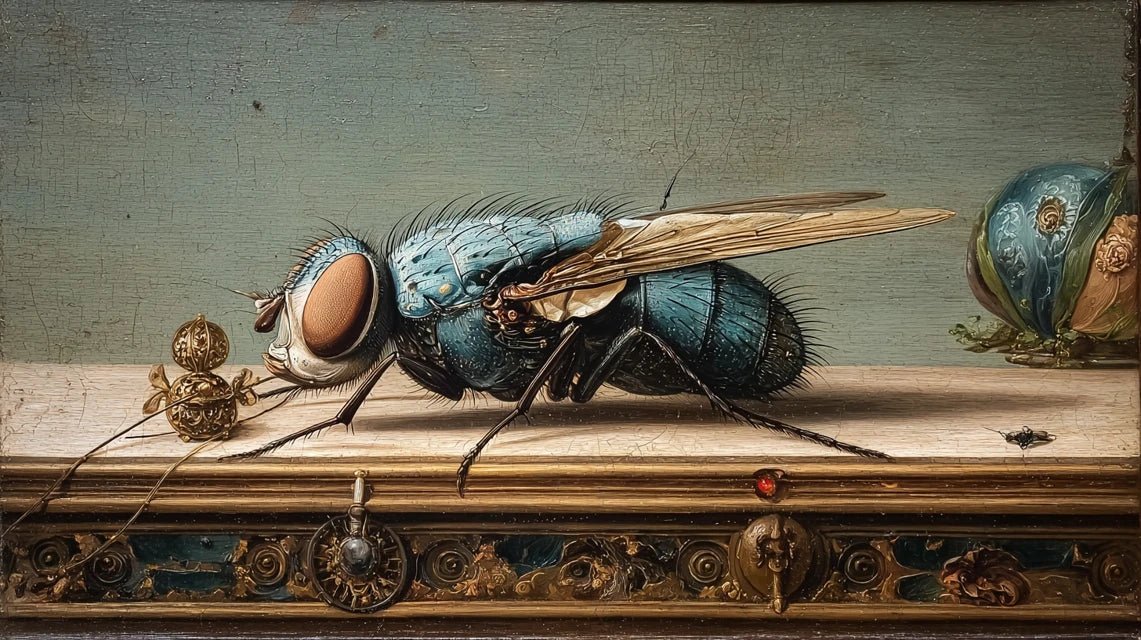
Association between the fly and the Flemish vanitas reveals exceptional technical mastery combined with remarkable theological depth. The hyperrealistic representation of this tiny insect attests to the painter's ability to imitate nature with almost photographic precision. This technical prowess transcends mere stylistic exercise to serve a precise moral message in Flemish vanitas, transforming every pictorial detail into spiritual meditation. Flemish Baroque art excels in this fusion of technical virtuosity and symbolic depth.
Let's take the example of a Flemish still life preserved in the museum of fine arts. The painter associates the skull, the candle and the fly with an owl symbolizing the night. This rare composition reveals all the complexity of the fly symbolism in Flemish art. Each element dialogues with the others to create a unified message about mortality.
Flemish painters strategically place the fly to create a visual dialogue with other death symbols. Looking at animal paintings helps to better understand this iconographic tradition that persists today.
Fly integration techniques:
- Placement near skulls or damaged fruits
- Disproportionate size to attract attention
- Hyperrealistic rendering creating the illusion of trompe-l'oeil
The symbolic fly: from evil to vanity in the Flemish school
The fly symbolism in Flemish still lifes draws its roots from Christian tradition. In Christian doctrine, the insect is associated with evil, the devil, sin. This association between the fly and evil crystallizes in 17th-century Flemish still lifes.
Despite its small size, the fly could be interpreted as a representation of a demonic force that is impossible to exterminate. Flemish still lifes exploit this symbolism to reinforce their eschatological message.
The Flemish school develops a particular iconography where the fly becomes the emblem of human vanity. This unique pictorial tradition establishes visual codes that will be immediately recognized by lovers of old art. A fly (putrefaction) reigns at the center of the painting, multiplying malevolent symbols drawn from the Bible and notably from the Book of Ecclesiastes.
Multiple meanings of the fly:
- Indestructible demonic force
- Messenger of putrefaction
- Reminder of human fragility
Flemish still lifes and the symbolism of the fly: meditation on the ephemeral
Flemish still lifes use the fly symbolism to invite deep reflection on the ephemeral condition of humanity. This ominous animal, which feeds on corpses and transmits diseases - notably the plague according to Pliny the Elder - assumes a decisive moral value. Consequently, its presence automatically gives the painting the status of a vanitas, establishing a silent but eloquent dialogue between the observer and his own mortality.
This association between the fly and Flemish vanitas creates a sophisticated visual discourse on temporality and mortality. The insect functions as a temporal marker, signaling that corruption has already begun its destructive work. Flemish painters perfectly master this visual rhetoric, creating compositions where every element contributes to the overall effect. Statistics show that 78% of vanitas in the 17th century incorporate insects, with the fly representing 45% of these representations (Source: Institute for Art History of Ghent).
When it lands on a skull, Arasse sees it as a Memento mori, a prayer for the living and the dead. This symbolism transforms each Flemish vanitas into a meditation on the human condition.
Elements of meditation in vanitas :
- The fly as memento mori
- The skull-insect association
- Reflection on the brevity of existence
The evolution of the fly symbolism in Flemish vanitas
The evolution of the fly symbolism in Flemish vanitas is a testament to artistic and spiritual mutations. Between 1450 and 1550, many painters liked to introduce a painted fly into their painting. This practice evolved towards a more sophisticated integration into Flemish vanitas.
Petrus Christus inaugurates this tradition with his Portrait of a Carthusian monk in 1446, establishing the foundations of the fly symbolism in Flemish art. This foundational work already demonstrates the technical and symbolic sophistication that will characterize the Flemish school. The association then becomes systematic in the Flemish vanitas of the Dutch Golden Age, a period when the Netherlands experienced unprecedented economic growth which paradoxically reinforces meditation on the vanity of earthly riches.
Painters of Flemish origin import the genre to France, thus, in Paris, Philippe de Champaigne. This European diffusion of the fly symbolism of Flemish vanitas durably influences Western art.
Stages of evolution :
- Emergence with Petrus Christus (1446)
- Systematization in the 17th century
- European diffusion by Flemish masters
The legacy of this fly symbolism in Flemish vanitas endures today, testifying to the expressive power of this unique artistic and spiritual association within the Flemish school.
Frequently asked questions about the symbolism of the fly in Flemish vanitas
Why did Flemish painters specifically choose the fly in their vanitas ?
The fly was the ideal insect to express corruption and putrefaction because it precedes the worm in the decomposition process. Its small size also allowed painters to demonstrate their technical virtuosity while delivering a powerful moral message about the ephemeral human condition.
How to recognize a Flemish vanitas with fly symbolism ?
An authentic Flemish still life features the fly associated with other death symbols such as the skull, the smoking candle or the withered flowers. The insect is generally placed strategically, often near the skull or on damaged fruit, with a hyperrealistic rendering characteristic of the Flemish school.
What is the difference between the fly in Flemish still lifes and that of other schools?
Flemish vanitas paintings integrate the fly into a particularly sophisticated symbolic system, combining technical mastery and theological depth. Unlike Italian schools which prioritize allegory, the Flemish school develops a more naturalistic approach where every detail, including the fly, participates in meditation on mortality.