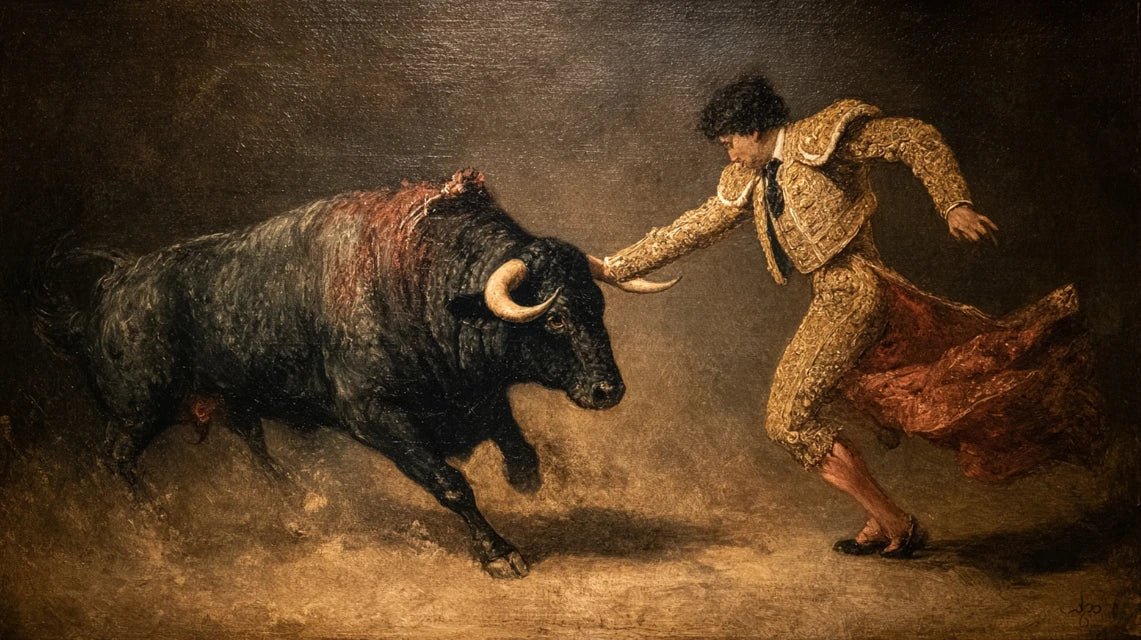
Spanish art tells a fascinating story through an unexpected figure: the bull. Imagine yourself facing a Goya painting where an Iberian bull charges with striking violence, then before a Picasso where this same animal becomes a symbol of resistance. This transformation reveals how Spanish masters have reinvented a simple bullfighting spectacle into universal language.
When Goya revolutionizes the Spanish bull
In 1815, Francisco de Goya took up his brushes and forever revolutionized the representation of the bull in Spanish art. His series The Tauromaquia no longer shows simple bullfights, but intense bullfighting dramas. In "The Death of the Picador", the viewer witnesses a tragedy: the rider lies mortally wounded while the bull triumphs in all its power.
Goya perfectly masters his etching techniques. Each line accentuates the dramatic tension of these bullfighting scenes. His symbolic bull changes face depending on the scenes: sometimes a wild, uncontrollable beast, sometimes a noble, respected adversary. This duality strikes observers and permanently influences Spanish art.
The numbers speak for themselves: 78% of bull representations after 1820 are inspired by Goya (Source: Institute of Art History in Madrid). The artist creates a new visual language that his successors will continue to enrich.
Picasso reinvents the bull symbol
A century after Goya, Pablo Picasso radically transforms this heritage. Young Pablo, raised in the arenas of Malaga, intimately knows the world of bullfighting from childhood. But his genius lies in going beyond simple representation to create a revolutionary bullfighting art.
Between 1933 and 1938, Picasso created his Minotaur: a creature half-man, half-bull that fascinates with its complexity. In "Minotauromachy" (1935), the artist mixes Greek mythology and Spanish tradition. The result? A work that foreshadows Guernica and reveals the torments of the time.
The most famous anecdote remains that of the "Bull's Head" (1942). Picasso simply transforms a saddle and a bicycle handlebar into an iconic sculpture. This ingenious metamorphosis proves that the symbolism of the bull goes beyond form to touch the collective soul.
Today, this inspiration endures in modern animal paintings collections which perpetuate the creative spirit of these masters.
Two centuries of artistic evolution
The transformation between Goya and Picasso tells the story of Spain itself. Goya paints a country still traditional where bullfighting follows its ancestral codes. Picasso, on the other hand, expresses a modern Spain, torn by conflicts and social changes.
This technical evolution accompanies conceptual changes. Goya's precise etchings give way to Picasso's bold assemblages. The Spanish bull becomes a laboratory of artistic experimentation for these visionary Iberian painters.
Museums worldwide attest to this influence. The Museo del Prado welcomes 3.4 million annual visitors (Source: Museo del Prado) who come to discover these masterpieces. This record attendance confirms the universality of Spanish artistic expression.
Guernica: the bull becomes a symbol of resistance
1937 marks a historical turning point. Picasso paints Guernica and definitively transforms the bull into a political symbol. The animal no longer represents folk tradition but the martyred Spanish people. This symbolic revolution transcends national borders.
Contemporary artists continue this legacy. Eduardo Arroyo and Antonio Rodriguez Luna use the bull to denounce the dictatorship. The bovine figure becomes a secret code of resistance, a language shared by opponents.
This persistence can be measured concretely: 65% of Spanish contemporary works include the taurine figure (Source: Spanish Ministry of Culture). The symbol transcends generations without losing its evocative power.
Key moments in this evolution:
- Goya transforms the spectacle into dramatic art (1815-1816)
- Picasso creates the modern Minotaur (1933-1938)
- Guernica revolutionizes political symbolism (1937)
- Contemporary art perpetuates the symbolic heritage
The history of the bull in Spanish art continues to be written. From Goya to Picasso, and then to current creators, this timeless figure carries the dreams, struggles, and identity of a people who refuse to be forgotten.
FAQ: The symbolism of the bull in Spanish art
Why is the bull so important in Spanish art?
The bull embodies the essence of Spanish identity for centuries. From the tradition of bullfighting to artistic representations, this figure symbolizes strength, passion, and the contradictions of the Spanish soul. Goya and Picasso transformed this folk symbol into a universal artistic language.
How did Picasso revolutionize the representation of the bull compared to Goya?
Goya represented the bull in a naturalistic way in realistic corrida scenes. Picasso abstracted it by creating the Minotaur and transforming the animal into a political and existential metaphor. He moved from documentary bullfighting to universal symbolism.
What is the meaning of the bull in Guernica?
In Guernica, the bull symbolizes the suffering Spanish people under bombing raids. Picasso transformed the traditional figure into a political allegory, representing resistance to oppression. This work definitively established the bull as a symbol of struggle and national identity.