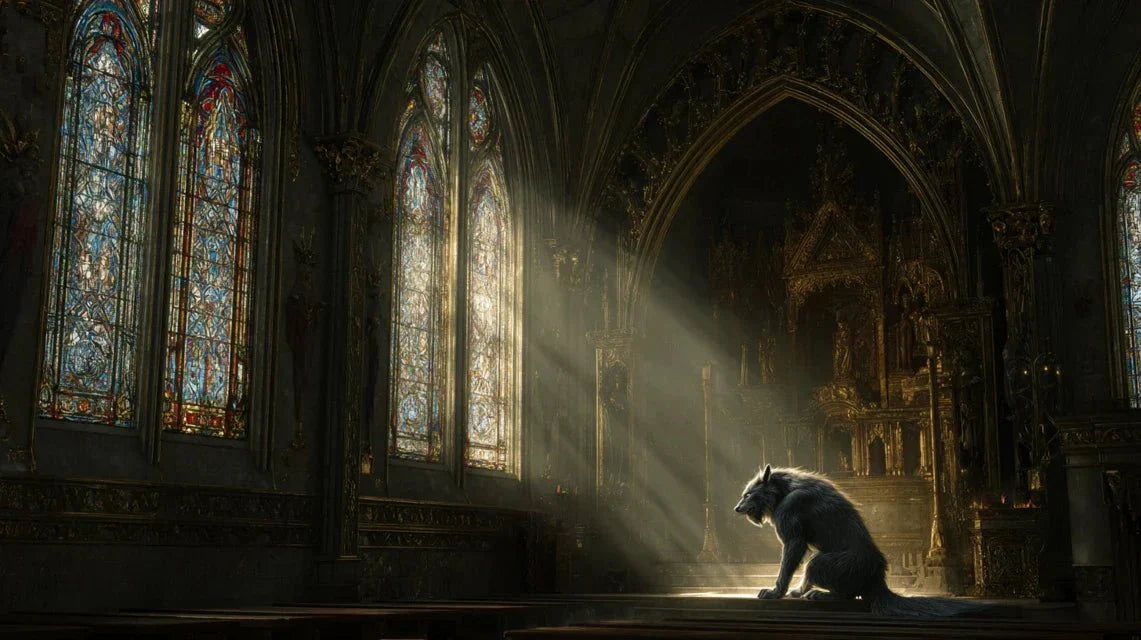
Imagine facing Notre-Dame Cathedral in Paris. Look up at its majestic towers. Up there, carved into the limestone, strange creatures watch you. Half-men, half-wolves, they embody one of the most fascinating artistic obsessions of the Middle Ages: werewolves.
These hybrid beings have haunted European art for centuries. But it is truly with Gothic art that they find their most striking expression. From the 12th to the 16th century, and then during the neo-Gothic revival of the 19th century, these lycanthropes evolve far beyond a simple decorative motif. They become a true artistic language, revealing our deepest fears and our fascination with the forbidden. This medieval iconography reflects the evolution of religious mentalities in the face of the supernatural.
Werewolves in Gothic Art: The Emergence of Medieval Representations
It all begins in the 12th century with a major artistic revolution. Gothic art completely transforms the way werewolves are represented. No more abstract creatures from Romanesque art! Place for a striking realism that gives flesh to our oldest nightmares.
This transformation is not random. It accompanies the theological evolution of the time. With scholasticism and the writings of Saint Thomas Aquinas, the Church encourages a truer representation of the world created by God. The werewolves of Gothic art benefit from this new breath: they retain their role as a moral warning but gain a disturbing credibility.
The first artistic manifestations of werewolves in Gothic art appear mainly in illuminated manuscripts (Source: Corinne Pierreville, Werewolves of the Middle Ages, Honoré Champion, 2024). Medieval illuminators develop a specific visual vocabulary for these creatures: elongated human bodies, elongated muzzles, prominent claws and detailed fur. This lycanthropic iconography gradually standardizes in European scriptoriums, creating a true bestiary fantastique.
Gothic sculptures integrate these lycanthropic figures with unparalleled technical mastery, particularly visible in the gargoyles and grotesques adorning cathedrals. At Notre-Dame de Paris, several gargoyles display pronounced lupine characteristics, with gaping mouths with protruding fangs and bodies with finely sculpted hybrid musculature. These architectural creatures serve a double symbolic and practical function: to evacuate rainwater while spiritually warding off demonic forces, thus embodying the victory of the sacred over the profane.
Beyond their utilitarian function, these gothic werewolves convey a complex theological message. They represent the fallen nature of man after original sin, but also the possibility of redemption through divine grace. This fundamental duality explains their omnipresence in medieval religious iconography.
The stylistic evolution of werewolves in Gothic art follows the general chronology of the artistic movement (Source: Alain Erlande-Brandenburg, Gothic Art, Mazenod, 1983). Early Gothic (1140-1190) favors still rigid forms, inherited from Romanesque art. High Gothic (1190-1240) brings more naturalness to poses and expressions, while Rayonnant Gothic (1240-1350) accentuates the dramatic expressiveness of these creatures.
Gothic artistic techniques for representing werewolves
Artists of Gothic art revolutionize the representation of werewolves thanks to remarkable technical innovations. Stone sculpture becomes their preferred medium, allowing unparalleled finesse in rendering bodily transformations.
The technique of direct carving characterizes this production. Sculptors work directly on the block of limestone or sandstone, without an intermediate model. This approach gives the works a striking spontaneity, amplifying the dramatic effect sought.
The art of illumination also perfects these representations. Manuscripts use specific pigments: reddish ochres for fur, vermilion for gaping mouths, ultramarine for shadows. This color palette becomes codified throughout Europe.
The major innovation lies in the treatment of volumes and expressions. Gothic sculptors perfectly master the art of suggesting metamorphosis in progress, freezing the moment of transformation between humanity and bestiality.
To admire contemporary representations of wild animals perpetuating this millennial artistic tradition, discover an exceptional selection of animal paintings that capture the wild and mysterious essence of these creatures.
Neo-Gothic art and the renaissance of sculptural werewolves
The 19th century neo-Gothic movement gives new youth to representations of werewolves. This artistic renaissance is set within the broader context of rediscovering medieval art, popularized in particular by the writings of Victor Hugo and the work of Viollet-le-Duc.
Neo-Gothic architecture massively reintroduces figures of werewolves into monumental decoration. The restoration of Notre Dame de Paris (1844-1864) constitutes a laboratory for this renaissance: Viollet-le-Duc has sculpted new gargoyles with lycanthropic features, drawing inspiration from medieval models while bringing a romantic sensibility.
Neo-gothic sculptors like Geoffroy-Dechaume develop a personal style in the treatment of werewolves. Their creatures exhibit a more theatrical expressiveness than their medieval models, reflecting the romantic taste for the sublime and the horrific. This approach permanently influences popular imagery of lycanthropes and enriches European architectural heritage.
Industrial production also transforms the dissemination of neo-gothic werewolves. Moulding workshops allow for the serial reproduction of gargoyle and grotesque models, democratizing these motifs beyond religious buildings alone. This standardization contributes to establishing the modern iconography of the werewolf.
Neo-gothic decorative arts also embrace the motif. Goldsmiths, cabinetmakers, and ceramists integrate figures of werewolves into their creations, adapting monumental aesthetics to domestic objects. This transposition marks the definitive entry of the werewolf into Western artistic imagination.
Stylistic evolution of werewolves: from gothic to neo-gothic
Comparative analysis reveals a significant evolution in the artistic treatment of werewolves between medieval gothic art and neo-gothic. This transformation reflects changes in mentalities and aesthetic approaches over nearly eight centuries.
Medieval gothic art favors a symbolic and functional approach to werewolves. These creatures are integrated into a coherent iconographic program, serving as moral warnings or spiritual protection. Their treatment remains relatively codified, following canons established by monastic tradition and cathedral workshops.
Neo-gothic, on the other hand, develops a more individualistic and psychological approach to werewolves. 19th century artists explore the human dimension of transformation further, seeking to make visible the suffering and moral ambiguity of these hybrid beings.
Technical evolution accompanies this stylistic transformation. While medieval gothic art works primarily in bas-relief and simple high-relief, neo-gothic fully exploits the possibilities of high-relief and autonomous sculpture. This technical freedom allows for more complex and expressive compositions.
The social function of artistic werewolves also evolves. From spiritual guardians in gothic art, they become objects of aesthetic contemplation in neo-gothic. This mutation reveals the progressive secularization of Western art and the emergence of new artistic sensibilities.
Conservation and restoration of werewolves in contemporary gothic art
The preservation of werewolves from gothic art constitutes a major challenge for European heritage. These works, exposed to the elements, require specialized interventions for their conservation.
Modern techniques allow to preserve their authenticity while ensuring their durability. Laser cleaning reveals the original details masked by centuries of pollution, restoring the first expressiveness of these sculptures.
Digital documentation revolutionizes their study. Photogrammetry and 3D modeling techniques enable detailed analysis, revealing technical aspects invisible to the naked eye.
Public awareness programs value this exceptional heritage. Temporary exhibitions and thematic routes allow discovering the iconographic richness of werewolves in Gothic art, contributing to the transmission of this knowledge to future generations. This cultural mediation reveals the importance of these works in the history of European art.
Key points to remember :
- Gothic art transforms the representation of werewolves by favoring naturalism
- Sculptural techniques allow for striking dramatic effects
- Neo-gothic reinterprets these motifs with a romantic sensibility
- Modern conservation ensures the transmission of this exceptional heritage
- The werewolf iconography evolves from religious symbol to aesthetic object
- Illuminated manuscripts constitute the first documented artistic testimonies
This millennial artistic tradition testifies to the permanence of certain archetypes in the Western imagination, where the werewolf remains a fascinating figure embodying the fundamental duality between civilization and savagery.
Frequently asked questions
Where can we see the most beautiful representations of Gothic werewolves?
Notre-Dame de Paris, Chartres Cathedral and Amiens Cathedral house the most remarkable examples. The gargoyles of Notre-Dame, notably the famous Stryge, perfectly embody Gothic art in its representation of lycanthropic creatures.
What is the difference between Gothic and Neo-Gothic werewolves?
The medieval Gothic privileges a symbolic and religious function, while neo-Gothic of the 19th century develops a more psychological and romantic approach. Neo-gothic creatures present a more theatrical and individualized expressiveness.
Why do werewolves appear so often on cathedrals?
These creatures serve a double function: practical (rainwater drainage for gargoyles) and spiritual (protection against evil forces). They embody the victory of the sacred over the profane and remind the faithful of the struggle between good and evil.