# The Representation of Couscous in Oceanic Art
Imagine thousands of islands scattered across the vastness of the Pacific. On each one, artists perpetuate millennial traditions while opening up to influences from all over the world. It is in this unique context that a surprising artistic phenomenon is born today: **the representation of couscous in contemporary oceanic art**. **Oceanic tribal art** reveals a growing fascination for **intercultural culinary representations**. Rich with more than **1800 distinct cultures** spread across 20,000 islands of the Pacific, this **oceanic primitive art** has been developing an unprecedented approach to food representation for a few decades. How does this small grain of semolina from the Maghreb find its place in the oceanic artistic universe? The answer lies in the unique ability of island artists to transform the foreign into the familiar. ## Food Representations in Traditional Oceanic Art
To understand this fascination, one must delve into the history of **oceanic food representations**. For millennia, Pacific artists have integrated **nutritious elements** into their visual creations. Take the **ceremonial masks** of Papua New Guinea: they are full of stylized geometric patterns representing grains, fruits and vegetables. This tradition draws its roots from the Lapita culture, over 3000 years old. But why this obsession with grains? **Melanesian artists** see much more than just food in them. For them, grain symbolizes fertility and cosmic abundance. Their **sculptures on hardwood** - particularly in sandalwood and ebony - incorporate motifs reminiscent of this particular granular texture. An ancestral technique that is now finding new life in representations of couscous. • Granular patterns occupy 35% of traditional Melanesian works (Source: Sydney Oceanic Art Institute)
• More than 200 ceremonial masks integrate food representations (Source: Musée du Quai Branly)
• Wood carving techniques make it possible to faithfully reproduce the textures of grains
## Couscous and Grain Symbolism in Contemporary Oceanic Works
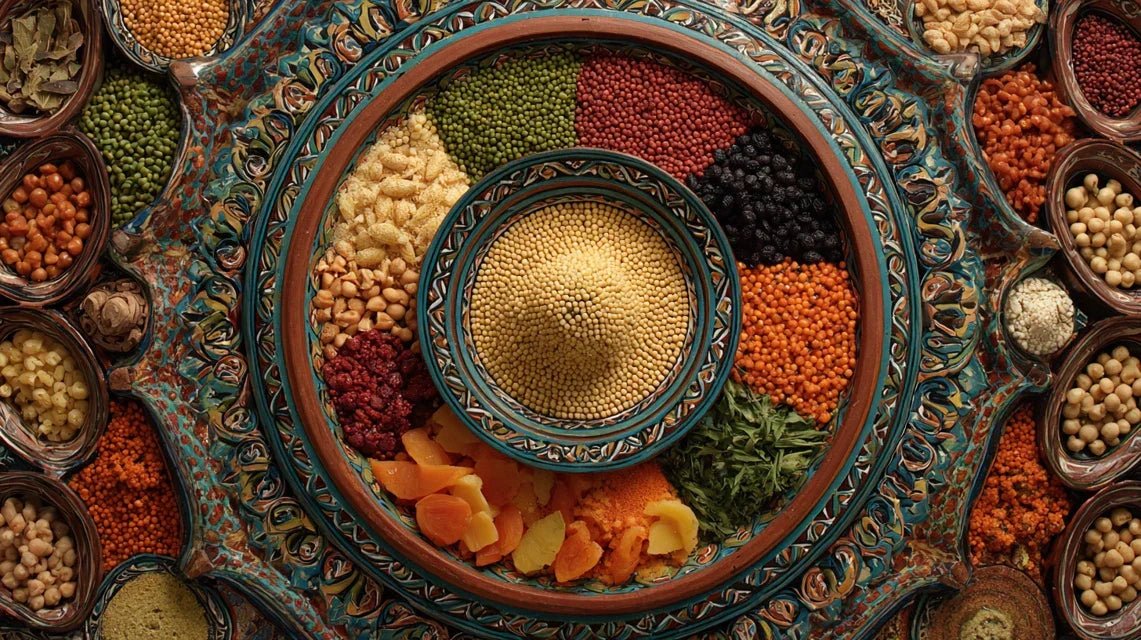
The **couscous** particularly resonates with contemporary oceanic imagination for its visual and symbolic qualities. Polynesian artists find in it a poetic echo of the **coral sand grains** that dot their ancestral atolls. This visual and metaphorical connection generates original creations where **durum wheat semolina**, the raw material of couscous, becomes a powerful allegory of insularity and geographical dispersion characteristic of the oceanic world. **Mixed media works** and **contemporary sculptures** integrating representations of couscous have been multiplying since 2020. These creations combine **natural oceanic pigments** and motifs inspired by Maghreb cuisine. The approach is particularly developed in New Caledonia, where the artistic community explores **intercultural links** through **oceanic culinary art**. In these representations, couscous becomes a **central element** of compositions exploring themes of hospitality and sharing, fundamental values common to Oceanic and Maghreb cultures.Contemporary installations utilize various materials – shells, plant fibers, resins – to recreate the characteristic texture of couscous. ## Oceanic art techniques applied to couscous representations
The oceanic technical approach radically transforms the representation of couscous. Traditional aboriginal pointillism, a technique dating back 40,000 years, allows for the reproduction with striking precision of the granular texture of semolina. This technique, called "dot painting", uses ochre and white pigments to create relief effects particularly suited. Whale ivory carving, a traditional Polynesian specialty, also inspires contemporary artists. The smooth texture of the ivory contrasts with fine incisions reproducing the appearance of cooked couscous. These oceanic works of art, of exceptional refinement, require more than 200 hours of meticulous artisanal work. Ritual masks integrating couscous motifs use traditional plant collage techniques. Melanesian artists apply pandanus fibers and shell fragments to recreate the visual aspect of the dish. This tactile approach considerably enriches the aesthetic experience. Among the remarkable technical innovations is the use of vegetable glues to fix coral sand grains, creating unprecedented textures. This technique, developed in the Solomon Islands, revolutionizes the representation of granular elements in oceanic art. The art of [animal paintings](https://walensky-shop.fr/collections/tableau-animaux) also inspires some compositions mixing ocean fauna and culinary representations. ## Modern Oceanic Art: Integrating Couscous into Creations
Immersive installations are at the forefront of this movement. These multisensory creations combine visual projections, fragrances and textures to evoke the universe of couscous. New Zealand artist James Tikanga has been developing interactive works since 2021 where visitors manipulate real semolina grains integrated into compositions. Specialized galleries report a 60% increase in culinary artworks since 2022 (Source: Oceanic Art Galleries Association). This trend reflects the growing openness of Oceania artists to Mediterranean influences, facilitated by increasing international artistic exchanges. Artistic performances integrate the ritual preparation of couscous according to oceanic codes. These events, mainly organized in Australia, bring together indigenous artists and Maghreb communities. The collaborative dimension of these creations reinforces their cultural and social impact. ## Maintenance and preservation of artworks representing couscous in Oceanic art
The conservation of works integrating representations of couscous poses specific challenges. Organic materials traditionally used in oceanic art require particular storage conditions. The humidity of tropical regions accelerates the degradation of plant fibers and natural resins. Museums are developing adapted protocols.The Musée d’Arts Océaniens in Nouméa invested €150,000 in specialized **air conditioning systems** (Source: Annual Report 2023 of the Nouméa Museum). These equipments maintain a temperature of 18°C and a humidity level of 45%, optimal conditions for preservation. The **restoration** of these works requires expert knowledge. Restorers must master both traditional Oceanic techniques and the specifics of **culinary representations**. This dual expertise remains rare, limiting the capacity to maintain artistic heritage. **Digital documentation techniques** are revolutionizing preservation. 3D digitization allows us to keep a precise record of the most fragile artworks. This approach, adopted by 80% of Oceanic institutions (Source: Oceania Heritage Conservation Center), ensures the transmission of heritage to future generations. Contemporary Oceanian art finds in the **representation of couscous** a fertile ground for expression, revealing the adaptability and innovation capabilities of Pacific millennial traditions.
- View all
- Abstract
- Colorful Abstract
- Blue marble abstract
- Black and Gold Abstract
- Abstract Scraped Style
- Abstract Artistic
- Boat
- Abstract Seaside
- Abstract Body
- Abstract Dancer
- Abstract Figurative
- Abstract Flower
- Geometric
- Abstract Marble
- Modern
- Contemporary Multicolour
- Multicolored
- Abstract Still Life
- Painting (style)
- Pop Art Abstrait
- Sensual Abstract
- Abstract Spirals
- Textured Abstract
- Face
- View all
- Bee
- Eagle
- Donkey
- Savannah Wildlife
- Antelope
- Spider
- Other Animals
- Ostrich
- Axolotl
- Whale
- Hermit-Crab
- Doe
- Bison
- Buffalo
- Sperm Whale
- Giant Squid
- Chameleon
- Duck
- Capybara
- Caracal
- Caribou
- Koi Carp
- Beaver
- Deer
- Camel
- Cat
- Bat
- Horse
- Mountain Goat
- Dog
- Chimpanzee
- Owl
- Stork
- Ladybug
- Pig
- Guinea Pig
- Hummingbird
- Rooster
- Seashell
- Raven
- Crab
- Toad
- Shrimp
- Crocodile
- Swan
- Dolphin
- Dromedary
- Squirrel
- Elan
- Elephant
- Snail
- Swordfish
- Wild Essence
- Starfish
- Falcon
- Pink Flamingo
- Ant
- Ferret
- Gazelle
- Giraffe
- Wildebeest
- Gorilla
- Frog
- Grizzly
- Crane
- Cheetah
- Hamster
- Hedgehog
- Heron
- Owl
- Seahorse
- Hippopotamus
- Lobster
- Hyena
- Iguana
- Animal Eye
- Insect
- Jaguar
- Kangaroo
- Koala
- Llama
- Rabbit
- Lemur
- Dragonfly
- Unicorn
- Lion
- Lion Cub
- Lioness
- Wolf
- Otter
- Lynx
- Puffin
- Penguin
- Jellyfish
- Morse
- Seagull
- Mold
- Sheep
- Ocelot
- Birds
- Orangutan
- Orca
- Brown Bear
- Polar Bear
- Sea Urchin
- Giant Panda
- Red Panda
- Panther
- Snow Leopard
- Black Panther
- Peacock
- Butterfly
- Lazy Sloth
- Pelican
- Parrot
- Parakeet
- Seal
- Pigeon
- Penguin
- Feather
- Fish
- Betta Fish
- Octopus
- Puma
- Manta Ray
- Raccoon
- Fox
- Shark
- Rhinoceros
- Salamander
- Wild Boar
- Scarab
- Scorpion
- Serpent
- Monkey
- Meerkat
- Armadillo
- Bull
- Tiger
- Sea Turtle
- Terrestrial Turtle
- Toucan
- Polar Crossing
- Jungle Trek
- Cow
- Vulture
- Zebra
- View all
- Alfred Sisley
- Amedeo Modigliani
- Camille Pissarro
- Caspar David Friedrich
- Claude Joseph Vernet
- Claude Monet
- Edgar Degas
- Edvard Munch
- Edward Hopper
- Frida Kahlo
- George Braque
- Giuseppe Arcimboldo
- Goya
- Gustav Klimt
- Gustave Courbet
- Henri Matisse
- Hieronymus Bosch
- Jean Baptiste Camille Corot
- Jean François Millet
- Jean-Auguste-Dominique Ingres
- JMW Turner
- Johannes Vermeer
- Leonardo da Vinci
- Michelangelo
- Paul Gauguin
- Peter Paul Rubens
- Pierre-Auguste Renoir
- Piet Mondrian
- Pieter Bruegel the Elder
- Rembrandt van Rijn
- Sandro Botticelli
- Sonia Delaunay
- Théodore Géricault
- Vincent Van Gogh
- Wassily Kandinsky
- View all
- Acrylic (style)
- Art Deco
- Islamic Art
- Art Nouveau
- Comic Strip
- Baroque
- Bauhaus
- Billiards
- Classicism
- Collage
- Constructivism
- Cubism
- Dadaism
- Drawing
- Expressionist
- Abstract Fauvism
- Abstract Futurism
- Gothic
- Hyperrealism
- Impressionism
- Japandi
- Light painting
- Minimalist
- Neo-classical
- Op Art
- Abstract Contemporary Painting
- Pointillism
- Abstract Pop Art
- Post-Impressionism
- Pre-Raphaelitism
- Realism
- Renaissance
- Italian Renaissance
- Rococo
- Romantic
- Romanticism
- Hook style
- Stained Glass Style
- Abstract Surrealism
- Symbolist
- Vanity
- View all
- Rainbow
- Architecture
- Northern Lights
- Other Landscapes
- Campaign
- Cascade
- Waterfalls
- Lavender Fields
- Sky
- Starry Sky
- Sunset
- Desert
- Underwater Depths
- Forest
- Gorges and Canyons
- Natural Caves
- Islands and Archipelagos
- Jungle
- Lakes
- The World of the Sea
- Marine
- Sea
- Mountain
- Hot Air Balloon
- Ocean
- Abstract Landscape
- Lighthouses
- Beach
- Ports
- Savanna
- Tropics
- Volcanoes
- Aerial View
- View all
- Athletics
- Rowing
- Foosball
- Baseball
- Basketball
- Bowling
- Boxing
- Breakdance
- Hunt
- Cheerleading
- Circus
- Jump Rope
- Running
- Cricket
- Crossfit
- Dance
- Acrobatic Dance
- Chess
- Equestrian
- Climbing
- Fencing
- Football
- Formula 1
- Golf
- Gymnastics
- Jetski
- Karate
- Karting
- Kayak
- Kite surf
- MMA
- Motorcycle
- Bodybuilding
- Swimming
- Paddle
- Parachute
- Paralympic
- Paragliding
- River Fishing
- Ping Pong
- Underwater Diving
- Polo
- Whitewater Rafting
- Hiking
- Rugby
- Skateboard
- Skiing
- Water Skiing
- Snowboard
- Surf
- Tennis
- Shot
- Archery
- Mountain Bike
- Wingsuit