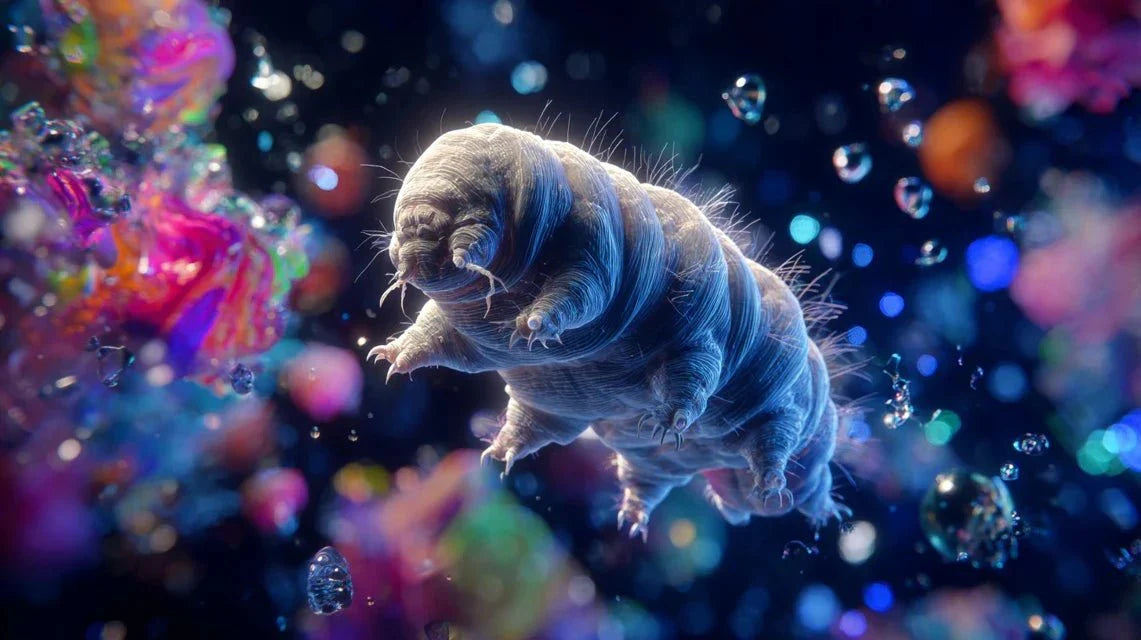
In the invisible universe that surrounds us, a silent artistic revolution is taking shape. Tardigrades, these minuscule creatures of 0.5 millimeters, are spectacularly disrupting contemporary microscopic art.
Imagine "water bears" so small they escape our vision, yet so fascinating that they become the stars of a new artistic movement. These microorganisms transform science into bioart, creating an unprecedented bridge between laboratory and gallery.
When tardigrades become art
Why do these microscopic creatures captivate artists so much? The answer lies in their unique appearance. With their rounded shapes and eight tiny legs, they evoke both teddy bears and miniature aliens.
Kamil Czapiga, a visionary Polish artist, discovered their extraordinary aesthetic potential. Through his Cosmodernism project, he films these creatures reacting to light and sound. The result? Hypnotic videos that reveal an unsuspected natural choreography in digital art.
But the artistic appeal goes further. These creatures possess a superpower: they can "switch off" completely and resurrect later. This ability of cryptobiosis inspires artists who see it as a powerful metaphor for human resilience.
Microscopic art operates a particular magic: it transforms the invisible into the monumental. Suddenly, these creatures we cannot see become artistic giants that question our perception of the living world.
The technical secrets of microscopic artists
How do you capture the beauty of the infinitely small? Contemporary artists are developing revolutionary techniques that would make old masters dream.
The latest innovation is making a sensation: lithography on ice. This nanotechnology art technique literally allows you to "tattoo" tardigrades with nanometric patterns (Source: Nano Letters). Imagine living creatures bearing works of art engraved on their skin!
Artistic tools are diversifying:
- Electron microscopes that reveal every anatomical detail
- Digital colorization that transforms scientific black and white into an artistic rainbow
- Motion sensors that translate movements into music
- High-resolution photomicrography to create monumental prints
Steve Gschmeissner has mastered this art for fifty years (Source: Nature Magazine). Each image requires days of meticulous work. He first cultivates his specimens, prepares them carefully, then photographs them under the electron microscope. Finally comes the coloring, a crucial step that transforms scientific imagery into artwork.
The pioneering artists of the movement
Patrik Proško has created something extraordinary: giant tardigrades. His hyperrealistic reconstructions completely reverse our perspective. Suddenly, we become the microbes facing these monumental creatures. This unsettling reversal questions our place in the microscopic universe.
The Cosmodernism movement reveals the hidden beauty of the microscopic everyday. Kamil Czapiga films live tardigrades in their natural environment, creating artistic documentaries of stunning beauty.
Michel Paysant explores nanosculpture with his OnLab project. Although he mainly works with reproductions of Louvre masterpieces, his technique opens up fascinating perspectives for the micro-sculpture of living creatures.
This recognition is growing rapidly. Collectors of contemporary art are now snapping up animal paintings depicting microscopic subjects. These works find their place in specialized galleries, alongside traditional masters.
Microscopic art enters our lives
Contemporary microscopic art is leaving laboratories to invade our daily lives. Museums offer interactive installations where visitors manipulate virtual environments populated by giant tardigrades.
Some artists go even further: they use live tardigrades to create real-time performances. These creatures become unwitting actors, their movements generating unique visual and sound compositions in bioart.
Fashion is embracing the phenomenon. Designers are transforming the organic shapes of tardigrades into textile patterns. The infinitely small becomes infinitely large on fabrics and accessories.
Virtual technologies revolutionize the experience. Equipped with VR headsets, viewers literally travel inside a tardigrade. They explore its anatomy like a fantastic landscape, turning a biology lesson into an immersive artistic adventure.
A promising microscopic future
Tardigrades are radically transforming contemporary microscopic art. Their recent media celebrity, notably thanks to nanometric tattoo experiments published in 2025 (Source: Nano Letters), attracts new creative talents.
Technology multiplies the possibilities. New microscopes reach dizzying levels of precision, revealing architectural details previously invisible. Each technological advancement opens up new artistic avenues in artistic nanotechnology.
Cultural institutions are following suit. The Rozsa Art Galleries is programming "Nanowonder: Images of the Microscopic World" for September 2025, confirming the artistic legitimacy of this emerging movement.
The future looks revolutionary. Soon, we might be artistically directing live tardigrades, creating the world's first microscopic theater. A spectacle invisible to the naked eye, but visible to the artistic soul.
This silent revolution transforms our relationship with living things. In a world obsessed with gigantism, microscopic art reminds us that beauty is sometimes hidden in the infinitely small.
FAQ
What is contemporary microscopic art with tardigrades?
Contemporary microscopic art uses tardigrades as artistic subjects, transforming these 0.5 mm creatures into visual works through various imaging and microscopic manipulation techniques.
What techniques do artists use to represent tardigrades?
Artists employ colorized electron microscopy, high-resolution photomicrography, ice lithography, and sonification technologies to create artistic works from tardigrades.
Where can one see microscopic art of tardigrades?
These works are exhibited in specialized galleries, research centers, and events such as the "Nanowonder" exhibition or in collections of microscopic animal paintings in contemporary art galleries.