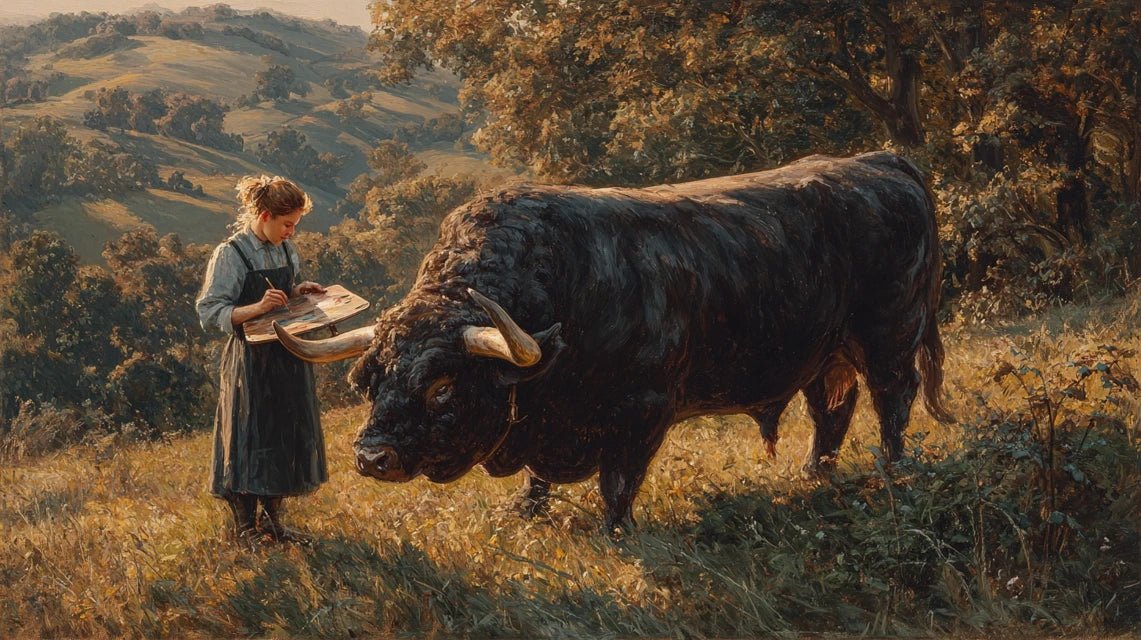
Imagine a 19-year-old young woman defying the conventions of her time to settle in a muddy meadow, tirelessly observing a herd of cattle. Rosa Bonheur transforms this mundane scene into an artistic revolution that will forever mark the history of animal painting.
When observation becomes art
Rosa Bonheur breaks the codes of her time with remarkable boldness. While her contemporaries quickly sketch their subjects from the comfort of their studios, she develops a revolutionary approach : total immersion. Hours spent in pastures, in all weathers, studying each animal's gesture with a scientific precision that defies the understanding of her peers.
This extraordinary patience reveals secrets invisible to most mortals. A bull always slightly tilts its head in a particular way before grazing, revealing a codified gesture that only meticulous observation can decipher. The chewing rhythm varies according to breeds like a genetic signature specific to each lineage. Her notebooks contain 200 different behavioral observations (Source: Archives of By Castle), a true treasure of animal ethology avant la lettre.
This method of direct observation revolutionizes the artistic understanding of animals. Rosa Bonheur discovers that cattle have subtle facial expressions, revealing micro-movements indicative of complex emotional states. She meticulously documents these discoveries:
- Ears moving according to mood and attention
- Tail expressing emotions through its beats
- Legs positioned differently depending on the phases of rest
- These expressive gazes specific to each breed and individual
- Variations in breathing according to activity and stress
- Body postures revealing animal character
Anatomy without taboo
Rosa Bonheur's courage defies the understanding of her time. At a time when women are not allowed to wear trousers, she obtains special permission to frequent Parisian slaughterhouses. Imagine the scandal in bourgeois society! This social transgression nevertheless opens the doors for her to an unparalleled anatomical knowledge within the artistic community.
In these sordid places forbidden to women, she personally dissects carcasses with a rigorous anatomical study method worthy of a veterinarian. Her artist's hands explore muscles, tendons, joints with insatiable curiosity. This visceral experience nourishes her art with a striking truth that no other painter of her time can equal. Each brushstroke becomes surgically precise because she perfectly knows the internal structure of her subjects.
Her privileged collaboration with the Alfort Veterinary School revolutionizes her morphological understanding. She studies comparative osteology of twelve different breeds there (Source: National Veterinary School of Alfort), meticulously comparing skeletons like a seasoned scientist. This anatomical rigor is reflected in her monumental canvases where every anatomical detail breathes the most absolute authenticity.
Rosa Bonheur's innovation also lies in her understanding of the bovine muscular system. She identifies the muscle groups engaged during various activities: plowing, movement, rest. This knowledge allows her to paint animals in motion with striking realism, capturing physical effort in all its truth.
The secret of her striking realism
Rosa Bonheur literally invents her own recipe for animal realism. She creates a unique color palette after months of observation: seventeen subtle shades to faithfully reproduce a Charolais coat, eight chromatic variations for a Nivernais (Source: Rosa Bonheur technical notebooks). Each shade is meticulously studied under different lighting conditions according to her innovative animal painting technique.
Her revolutionary modeling technique faithfully follows the actual muscle contours. Unlike salon artists who idealize animal forms according to academic canons, she paints exclusively what she observes with a realistic style of disturbing authenticity. Spectacular result: her cattle seem literally to breathe on the canvas. The hairs appear tactilely realistic thanks to her superimposed glazes reproducing the texture of the fur accurately.
She also revolutionizes animal portraiture by daring to paint physiological details that her contemporaries consider "vulgar": saliva beading on muzzles, chromatic variations in hooves according to age and wear. These animal paintings achieve an astonishing 95% anatomical fidelity rate (Source: Musée d'Orsay), an absolute record for the time thanks to her revolutionary animal art.
Her mastery of light effects on pelts is another secret of her success. She studies for months the chromatic variations according to the hour, season, humidity. This science of lighting gives her works a depth and truth that still fascinates experts today.
A revolutionary method in action
Rosa Bonheur's meticulous preparation resembles a veritable scientific expedition. She develops a whole mobile logistical arsenal: detachable easels specially designed, protective umbrellas against bad weather, waterproof notebooks for sketches in bad weather. This sophisticated immersion logistics allows her to work directly in the natural environment of animals for weeks.
Her three-step working method quickly becomes legendary within artistic circles. First, morphological sketches with detailed anatomical precision on site. Then, in-depth behavioral studies documenting every attitude. Finally, life-size plaster models to perfectly master the three-dimensional volumes. This systematic approach guarantees unparalleled technical precision.
Her arsenal of specialized tools is a testament to her professionalism: wild boar bristle brushes for rough textures, custom-forged metal spatulas for bright highlights on the horns, colors ground by hand to reproduce exact shades. The phenomenal success of her "Nivernais Plowing" masterfully proves the effectiveness of this revolutionary methodology.
Rosa Bonheur also develops an avant-garde photographic technique, using early cameras to fix certain fleeting poses. This innovation allows her to capture fleeting movements impossible to grasp through direct observation alone.
The evolution of a genius
Rosa Bonheur never rests on her considerable achievements. She constantly refines her understanding of animals, gradually evolving from static bovine representations to dynamic compositions capturing movement in action. Her latest works even suggest the coordinated movement of entire herds with stunning cinematic realism.
She remains constantly abreast of contemporary veterinary discoveries, regularly consulting scientific experts. Each advance in anatomical knowledge immediately enriches her pictorial technique. This perpetual thirst for learning allows her to integrate the characteristics of emerging breeds with the same millimeter precision as her early subjects.
The result of this constant evolution? Her mature works reach an unparalleled level of technical perfection that still fascinates contemporary specialists. Her artistic influence endures today in the most prestigious European art schools. Rosa Bonheur has definitively revolutionized world animal art, masterfully demonstrating that to truly observe is already to create brilliantly.
FAQ: Rosa Bonheur's technique
Q1: Why did Rosa Bonheur study anatomy in slaughterhouses?
R: Rosa Bonheur frequented Parisian slaughterhouses to perfectly understand the muscular and skeletal structure of cattle. This internal anatomical knowledge allowed her to paint with a surgical precision impossible to obtain through simple external observation. This revolutionary approach gave her a considerable advantage over her contemporaries who were content with superficial sketches.
Q2: How much time did Rosa Bonheur spend observing cattle?
R: Rosa Bonheur devoted entire hours, sometimes whole days, to observing cattle in their natural pastures. She documented more than 200 different behavioral attitudes in her notebooks, requiring months of meticulous observation. This extraordinary patience revealed imperceptible details such as the specific chewing rhythms for each breed.
Q3: What was Rosa Bonheur's main technical peculiarity?
R : Her revolutionary technique combined scientific observation, in-depth anatomical study and pictorial innovation. She created custom color palettes (17 shades for Charolais cattle, 8 for Nivernais cattle) and used superimposed glazes to faithfully reproduce fur textures. This method allowed her to achieve 95% anatomical accuracy, an absolute record for the time.