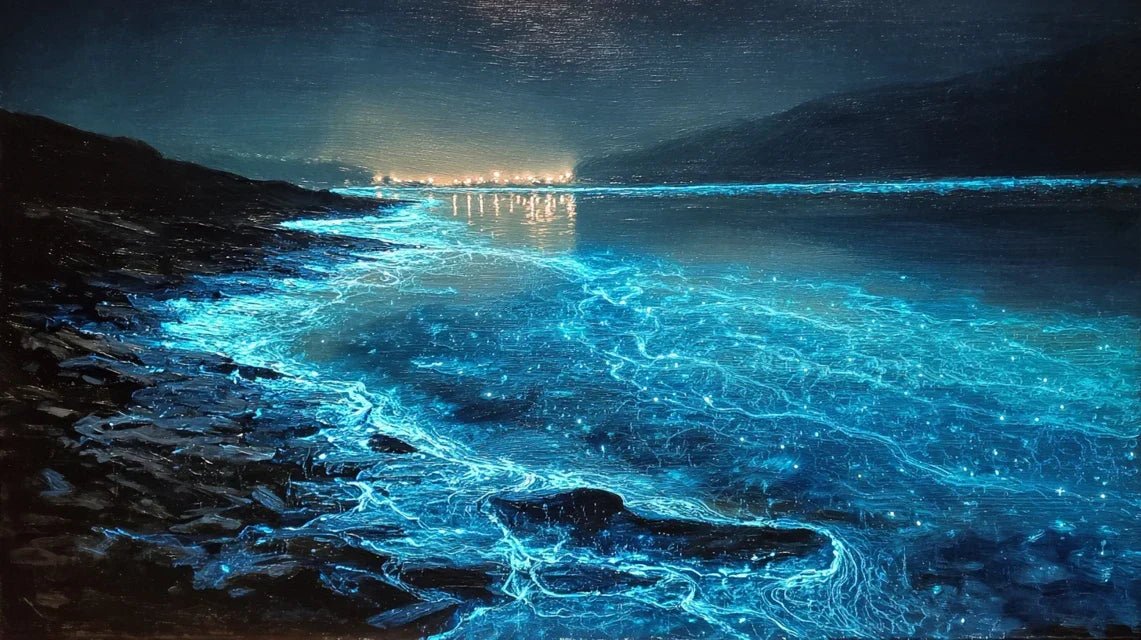
Night falls on the humid meadows. In the nascent darkness, mysterious points of light begin to sparkle. These glowing worms offer a spectacle of photoluminescence that artists have been trying to reproduce for centuries. But how do you paint this living light so particular that defies classical art laws?
Deciphering the luminous secret of glowing worms
Imagine a chemical reaction so perfect that it transforms almost 100% of its energy into pure light. That's exactly what happens in the bodies of glowing worms. This bioluminescence is born from the encounter between two essential molecules: luciferin and luciferase. This reaction takes place in the presence of oxygen and ATP, creating a mechanism of remarkable efficiency.
This spectral emission shines within a very specific range: between 440 and 560 nanometers. To give you an idea, it's this recognizable blue-green hue that fascinates in the summer twilight. Females, veritable living beacons of our countryside, emit a nocturnal luminance ten times more intense than their male counterparts. This difference in intensity is a crucial element to master in order to paint bioluminescence realistically.
Look carefully at a female glow worm: you will discover three segments that shine on her abdomen. The last one shows only two small, particularly intense points of light. This unique luminescent anatomy guides the hand of the artist who wants to paint bioluminescence with scientific precision.
Mastering the art of painting this magical light
Painting bioluminescence requires forgetting the classic rules of traditional painting. Here, the light does not come from an external source: it is born from the subject itself. This revolutionary particularity changes everything in your artistic and technical approach.
Always start with a professional-quality reflective white background. This base amplifies the effect of your luminescent pigments, like a mirror that would multiply the brightness of a candle in the dark. Then apply your phosphorescent layer thinking about the intensity you observe in the nocturnal world.
The technique of glazing becomes your best ally in this artistic quest. Superimpose transparent colored layers over your luminous base with patience and meticulousness. Each translucent veil adds a subtle nuance, a depth that gets closer to this cold light so characteristic with its particular luminescence persistence.
- Prepare your white support with meticulous care
- Apply your phosphorescent base evenly
- Add your colored glazes in delicate touches
- Protect the whole thing with a varnish suitable for luminescent pigments
- 60% light cadmium green for the main luminous base
- 25% ceruleum blue for subtle reflections and variations
- 15% Naples yellow for the most intense and brilliant points
To capture a firefly in motion, use an almost dry brush with fluid movements. These glowing trails tell the captivating story of the female climbing towards the heights to attract her partner in the mating dance.
Choosing the right colors and materials
The chartreuse green reigns supreme in the firefly's palette. This characteristic shade, which corresponds to a wavelength of 570 nanometers, should dominate your pictorial composition. But be careful: this natural chromaticism varies subtly depending on the intensity of the emission and the physiological state of the insect.
Pigments based on strontium aluminate best reproduce this natural bioluminescence with remarkable fidelity. These magical materials store light during the day and release it for 10 hours in complete darkness. Just like their living models that roam our meadows!
Here is the professional color recipe that works perfectly:
High-quality luminescent acrylic paints offer the precision necessary for this meticulous work. They dry quickly and allow for successive corrections without altering the overall desired effect. To discover other artistic representations of animals in their natural environments, this collection of animal paintings offers magnificent works inspired by wild beauty.
Reproducing different luminous behaviors
Each light signal tells a unique behavioral story. The female searching for a partner emits differently from one feeling threatened by a predator. To paint these behavioral nuances, vary the intensity and spatial distribution of your colors with subtlety.
The stroboscopic effect of love signals is translated into superimposed layers of different and calculated intensities. Imagine light waves propagating in the nocturnal space: each transparent layer represents a precise moment of this fascinating vital pulsation.
The season dramatically influences light activity. In July, at the heart of European summer, 80% of fireflies are active simultaneously (Source: CNRS). Your painting should reflect this maximum intensity with more saturated colors and stronger contrasts to translate this explosion of life.
Never forget the environment that contextualizes the subject: the deep darkness surrounding the firefly is an integral part of the visual spectacle. Without this carefully calculated dramatic contrast, even the most beautiful painted bioluminescence would lose its emotional and visual impact.
Perfecting and preserving your luminous work
Your studio becomes a veritable artistic research laboratory. Work under specialized UV light to constantly control the effect of your phosphorescent paints. This technical light immediately reveals areas that are too weak or excessively intense, which would compromise the final balance.
The choice of final varnish determines the longevity and quality of your artistic work. A yellowing varnish would destroy the color balance achieved in just a few years. Opt for transparent protections specially formulated to durably preserve luminescent pigments.
The conservation requires some simple but essential precautions. Keep your work in a dry environment (humidity below 60%) and thermally stable. Under these optimal conditions, a well-executed bioluminescence painting retains its luminous properties for more than 20 years (Source: Institute of Materials Research).
For future retouches, keep your original color mixes preciously in airtight containers. The homogeneity of the luminous effect depends entirely on this rigorous consistency in the materials used.
FAQ: Painting the bioluminescence of fireflies
Q: What is the difference between phosphorescent paint and fluorescent paint to reproduce the bioluminescence of fireflies?
R: Phosphorescent paint stores light and releases it in the dark for several hours, perfectly imitating the natural persistence of fireflies. Fluorescent paint only glows under UV light and immediately disappears without a light source, which does not correspond to the behavior of natural bioluminescence.
Q: How long does it take to "charge" phosphorescent paint to obtain an optimal effect of painted bioluminescence?
R: Exposure for 10 to 15 minutes under bright light (natural or artificial) allows you to achieve optimal brightness for 8 to 10 hours. Strontium aluminate pigments reach their maximum intensity after this charging time, faithfully reproducing the duration of emission of natural fireflies.
Q: Can different brands of phosphorescent paints be mixed to paint the bioluminescence of fireflies?
R: Mixing different brands is strongly discouraged because chemical compositions vary. These differences can create undesirable reactions, variations in luminous intensity or unequal persistence durations. Always use the same range of products to maintain the homogeneity of your painted bioluminescence.