George Stubbs revolutionized equestrian painting in the 18th century thanks to a revolutionary method: dissecting horses to understand their equine morphology. This approach of scientific dissection radically transformed animal art, establishing new standards of anatomical precision never achieved before.
Stubbs' Anatomical Studies Revolutionize Equestrian Painting
Imagine yourself in 1756 at a remote farm in Lincolnshire. George Stubbs installs an ingenious system of pulleys on the ceiling of a barn. For 18 months (Source: The Metropolitan Museum of Art), he methodically dissects horse carcasses. Layer by layer, he discovers the secrets of equine anatomy.
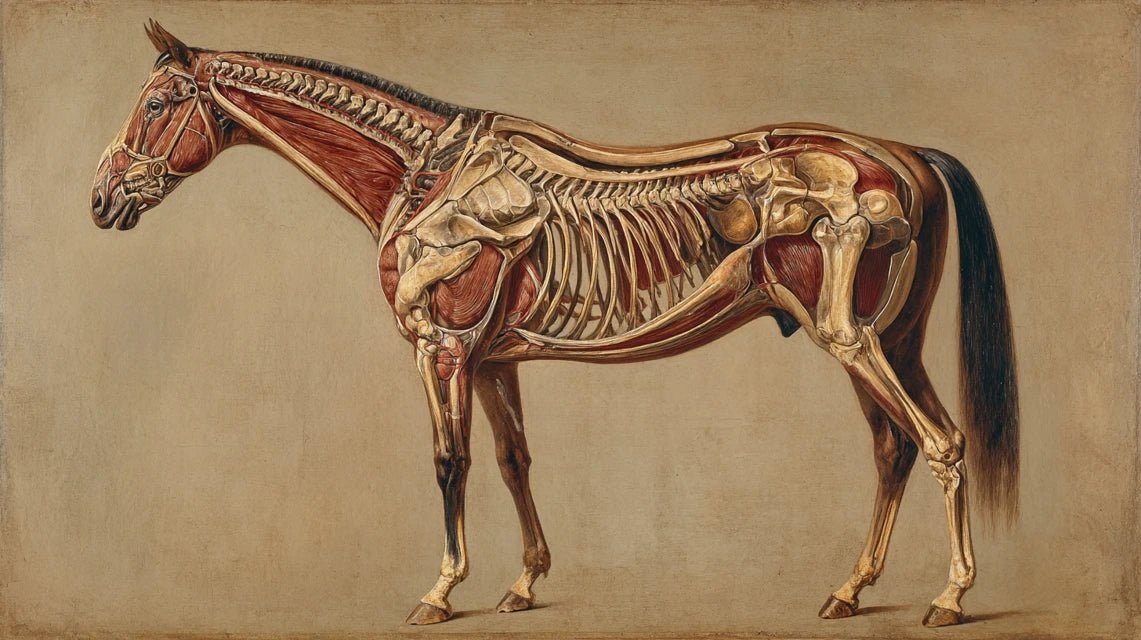
This bold approach distinguishes him radically from his contemporaries. James Seymour, Peter Tillemans and John Wootton painted horses without really understanding them. Stubbs, on the other hand, explores each muscle, each tendon. He injects hot wax into blood vessels to preserve their shape. Three angles of observation: frontal, lateral, posterior. A scientific method applied to art.
How Stubbs Develops His Anatomical Techniques for Equestrian Painting
In 1766 (Source: Royal Academy of Arts), Stubbs publishes "The Anatomy of the Horse". This revolutionary treatise, engraved by his own hand, marks a pictorial revolution. The anatomical plates reveal bone structures, muscular systems, circulatory networks. An unparalleled precision that immediately shines through in his paintings.
No more idealized horses! Stubbs faithfully reproduces every detail. In his canvases, taut muscles, visible veins, dynamic musculature in action. His horses literally breathe life. This biomechanics allows him to represent movement with an authenticity never achieved before.
To discover contemporary works inspired by this tradition, explore our collection of animal paintings that perpetuates the art of animal representation.
The Impact of Stubbs' Dissections on Equestrian Representation
Methodical dissections instantly transform Stubbs' art. "Whistlejacket" (1762) perfectly illustrates this revolution. This life-size portrait shows an Arabian thoroughbred in a striking pose. Taut muscles, visible veins, anatomy perfectly rendered. The neutral background focuses all attention on the animal.
The British aristocracy immediately recognizes this technical superiority. In 1759, the Duke of Richmond commissioned three large canvases. Collectors flock, seduced by this anatomical fidelity that elevates animal painting to the level of high art.
Stubbs' Innovations in Equestrian Painting Thanks to Anatomy
Anatomy revolutionizes Stubbs' pictorial technique. Games of light and shadow reveal muscular relief. Striking three-dimensionality resulting from his internal knowledge. His horses possess an extraordinary physical presence.
His "Lion attacking a horse" series demonstrates this mastery. Dramatic tension, balance of masses, perfectly calculated muscle tensions. Stubbs even anticipates Eadweard Muybridge's discoveries on the decomposition of movement. His horses "fly" in naturally accurate poses.
Stubbs' revolutionary innovations include:
- Dissection method: 18 months of in-depth anatomical studies
- Injection technique: hot wax to preserve vascular forms
- Triangular approach: frontal, lateral and posterior observation
- Morphological precision: faithful reproduction of every anatomical detail
- Artistic innovation: neutral backgrounds focusing attention
- Biomechanics of movement: scientifically accurate representation of locomotion
The legacy of Stubbs' anatomical studies in equestrian painting
The influence of Stubbs crosses the centuries. His treatise remains a reference for more than a century. Reissues until 1853 (Source: ACC Art Books), testifying to its lasting importance in artistic training.
Theodore Gericault and Edgar Degas were directly inspired by his innovations. European transmission of his revolutionary methods. Contemporary artists still use his anatomical plates as a reference. Stubbs definitively established the artistic legitimacy of animal painting.
FAQ: Frequently asked questions about Stubbs and the revolution of equestrian painting
How much time did Stubbs dedicate to his anatomical studies?
Stubbs spent 18 months (1756-1758) dissecting horses methodically on a farm in Lincolnshire, developing an unparalleled anatomical knowledge that revolutionized his equestrian painting.
What is the most famous work illustrating this anatomical revolution?
"Whistlejacket" (1762) perfectly represents this revolution. This life-size portrait of a thoroughbred Arabian, with its neutral background and striking anatomical precision, embodies Stubbs' innovation.
How did Stubbs' studies influence modern equestrian art?
His treatise "The Anatomy of the Horse" (1766) remained a reference for more than a century, influencing Gericault, Degas and establishing the scientific foundations of contemporary animal art.
George Stubbs created a revolutionary synthesis between science and art, forever transforming the representation of horses through his meticulous anatomical studies.