Imagine for a moment. It is 1804, and a man of exceptional destiny is preparing to be crowned emperor. Napoleon Bonaparte leaves nothing to chance, not even the choice of his imperial symbols. Behind every detail of his coronation lies a meticulously orchestrated strategy. The story of the bees that adorn his cloak tells us more than just an aesthetic choice: it reveals a political genius capable of transforming history into legitimacy.
Merovingian Bees Discovered in Childeric's Tomb
It all begins with an extraordinary discovery, more than a century before Napoleon. On May 27, 1653, in Tournai, a deaf-mute worker named Adrien Quinquin changes the course of French history without knowing it. While demolishing a house near Saint-Brice church, he unearths a dazzling treasure: the tomb of Childeric I, Merovingian king who died in 481.
Among the riches buried for over a thousand years shine 300 gold bees, veritable jewels of heraldry set with red garnets. These precious insects, crafted according to the cloisonné Merovingian art, probably decorated the royal cloak of Clovis's father. The scholar Jean-Jacques Chifflet, fascinated by this discovery, develops a bold theory in his 1655 treatise: what if the bee was actually the oldest emblem of the French royalty?
This revolutionary idea will make its way to the ears of Napoleon, who will find inspiration for his future imperial symbols.
The Transformation of Bees into Napoleonic Imperial Symbols
In 1804, Napoleon faces a colossal challenge. How to legitimize power born from the Revolution? How to create a dynasty without renouncing republican gains? The archchancellor Cambacérès brings him the solution on a silver platter: the bees.
"A republic that has a leader," he explains to the Emperor. The metaphor is perfect. In the hive, each worker contributes to the common good under the benevolent authority of the queen. Order, efficiency, social harmony: everything is there to seduce Napoleon.
But the first sketches by Vivant Denon disappoint the Emperor. These Merovingian bees with folded wings seem too archaic for a reign that wants to be modern. The imperial artistic team completely rethinks the design. The new bees with spread wings perfectly embody the momentum and grandeur of the nascent French Empire.
Napoleon's Strategic Adoption of Bees in 1804
Napoleon then deploys all his strategic genius. Adopting bees as imperial symbols allows him a master political stroke: to circumvent the Bourbon lily without denying French monarchical heritage. Moreover, by claiming descent from the Merovingians, he proclaims himself founder of the "fourth" royal race, skillfully jumping over the Capetians and Bourbons.
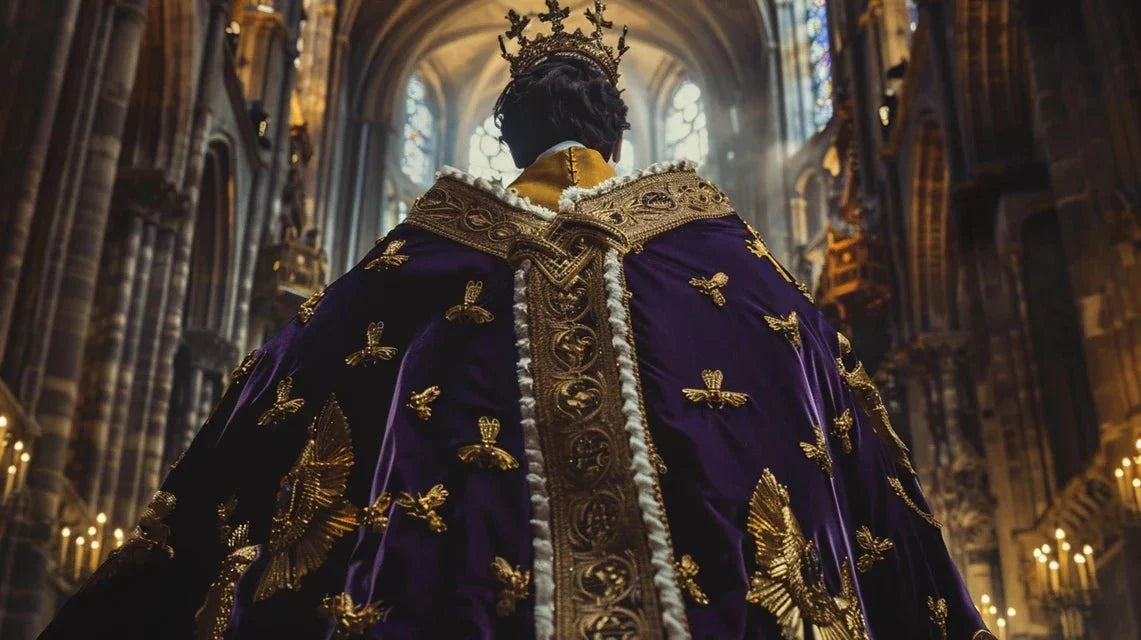
December 2, 1804 will remain in history. At Notre-Dame de Paris, before a stunned audience, Napoleon appears in a purple cloak embroidered with 1,500 golden bees. Each guest immediately understands the message: a new chapter in French history opens, rooted in its oldest traditions. To appreciate other representations of animals in art from this era, discover this collection of animal paintings which bears witness to the importance of animal figures in the art of dynastic power.
The integration of bees into official imperial symbolism
Bees as imperial symbols swarm throughout all places of power with remarkable efficiency. They radically transform French official aesthetics:
- Imperial palaces sparkle with golden hangings studded with bees
- Court uniforms proudly display these new iconic emblems
- State tableware and royal silverware adopt this distinctive motif
- Public monuments display their affiliation to the French Empire
- Administrations systematically replace the old symbols
In 1811, a surprising turn of events: Napoleon orders golden bees to replace lilies on the Parisian coat of arms. Paris, heart of France, now bears the colors of the Empire. This symbolic decision definitively seals the triumph of bees in the French imagination.
The political significance of bees as imperial symbols
Why do bees seduce Napoleon so much? Their political symbolism goes far beyond historical anecdote. They embody immortality and resurrection (Source: Fondation Napoléon), essential promises for a dynasty that dreams of eternity. Their perfectly organized society reflects the Napoleonic ideal: order, work, devotion to legitimate authority.
The Emperor also draws on the most prestigious ancient heritage. The pharaohs of Egypt and the kings of Chaldea already bore the bee as a divine symbol. Napoleon thus inscribes himself in a millennial tradition of sacred power, transcending the borders of Europe to claim universal legitimacy.
This symbolic alchemy reveals all of Napoleon’s genius. By reviving Merovingian bees, he creates a revolutionary imperial identity: modern in its forms, ancestral in its roots. Even today, these golden bees continue to fascinate, eternal witnesses of a reign that knew how to transform history into legend.
FAQ: The Imperial Bees of Napoleon
Q: Why did Napoleon choose bees rather than other animals?
R: Napoleon favored bees because they symbolized "a republic that has a chief," according to Cambacérès. Their hierarchical social organization and their connection to the Merovingians offered perfect historical legitimacy for an Empire born from a Republic.
Q: How many bees adorned Napoleon's coronation cloak?
R: The purple velvet cloak worn during the coronation of 1804 was embroidered with 1,500 golden bees, creating a spectacular visual effect and symbolically affirming the new French imperial identity.
Q: What happened to Childeric's original bees?
R: Most of the 300 Merovingian bees discovered in 1653 disappeared during the theft of the treasure from the Royal Library in 1831. Only two original bees are now preserved at the Cabinet des Médailles of the National Library of France.