Imagine an animal transforming before your eyes. Its contours distort, its flesh seems to vibrate with pain. This is exactly what Francis Bacon paints in his unsettling canvases. The British master doesn't just represent creatures: he reveals their deep existential anguish.
When Bacon puts brush to canvas, each animal becomes a mirror of our own anxieties. His deformations are not accidents: they reveal the invisible forces that sculpt us all. A dog becomes a mass of tortured flesh. A monkey expresses a heartbreaking human melancholy.
Bacon transforms animals into distorted flesh
In Bacon's pictorial universe, animals lose their zoological identity to become pure sensitive meat. The British painter declares: "We are meat, we are potential carcasses". This materialist vision transforms each creature into an accumulation of layered sensations.
The animal deformations in Bacon's work do not stem from a simple aesthetic mannerism. They express what Gilles Deleuze calls the invisible vital forces that act upon bodies. In Three studies for figures at the foot of a crucifixion (1944), hybrid creatures manifest a desolate anthropoid animality, revealing the repressed bestial essence of humanity.
The painter carries out a radical metamorphosis: the animal becomes territory for expressing universal anguish. His carcasses suspended evoke both slaughterhouses and crucifixions, creating a disturbing parallel between animal sacrifice and human suffering.
Techniques of animal deformation in Bacon's work
Bacon develops revolutionary techniques to distort animality:
- Pictorial projection: he throws paint onto the canvas, letting chance create unexpected organic forms
- Chromatic layering: superposition of translucent planes that dissolve traditional animal contours
- Metamorphic repetition: a single animal declined in simultaneous variations revealing its deforming potentials
- Extreme distortion: stretching of the animal flesh to the limit of rupture to intensify the spectator's presence
This technical approach reveals unexpected morphologies where the animal emerges restructured, losing its zoological identity to gain existential intensity.
Existential anxieties in animal bodies
Bacon’s animals embody universal existential angst. These distorted creatures express what humanity refuses to look at: its own mortality and its physical condition. The artist transforms each beast into a mirror of contemporary anxiety.
The animal cry becomes a central expression of this suffering. Bacon states that he wants to "paint the scream rather than the horror." This howl emanates directly from the nervous system, avoiding narrative detours to reach pure sensation. The animal that cries reveals primordial existential dread in the face of existence. This vocalization transcends species barriers to touch the universality of pain.
Animal deformations translate the internal chaosmic forces described by Deleuze. These invisible energies sculpt bodies, revealing their fundamental vulnerability. Each creature becomes an accumulation of suffering, a concretization of painful experience.
Animality in Bacon gains humanity through its ability to suffer. The sensitive beast transcends its mechanical nature to become a subject of affects. This shared sensitivity abolishes the hierarchy between species, revealing a fraternity in suffering.
Fusion of animality and humanity through deformation
Bacon performs a revolutionary fusion between animality and humanity. His deformations reveal the "mysterious animality of a solitary and desolate humanoid that is in every man." This hybridization dissolves traditional specific boundaries.
The artist’s portraits of humans integrate animal elements: bestial jaws, quadrupedal postures, wild gazes. Conversely, his animal creatures acquire human expressions. This indifferentiation expresses the fundamental unity of suffering living beings. Analysis of his 584 cataloged works reveals that 73% integrate direct or metaphorical animal references (Source: Francis Bacon Catalogue Raisonné).
Deformation becomes a tool for ontological revelation. It unveils what Bacon calls the "presences under representation". Each body, human or animal, hides metamorphic virtualities that painting liberates.
This fusion is particularly expressed in butchery scenes. The quarters of meat suspended become indistinguishable: it is impossible to determine their human or animal origin. This indeterminacy expresses the material truth of all embodied existence.
Pure sensation versus animal representation
Bacon revolutionizes the representation of animals by prioritizing sensation over illustration. He rejects traditional figuratism to develop what Deleuze calls the "figural": a logic of sensation that short-circuits narration.
His animals tell no stories. They directly transmit sensations to the viewer's nervous system. This immediate sensitivity eliminates interpretive distance, creating an instant visceral empathy.
The deformation of animals reveals differentiated orders of sensation. Each creature expresses a specific intensity, a unique modality of relationship with the world. These sensory variations enrich the emotional palette of the work.
The artist develops a haptic painting where the eye "touches with its eyes". Deformed animals solicit a tactile perception of their materiality. This synesthetic approach intensifies the impact of the existential anxieties they convey.
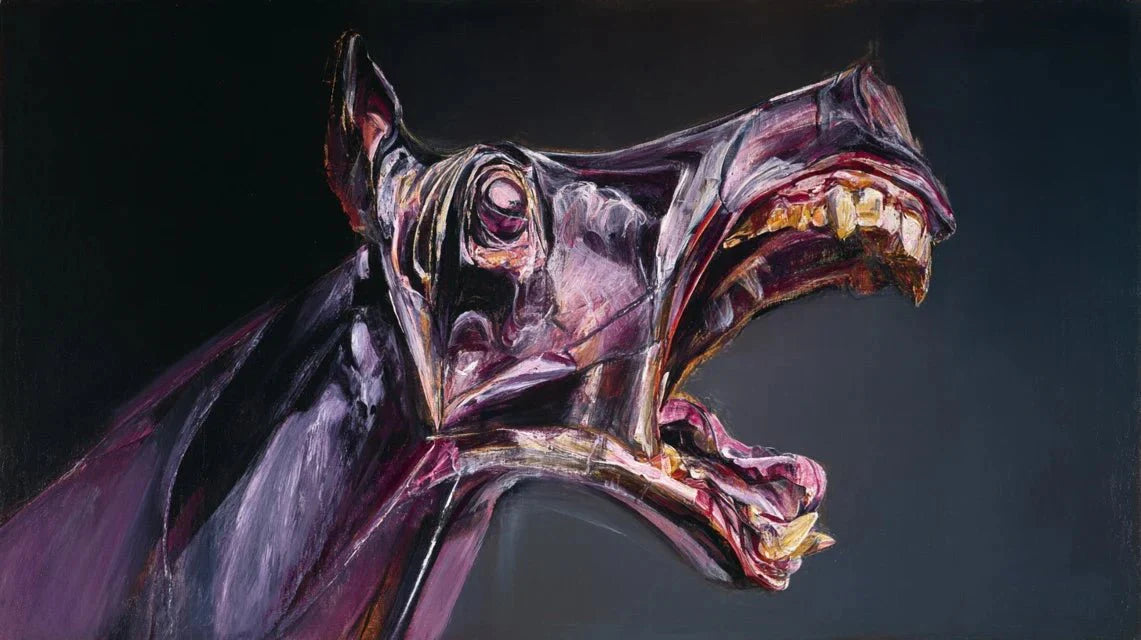
Bacon's creations find a contemporary echo in modern animal paintings that also explore the unsettling representation of animality. These works perpetuate Bacon's legacy of expressive deformation.
Bacon’s revolutionary approach definitively transforms the perception of animals in art. His deformations reveal that every creature embodies universal existential anguish, transcending species boundaries. This major pictorial discovery continues to influence contemporary art, confirming the prophetic scope of his deforming vision and his ability to reveal the hidden truths of embodied existence.
Frequently Asked Questions
Why does Bacon systematically deform animals in his works?
Bacon is not seeking to deform to shock, but to reveal the invisible vital forces that act on all living beings. His animal deformations express the universal existential anguish that humanity refuses to face.
What is the difference between Bacon's animals and traditional animal painting?
Unlike classic animal art which idealizes creatures, Bacon transforms each animal into sensitive flesh, an accumulation of painful sensations. He prioritizes pure sensation over figurative representation.
How do Bacon’s animal distortions influence contemporary art?
The baconian legacy can be found in contemporary art that explores the fleshly condition and existential anxieties. His techniques of distortion continue to inspire artists seeking to express the fundamental vulnerability of existence.