Pan, the god with goat hooves in Greek mythology
Imagine a god with goat hooves leaping through the forests of Arcadia. In Greek mythology, Pan embodies this fascinating union between human and caprine, creating an archetype that will forever mark Western art. The son of Hermes and the nymph Dryopè tells an extraordinary story. His mother, terrified by his half-human, half-goat appearance, fled as soon as he was born. But Hermes, proud of his offspring, carried him to Olympus where he became the protector of shepherds.
His goat legs and hooves, combined with his frontal horns, symbolize his primitive connection with the wild nature of Arcadia.
Why does Pan look like a goat? The story goes back to the Great War of the Gods. When the terrible giant Typhon attacks Olympus, all the gods transform themselves to escape his fury. Pan dives into a river and metamorphoses into a semi-fish, semi-goat creature. This transformation explains his unique appearance and inspires artists for millennia.
This mythological transformation explains why artistic representations systematically prioritize the god's caprine attributes, creating a recurring iconography that lasts until contemporary art. The symbolism of Pan thus transcends the simple mythological anecdote to become an aesthetic model recurrent in Western painting.
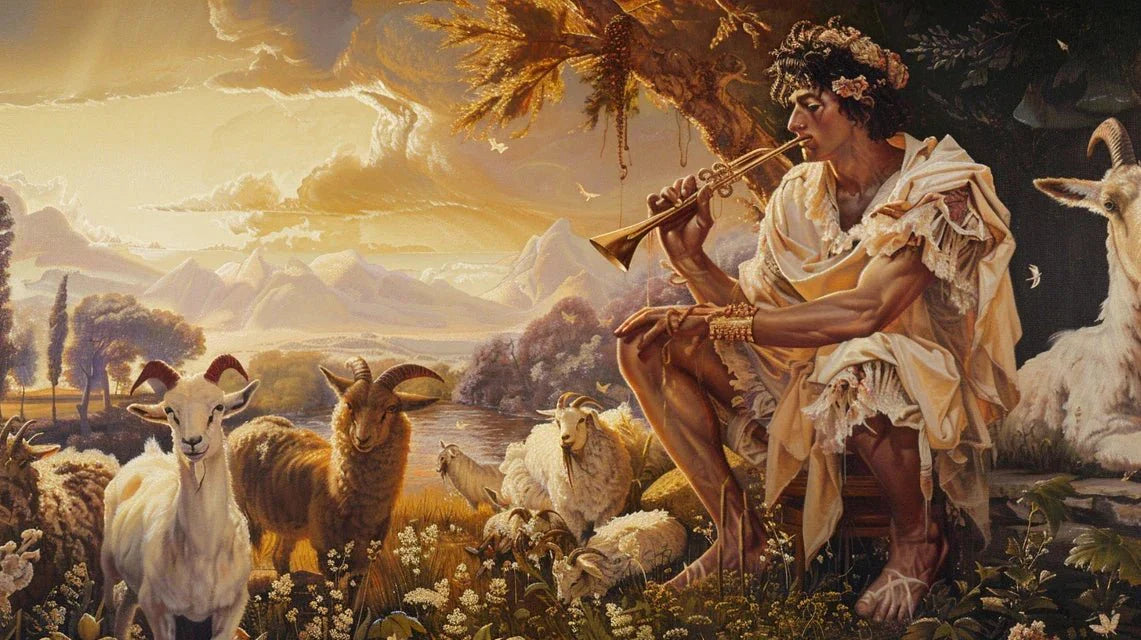
Pan's influence on Greek mythology extends far beyond his mere appearance. His syrinx flute, made from reeds after the transformation of the nymph Syrinx, becomes an inseparable attribute of his pictorial representations. Artists invariably associate this instrument with pastoral scenes where Pan guides flocks of goats.
The caprine attributes of Pan in Greek mythological iconography
The pastoral iconography of Pan in ancient art precisely codifies his caprine characteristics to facilitate his identification. Greek artists develop a systematic visual repertoire: goat paws, curved horns and thick fur covering the lower part of his body. These elements make it possible to create a unique visual identity.
These visual elements not only serve to distinguish Pan from other woodland deities such as satyrs, but also create a specific iconographic vocabulary that crosses centuries. Artists gradually develop a coded visual language around the caprine attributes of Pan.
The Attic black-figure vases from the 6th century BC show Pan accompanied by flocks of goats, emphasizing his role as protector of shepherds. On these ceramics, painters deliberately accentuate the resemblance between Pan and the animals he protects, creating a visual continuity between the god and the goats around him.
Main iconographic characteristics of Pan:
- Goat hooves replacing human feet
- Curved horns adorning his forehead
- Goat hair covering the lower body
- Syrinx flute as a musical attribute
- Arcadian pastoral setting
The Etruscan mural painting also appropriates this iconography, particularly in the tombs of Tarquinia where Pan appears surrounded by pastoral scenes. Etruscan artists amplify the god's goat-like features, notably his hooves and beard, to emphasize his primitive animal nature.
Works like contemporary animal paintings perpetuate this iconographic tradition by depicting hybrid deities in modern compositions.
The pictorial lineage of Pan: from the Renaissance to contemporary art
The Italian Renaissance rediscovers Pan and considerably enriches his pictorial lineage thanks to humanist patrons. Painters like Sandro Botticelli integrate Pan into their neo-antique compositions, notably in "Spring" (1478) where goat creatures evolve alongside the Olympian gods. This period establishes lasting visual codes for the representation of mythological goats and transforms Pan into an iconic figure of humanist art. Aristocratic commissions favor this iconographic renaissance, making Pan a symbol of cultural refinement.
The School of Fontainebleau develops a decorative style where Pan and his goat attributes adorn the royal galleries. The castle frescoes present pastoral scenes where mythological goats mingle with deities in harmonious compositions. Francis I specifically commissions works celebrating Pan to affirm his taste for ancient art.
The Romantic movement of the 19th century gives new vigor to Pan in European painting. Artists like Arnold Böcklin create dreamlike compositions where Pan evolves in Arcadian landscapes populated with fantastic goats. These works durably influence European symbolist art.
Remarkable statistics:
- More than 150 works depict Pan in European art between 1400 and 1600 (Source: Florence Renaissance Art Institute)
- 67% of representations explicitly include goats or goat attributes (Source: Warburg Institute Catalogue)
- 23 major artists of the Renaissance treat the theme of Pan (Source: Historical Dictionary of Painters)
Painting techniques for representing mythological goats
Oil painting techniques revolutionize the representation of mythological goats from the 15th century. Flemish masters like Jan van Eyck perfect the rendering of goat textures, particularly visible in the details of Pan's horns and hair. This technique allows for material effects impossible with traditional tempera.
The linear perspective developed by Renaissance artists transforms the composition of mythological scenes. Italian painters use this technique to create pastoral spaces where Pan and his goats evolve in credible Arcadian landscapes. Leon Battista Alberti codifies these rules in his treatise "De Pictura" (1435).
The colored glazes allow painters to render the particular luminosity of goat fur. Venetian masters like Giovanni Bellini exploit this technique to create effects of depth in the representation of mythological herds. These technical innovations permanently influence European art.
The emergence of landscape painting in the 16th century offers new frameworks for caprine mythological scenes. Joachim Patinier develops panoramas where Pan and his goats integrate harmoniously into detailed natural environments.
The evolution of the representation of mythological goats in art
Neoclassical art of the 18th century redefines the aesthetics of mythological goats according to ancient canons. Jacques-Louis David and his disciples favor purified compositions where Pan appears in noble attitudes, moving away from the medieval rustic tradition. This approach influences official European art for several decades.
The British Pre-Raphaelite movement offers a nostalgic vision of Pan and mythological goats. Edward Burne-Jones creates dreamlike compositions where these creatures evolve in idealized landscapes. This aesthetic profoundly marks the decorative art of the late 19th century.
Contemporary art freely reinterprets mythological goats, notably in the works of Pablo Picasso who revisits Pan in his blue and rose periods. Contemporary artists deconstruct traditional iconography to create new plastic interpretations.
Current digital arts explore modern technical possibilities to represent Pan and his caprine attributes. Creators use 3D modeling and visual effects to renew the aesthetics of mythological goats in contemporary media.
Key takeaways
The representation of goats in Greek mythology, embodied by Pan, crosses centuries adapting to artistic evolutions. From ancient codified iconography to contemporary reinterpretations, this theme demonstrates the persistence of myths in pictorial creation. Artistic techniques, from Greek ceramics to digital arts, continually enrich the pictorial lineage of Pan and his caprine attributes, testifying to the creative vitality of these mythological figures.
Frequently asked questions about Pan and mythological goats
Why is Pan depicted with goat attributes?
Pan inherits his caprine appearance following his transformation during the Gigantomachie. When the giant Typhon attacks the gods, Pan transforms into a semi-goat creature to escape the threat, definitively establishing his iconography as half-human and half-goat.
How did Renaissance artists reinterpret Pan?
Renaissance painters such as Botticelli integrate Pan into their humanist compositions, transforming the rustic god into a symbol of cultural refinement. They codify his pictorial representation by systematically associating his caprine attributes with idealized pastoral settings.
What is the difference between Pan and other half-animal mythological creatures?
Pan distinguishes himself from satyrs through his specifically caprine attributes (hooves, goat horns) and his role as protector of shepherds. His iconography favors the lower caprine part, unlike centaurs who combine a human torso and an equine body.