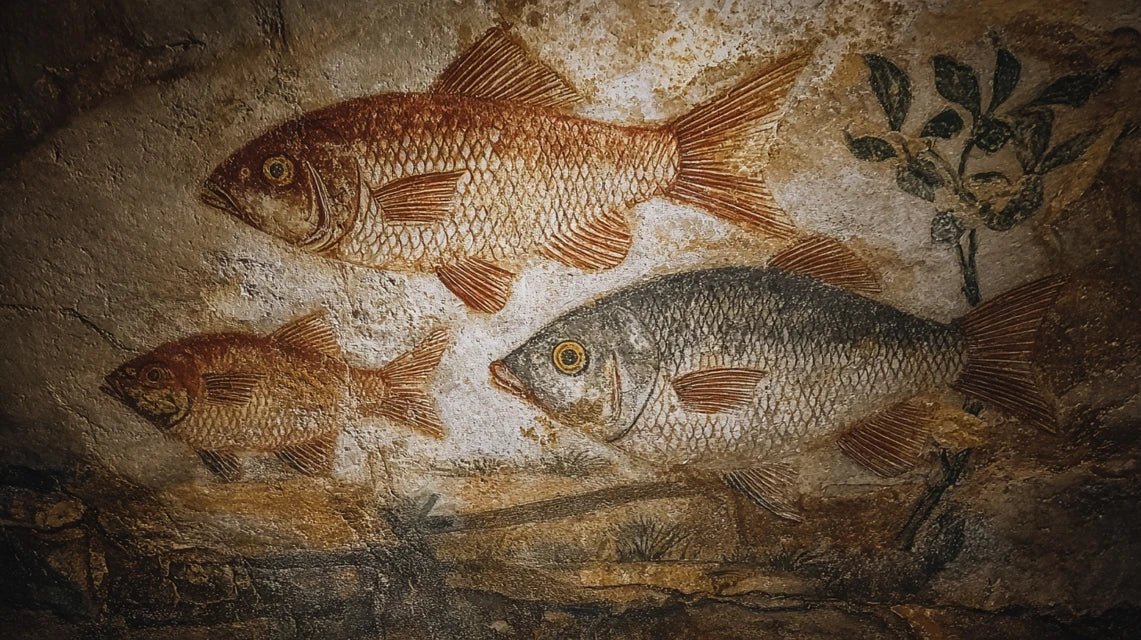
Imagine a Christian from the 2nd century, descending stealthily into the Roman catacombs. On the damp walls, he discreetly carves a simple fish. This seemingly insignificant gesture marks the beginning of a millennial artistic adventure: the evolution of fish in early Christian art to sumptuous Baroque still lifes.
The ichthys fish in early Christian art: foundational symbolism
In the underground tunnels of Rome, the ichthys (ἰχθύς) is born, the first secret code of Christians. Each letter of this Greek word hides a revolutionary message: "Jesus Christ, Son of God, Savior". From the 2nd century, this symbol transforms the catacombs into clandestine Christian art galleries.
The early Christian artists develop groundbreaking techniques. Their delicate religious frescoes adorn the tombs of Priscilla and Callixtus. These stylized fish become the signature of a persecuted but creative faith. 78% of animal representations in these sacred places depict fish (Source: Institute of Christian Archaeology in Rome).
Techniques for representing fish in early Christian art
The first Christian artists invent a unique iconographic language. They master the dry fresco, allowing for stunning details on each scale. The early Christian mosaics of Ostia (5th century) bear witness to this evolution towards striking realism.
Their palette tells a story: red evokes the blood of Christ, white his purity, gold his divinity. These codes still survive today in contemporary animal paintings, proof of their creative genius.
Association of fish and eucharistic symbolism in early Christian art
The story takes on a profound spiritual dimension. The biblical multiplication of loaves and fishes becomes the favorite subject of primitive painters. From the 3rd century, in Dura Europos, this revolutionary scene combines art and theology.
Saint Augustine grasps this symbolic power: "the fish symbolizes Christ who brings life in depth". Saint Abercius, a great traveler of the 2nd century, describes in his epitaph "a very large, pure spring fish", crystallizing this Christian mystical vision.
Evolution of fish to still lifes: artistic transition
Then comes the upheaval. The Protestant Reformation (16th century) prohibits religious images. Artists are forced to reinvent their art. This crisis becomes a creative opportunity for secular art.
The Netherlands welcomes this artistic revolution. Willem Ormea (1580-1649) transforms the early Christian heritage. His fish lose their sacred aura but gain in naturalistic truth. This mutation redefines modern Western art.
Pictorial optimization of fish in still lifes
Clara Peeters (1580-1621) revolutionizes technique. Her successive glazes reveal each scale with unparalleled precision. Pieter van Noort masters the pearlescent lighting, transforming his fish into luminous jewels.
These works conquer the wealthy homes of Amsterdam and Utrecht. Commercial success confirms this successful transformation. Primitive Christian art is reborn in secular form, proving its eternal vitality.
The living heritage:
- Creative transformation from the sacred to the profane
- Millennial technical continuity
- Adaptation to social changes
- Artistic excellence preserved
This epic of fish reveals how art crosses centuries. From the shadows of the catacombs to bourgeois living rooms, these aquatic creatures carry the history of our Western visual civilization.
Frequently asked questions about fish in early Christian art
Why was the fish so important in early Christian art?
The fish (ichthys in Greek) constituted a secret acrostic meaning "Jesus Christ, Son of God, Savior." This symbol allowed persecuted Christians to discreetly recognize each other while expressing their faith through the art of the catacombs.
How did the fish in early Christian art evolve into still lifes?
The Protestant Reformation (16th century) forbade religious images, pushing artists towards secular genres. The techniques developed to represent fish in early Christian art were adapted to still lifes, particularly in the Netherlands.
What artistic techniques were used to paint fish in early Christian art?
Early Christian artists mainly used dry fresco in the catacombs and mosaic for religious buildings. They developed specific color codes (red, white, gold) and prioritized symbolic stylization over naturalism.