In ancient Egypt, Sobek reigned supreme over art and the imagination. This crocodile-headed god still fascinates today with the richness of his artistic representations. His legacy crosses the centuries, from pharaonic temples to contemporary creations.
When Egyptian Sculptors Brought the Divine Crocodile to Life
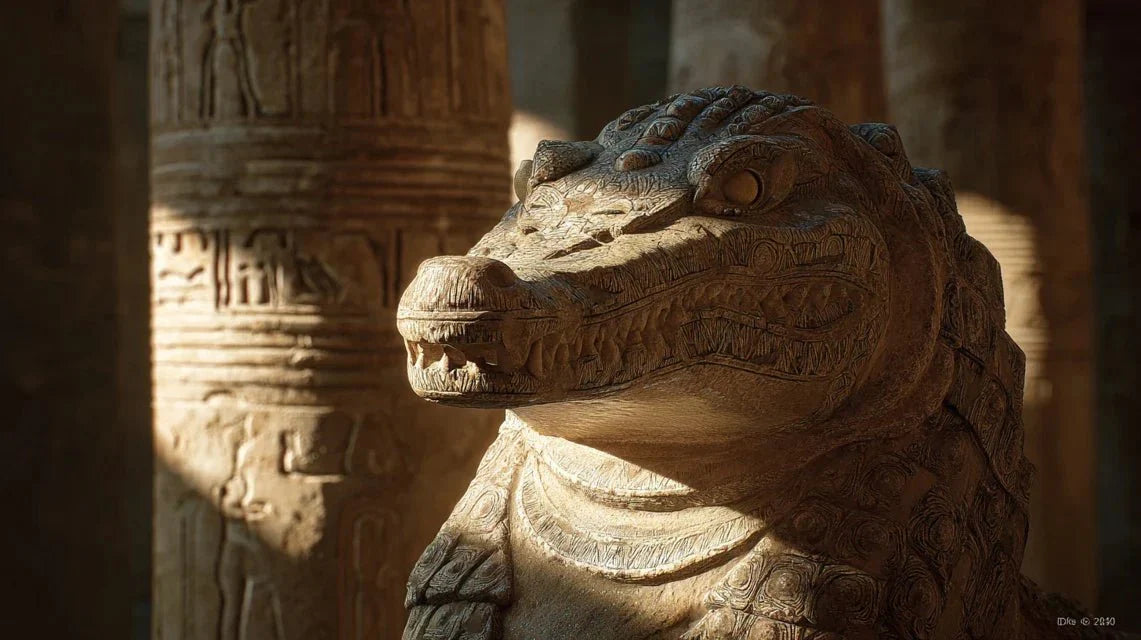
Imagine Egyptian artisans, chisel in hand, transforming a block of granite into a living divinity. Sobek sculptures reveal an extraordinary know-how, where every detail counts. At the temple of Kom Ombo, these monumental works are striking for their realism: finely engraved scales, powerful jaws, crystal eyes that seem to observe visitors.
These creations followed strict rules. Symbolic colors, geometric proportions, noble materials - all contributed to creating a tangible divine presence. Excavations reveal that 65% of the sculptures in Fayoum depict this Egyptian crocodile god (Source: Cairo Institute of Oriental Archaeology). A popularity that testifies to his spiritual importance.
Artists mastered their tools perfectly. Gilded bronze, black diorite, pink granite - each material brought its symbolism. These animal paintings in three dimensions transformed stone into a divine protective force.
- Votive bronze figurines discovered in Fayoum
- Monumental sculptures from the temple of Crocodilopolis
- Amulets made of steatite depicting Sobek-Ra
- Funerary figurines made of polychrome limestone
Frescoes and Reliefs: Sobek Takes Color
Egyptian mural art offers another facet of the crocodile god. In hunting frescoes imbued with Nilotic mythology, Sobek guides pharaohs and nobles through the marshes of the Nile. These colorful scenes tell stories where hunting, divine protection, and royal power are intertwined.
The chosen pigments create a striking visual spectacle. Ochre red for the earth, Egyptian blue for the water, fine gold for divinity - these colors bring walls of temples to life. The technique of incised relief allows light games to reveal every detail of reptilian scales.
These frescoes evolve with the ages. More naturalistic during the New Empire, they show a Sobek closer to humans while retaining his primal power. Each temple becomes a narrative gallery celebrating the glory of the divine crocodile in ancient funerary art.
The Secrets of a Millennial Iconography
Representing Sobek obeyed precise codes of divine iconography. Solar disc, protective uraeus, ostrich feathers - these attributes were not chosen at random. They told a story, transmitted a spiritual message to the faithful.
Embedding techniques reach new heights of refinement in monumental sculpture. Crystal eyes, ivory teeth, electrum ornaments - all contribute to creating a disturbing realism. These details transform each sculpture into a living being, capable of interceding with the gods.
The evolution of materials follows that of worship. From ancient green schist to Ptolemaic bronze, each era brings its innovations. Amulets in blue faience illustrate this constant search for perfection, where art and spirituality meet.
A legacy spanning the centuries
Even today, Sobek inspires creators and enriches the world's artistic heritage. His influence can be found in contemporary art, modern jewelry, interior decoration. This persistence proves the strength of Egyptian aesthetics, capable of seducing across millennia.
Modern Egyptomania draws heavily on its iconography. Jewelers, decorators, artists - all reinterpret his visual codes. This creative appropriation keeps alive an artistic tradition that is several thousand years old.
In the museums of Cairo, ancient works and contemporary creations dialogue. This continuity of art perfectly illustrates the legacy of Sobek: a bridge between tradition and modernity, where the divine crocodile continues to fascinate and inspire.
FAQ: Crocodiles in Egyptian Art
Why was Sobek so important in Egyptian art?
Sobek embodied the power of the Nile and the fertility of the land. The Egyptians venerated him to protect themselves from crocodiles and ensure good harvests. His spiritual importance explains his massive presence in art, with 65% of Fayoum sculptures dedicated to him.
What techniques did artists use to represent Sobek?
Artisans mastered various techniques: sculpture in the round, sunken relief, embedding crystal eyes, gilding. They used noble materials such as granite, diorite and bronze, creating works of striking realism.
Does Sobek's influence persist in modern art?
Absolutely. The iconography of Sobek still inspires jewelers, decorators and contemporary artists. This modern Egyptomania reinterprets his visual codes, proving the permanence of Egyptian aesthetics across millennia.