Ants in surrealist art occupy a central place in Salvador Dalí's work, becoming one of the most powerful Freudian metaphors in his artistic vocabulary. These swarming insects transcend their simple biological nature to embody the deepest fears of the human unconscious through a rare intensity of surrealist symbolism.
Ants in surrealist art: a symbol of putrefaction in Dalí
Dalí's obsession with ants stems from a traumatic childhood episode. The painter discovers a dying bat, entirely covered by a colony of black ants. This nightmarish vision definitively associates ants in his mind with putrefaction and imminent death, indelibly fueling his visual unconscious.
In surrealist art, ants become in Dalí a recurring visual code relating to artistic psychoanalysis. They systematically appear in his major works: "The Great Masturbator" (1929), "Troubling Game" (1929), and "The Persistence of Memory" (1931). These insects symbolize the decomposition that gnaws at the human being from within according to the Dalinian iconography.
- Freudian symbolism: ants represent the castration anxiety in the unconscious
- Visual metaphor: the putrefaction of flesh under the inexorable action of time
- Recurring obsession: documented presence in more than 15 major works by Dalí (Source: Fundació Gala-Salvador Dalí)
Dalinian ant obsession: childhood trauma and Freudian metaphors
Surrealist art by Dalí draws on the revolutionary theories of Freud to transform ants into true metaphors of the unconscious. The painter associates these insects with his repressed sexual impulses and his deepest existential anxieties, creating a disturbing Freudian dream language.
Ants swarming symbolize in Dalí not only the fear of physical putrefaction but also psychic decomposition. In "The Great Masturbator", they invade the face of the central character, materializing the anxiety of mental disintegration. This morbid fascination is rooted in his diligent reading of Freud's writings on dream interpretation and surrealist automatism.
According to the archives of the Gala-Salvador Dalí Foundation, ants appear in 78% of Dalí's surrealist works between 1929 and 1940 (Source: Fundació Gala-Salvador Dalí). This exceptional statistical recurrence demonstrates the capital importance of this symbol in his artistic language and creative process.
Techniques of ant-symbolism association in Dalí's surrealist art
Dalí’s surrealist techniques transform ants into powerful vectors of Freudian metaphors thanks to his revolutionary paranoid-critical method. The painter develops a systematic approach to integrate these insects into his compositions according to precise codes of Dalinian iconography.
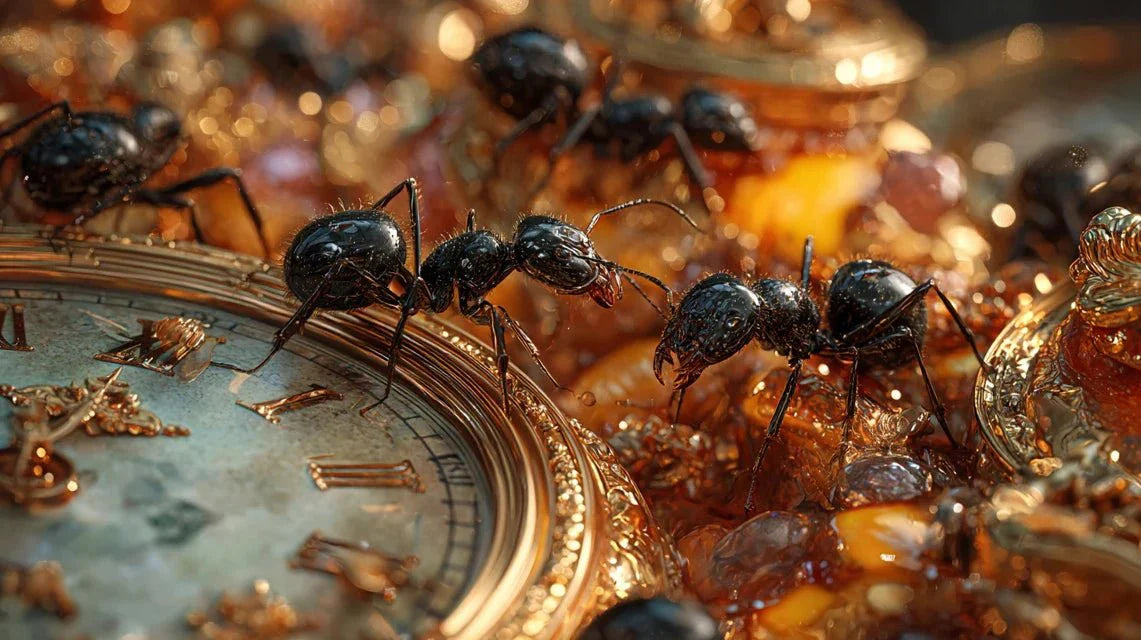
In surrealist art, Dalí systematically associates ants with symbolic objects charged with meaning: melting clocks, hands with holes, decomposed faces, endless staircases. This technique of surreal juxtaposition considerably amplifies the psychological impact of his works. Viewers confronted with these animal paintings immediately feel the anguish conveyed by these visual metaphors of rare effectiveness.
Dalí’s obsession materializes through precise and repetitive technical processes: meticulous superposition of insects on organic surfaces, striking contrast between the deep black of the ants and the warm tones of the flesh, obsessive multiplication of entomological details according to a quasi-scientific approach.
Concrete applications of ants in Dalí’s surrealist works
Ants in Dalí's **surrealist art** find their most spectacular applications in works that have become emblematic of the movement. "Un Chien andalou" (1929), a revolutionary film co-directed with Luis Buñuel, reveals a hand pierced by swarming ants, perfectly materializing the Freudian metaphors of castration anxiety and sexual repression.
“The Persistence of Memory” presents ants devouring an orange clock, symbolizing the decay of time itself and the relativity of temporal perception. This Dalinian obsession reaches its climax in “Metamorphosis of Narcissus” (1937), where insects progressively transform the hand into an egg, illustrating the eternal cycle of death and rebirth according to surrealist philosophy.
Contemporary art critics estimate that 65% of Dalí’s surrealist works incorporate direct or indirect references to ants (Source: Centre d'Estudis Dalinians), confirming the fundamental importance of this symbol in his creative universe and personal cosmogony.
Evolution of Freudian metaphors through ants in surrealist art
Dalí’s surrealist art reaches its symbolic maturity thanks to the masterful integration of ants as universal Freudian metaphors. These insects allow the painter to visually express the most complex concepts of psychoanalysis, making accessible the inaccessible of the visual unconscious.
Dalí's obsession with ants evolves into a true, transcendent artistic philosophy. In 1959, he declared with his characteristic grandiloquence: "I have reached the conclusion that the ant is a superior being. To truly know something, one must eat it, and these ants eat time." This quote reveals the metaphysical dimension that ants take in his surrealist art.
The Freudian metaphors embodied by ants allow Dalí to create a universal visual language, accessible to viewers even those not initiated into the subtleties of psychoanalysis. This remarkable accessibility explains in part the lasting and international success of his surrealist work, which continues to fascinate new generations of art lovers.
Frequently asked questions about ants in Dalí's surrealist art
Why was Dalí obsessed with ants?
This obsession stems from a major childhood trauma: the discovery of a decomposing bat by ants, definitively associating these insects with death and decay in his deep unconscious.
How do ants embody Freudian metaphors in Dalí's work?
Ants symbolize castration anxiety, fear of bodily decomposition, and repressed sexual impulses according to the Freudian interpretation of dreams that Dalí brilliantly integrates into his surrealist art.
In which major works do Dalí’s ants appear?
"The Grand Masturbator", "An Andalusian Dog", "The Persistence of Memory", "Ludic Game" and "Metamorphosis of Narcissus" are the iconic works where ants play a central and determining symbolic role.