You've repainted your living room in that trendy shade you saw on Pinterest, but three months later, you already find it outdated and dream of something else.
Barely put the brush away, that color which made you so much dream seems to you already faded, too dark, or even kitschy depending on your mood of the day.
You've tried neutral colors, then bold hues, maybe even that famous accent wall everyone is talking about, but the result always leaves you bored after a few months.
It’s perfectly normal and it’s not a lack of taste on your part. The problem comes from the fact that paint freezes your decor in an era, while your personality and desires continue to evolve.
By the end of this article, you will know why keeping white walls and betting on strong paintings is the smartest strategy to create an interior that evolves with you, without ever tiring you.
Why your current approach costs more than you thought?
Repainting regularly represents a colossal budget that most people underestimate. Between the paint, the tools, the time spent and sometimes the intervention of a professional, you spend easily 500 to 1500 euros each time you want to change. Imagine if instead of buying a new car every two years, you just changed the interior accessories: it's exactly the same logic. The opportunity you are missing? Creating a timeless interior that reinvents itself infinitely without major work.
💡 Customer testimonial : "I repainted my bedroom four times in three years. Powder pink, then anthracite gray, then sage green... Each time, I was sure that it was THE color. Result: 2000 euros spent and still this feeling of 'something is wrong'. Since I opted for white walls and paintings that I change according to my moods, my decor budget has been divided by three and I finally love my interior."
💬 Conversation with a decor expert
The golden rule of timeless interiors: Invest in what changes, save on what stays put. Walls remain, your tastes evolve. In 6 months, you'll have a completely different interior without a single brushstroke.
What really happens when you get tired of your decor
Recognize these situations? You’ve been avoiding posting photos of your living room on Instagram for months, you hesitate to invite friends because “you need to redo the decor first,” or you compulsively scroll through Pinterest thinking “I wish I had that at home.”
What you're experiencing isn't a problem with taste or indecision. It’s a symptom of a stagnant décor that can’t keep up with the natural evolution of your personality and inspirations. The real cause? You put your personality in the wrong places.
It's like tattooing your favorite outfit instead of wearing it: after a while, you won't be able to change it without major intervention.
The first hidden cause: The illusion of “forever”
Contrary to what we believe, choosing a 'timeless' color doesn’t solve anything. Even gray, even beige, even the famous 'off-white' end up weighing you down because they carry with them the era in which you chose them. The reality? There is no color that is eternally trendy, only colors that go out of fashion more or less quickly.
Imagine being forced to wear the same lipstick every day for three years: even if it suited you perfectly at first, you would eventually have enough.
What’s the impact on your daily life? This fatigue gradually demotivates you and makes you lose the desire to take care of your interior. Instead of recharging, your home becomes a constant reminder of your décor “mistakes.”
🔍 Quick test: Honestly ask yourself about the main wall in your living room: “If I could change it with a snap of my fingers, would I?” If the answer is yes, that color no longer represents you.
The trap of chromatic uniformity
Many people think that having the same color throughout the room creates harmony. In reality, it creates visual monotony. Your eye needs anchor points, subtle contrasts, and visual surprises to stay stimulated. The simple mechanism: when everything is the same color, nothing really stands out.
It's like a dish where all the ingredients have the same taste: technically harmonious, but deeply boring.
Concrete result: Even though you may have beautiful furniture and pretty objects, they blend into the background and your interior lacks character and dynamism.
The error of wall expression
Popular belief has it that walls are your main means of decorative expression. It’s exactly the opposite: walls should be the frame, not the subject matter. When you put your personality into paint, you block your future creativity.
How to spot it in your home? If you hesitate to buy a decorative object because "it won't go with the color of the walls," then your walls are dictating your choices instead of enhancing them.
The daily impact: You end up buying only accessories that "go with" rather than choosing what you really want, stifling your natural creativity.
🎯 The 3 telltale signs:
- You avoid certain areas of your home: This is a sign that this color no longer inspires you and even creates a feeling of rejection
- You keep putting off buying decorative items: Your subconscious knows that nothing will work with this base that no longer suits you
- You dream of moving to "start from scratch": In reality, you just want to escape this rigid decor that no longer looks like you
The trigger factor: The natural evolution of your taste
Here's what really makes the difference: accepting that your taste evolves constantly, like your clothing style or your culinary preferences. It is a natural and healthy process that testifies to your openness to the world and your creativity. What are the concrete clues? If you no longer like the photos of your interior taken a year ago, if you mentally "skip" certain rooms in your home, if you feel a form of decorative suffocation, it means that your personality has grown and that your decor has remained frozen.
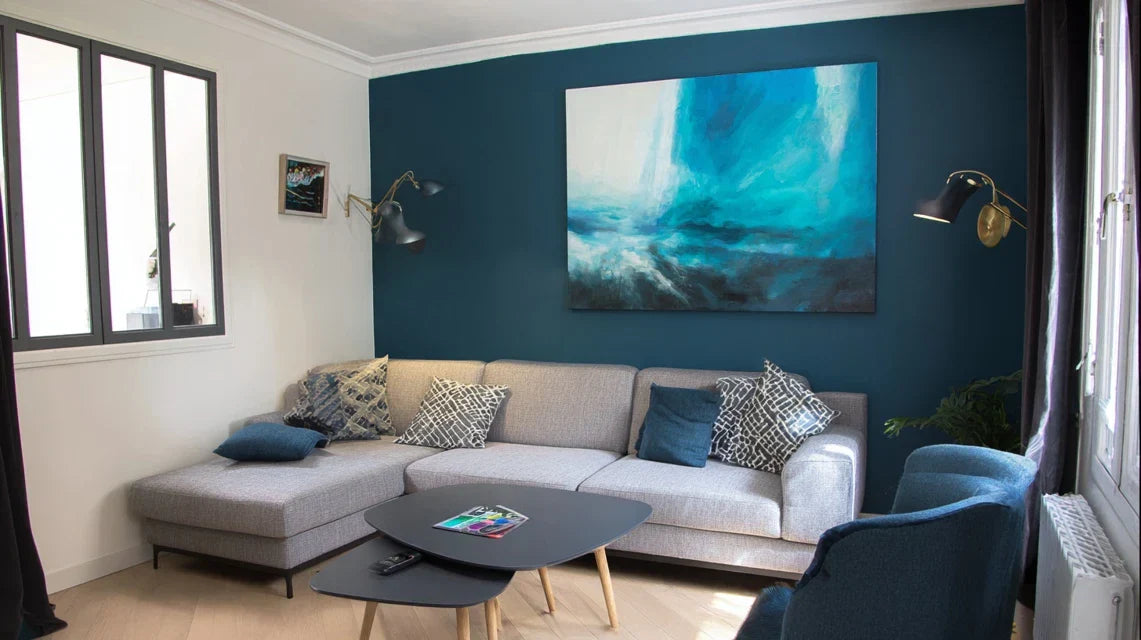
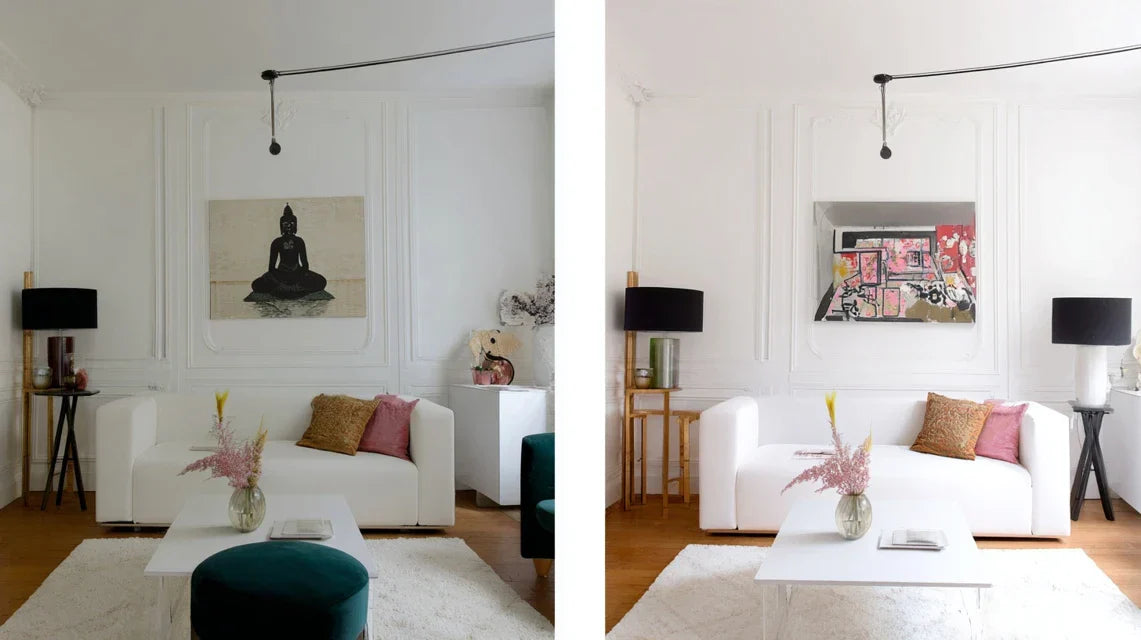
The universal rule of evolving interiors: The more neutral your base, the more freely your creativity can express itself. Test now: look at an interior photo with white walls and beautiful paintings, then the same room with colored walls. In which case do you notice the details the most?
| ❌ Colored wall approach | ✅ Neutral wall + painting approach | 💡 Why it works | 🎯 Concrete benefit |
|---|---|---|---|
| Imposes a rigid atmosphere | Allows all atmospheres | The color comes from the art, not the support | Change of atmosphere in 5 minutes |
| Limits future decorative purchases | Frees up all choices | No chromatic constraints | Total creative freedom |
| High cost with each change | Evolving, one-time investment | The painting moves and is resold | Decor budget controlled in the long term |
| Regular work and disturbances | Instant transformation | Simple hanging, no construction site | Zero stress, zero dust |
The 3-step method to transform your decorative approach
Rest assured, this transition is smooth and without a major revolution in your interior. Imagine reorganizing your wardrobe: you keep the timeless basics and have fun with accessories that make all the difference. The process is progressive: you will first neutralize your base, then create strong visual impact points, and finally develop your own decorative evolution system. The final result? An interior that truly reflects you and can evolve with you without ever costing you a fortune.
🗺️ Your roadmap: Step 1 - Create your perfect backdrop (neutral walls), Step 2 - Install your impact points (bold artworks), Step 3 - Master the art of change without renovation. Each step brings you immediate satisfaction while preparing for the next.
Step 1: Creating Your Perfect Neutral Base
Why start with the walls? Because it's the foundation for everything else, like underwear in an outfit: invisible but essential for everything to fit perfectly. This step immediately frees you from 80% of your current decorative constraints. Immediate satisfaction: as soon as your walls are neutral, you will feel that sensation of "breathing" finally in your interior.
🎨 Choosing the Right White (yes, they're all different!)
- Slightly warm off-white: This is a white with a touch of ochre or beige that avoids the "hospital" effect. Look for references like "Blanc Marbre" or "Ivoire Naturel" from major brands. Avoid pure white which can appear cold and unforgiving with wall imperfections. High-quality matte paint: It absorbs light instead of reflecting it, creating that sophisticated cocoon feeling found in beautiful hotels. The quality test: it should cover perfectly in two coats and resist fingerprints. High-tech universal primer: This is your assurance of a perfect result that masks old colors without transparency. It avoids those areas where the old color "reappears" and spoils the final rendering.
Now let's move on to concrete practice:
🔧 The Pros' Technique Within Your Reach
Strategic wall preparation: First, clean with a slightly damp sponge and a drop of dish soap to remove dust and grease that prevent adhesion. Fill holes with ready-to-use filler and sand gently once dry to avoid visible bumps under the paint.
⏱️ Time: 2h for a room | ✅ Success when: The wall is smooth to the touch and uniformly clean | ⚠️ Attention: Many skip this step and end up with an uneven finish that is revealed as soon as light rakes across it.
Primer application like a pro: Use a high-quality anti-drip roller (short fibers) and apply in cross strokes: vertical first, then horizontal to even out. The primer must completely cover the old color to avoid chromatic surprises.
⏱️ Time: 1h per room + 4h drying time | ✅ Success when: The previous color has completely disappeared | ⚠️ Attention: A poorly applied primer is visible through unevenly absorbent areas that give the final paint a marbled appearance.
Perfect two-layer finish: First coat in cross strokes, second coat strictly vertical for an impeccable finish. Each coat must be completely dry before the next (minimum 6h) to prevent tearing.
⏱️ Time: 3h over 2 days | ✅ Success when: The color is perfectly uniform under all lighting conditions | ⚠️ Attention: Rushing between coats is mistake #1, which gives a striated and uneven result.
✨ Validation of your perfect base: Your wall should have the velvety appearance of an art gallery: uniform, without reflections or roller marks. Test by illuminating from the side with your phone: no irregularities should appear. If so, congratulations! You have just created the perfect frame to showcase your future paintings.
OUR RECOMMENDED PRODUCTS
Step 2: Select and install your impactful artworks
You are now entering the creative part where your personality can fully express itself. Unlike wall painting, which imposes a single atmosphere, each artwork can create a different emotion depending on your mood and the function of the space. The snowball effect: The more you master this art of choice and hanging, the more you will develop your decorative confidence and artistic eye.
🎯 Criteria for an artwork that transforms a space
- Significant size: Count at least 1/3 of the width of the furniture it overlooks, or 60-80cm for a bare wall. A painting that is too small disappears visually and breaks the desired effect. Where to find it: prioritize original canvas creations or high-end art prints on rigid support. Intelligent chromatic contrast: Your artwork must contain at least one color that "pops" compared to your existing furniture, without clashing. The principle: harmonize with nuances, contrast with intensity. The impact: this visual tension maintains interest without creating eye fatigue. The invisible mounting technique: Invest in a wall-mounted rail system or custom fixings that allow for easy changes without damaging the wall. The visible benefit: your paintings seem to "float" on the wall with a professional finish.
🖼️ The art of hanging like a gallery owner
Calculating the perfect height: The center of the painting should be 1m45-1m50 from the floor, which is eye level for an average-height person. This universal rule works in 95% of cases and immediately gives your hanging a professional look.
⏱️ Time: 15 minutes per painting | ✅ Success when: The painting naturally attracts the eye without having to tilt your head up or down | ⚠️ Attention: Many people hang too high for fear of it being too low, creating a general feeling of imbalance.
Paper template technique: Cut out the exact shape of the painting from newspaper and attach it to the wall with masking tape to test the location before making the final drilling. This pro tip avoids 90% of placement errors and unnecessary holes.
⏱️ Time: 10 minutes installation test | ✅ Success when: The composition seems balanced from several points in the room | ⚠️ Attention: The effect can change depending on the lighting, test at different times of the day.
Installing the evolving system: Use X hooks or powerful magnetic fixings that support the weight without damaging the surface. The goal: to be able to change paintings in less than 2 minutes to follow your desires without technical constraints.
⏱️ Time: 30 minutes system installation | ✅ Success when: The painting holds perfectly and can be moved without tools | ⚠️ Attention: Underestimating the weight of the framed painting is the mistake that causes falls and damage.
🎨 Verification of your artistic installation: Step back 3 meters and observe the overall effect: the painting should create an immediate focal point that visually structures the space. Also test artificial lighting to ensure the artwork retains its impact in the evening. If you feel this satisfaction of "finally, it looks like something", you've got it!
Step 3: Mastering the art of instant decorative change
You are now reaching expert level where you can completely transform the atmosphere of your interior according to the seasons, your moods, or simply the desire for novelty. This mastery gives you total creative freedom and makes you the person everyone turns to for decor advice in your circle. The final visualizable result: an interior that evolves naturally with you, where each change brings pleasure instead of stress, and which always impresses your guests with its consistency and originality.
🔄 Building your evolving collection
- Seasonal rotation: Plan for 3-4 artworks per location to adapt the atmosphere to seasons or life stages. Store them in protective sleeves that preserve their quality. The rotation criterion: each artwork should evoke a different emotion.
- Modular formats: Invest in some standard-size artworks that can be moved from room to room as needed. This flexibility multiplies decor possibilities without multiplying costs. Pro tip: prioritize 50x70cm and 40x60cm formats which adapt everywhere.
- Creative cataloging system: Photograph each successful composition so you can recreate or draw inspiration from it. This visual memory becomes your personal source of inspiration and avoids repetition or mistakes.
🎭 Advanced staging techniques
Evolving color harmony: Learn to identify the dominant colors in your artworks and subtly recall them in your accessories (cushions, vases, throws). This technique creates a sophisticated coherence that changes with your artworks without having to buy everything again.
⏱️ Time: 1h analysis and setup | ✅ Successful when: The whole looks naturally coordinated | ⚠️ Attention: Avoid exact color matching which gives a "catalog" effect, favor nuances and different intensities.
Mastered multi-artwork composition: Experiment with arrangements in groups of 2, 3 or 4 artworks while respecting the rules of proximity and visual balance. Optimal spacing: 5-10cm between each frame to create a unified ensemble while preserving the identity of each piece.
⏱️ Time: 45 minutes per composition | ✅ Successful when: The eye naturally moves from one artwork to another | ⚠️ Attention: More than 4 artworks together requires advanced expertise to avoid a "visual clutter" effect.
Adaptation to natural lighting: Observe how your artworks change appearance depending on the daylight and adjust their positioning to optimize their impact. Some artworks reveal their details better in the morning, others come into their own at the end of the day.
⏱️ Time: Observation over a week | ✅ Successful when: Each artwork has its moment of glory during the day | ⚠️ Attention: Direct sunlight can damage certain supports, provide UV protection if necessary.
🏆 Validation of your decorative expertise: You master this system perfectly when you can transform the atmosphere of your room in less than 30 minutes according to your mood. Your guests consistently notice your changes and ask for advice. Above all, you never feel that "decor fatigue" again because your interior evolves naturally with you.
The smart progression rule: Change an element when you look at it without really "seeing" it. This is a sign that your eye has become accustomed and your brain is asking for renewal. Balance patience (allow time for emotion to settle) with ambition (dare to make changes that excite you).
Congratulations! You now master the subtleties of an expert that separates an amateur decoration from a true art de vivre. These advanced techniques give you a considerable advantage: where others suffer their decor, you actively create your ideal environment.
🎓 Gallery tip: Create "visual conversations" between your artworks by choosing pieces that respond to each other with their shapes, colors or emotions without being identical. This subtle technique gives intellectual depth to your decoration which always impresses connoisseurs. Concrete example: associate a black and white urban photograph with an abstract painting with the same contrasts but with a touch of warm color.
💭 "What if my guests find my walls too empty?"
"I'm afraid that white walls will give an impression of an unfinished house or a lack of personality..."
This is a very understandable concern, but it’s exactly the opposite that happens! Neutral walls with well-chosen paintings immediately give an impression of sophistication and decorative mastery. Your guests will notice your artworks, your objects, your furniture instead of being distracted by the color of the walls. Think about the most beautiful interiors you have seen in magazines: they almost all have neutral walls that highlight the rest. To reassure yourself immediately: start with a single room and observe the reactions. You will see that compliments finally focus on your decor choices rather than "that beautiful paint color".
🎯 Reassuring action: Before you start, look at the Instagram stories of your favorite decorators and count how many have colored walls vs neutral. You will discover that 90% of professionals prefer neutral bases!
The 5 mistakes that can ruin your transformation
Warning, these traps are tempting but can ruin all your work. The good news? Now that you know them, you will easily avoid them and save valuable time.
- ⚠️ Choosing a white too cold for economy: It’s tempting to take the "basic white" cheaper, but it gives this “hospital” look that everyone fears. The consequence: you will never feel comfortable in this space. The solution: invest in a slightly off-white, the price difference is minimal but the impact is huge. Rest assured, it's the mistake 80% of people make at first! 🔧 Neglecting the quality of mounting due to impatience: Faced with a beautiful painting, you want to hang it immediately with what you have on hand. Result: guaranteed fall and damaged painting. How else to do it: take 30 minutes to install a fixing system suitable for the weight. This half-hour will save you years of regret.
- 🎨 Accumulating too many paintings at once due to enthusiasm: The "kid in a candy store" effect can make you buy 10 paintings in one day. The problem: you lose the coherence and impact of each piece. The right approach: start with a maximum of 2-3 works and take your time to appreciate before adding more. It's normal to want to change everything quickly!
- 📏 Underestimating the necessary size due to fear: Many people choose paintings that are too small for fear that they will be "too noticeable". Consequence: the expected effect does not occur and the space still lacks character. Advice: dare to go above what your first instinct tells you. A slightly too large painting is always better than a too small one.
- 🔄 Changing too often due to excitement: The ease of the system can make you want to change every week. Problem: you don't allow time for emotion to settle in and you creatively exhaust yourself. The golden rule: wait at least a month before each major change to fully enjoy each composition.
🛡️ Your safety checklist before each step: Check that your white has warm undertones under different lighting, always test your fixings with a similar weight before hanging the original, take a photo of each successful composition so you can reproduce it, and above all: trust yourself! If something bothers you visually, then it deserves to be adjusted.
🎁 Special offer for readers
Because you took the time to inform yourself, enjoy 10% discount on your first order:
⏰ Valid 72h after reading • Applicable to all our products
❓ Your most frequent questions about this transformation
Initial investment: 200-400€ for quality white paint + 150-800€ for 2-3 starting paintings = 350-1200€ total. Compared to: repainting every 2-3 years costs 500-1500€ each time. Optimization: start with the main room, then gradually extend. In 5 years, you easily save 50% while having an infinitely more flexible and sophisticated result.
Instant results: From the first coat of white, you'll feel a sense of calm and expanded space. Complete decor impact: 1 weekend to transform a room (painting + hanging). Total mastery: 2-3 months to develop your eye and confidence. Concrete example: Sarah transformed her living room in one weekend and is still receiving compliments 6 months later!
Technical level required: know how to use a paint roller and a basic drill. Pitfall to avoid: wanting to do everything perfectly the first time. Reassuring tip: start with a less visible wall to get the hang of it. Minor imperfections are unnoticeable on a white wall, unlike dark colors which reveal every flaw. 95% of our readers manage it without professional help!
The foolproof technique: first choose with your emotion (what immediately makes you vibrate?), then validate with your reason (does it fit into my lifestyle?). Decisive test: if you continue to think about it 48 hours after seeing it, that's a good sign. Security: start with reproductions of recognized artists or contemporary creations within your budget, even if you evolve towards more exclusive pieces later.
That's exactly the advantage of the system! Unlike paint, you can change, move, resell or store your paintings. Evolving strategy: build a small collection of 4-5 pieces that you rotate according to the seasons or your moods. Heritage value: a good painting keeps or gains value, unlike cans of paint that end up in the trash. You transform an expense into an investment!
🌟 Your interior in 3 months: the transformation you dreamed of
Imagine yourself in your living room in a few weeks: your friends ask who your decorator is, you finally enjoy posting photos of your interior on social networks, and above all, you feel that authentic pride of living in a space that truly resembles you. Your surroundings immediately notice this new decorative confidence which appears in your choices and the way you live your space.
Beyond decoration, you have developed a true artistic eye and creative confidence that impacts all your aesthetic choices: fashion, gifts, cultural outings. You are now part of those people who are naturally consulted for their decor advice and who know how to create beauty wherever they go.
Understanding was indeed the most difficult part. Now that you know why this approach works, your first step can be as simple as taking the temperature of your current white by comparing it to a few samples. Start today: your future self will thank you for having the courage to break out of the decor routine that limited you.
✨ Your moment is now: You have all the keys to create the evolving interior of your dreams. The only difference between those who continue to suffer their decoration and those who master it, is taking action. Your home can become that inspiring cocoon that recharges you every day instead of weighing you down!