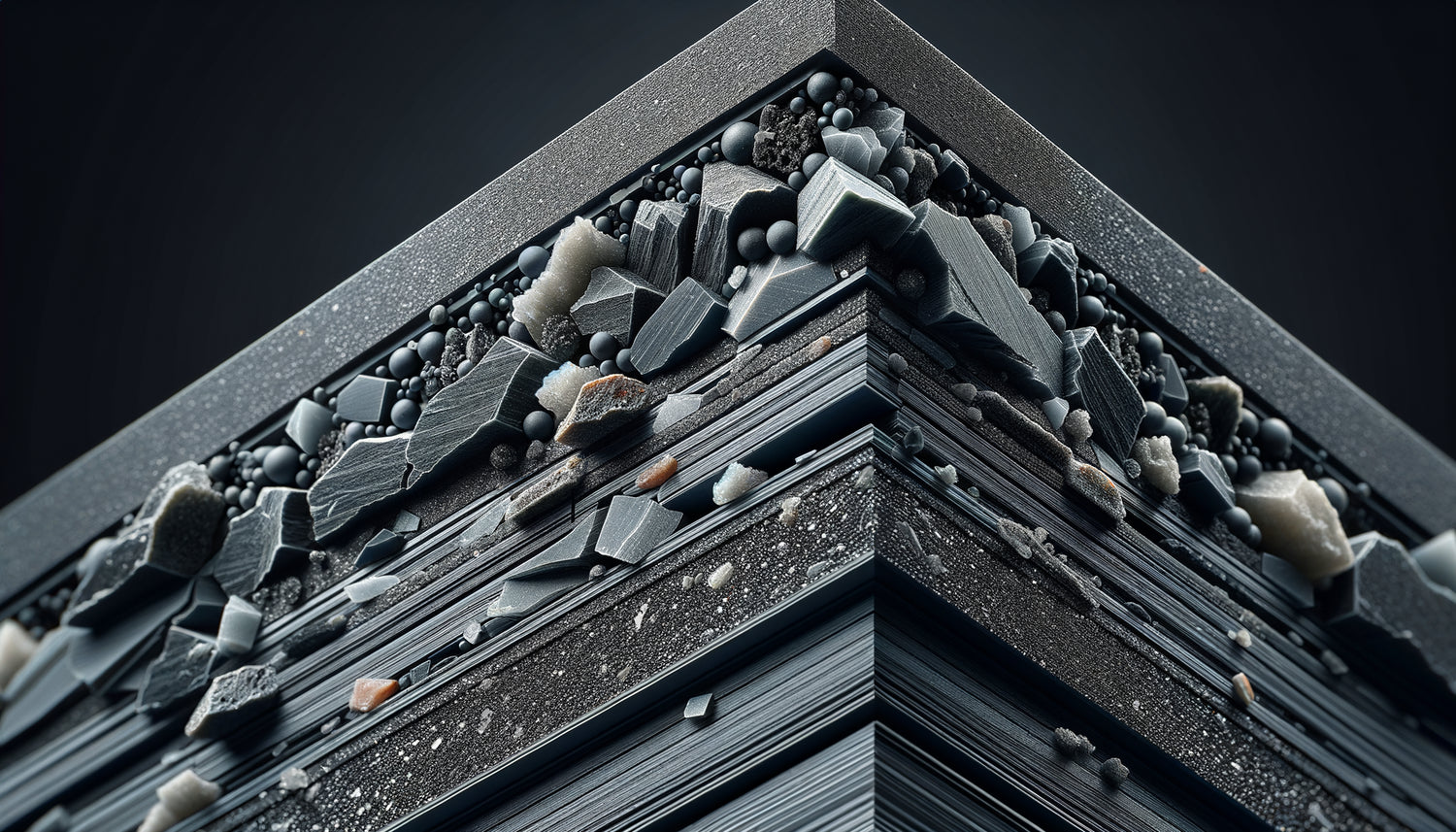
When renovating a loft in the heart of Brooklyn, I faced a fascinating challenge: recreating the raw authenticity of natural slate on walls that could not support more than 15 kilos per meter. The owner dreamed of this deep mineral texture, these graphite shades that tell millions of years of sedimentation. But installing actual slate slabs? Impossible without reinforcing the entire building structure.
Here's what synthetic slate wall decor brings: the visual and tactile authenticity of natural stone, simplified installation on any support, and total creative freedom without the structural constraints of the original material.
Do you know this frustration? Falling for a sublime mineral coating, then discovering that your drywall won’t hold the weight. Or worse: receiving a quote for structural reinforcement that blows your budget. I've experienced this disappointment with my clients dozens of times, until I discovered new generations of synthetic slate whose composition now rivals the authenticity of stone.
In this article, I reveal the precise formulations that give these composite materials their visual credibility, their convincing texture and their revolutionary lightness. Get ready to transform your walls without sacrificing either aesthetics or the solidity of your home.
The revolution of composite resins: when chemistry imitates geology
The first time I handled a plate of next-generation synthetic slate, I was amazed. Not that typical plasticized texture of the early 2000s industrial trials. No, there, under my fingers: the slightly rough grain, the random micro-irregularities, even that mineral coolness to the touch.
The secret? A tripartite composition carefully measured. The base rests on high density polyurethane resins (between 40 and 50% of the formulation) which constitute the structural framework of the panel. These polymers offer mechanical resistance comparable to some hardwoods, while maintaining a weight per square meter less than 8 kilos – against 25 to 40 kilos for natural slate.
But what makes all the difference is the natural mineral fillers incorporated into the matrix: schist powder, mica particles, iron oxide pigments. These elements represent 30 to 40% of the composition and create this characteristic visual depth. When light hits the surface of a well-formulated synthetic slate wall decor, it behaves exactly like on stone: partial absorption, micro-reflections on the mica particles, subtle nuances between matte and satin areas.
The additives that make the difference
The remaining 10 to 20%? Technical additives that transform an ordinary composite into premium synthetic slate. UV protectants prevent fading even in full sun. Rheology modifiers control viscosity during manufacturing to reproduce natural striations. And most importantly, dimensional stabilizers prevent deformation with humidity variations – a problem that even natural slate doesn't always solve.
I’ve tested different brands on various projects. The constant of successful products? A varied grain size in the mineral fillers. The best formulations combine fine particles (less than 50 microns) for the overall appearance and coarser grains (up to 500 microns) to create those micro-reliefs that catch the light as authentic stone would.
Anatomy of a convincing texture: the secrets of natural relief
During a project for a gourmet restaurant in Portland, the chef demanded that the wall behind his bar resemble the slate cliffs of his native Brittany. Not a smooth and tame imitation – the true ruggedness, the irregular fractures, this imperfect geometry that tells a geological story.
Synthetic slate wall decor achieves this level of authenticity through sophisticated molding techniques. Manufacturers create their matrices from molds of real natural slates. But the trick lies in diversifying the molds: using 15 to 20 different imprints and alternating their arrangement avoids any visible repetition of the pattern.
The surface texturing process adds an extra layer of realism. After initial demolding, some manufacturers apply a mechanical treatment: light directional brushing, controlled micro-percussion, or even projection of mineral particles that partially embed themselves in the still malleable resin. Result: each piece of synthetic slate becomes unique, with its own micro-variations in texture.
The importance of edges and angles
A detail that enthusiasts often overlook: the appearance of the edges. On real slate, the edge reveals the characteristic layered structure. The best synthetic slates reproduce this effect through an apparent layering technique: several layers of resin slightly differently tinted, visible in cross-section. This attention to detail makes all the difference during installation in a herringbone pattern or with exposed cuts.

The chromatic spectrum of authenticity: far beyond uniform grey
The classic mistake of the first generation of synthetic slate? A flat, monochrome grey that screamed 'fake' from three meters away. Natural slate is never uniform. It varies from deep black to bluish grey, with ochre veins, greenish inclusions, and sometimes even purple reflections depending on its geological origin.
Modern formulations incorporate this chromatic complexity from the basic composition. Rather than a single pigment, manufacturers use a palette of 4 to 7 mineral colorants: carbon black for the base, iron oxide for warm tones, minute amounts of titanium dioxide for lighter areas, and cobalt or chrome pigments for those subtle bluish or greenish touches.
The real magic happens during the manufacturing process. The best synthetic slate producers do not completely homogenize the pigmented resin. They maintain a controlled partial dispersion of colorants, creating these natural marbling patterns, areas of variable concentration that bring the material to life. Under raking light, these variations become particularly noticeable – just like on natural stone.
Surface finishes that amplify realism
The synthetic slate wall decoration comes in several finishes, each adapted to a specific effect. The natural matte finish (gloss coefficient below 10) reproduces raw slate, never polished. The satin finish (shine between 20 and 40) evokes damp slate, ideal for wellness spaces. Some manufacturers even offer a riven finish, with random micro-splintering on the surface that imitates the natural fracturing of schist.
Structural performance: how 6 kilos replaces 35 kilos
During the transformation of a Parisian attic apartment, we had to clad an inclined wall following the slope of the roof. It was impossible to consider natural slate on this already stressed structure. Synthetic slate proved to be the only viable solution.
The structural lightness does not mean fragility. Modern panels display a flexural strength between 25 and 35 MPa – comparable to some hardwoods. This performance stems directly from the composition: polyurethane resins form a three-dimensional network reinforced by mineral fillers that act as micro-reinforcements.
The real advantage? The exceptional strength-to-weight ratio. A synthetic slate panel weighing 6 kilos per square meter can withstand mechanical stresses similar to a stone slab weighing 30 kilos. This feat allows installation on light supports: drywalls, insulating linings, even some correctly fixed particleboard panels.
Dimensional stability and durability
A crucial aspect rarely mentioned: hygrometric stability. Unlike wood or even some natural stones, a well-formulated synthetic slate has a thermal expansion coefficient of less than 0.0001 per degree Celsius. What does that mean in practice? No visible deformation between -10°C and +50°C. This stability comes from the balanced composition of resins and mineral fillers which compensate for each other.
UV resistance is another major asset. Stabilizing additives integrated into the matrix protect the synthetic slate wall decoration against photodegradation. I have installations in full Californian sunshine that, after five years, show no measurable discoloration. This durability even surpasses some natural slates which can fade or develop efflorescence over time.

Intelligent installation: techniques that maximize the illusion
The perfect composition of a synthetic slate is not enough if the installation betrays its composite nature. I have developed several techniques to reinforce the credibility of the final result.
First, dimensional variation. Instead of installing identical panels, I cut some pieces to create irregular formats – 30x40 cm, 25x60 cm, 40x40 cm. This diversity mimics natural slate slabs which are never perfectly standardized. Manufacturers of synthetic slate facilitate this approach by offering panels easily cut with a circular saw equipped with a metal cutting blade.
Next, the joint play. On natural slate, joints are never perfectly regular. I vary the spacing between 3 and 8 millimeters randomly, and I use a slightly tinted mortar-glue (anthracite grey with a touch of ochre) rather than a glaring white joint. This attention to detail radically transforms the final perception of the synthetic slate wall decoration.
Lighting as a texture amplifier
A synthetic slate wall reveals its depth with proper lighting. Grazing sources (adjustable spotlights at a 30-40° angle from the surface) create cast shadows that accentuate the relief. Warm color temperatures (2700-3000K) enrich mineral nuances. I systematically install dimmable LEDs to adjust intensity according to the time and desired ambiance.
Transform your professional spaces with mineral elegance
Discover our exclusive collection of wall art for real estate agencies that captures the same material authenticity and strengthens your premium visual identity.
The new frontiers: innovations that redefine what's possible
The field of synthetic slate is evolving rapidly. The latest innovations I have tested open up fascinating perspectives.
Biosourced formulations are gradually replacing some petrochemical resins with polymers of vegetable origin (bio epoxy resins, polyols derived from castor oil). These compositions maintain technical performance while reducing the carbon footprint by 30 to 40%. Synthetic slate wall decoration thus becomes compatible with building environmental certifications (LEED, BREEAM, HQE).
Integrated acoustic systems represent another major advance. Some manufacturers incorporate hollow microspheres into the composition of synthetic slate, creating micro-cavities that absorb sound waves. Result: a sound absorption coefficient (αw) between 0.25 and 0.45 – sufficient to noticeably improve the sound comfort of a restaurant or open space.
Finally, self-cleaning surfaces are emerging. A photocatalytic surface treatment (nanostructured titanium dioxide) decomposes organic dirt under the effect of light. This technology, initially developed for facades, is now adapting to indoor synthetic slates, particularly relevant in kitchens or high-traffic areas.
Imagine your space transformed: that wall which seemed ordinary becomes a work of contemporary geology. The morning light glides over the micro-reliefs of your synthetic slate wall decoration, revealing nuances you hadn't noticed the day before. Your guests instinctively reach out to check if it isn’t real stone. And you smile, knowing that behind this perfect authenticity lies an intelligent, lightweight, durable composition.
The secret to a successful synthetic slate lies in this subtle balance: 45% high-performance resins, 35% authentic mineral fillers, 15% natural pigments, and 5% technical additives. A simple formula in appearance, but mastering it requires years of research. Now that you know these composition secrets, observe synthetic slates differently. You will be able to recognize exceptional products from their mediocre imitations. And above all, you will be able to create this timeless mineral atmosphere at home, without sacrificing lightness or durability.
Frequently Asked Questions About Synthetic Slate
Is synthetic slate suitable for humid rooms like the bathroom?
Absolutely, and it is even one of its major advantages. Unlike natural slate which can develop moisture stains or efflorescence in very humid environments, well-formulated synthetic slate is totally impermeable. Its composition based on polyurethane resins gives it an almost negligible water absorption (less than 0.5% according to standardized tests). I have installed many synthetic slate wall decorations in bathrooms, walk-in showers and even spas. The secret? Check that the product has a certification suitable for wet areas and use a specific adhesive for aqueous environments. After five years of intensive use, the installations I have carried out show no degradation, discoloration or peeling. Maintenance is simple: a wipe with a neutral cleaner is sufficient, without special products or precautions.
Can you really tell the difference between natural and synthetic slate to the touch?
This is the question my clients invariably ask me, and the answer is nuanced. Entry-level synthetic slates betray themselves to the touch: different surface temperature, too regular texture, slightly plastic feel. On the other hand, current premium products achieve a stunning level of mimicry. The key lies in the composition: incorporating 30 to 40% natural mineral fillers (schist powder, mica) gives the surface that characteristic roughness and coolness to the touch typical of stone. In blind tests I organized with architects and designers, the correct identification rate did not exceed 60% - barely better than chance! The real difference is in weight: pick up a panel and you will immediately understand that it is not natural stone. But once installed on the wall, the illusion becomes almost perfect, especially with appropriate lighting that reveals the micro-reliefs and chromatic variations of the synthetic slate wall decoration.
What is the real lifespan of a synthetic slate compared to natural slate?
Natural slate can last for centuries under optimal conditions – centennial slate roofs are proof of this. But this millennial potential is not always realized in interior decoration, especially in polluted urban environments or chemically aggressive settings. High-quality synthetic slate has a guaranteed lifespan between 15 and 25 years, with a field reality often higher. The oldest installations I know date back to 2005 (the first really high-performance generation) and remain in excellent condition. The modern composition includes UV stabilizers and antioxidants that protect the polymer matrix from aging. In practice, your synthetic slate wall decoration will likely outlast several cycles of interior renovation before requiring replacement. Typical wear mainly concerns the possible very gradual attenuation of the surface finish in frequently contacted areas – a problem easily solved by applying a specific renovation varnish every 10-12 years. A significant advantage: unlike natural slate which can crack or erode with thermal shocks, synthetic slate maintains its structural integrity even when facing significant temperature variations.